The Guam Blinking Light and the Weather Balloon That Did Not Quite Explain It, 31 December 1956
An Air Force pilot holding over Guam on the last night of 1956 reported a blinking light. A weather balloon had gone up ninety-eight minutes earlier and had been out of sight for seventy of them, and the officer who wrote the case up refused to close it on that.
What did witnesses see at Guam radio range holding pattern?
An Air Force pilot in a holding pattern over Guam watched a blinking light on the last night of 1956. The intelligence officer who wrote it up declined to explain it away.
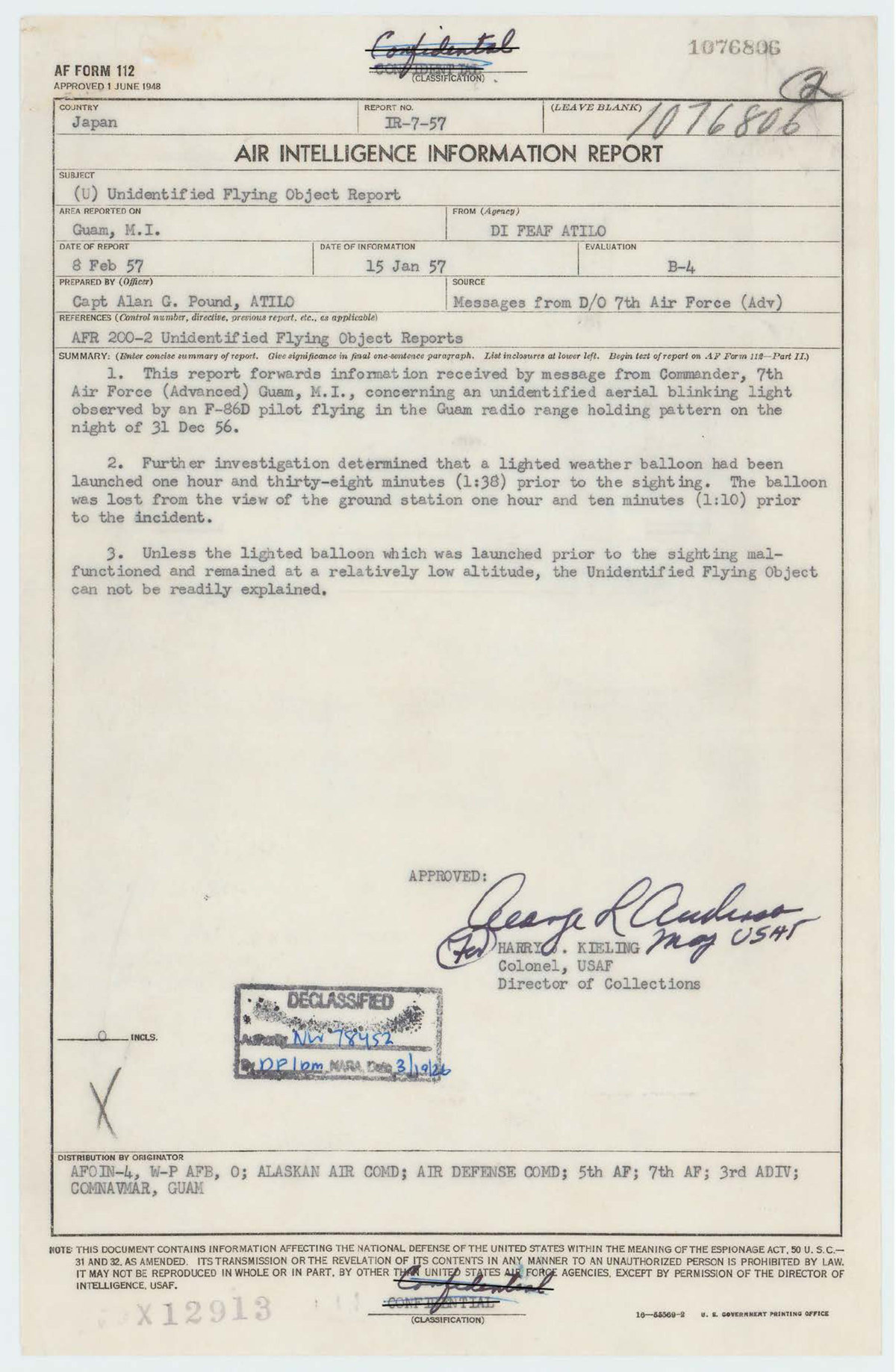
The released document is short and its first paragraph carries the whole sighting: the report "forwards information received by message from Commander, 7th Air Force (Advanced) Guam, M.I., concerning an unidentified aerial blinking light observed by an F-86D pilot flying in the Guam radio range holding pattern on the night of 31 Dec 56."
That is the entire description of the object. There is no shape, no colour beyond the blinking, no altitude, no bearing, no duration and no account of how it moved. What survives in the release is a transmittal summary rather than the pilot's own statement, and the originating message from 7th Air Force (Advanced) is not part of it.
The second paragraph supplies the candidate explanation. "Further investigation determined that a lighted weather balloon had been launched one hour and thirty-eight minutes (1:38) prior to the sighting. The balloon was lost from the view of the ground station one hour and ten minutes (1:10) prior to the incident."
The third paragraph is the one that matters, and it is reproduced here in full because its construction is the case: "Unless the lighted balloon which was launched prior to the sighting malfunctioned and remained at a relatively low altitude, the Unidentified Flying Object can not be readily explained."
What is the official explanation?
The document is an Air Intelligence Information Report on AF Form 112, the standard Air Force field intelligence collection form of the period, approved 1 June 1948. The subject line reads "(u) Unidentified Flying Object Report" and the reference field cites Air Force Regulation 200-2, Unidentified Flying Object Reports.
It originates with the Far East Air Forces Air Technical Intelligence Liaison Office and was prepared by Captain Alan G. Pound. The source is given as a message from the Director of Operations, 7th Air Force (Advanced). The area reported on is Guam, Mariana Islands.
Distribution ran wide for a two paragraph report: AFOIN-4 at Wright-Patterson Air Force Base, Ohio, Alaskan Air Command, Air Defense Command, 5th Air Force, 7th Air Force, 3rd Air Division and the naval command on Guam. The page carries the standard Espionage Act caveat of the era.
One oddity in the form's own header is worth recording. The COUNTRY block reads "Japan" while the area reported on is Guam. That is a reporting chain artifact rather than a contradiction about where the event happened: the report was raised by Far East Air Forces, headquartered in Japan, and the country block on this form records the originating command's country rather than the place of the incident. It is noted here because a search of these records by country would never return this case under Guam.
What did the witnesses think it was?
There is no witness testimony in the released file. The pilot is not named, his squadron is not given, and his own words do not appear. Everything known about what he saw is contained in the single phrase "an unidentified aerial blinking light," written by an officer relaying a message from another command.
That is worth stating clearly rather than filling with inference, because the absence shapes everything else. No altitude means the balloon's reported behaviour cannot be compared against the object's. No duration or direction of travel means the two cannot be separated by motion either. The one substantive fact the file contains about the sighting beyond its existence is that it happened at night, in a radio range holding pattern, and that the Air Force thought it worth a formal intelligence report under AFR 200-2 rather than a routine dismissal.
The balloon timings, by contrast, are precise, and they can be read against each other. The balloon was launched one hour and thirty-eight minutes before the sighting and was lost from the ground station's view one hour and ten minutes before it. The station therefore tracked it for about twenty-eight minutes after launch and then had no idea where it was for the seventy minutes leading up to the sighting. The file contains no recovery, no recapture and no later fix on it.
That gap is the reason the report's conclusion is written as a condition rather than a finding. Nobody could say where the balloon was when the pilot saw the light, because nobody had been watching it for more than an hour.
Is the Guam Blinking Light and the Weather Balloon That Did Not Quite Explain It, 31 December 1956 real? The two-pass assessment
Pass one, how this could be ordinary. A lighted weather balloon launched ninety-eight minutes before an unexplained night light, from the same island, is a strong candidate and the Air Force plainly thought so. Balloons carrying lights were a routine cause of sightings in this period, and a pilot in a holding pattern has poor cues for judging the range or altitude of an isolated light at night. If the balloon malfunctioned and stayed low, the case closes.
The difficulty is that the file never establishes the condition it rests on. Nothing in the report says the balloon malfunctioned, nothing says it remained at a relatively low altitude, and nothing fixes its position at the time of the sighting. A normally performing balloon launched an hour and a half earlier would be far above an F-86D's holding altitude and well downwind. The explanation requires a specific failure that the investigation did not document, and the officer who conducted it wrote his sentence accordingly.
That construction is where the release manifest and the document part company, and the difference is worth naming. The manifest blurb leads with the balloon, states that if it had malfunctioned and remained low "it could possibly explain the reported object," and then adds that the preparing officer did not regard the explanation as sufficient unless that condition applied. The document is built the other way round. Its default is that the object "can not be readily explained," and the balloon is admitted only as an exception to that default, on a condition the file never meets. The manifest is not false, but it puts the emphasis where the document does not, and a reader working from the blurb alone would come away thinking the case was substantially solved. The blurb is a finding aid, and the sentence on the page is the record.
Pass two, if it was not the balloon. An unidentified light, blinking, seen at night by a military pilot in a holding pattern over a Pacific island. That is as far as the evidence reaches, and no shape, size, speed or behaviour claim is available to build on, because none was released.
The honest limit on this page is larger than usual: this is a summary of a message, not a sighting report. The pilot's account, if it was ever written down, is somewhere else. Until the originating 7th Air Force message surfaces, the case cannot be developed further in either direction.
Tier: Unknown. The Air Force's own operative sentence says the object cannot be readily explained, and it offers a conditional escape that its own investigation failed to substantiate.
Sources
- www.war.gov/medialink/ufo/release-07/documents/DOW-UAP-D156-Air_Intelligence_Information_Report_Guam-1956.pdf
- www.war.gov/Portals/1/Interactive/2026/UFO/uap-data.csv
- www.war.gov/UFO/
More cases from this region: UFO sightings in Guam (United States)