A Round Blinking Light Reported 150 Feet above Prince George Airport, British Columbia, 8 November 1953
Two airmen guarding a B-29 on a Canadian airfield watched a blinking white light drop to within 150 feet of the ground, hold still for half a minute, climb, stop again and leave to the west. Their intelligence officer wrote two words in the box for his own assessment: cause unknown.
What did witnesses see at Prince George Airport?
Two United States Air Force non-commissioned officers were guarding a B-29 at Prince George Airport when a round white light descended on them. Their report reached the Director of Intelligence at Headquarters USAF five days later.
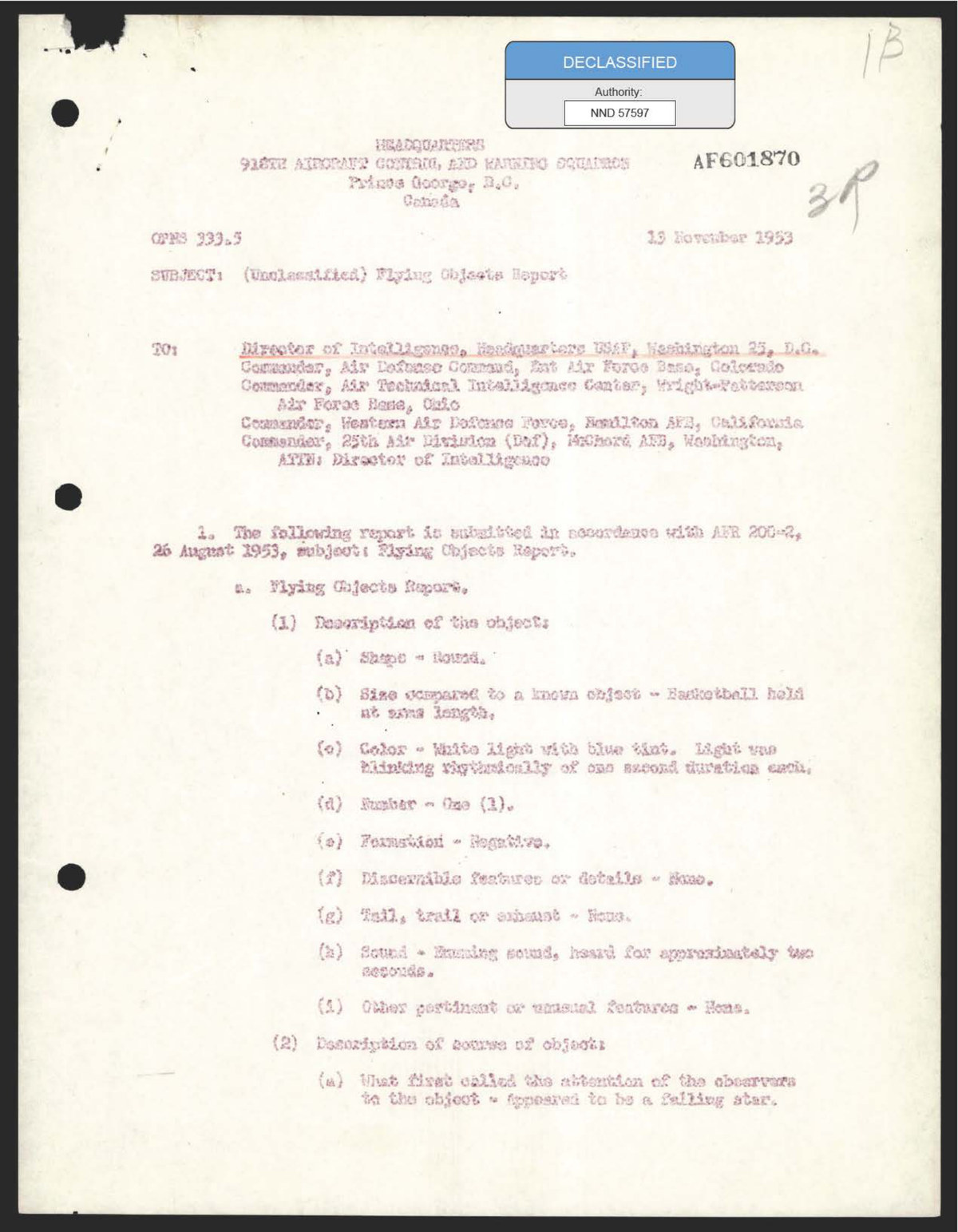
The object is described on the form field by field. Shape, round. Size compared to a known object, a "Basketball held at arms length." Colour, "White light with blue tint," with the light "blinking rhythmically of one second duration each." Number, one. Formation, negative. Discernible features or details, none. Tail, trail or exhaust, none. Sound, a "Humming sound, heard for approximately two seconds." Other pertinent or unusual features, none.
What first drew the observers' attention was that it "Appeared to be a falling star." It did not behave like one. The flight path entry reads in full: "Appeared at first to be a falling star. Came to within approximately 150 feet of the ground, staying at that altitude approximately 30 seconds, unmoving. Ascended straight up from this position for about 300 feet and was motionless for nearly 10 seconds then disappeared in a westerly direction, climbing."
It was lost to sight "due to distance and altitude" after approximately four minutes. The observation was ground-visual, with no optical aids, and was not made from the air. Light conditions are entered as night.
More footage and images of this sighting
What is the official explanation?
The document is a Flying Objects Report submitted under Air Force Regulation 200-2 of 26 August 1953, on the letterhead of Headquarters 918th Aircraft Control and Warning Squadron, Prince George, British Columbia, Canada. It carries the file number AF601870 and the office symbol OPNS 339.5, and it is dated 13 November 1953. The declassification authority stamped on the first page is NND 57597.
It was addressed to the Director of Intelligence at Headquarters USAF, Washington 25, D.C., with copies to the Commander of Air Defense Command at Ent Air Force Base, Colorado, the Commander of the Air Technical Intelligence Center at Wright-Patterson Air Force Base, Ohio, the Commander of Western Air Defense Force at Hamilton Air Force Base, California, and the Commander of the 25th Air Division (Defense) at McChord Air Force Base, Washington. A received stamp on the reverse of the first sheet is dated 18 November 1953.
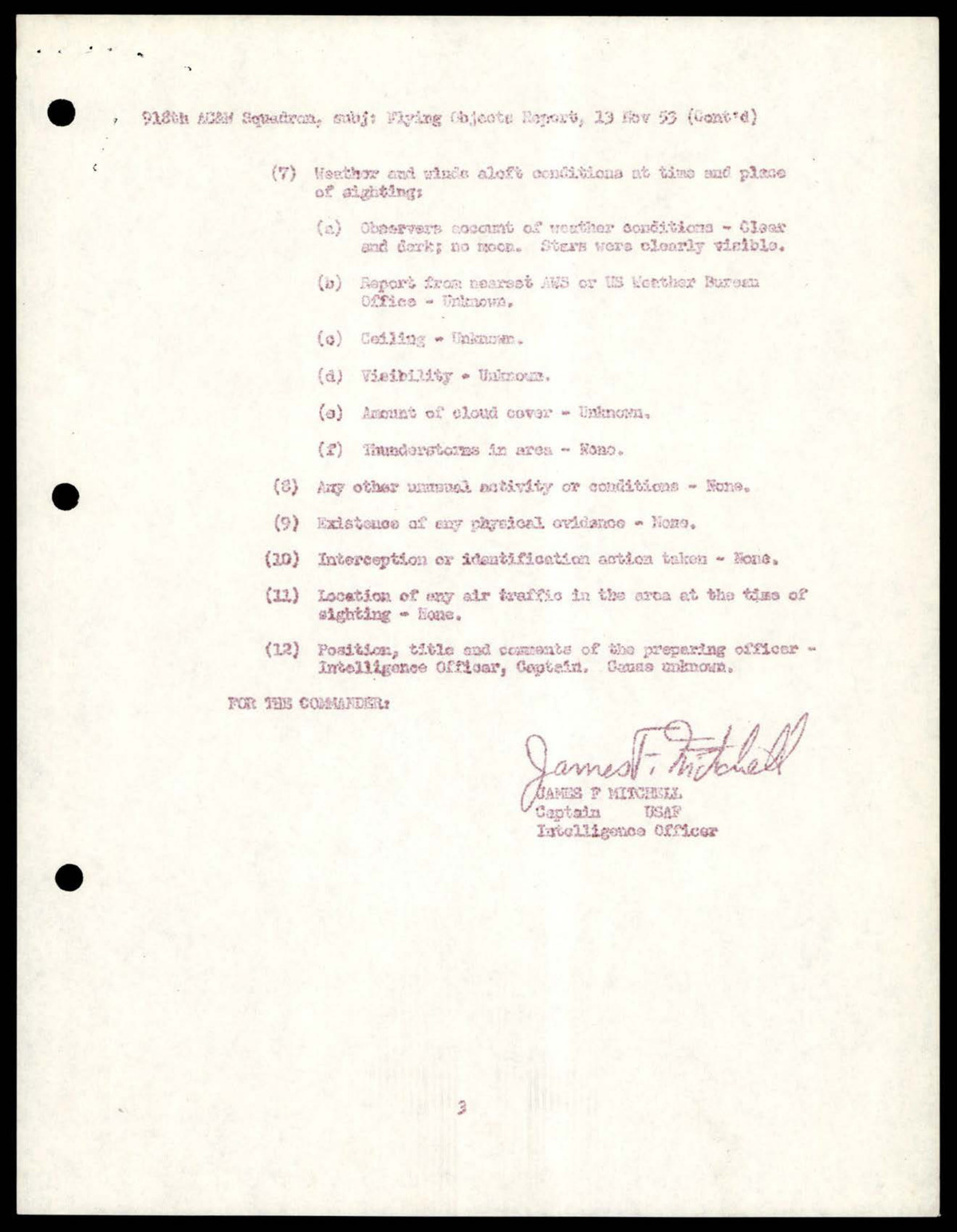
The closing fields are as important as the sighting description. Any other unusual activity or conditions, none. Existence of any physical evidence, none. Interception or identification action taken, none. Location of any air traffic in the area at the time of sighting, none. And in field 12, the position, title and comments of the preparing officer: "Intelligence Officer, Captain. Cause unknown."
The report is signed for the commander by James F. Mitchell, Captain, USAF, Intelligence Officer.
What did the witnesses think it was?
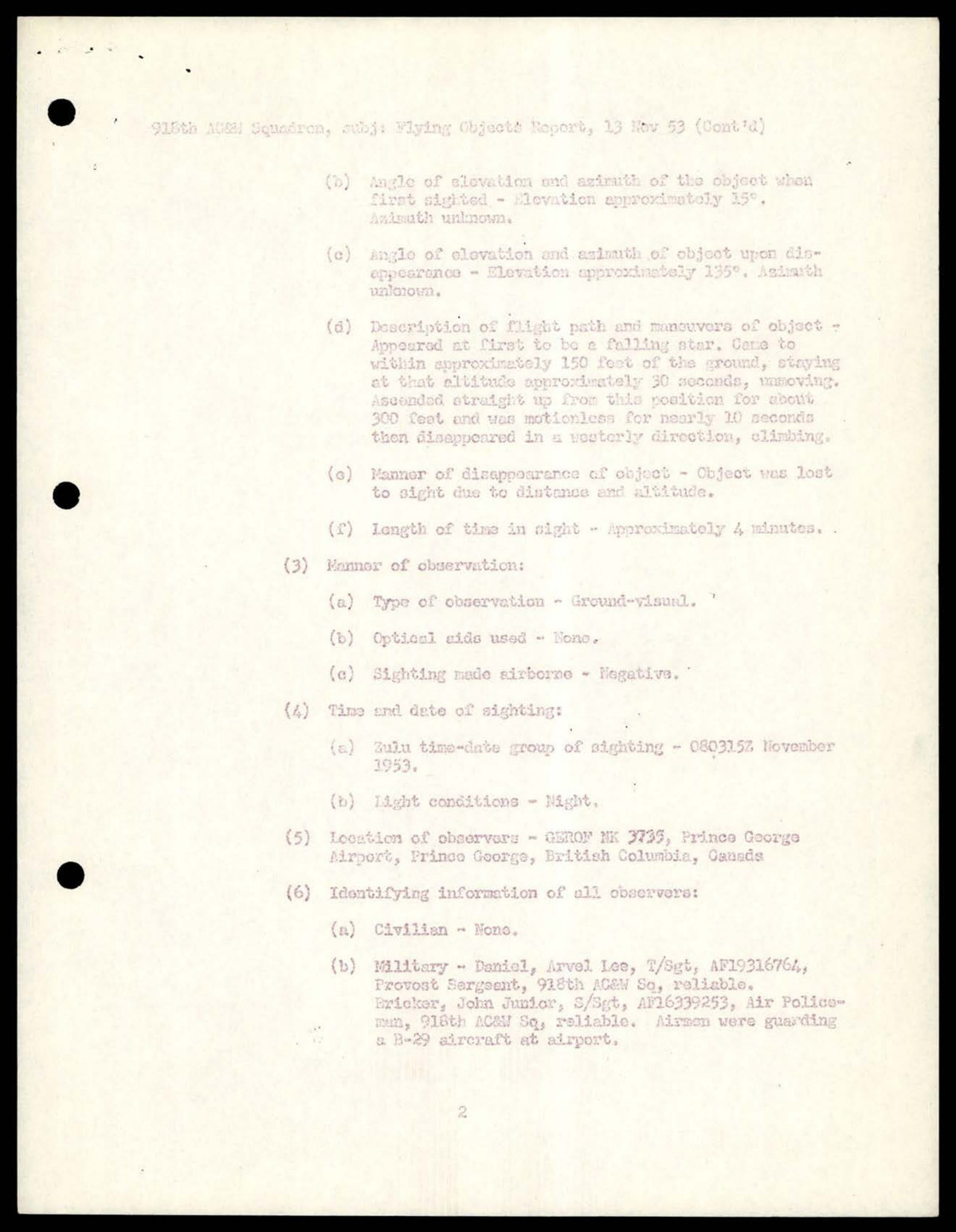
The two observers are named on the form, with service numbers, and both are rated by the preparing officer.
Arvel Lee Daniel, Technical Sergeant, AF19316764, Provost Sergeant, 918th Aircraft Control and Warning Squadron, assessed as reliable. John Junior Bricker, Staff Sergeant, AF16339253, Air Policeman, 918th Aircraft Control and Warning Squadron, assessed as reliable. The civilian observer field reads none. The form adds one line of context that explains why two air policemen were standing on an airfield apron at night: "Airmen were guarding a B-29 aircraft at airport."
Their account of the sky is recorded separately from their account of the object: "Clear and dark; no moon. Stars were clearly visible." The fields for the nearest Air Weather Service or United States Weather Bureau report, the ceiling, the visibility and the amount of cloud cover are all entered as unknown, so the only weather in the file is what the two men said they could see. Thunderstorms in the area, none.
Three points of the archive's own, drawn from the document and from arithmetic rather than from the file's framing.
The first concerns the date. The release manifest gives the incident date as 13 November 1953. That is the date the report was written; it appears in the letterhead and at the head of every continuation page. The document's own time and date group of sighting reads "080315Z November 1953," which is 0315 Zulu on 8 November. Prince George keeps Pacific Standard Time in November, eight hours behind, so the sighting falls at about 19:15 local on the evening of 7 November 1953. This archive dates the case by the document's own time and date group rather than by the manifest.
The second concerns the number of witnesses. The manifest blurb describes "three U.S. Air Force servicemembers." The form's identifying information block names two, and no third observer appears anywhere in the four released pages.
The third concerns the Moon, and it runs in the witnesses' favour. At the sighting instant the Moon was roughly 1.3 days past new and about 2 percent illuminated. A crescent that thin sets within about an hour of the Sun, so it was not in the sky at a quarter past seven in the evening. "Clear and dark; no moon" is exactly what the sky should have looked like, which is a small independent corroboration of the one environmental claim in the file that can be tested at this distance.
Is the A Round Blinking Light Reported 150 Feet above Prince George Airport, British Columbia, 8 November 1953 real? The two-pass assessment
Pass one, how this could be ordinary. The observers' own first impression, a falling star, is the right starting point, and a bright meteor seen low can look startlingly close. But a meteor does not stop. The reported sequence has the object arrest its descent, hold a fixed position for about thirty seconds, climb vertically roughly three hundred feet, hold again for about ten seconds and then depart westward while climbing, over a total of some four minutes. No meteor does that, and neither does a flare, which falls.
An aircraft is the strongest conventional candidate. A blinking white light with a bluish cast is a plausible navigation or anti-collision light, the two second hum would fit a distant engine, and air policemen on an apron at night are not well placed to judge the altitude of a light. Against it, the form records no air traffic in the area at the time of sighting, and a hovering ascent is not an aeroplane profile, though it is not far off a helicopter's. A lighted balloon drifts with the wind rather than rising vertically on command and then holding, and in any case no winds aloft data was recorded, so that candidate can be neither supported nor excluded from this file.
The limits are severe and they should be stated rather than written around. There are two witnesses and no third party. There is no photograph, no radar, no physical evidence and no interception. Both the azimuth fields are entered as unknown, so no bearing exists and no track can be reconstructed. The altitude figures, 150 feet and 300 feet, are unaided visual estimates made at night against a dark sky, which is the least reliable judgement a witness can be asked to make, and the archive does not treat them as measurements. One field is internally impossible: the angle of elevation on disappearance is entered as "approximately 135 degrees," when elevation runs from zero at the horizon to ninety at the zenith. Either that entry means something other than elevation or it is simply an error on the form, and nothing in the released pages resolves it.
The location block carries a GEOREF designator which the scan renders as "NK 3735." The latitude band letter is consistent with the 45 to 60 degree north zone that contains Prince George at about 53.9 north, but the first character is degraded in the scan and no full decode is asserted here. It does not matter much, because the same field names Prince George Airport in plain text.
Pass two, if the report is accurate. A single luminous object under control at low altitude over a defended aircraft, capable of arresting a descent, hovering, climbing vertically and holding again, with a brief acoustic signature and no visible structure, wings, exhaust or trail.
Tier: Unknown. This is the Air Force's own verdict rather than the archive's rhetoric. The preparing officer, an intelligence officer who had the witnesses in front of him and rated both of them reliable, entered "Cause unknown" in the box provided for his assessment, and the Air Force took no interception or identification action. Seventy-three years later the released file supplies nothing that would change that, and nothing that would support a stronger claim either.
Sources
- www.war.gov/medialink/ufo/release-07/documents/DOW-UAP-D158-Flying_Object_Report_Canada-1953.pdf
- www.war.gov/Portals/1/Interactive/2026/UFO/uap-data.csv
- www.war.gov/UFO/
More cases from this region: UFO sightings in Canada