The Missing AARO Historical Record Report Volume II and Andre Carson's Call for Its Release, 31 October 2026
Congress ordered one report on the government's historical record of unidentified anomalous phenomena, and set one deadline for it. That deadline passed 870 days ago, and the half of the report that carries the unresolved allegations has still not been published.
What happened
Congress ordered one report on the United States Government's historical record of unidentified anomalous phenomena. Half of it has never been delivered.
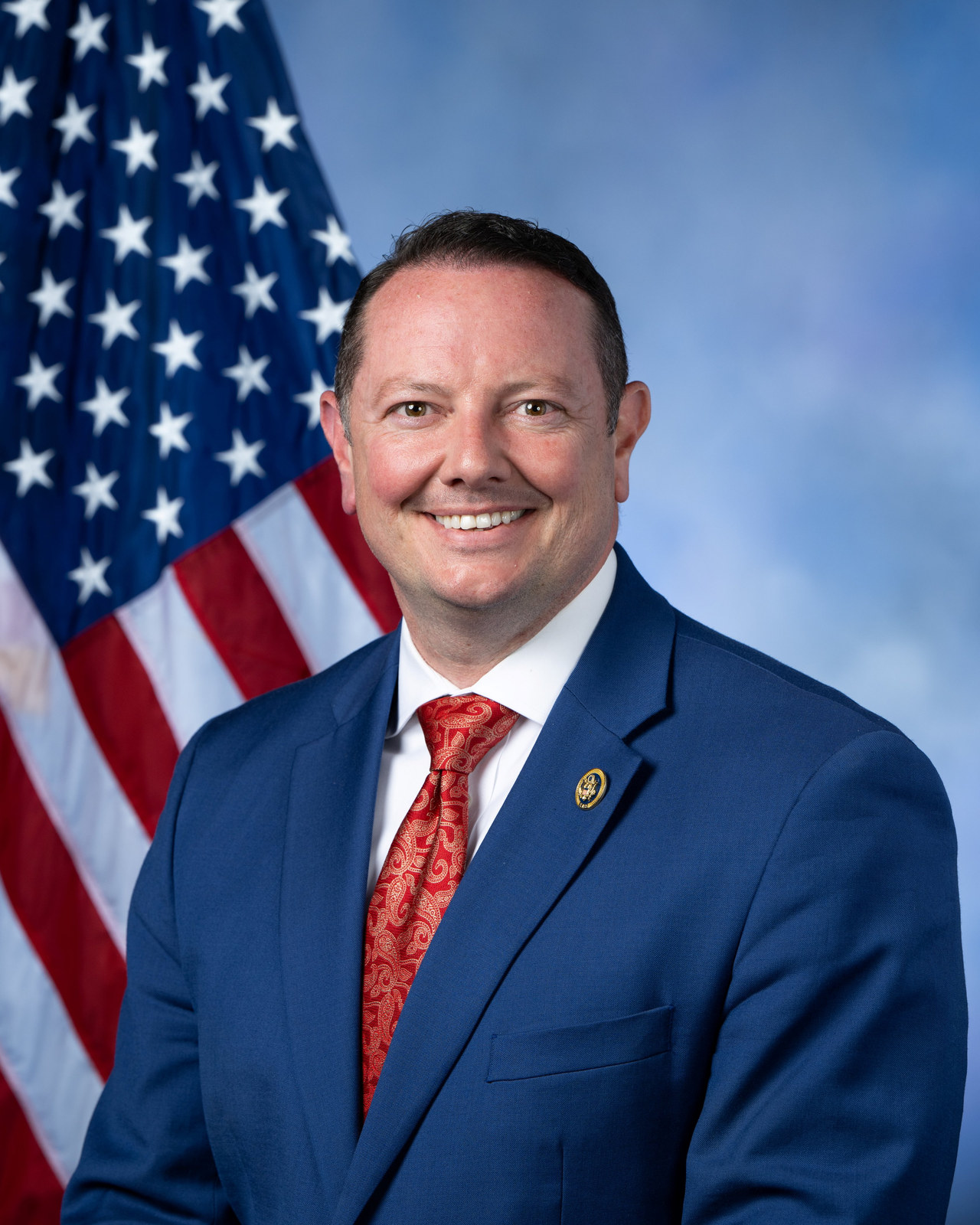
On 31 October 2026 the New York Post reported that House Democrats intend to stand up a dedicated UAP disclosure committee if they take control of the House after the midterm elections, supplanting the Task Force on the Declassification of Federal Secrets led by Representative Anna Paulina Luna of Florida. Inside that story sat a statement from Representative Andre Carson of Indiana, who chaired the first congressional hearing on the subject in 2022.
Carson told the paper that "the current administration has not been fully transparent on UAP and has slow walked several of the statutory requirements Congress established for UAP disclosure." He said the All-domain Anomaly Resolution Office "was established to receive, analyze, and resolve UAP reporting" but "has delayed the release of a key historical UAP record report for almost two years." He then called "for the immediate release of this report, which is expected to provide additional findings of historical military and intelligence investigations of UAP, including how incidents were investigated, the role of classified programs, and whether relevant activities were appropriately disclosed to Congress."
The report Carson is describing is Volume II of AARO's Historical Record Report. Volume I was published on 8 March 2024 and is already covered in this archive. Volume II has never appeared, and as of 2 November 2026 it is not listed anywhere on AARO's own UAP Records page.
What is the official position?
The statutory requirement is Section 6802 of the Intelligence Authorization Act for Fiscal Year 2023, which sits inside Public Law 117-263 and rewrote Section 1683 of the FY2022 National Defense Authorization Act, codified at 50 U.S.C. 3373. Its historical record provision reads: "Not later than 540 days after the date of the enactment of the Intelligence Authorization Act for Fiscal Year 2023, the Director of the Office shall submit to the congressional defense committees, the congressional intelligence committees, and congressional leadership a written report detailing the historical record of the United States Government relating to unidentified anomalous phenomena."
The statute goes on to require that the report "focus on the period beginning on January 1, 1945, and ending on the date on which the Director of the Office completes activities under this subsection," and that it itemise the key historical record of intelligence community involvement, including "any program or activity that was protected by restricted access that has not been explicitly and clearly reported to Congress," successful or unsuccessful efforts to identify and track the phenomena, and "any efforts to obfuscate, manipulate public opinion, hide, or otherwise provide incorrect unclassified or classified information about unidentified anomalous phenomena or related activities."
Public Law 117-263 carries the line "Approved December 23, 2022" at its foot. Five hundred and forty days after that date is 15 June 2024.
AARO has made no public statement explaining the non-publication, and no departmental notice of a revised date could be found. The Office's own UAP Records page, read on 2 November 2026, lists information papers, the Kona Blue material and NARA digitisation updates, and carries no Volume II.
Update, 10 November 2026. AARO has since published another report to Congress, and it says nothing about the missing volume. The Fiscal Year 2025 Consolidated Annual Report on Unidentified Anomalous Phenomena carries an information cut off of 30 May 2025 and the document control number 26-P-0880. AARO's own Congressional and Press Products page lists it under New Content with a date added of 20 July 2026, which is 416 days after its own information cut off and 613 days after the Fiscal Year 2024 edition was released on 14 November 2024.
The document runs to fourteen pages. Across the whole of it the word volume does not appear once, the phrase historical record does not appear once, the section number 6802 does not appear once, and the figure 540 does not appear once. Its single use of the word historical refers to reporting trends for UAP morphologies. Its single reference to 1945 describes the secure reporting mechanism on AARO's website, which invites people with first hand knowledge of a government UAP programme dating back to 1945 to come forward, and that is the same start date the historical record provision sets for the report itself. The annual report's AARO Program Updates section inventories what the Office did during the period, including a new analytic capability that resolved 238 reports as satellite flaring, multi domain sensor and algorithmic prototyping initiatives, the Director's media appearances, the publication of case resolutions and imagery, and the launch of an Electronic Freedom of Information Act reading room. Its Way Forward section sets out what the Office intends to do next. Neither mentions the outstanding volume.
The Congressional and Press Products page is also the second AARO surface on which Volume II is absent, and it is the one where a report to Congress would be expected to appear. Read on 10 November 2026, its reports table lists the Historical Record Report at Volume 1 only, dated 2024. Its news and press products table carries nothing later than 27 February 2026, and its only Historical Record Report entries are the Pentagon press secretary's statement and the media engagement with Acting Director Tim Phillips, both dated 8 March 2024 and both about Volume 1. There is no press release, no transcript and no departmental notice of a revised date. The UAP Records page, re-read the same day, still carries no Volume II. As of 10 November 2026 the single statutory deadline of 15 June 2024 is 878 days past.
What the people involved say
The documentary record is unusually clear because Volume I describes its own missing second half three separate times.
Its introduction states: "AARO will publish Volume II in accordance with the date established in Section 6802 of the National Defense Authorization Act for Fiscal Year 2023 (FY23); Volume II will provide analysis of information acquired by AARO after the date of the publication of Volume I."
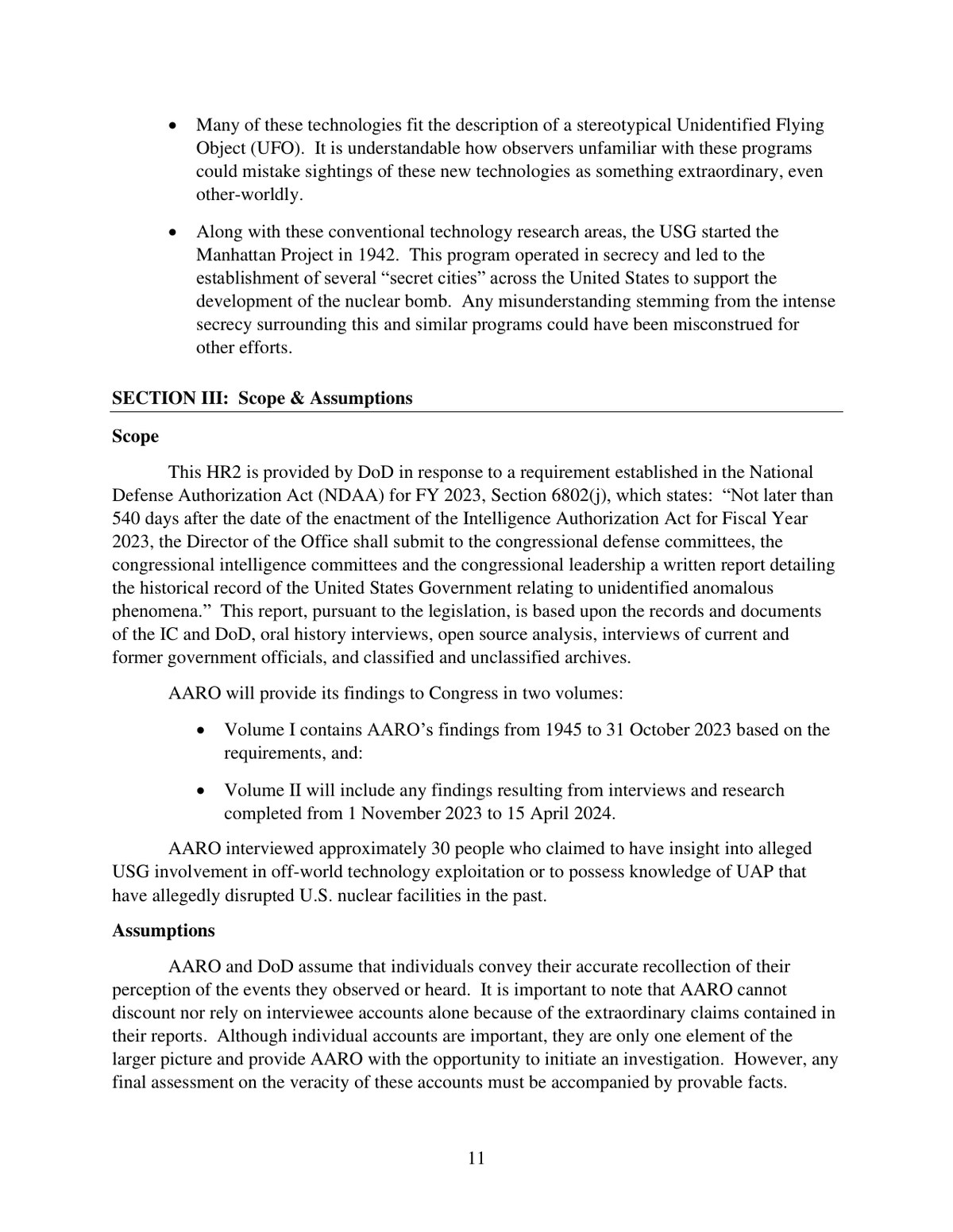
Its Scope section is more specific about the division of labour. "AARO will provide its findings to Congress in two volumes: Volume I contains AARO's findings from 1945 to 31 October 2023 based on the requirements, and Volume II will include any findings resulting from interviews and research completed from 1 November 2023 to 15 April 2024."
Two further sentences matter more than either, because they say what is actually inside the volume that never came. On the roughly thirty interviews AARO conducted with people claiming knowledge of off-world technology exploitation or of phenomena interfering with nuclear facilities, Volume I states: "AARO will report the results of the unresolved allegations in Volume II." And on the durability of its own conclusions it states: "AARO remains open to additional, verifiable information that may alter the conclusions rendered in Volume I and will note any changes to the findings in this report in Volume II."
So by Volume I's own account the unpublished volume is the one holding the unresolved allegations, and it is also the designated vehicle for any correction to the published findings.
Is the Missing AARO Historical Record Report Volume II and Andre Carson's Call for Its Release, 31 October 2026 real? The two-pass assessment
Pass one, the deflating reading. Reports slip. AARO has been through several directors, a change of administration and a renaming of its parent department since 2024, it has continued to publish annual reports and information papers throughout, and a classified or partially classified volume can sit in review for a long time without any of it being sinister. Carson is a member of the minority party describing an opposing administration during an election season, and his statement is an accusation rather than a finding. Nothing in the public record establishes why Volume II has not appeared, and this archive does not claim to know.
Pass two, what the documents establish regardless of motive. Three things are checkable and none of them depend on anyone's characterisation.
First, Section 6802 sets exactly one deadline. Across the whole of the section, 27,152 characters of statutory text, the word "volume" does not appear once, the word "interim" does not appear once, and the phrase "540 days" appears exactly once. The two-volume structure is AARO's own administrative construction, not a creature of the statute. Congress asked for a report; it did not authorise an instalment plan.
Second, that single deadline fell on 15 June 2024, and Volume I was published on 8 March 2024, which is 99 days before it. So AARO's own sentence, that it "will publish Volume II in accordance with the date established in Section 6802," points at a date that expired 99 days after Volume I shipped. Read literally, the commitment was already impossible to keep in the ordinary sense when it was written. As of 2 November 2026 that deadline is 870 days past, about two years and four months.
Third, Carson understates his own case. He says the report has been delayed "for almost two years." Measured from the statutory deadline it is 870 days, and measured from Volume I's own stated research cutoff of 15 April 2024 it is 931 days, a little over two and a half years. The archive notes this because it runs against the direction a partisan statement would normally be expected to exaggerate.
What follows from that is narrow and worth stating plainly. The outstanding volume is not a supplement or an appendix. By Volume I's own description it contains the results of the unresolved allegations, and it is the mechanism AARO reserved for correcting Volume I's findings. The statute separately requires the report to document "any efforts to obfuscate, manipulate public opinion, hide, or otherwise provide incorrect" information about the subject. Those are the parts that have not been delivered.
Tier: Unknown. There is no official narrative to weigh here, because the Office has offered no public explanation at all. This page records a documented statutory obligation, a documented commitment by the agency, and the measurable gap between them, and it takes no position on the cause.
Update, 3 November 2026. Carson returned to the subject in fresh reporting published by Cybernews at 12:53 UTC on 3 November 2026, and two things in it bear directly on this file. The first is his own characterisation of the obstruction, quoted as: "Unfortunately, the current administration has not been fully transparent on UAP and has slow-walked several of the statutory requirements Congress established for UAP disclosure." The second is more specific and more useful. The report states that the main sticking point Carson identifies is a retrospective UAP report being prepared by AARO which is, in that account, locked in a bureaucratic stalemate, and it describes that document as covering historical sightings, investigative methods, classified programs and the analysis of communication channels with Congress.
The outlet adds, in its own words, that "it remains unclear which document Carson is referring to." On the evidence assembled above it is not unclear. A retrospective AARO report covering the historical record, investigative methods and classified programs, which Congress required and which has not appeared, is Volume II of the Historical Record Report, and the description given matches the contents Volume I reserved for it. The archive records that identification as an inference from the documents rather than as a statement by Carson, who did not name the volume.
The same reporting carries a remark by David Grusch, made on The Joe Rogan Experience in September 2026 and quoted as "I don't trust another president," offered in the context of whether disclosure should depend on a single office holder. That is a statement of opinion about future risk, it is not evidence about the missing volume, and nothing in this file rests on it. It is recorded because it is the argument now being made publicly for putting the obligation on a committee rather than on an administration.
One caution about the source. The Cybernews page opens with a block of key takeaways which it attributes to an automated system, and none of the material above is drawn from that block. Every quotation here comes from the body text of the article.
Note, 10 November 2026. Pass one above credits the Office with continuing to publish annual reports throughout, and that remains true, but the cadence is worth stating with the dates attached. The Fiscal Year 2025 annual report reached the public 613 days after the Fiscal Year 2024 edition and 416 days after its own information cut off, and it is silent on the historical record volume from first page to last.
Nothing requires the annual report to discuss the historical record volume. The two obligations sit under different parts of 50 U.S.C. 3373, and the annual report has its own prescribed contents, which the Fiscal Year 2025 edition addresses. The point is therefore narrower than a second missed requirement, and it is this: AARO's published output now includes a document produced and released well over two years after the historical record deadline expired, and that document contains no acknowledgement of the outstanding report, no revised date and no explanation. The archive's position is unchanged, because silence is not evidence of a cause. What the silence removes is the possibility that an explanation exists somewhere in AARO's own published record and this file simply failed to find it.
Sources
- media.defense.gov/2024/Mar/08/2003409233/-1/-1/0/DOPSR-2024-0263-AARO-HISTORICAL-RECORD-REPORT-VOLUME-1-2024.PDF
- www.govinfo.gov/content/pkg/PLAW-117publ263/html/PLAW-117publ263.htm
- nypost.com/2026/10/31/us-news/democrats-plot-taking-ufo-disclosure-issue-from-gop-after-midterms/
- www.aaro.mil/UAP-Records/
- www.aaro.mil/
- www.reddit.com/r/UFOs/comments/1xl3idk/rep_andre_carson_is_calling_for_the_immediate/
- cybernews.com/news/democrats-republicans-uap-midterm-elections/
- www.aaro.mil/Portals/136/PDFs/FY25%20UAP%20Annual%20Report/AARO_FY2025_Consolidated_Annual_Report_on_UAP.pdf
- www.aaro.mil/Congressional-Press-Products/
More cases from this region: UFO sightings in United States