One Pilot Saw a Red Light and the Other Did Not: the Liverpool Approach Object of 11 July 2026
An airliner on final approach to Liverpool passed an object over its right wing, one pilot saw a red light on it and the other did not, and an unusually thorough investigation found no trace of anything.
What did witnesses see at 2.4NM west of Liverpool John Lennon Airport?
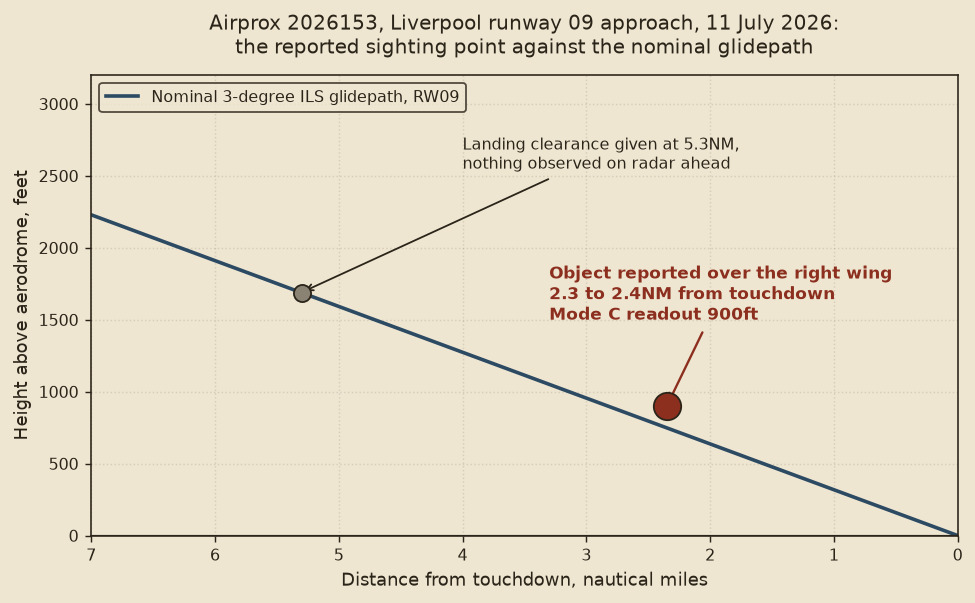
At 0523 UTC on 11 July 2026 an Airbus A320 was on the ILS approach to runway 09 at Liverpool John Lennon Airport. It was about 2.3 to 2.4 nautical miles from touchdown, at roughly 1,000ft, in Class D airspace of the Liverpool control zone.
The first officer saw an object pass over the right wing. The Board's record of the crew report describes it as a medium or standard sized object, "the size of a normal backpack", and notes that the first officer "may have seen a red light on the device which made them believe that it was a drone instead of a bird". No evasive action was taken and the object did not strike the aircraft. The crew reported it to air traffic control, and the reported risk of collision was entered as Low.
The detail that separates this file from the others is what happened to that red light. The Liverpool air traffic control investigation records that one flight crew member stated the object had a red light on it and was over the right wing at about 1,000ft, and that "subsequently, when on the ground, the other crew member reported that they did not see a red light". The single observation the identification rested on was not shared by both pilots.
The aircraft's own Mode C readout put it at 900ft at the time.
What is the official explanation?
The UK Airprox Board assessed this as Airprox 2026153 at its meeting of 16 September 2026, logging the object as "Unk Obj" and reaching the unknown-object finding: the reported altitude and description "were such that they were unable to determine the nature of the unknown object". On risk it recorded that there was insufficient information to make a sound judgement, which is Category D.
The investigative record behind that finding is the most thorough in the batch and is worth setting out, because a negative result is only as strong as the search that produced it. The Liverpool air traffic control investigation reports that runway 09 was in use, the weather was CAVOK, it was daylight, and traffic levels were light to medium. The aircraft was correctly vectored onto the ILS from the northwest and was under a Radar Control Service. Landing clearance was given at 5.3 nautical miles with nothing observed on the radar display ahead of the aircraft.
The investigator then reviewed the radar replay from 0530 UTC back through the time of the incident and observed no contacts in the vicinity. There were no small unmanned aircraft bookings on record through the Air Portal for that time and date. The investigator additionally reviewed all telephone lines into air traffic control from 0500 UTC and found that no calls had been received with any such requests.
Controllers isolated the area for thirty minutes as a precaution, which affected one following Boeing 737 that had to hold at KEGUN until the full period had elapsed.
What did the witnesses think it was?
This file is unusually honest about the limits of its own testimony, and that is its main value.
The red light is the hinge. It is the only observation in the report that points toward a manufactured object rather than a bird, and the crew member who reported it was explicit that it was uncertain even at the time, with the Board's record carrying the hedge "may have seen". By the time the aircraft was on the ground, the other pilot had said they did not see it. The controller's account records the same thing from the other direction, that there was a possible red light "but not confirmed by both pilots".
The size estimate has the same character. "The size of a normal backpack" is a comparison to a familiar object rather than a measurement, offered for something glimpsed beside a wing at approach speed, and the file attaches a weight figure of less than 1.2kg which appears to be the crew's inference about what class of device that would be rather than anything they could observe.
What the crew did not do is overclaim. They reported a possible drone, flagged their own uncertainty, and the uncertainty survived into the official record instead of being smoothed away. That is the correct behaviour and it is why this case can be assessed at all.
Is the One Pilot Saw a Red Light and the Other Did Not: the Liverpool Approach Object of 11 July 2026 real? The two-pass assessment
Pass one, how could this be mundane. A bird is the strongest candidate in this file and the crew effectively said so themselves by framing the red light as the thing that made them think otherwise. Once the red light is unconfirmed, the remaining description is a backpack-sized object passing an aircraft at 900ft on short final in daylight, which describes a gull or a similar large bird near a coastal airport on the Mersey estuary completely. The archive notes plainly that it has not quantified local bird activity for that morning and so cannot do more than name the candidate.
A drone remains entirely possible. The investigation's negative findings do not exclude one: small drones routinely leave no radar contact, and the absence of a booking or a phone call establishes only that nobody sought permission, which is what an illegal flight looks like rather than evidence against one.
A balloon is possible and fits the lack of reported motion, though the file records no drift and no direction.
The weather was CAVOK, meaning no significant cloud and visibility of ten kilometres or more, in daylight. So conditions were good, which strengthens the observation in one sense and does nothing to identify the object in another.
Pass two, if the prosaic answers do not hold. The honest position is that this case is unresolved in the weakest possible way, and this page says so. There is no imagery, no radar, no second independent witness on the ground, and the one feature that would have distinguished a manufactured object from an animal was reported by one pilot and contradicted by the other within the hour.
The archive records it as Unknown because that is what the Board recorded and because no identification has been demonstrated. It belongs in the collection not as a strange object but as a clean worked example of how an unidentified object report is actually built and dismantled: a thorough controller investigation, a complete radar review, a check of the permissions record and even the telephone logs, and at the end of all of it a disagreement between two people in the same cockpit about whether there was a light.
Sources
- www.airproxboard.org.uk/media/3oif3tkt/september-2026-drone-summary-sheet.docx
- www.airproxboard.org.uk/reports-and-analysis/monthly-airprox-reviews/airprox-reports-2026/september/
- www.airproxboard.org.uk/reports-and-analysis/individual-airprox-reports/2026/
More cases from this region: UFO sightings in United Kingdom