The Jersey Airport Airspace Incursions of 30 and 31 October 2026
An unidentified something closed the only airport of a Crown Dependency on two consecutive nights, grounded or diverted a dozen flights, cancelled nine hospital procedures, aborted an air ambulance transfer and brought a Royal Air Force counter-drone deployment to the island. Nobody has produced a photograph of it, no object was recovered, no operator was identified, and the island had no equipment capable of detecting a drone until after it was over.
What did witnesses see at Jersey Airport?
Jersey Airport closed to inbound traffic on two consecutive evenings at the end of October 2026. The closures followed reports from members of the public and from airport staff of drones near the airfield on Friday 30 and Saturday 31 October. The States of Jersey Police received the first report at about 20:20 on the Friday and further reports continued until roughly 22:30, with the objects described as operating inside restricted airspace and across active flight paths.
Four aircraft were prevented from landing that first night. Three inbound services were diverted back to the mainland, a British Airways flight from Heathrow, a Loganair service from Southampton and an easyJet flight from Gatwick, while a fourth was cancelled before it departed. One of the diverted aircraft was eventually able to land at about 23:45 after the airport stayed open late to accommodate it.
The following evening the pattern repeated. Jersey Airport reported disruption from 20:05 as a result of what it called illegal and persistent drone activity in the vicinity of the airfield, and four more flights were unable to land as scheduled. An inbound charter from Madeira was diverted to Paris Charles de Gaulle, services from Gatwick and Heathrow were delayed at length, and a Loganair departure from Southampton was cancelled.
The reported objects were never described in public. Across every statement issued by the police, the government, the airport and the island's own press, there is no account of what a witness actually saw: no colour, no number of lights, no shape, no sound, no estimate of size or altitude. The public record consists entirely of the word drone and the disruption that followed it.
What is the official explanation?
The official position is that these were deliberate and unlawful drone flights. Jersey's Chief Minister, Senator Lyndon Farnham, described the activity in exactly those terms and said that those responsible should expect to face the full consequences of the law, adding that the airport is a vital lifeline for the island and that the government would not tolerate behaviour putting its safe operation at risk. A major investigation was opened under the reference M07922/2026 and remains open.
Detective Chief Inspector Chris Beechey, who leads it, set out how the response began. The police, he said, received information from the public alerting them to sightings of drone activity around the airport, officers then convened with partners under established procedures, and on the back of that information Ports of Jersey determined it was necessary to close the airport. It was not until the drone activity had ceased that the airport could be reopened. The decision chain therefore runs from public reports to a closure, with no detection system anywhere in it.
On the Saturday, Inspector Rob McCallum told the BBC that police believed two or three drones had entered restricted airspace and that the activity was not thought to be linked to terrorism. That is the only official estimate of how many objects there were, and it is a belief rather than a measurement.
The search effort was large and came up empty. States and Honorary Police, Channel Islands Air Search, government staff and Ports of Jersey personnel searched several areas in the west of the island, and investigators asked specifically to hear from anyone who had been in Saint Peter, La Pulente, Watersplash, El Tico, L'Etacq or Jubilee Hill, or who held dashcam, CCTV, doorbell or mobile phone footage. No drone operator has been identified, no craft has been recovered, and no arrest has been reported.
Two further official actions followed. Specialist drone-detection equipment was brought to the island by a Royal Air Force deployment, arriving on the Sunday evening, and the government confirmed on 3 November that the capability was in place and that agencies now had an enhanced ability to detect, assess and respond. Unspecified additional measures were also put in place, withheld for operational reasons. The government asked the public to stop speculating about who was responsible and why, saying that police would follow the evidence wherever it leads.
What did the witnesses think it was?
There is no witness account on the public record, and that absence is the most unusual feature of the case. Every element of it, including the object count and the fact that there was an object at all, rests on reports made by members of the public and by airport staff to the police, none of which has been published in any form.
The consequences, by contrast, are documented in detail. The Government of Jersey stated that the incidents had consequences beyond flight disruption: nine planned clinical procedures were cancelled, a non-emergency air ambulance transfer had to be aborted, and patients receiving treatment in England were unable to return to the island as planned.
The most revealing testimony came six days later and from inside the government. Speaking to the Children, Education and Home Affairs Scrutiny Panel on 5 November, the Home Affairs Minister, Senator Helen Miles, said Jersey needed emergency legislation that was fit for purpose and that the Emergency Powers and Planning (Jersey) Law 1990 had been drafted in completely different times. Asked by Deputy Chris Rebindaine how updated legislation would help the island respond to cyber attacks, infrastructure failures and drones, she said her department was updating the Jersey emergency risk register following the activity, and made a remark that defines the case: the island's risk register tends to follow the national emergency risk register, and drones were not on that one either. She summarised it herself as not knowing what you do not know, and said that was the issue with the drones over the weekend.
The dispute
The objects were never detected by any instrument, never photographed and never recovered, and the island had no counter-drone or detection capability until after both nights had ended. The drone classification is the authorities' presumption, not a demonstrated identification, and a specialist aviation outlet said in print that whether drones were genuinely present remains to be established.
Is the Jersey Airport Airspace Incursions of 30 and 31 October 2026 real? The two-pass assessment
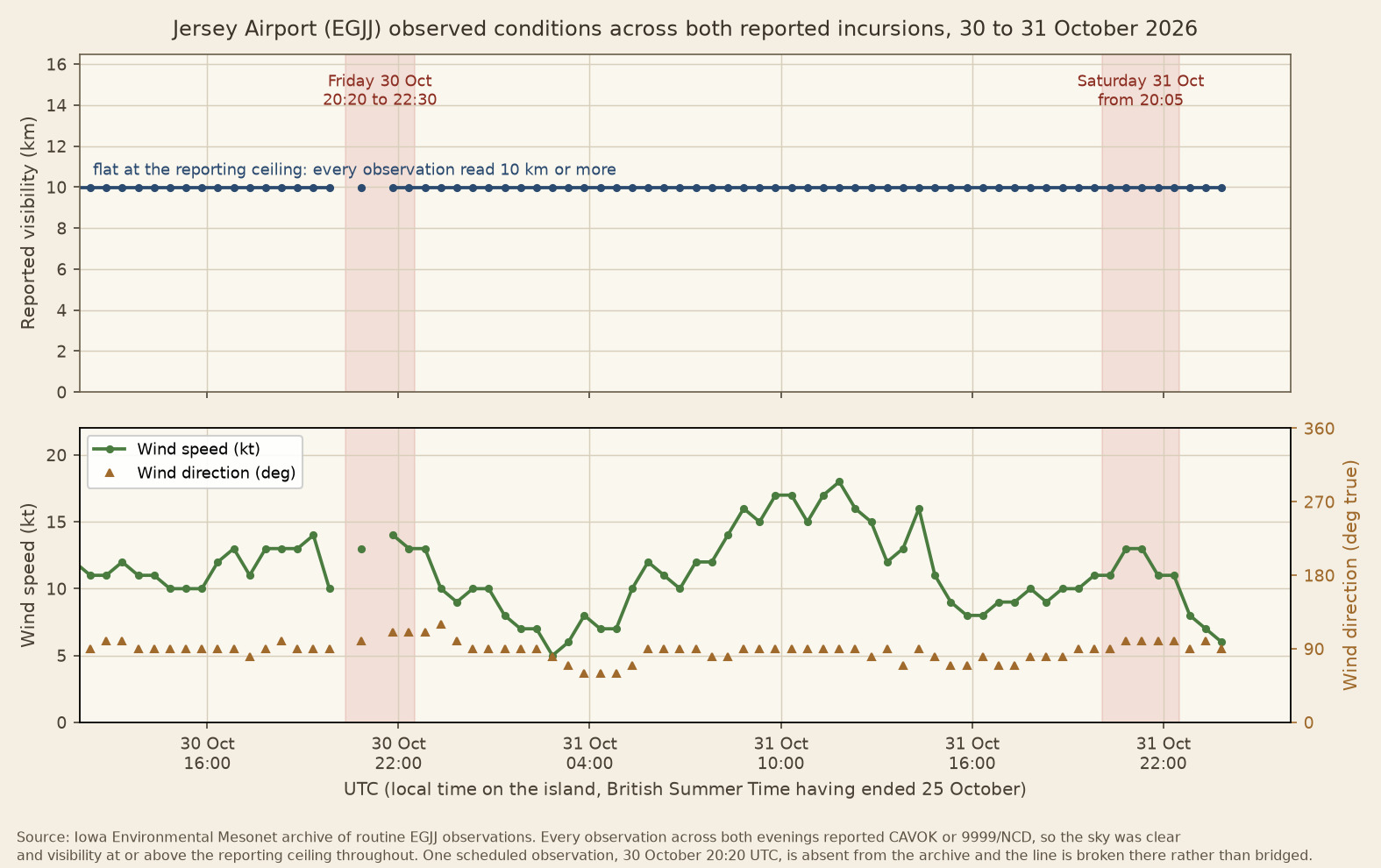
Pass one, the ordinary reading, is also the official one and it is entirely reasonable. Small uncrewed aircraft are cheap, widely held and routinely flown illegally near airports, the Air Navigation (Jersey) Law 2014 forbids flying inside an aerodrome traffic zone without permission from air traffic control, and anyone found to have endangered an aircraft faces a fine or up to five years in prison. Weather was no obstacle to an operator: every routine observation at the airport across both evenings read CAVOK or 9999 with no cloud detected, visibility at or above the ten-kilometre reporting ceiling, with a steady easterly wind of six to fourteen knots, which is benign flying weather for a small drone. The Sun was 34.3 degrees below the horizon when the first report came in and 51.0 degrees down by the time activity ceased, so this was full darkness and anything seen was a light rather than an airframe.
The same figures remove the usual astronomical and orbital candidates. At those solar depressions the zenith shadow cutoff stands at about 1,340 km rising to about 3,740 km, and even looking straight toward the sunward horizon at five degrees of elevation the lowest sunlit altitude is 381 km at a slant range of some 1,750 km, so nothing in low Earth orbit was illuminated anywhere in that sky. Of the planets only Saturn was above the horizon, at magnitude 0.46 and 36 degrees up to the southeast, with the Moon low in the east at 72 per cent illumination. None of that produces several moving objects over a runway across two separate evenings.
Pass two is not a claim that something exotic was present. It is the observation that the object class was assigned administratively and never established. Nothing was photographed, nothing was recovered, nobody was identified, and, most importantly, the island had no specialist detection capability at all until the Royal Air Force brought some on the Sunday evening, after both nights were over. There is therefore no radar track, no radio-frequency detection, no optical or thermal record, and no instrument of any kind that could have distinguished a drone from an aircraft light, a helicopter, a lantern or a misread point of light. The determination rests on reports from people looking at a dark sky, and the police account says so plainly.
That is not a hypothetical worry. Dronewatch Europe, a specialist outlet with no interest in the unexplained, closed its coverage by saying that whether drones were genuinely operating near Jersey Airport on both evenings remains to be established, and it set the case beside two precedents. At Gatwick in December 2018 the airport was shut for roughly 33 hours, more than a thousand flights were disrupted and about 140,000 passengers affected, and although Sussex Police concluded from corroborated witness statements that at least two drones had been present, no conclusive physical evidence was ever recovered and nobody was prosecuted. At Copenhagen in September 2025, four hours of closure followed reports of two or three large drones, and after a nine-month investigation Chief Police Inspector Soren Thomassen announced in June 2026 that police could neither confirm nor rule out that there had been drone activity, with the investigation closed and no suspects identified. The archive holds that case already.
So the honest tier here is Unknown. There is no official narrative that resolves what the objects were, only an official characterisation of what they were presumed to be, and the Home Affairs Minister's own words about a risk register that did not list drones describe a jurisdiction that was not equipped to find out. The case will be revisited if the investigation produces an operator, a recovered aircraft, or any record from the detection equipment now on the island.
One test would settle a great deal and cannot be run from here. Historical ADS-B playback for the two evenings would establish exactly where each diverted aircraft was and when, and would show whether any conventional traffic was in the reported quadrant at the reported times, which is the leading prosaic alternative to a drone. That requires an interactive browser session against a replay service and is carried as the case's open question.
Sources
- jerseyeveningpost.com/news/2026/10/31/flights-diverted-after-drone-reports-spark-major-operation-near-jersey-airport
- jerseyeveningpost.com/news/2026/11/02/additional-measures-put-in-place-after-drone-chaos-grounds-flights-and-sparks-investigation
- jerseyeveningpost.com/news/2026/11/04/new-specialist-anti-drone-equipment-puts-island-in-safest-possible-position-going-forward
- www.bailiwickexpress.com/news/nine-medical-procedures-cancelled-and-air-ambulance-transfer-aborted-amid-drone-disruption/
- www.bailiwickexpress.com/news/specialist-drone-detection-equipment-brought-to-jersey-as-investigation-continues/
- www.bailiwickexpress.com/news/minister-promises-fit-for-purpose-emergency-legislation-following-drone-disruption/
- www.dronewatch.eu/alleged-drone-sightings-cause-two-nights-of-disruption-at-jersey-airport/
- www.aerotime.aero/articles/jersey-airport-hit-by-drone-disruption-for-second-consecutive-night
- www.aviation24.be/airports/jersey-airport-jer/suffers-second-night-of-disruption-after-drone-sightings/
- dronelife.com/2026/11/02/drone-activity-disrupts-jersey-airport-for-two-consecutive-nights/
- mesonet.agron.iastate.edu/cgi-bin/request/asos.py?station=EGJJ&data=metar&year1=2026&month1=10&day1=30&year2=2026&month2=11&day2=1&tz=Etc%2FUTC&format=onlycomma&report_type=3&report_type=4
More cases from this region: UFO sightings in Jersey