The BAASS Deployment to Brazil, 25 May 2009 to 3 June 2009
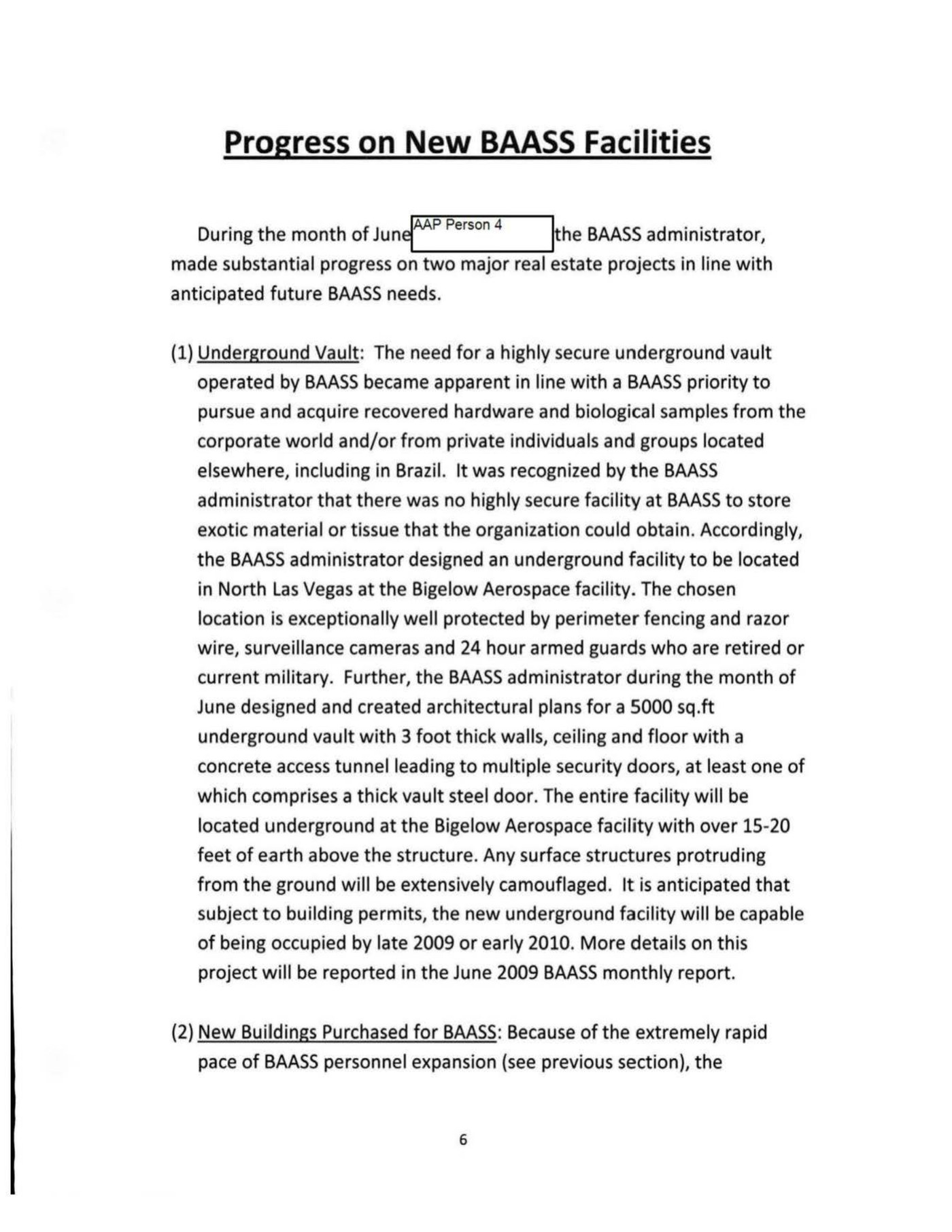
Two teams working for a Defense Intelligence Agency contractor flew to Brazil in 2009 under instructions to keep a very low profile and to dampen any media interest, and they came home with seventy gigabytes of other researchers' case files.
What did witnesses see at Fortaleza?
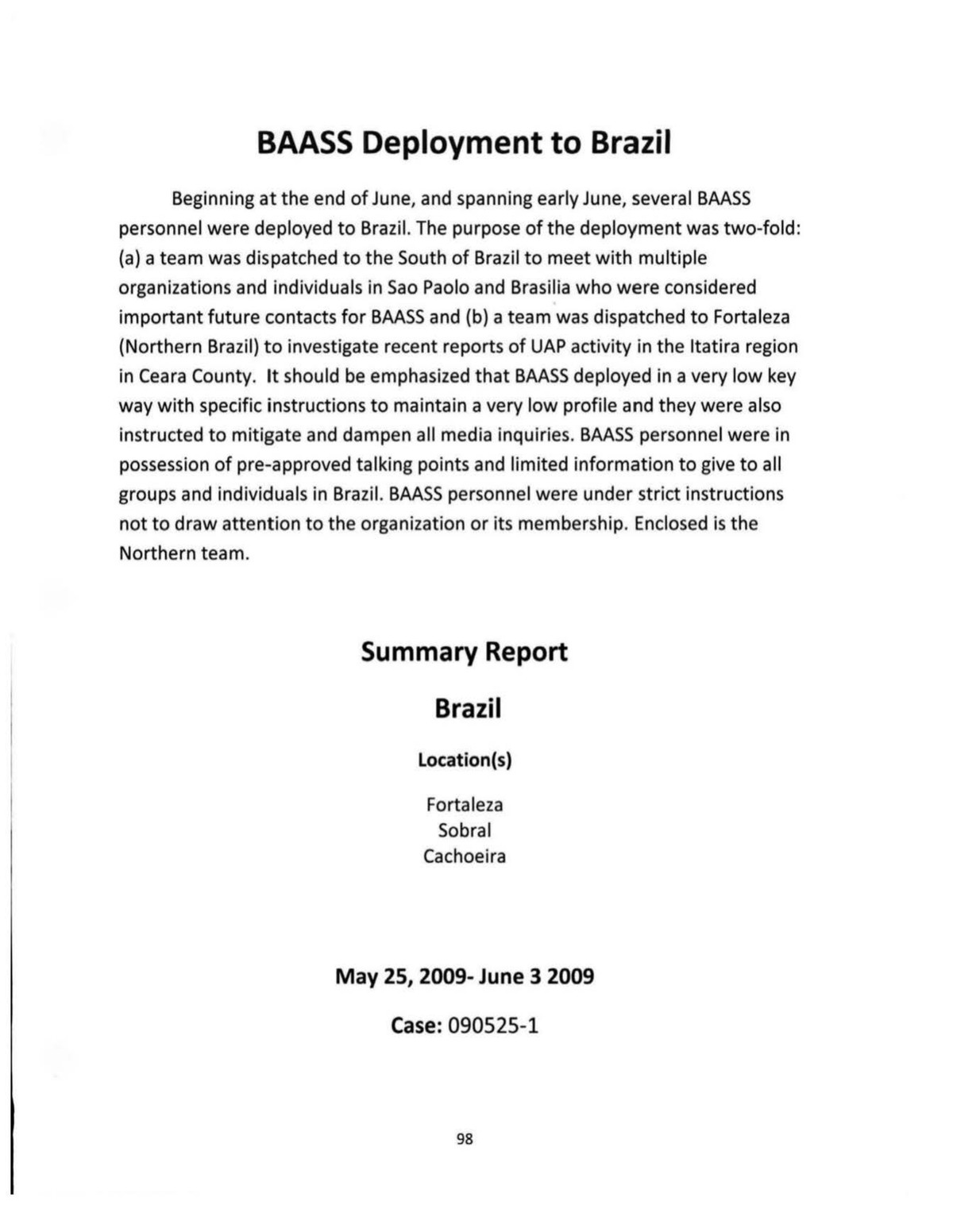
A Defense Intelligence Agency contractor sent two teams of its own people to Brazil in 2009. The deployment is written up under its own heading in the June 2009 monthly progress report of Bigelow Aerospace Advanced Space Studies, released by the Department of War on 23 October 2026, and the section runs for roughly twenty pages.
The report states the purpose in two parts. A southern team went to São Paulo and Brasília to meet organisations and individuals considered important future contacts. A northern team went to Fortaleza to investigate recent reports of UAP activity in the Itatira region, which the document places in "Ceara County" although Ceará is a state. The paragraph then sets out the posture in unusually direct language: "It should be emphasized that BAASS deployed in a very low key way with specific instructions to maintain a very low profile and they were also instructed to mitigate and dampen all media inquiries. BAASS personnel were in possession of pre-approved talking points and limited information to give to all groups and individuals in Brazil. BAASS personnel were under strict instructions not to draw attention to the organization or its membership."
The dates are given twice and the two statements disagree. The narrative paragraph opens "Beginning at the end of June, and spanning early June, several BAASS personnel were deployed to Brazil", which cannot describe any real interval. The summary report printed immediately below it gives 25 May 2009 to 3 June 2009 and assigns case number 090525-1, and the day by day narrative that follows is consistent with those dates: the team arrives on 25 May, meets its contacts from 27 May, attends a conference, spends 1 June copying files and travels home on 2 June. The summary report's dates are the usable ones.
The northern team was four people, two senior investigators and two translators, all unnamed. Its stated mission was to meet established contacts and interview as many witnesses to the UAP phenomena as possible. The report records candidly that this did not go to plan. A set of interviews arranged through a local newspaper reporter never happened because she was absent or did not cooperate, and the report also notes that the team deliberately withheld its hotel location from her because of her position as a reporter with the O POVO newspaper. A separate planned interview fell through for lack of cooperation. Another contact's telephone had been disconnected.
So the team changed objective. In the report's own words, "The north team's focus shifted to acquiring as much documentation as possible from each of the ufologist groups. The north team secured approximately 70+GB of information to include video, investigative reports and photographs." The groups named are the Centro de Pesquisas Ufológicas, abbreviated in the document as CPU, and a second body abbreviated as CSPU. The team spent an entire day at CPU headquarters and returned on 1 June to copy more, using the investigators' personal laptops because the BAASS computer's storage was already full.
The inventory is itemised. One compact disc obtained at Sobral held 252 megabytes across 56 files, 55 of them image files and one a Word document of thirteen pages of case summaries dated between 1992 and 2009, which the note taker observes resemble the summary format used by the French government's own UAP office. A further list runs from a sighting at Parambu in May 1958 through Facanha in April 1962, Icarai, Oiticica in January 1976, São Luiz do Curu in December 1977, Goiás in October 1978, Quixeramobim in August 1980, Canoa Quebrada in May 1982, Horizonte in July 1983, Morro Branco in November 1984, Mucuripe in February 1987 and a cluster of Fortaleza cases through the 1980s and 1990s, ending with more than 65 gigabytes of recorded footage of investigations.
The team also recorded what did not hold up. A case from the Corrego do Salgado area involving three young boys, a frisbee shaped object that landed and two beings that exited and assaulted one of the boys, is written up with the local investigators' own verdict attached: both of them agreed the boys' statements were inconsistent and thought it appeared to be an incident of abuse or related to a fishing accident, the family being in the fishing industry. A clip in which an object appears to move was explained by the person who supplied it, who said the object was stationary and the camera operator moved the phone. Of one widely circulated video the note taker simply writes that BAASS has seen this clip before online. A further clip, labelled as showing an object in the United States, carried a television announcer's suggestion that it might be connected to a collision between American and Russian satellites, which the note records as having occurred on 15 February 2009.
At a public conference in Ceará the team found itself conspicuous despite its instructions. The note reads that it was clear we were the center of the night, with a television camera crew and a local radio reporter filming and recording throughout, and that several people stood up and described encounters including abductions. One member of the group said afterwards that she had been abducted and could now communicate and write in an alien language.
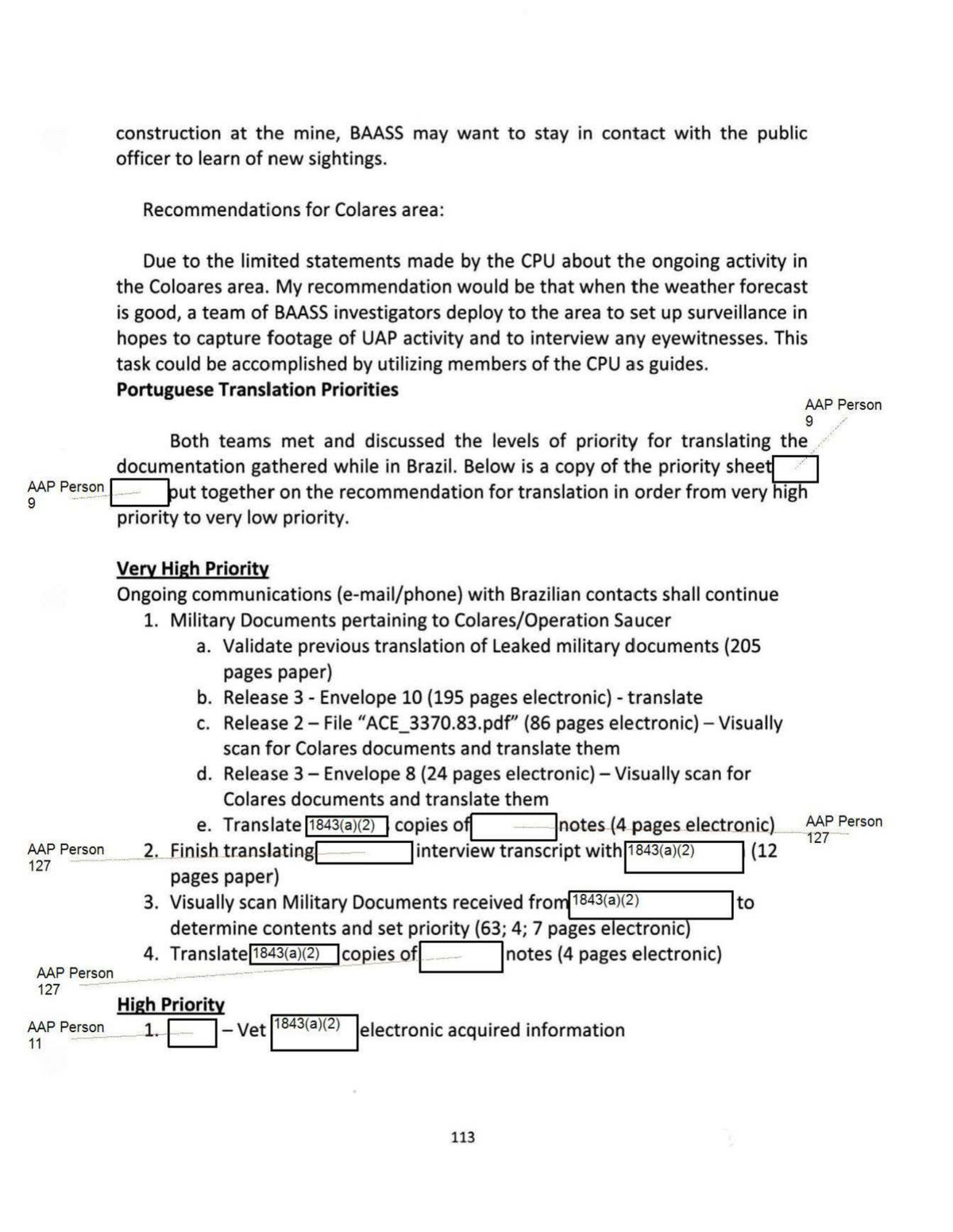
The deployment's practical output was a translation queue, and its first entry is the part that matters. Under Very High Priority the sheet reads "Military Documents pertaining to Colares/Operation Saucer", broken into validating a previous translation of leaked military documents running to 205 pages on paper, translating 195 pages of electronic material from one envelope, visually scanning and translating an 86 page electronic file for Colares documents, doing the same for a 24 page envelope, and translating four pages of electronic notes. Nothing else on the sheet is ranked above it. Medium priority includes a photocopied article on the Night of the UFOs, described by a contact as the best report on the known details of the incident. At the bottom of the queue sit five copies of a Brazilian UFO magazine and five books published by a Brazilian research body, to be visually scanned in case anything significant is inside them.
The section closes with a recommendation the northern team never carried out. Its author writes that because of the limited statements made by the CPU about ongoing activity in the Colares area, a team of BAASS investigators should deploy there when the weather forecast is good, set up surveillance in the hope of capturing footage of UAP activity, interview any eyewitnesses, and use members of the CPU as guides.
More footage and images of this sighting
What is the official explanation?
The record is DOW-UAP-D171, listed in the PURSUE manifest as "BAASS Monthly Report, June 2009" with an incident location of Las Vegas, Nevada and an incident date of 9 July 2009, which is the filing date. The PDF is 134 pages with a working text layer, and the Brazil section begins at printed page 98. It was published on 23 October 2026 in Release 07.
The United States government has published no assessment of the deployment and the document is a contractor's own account of it. There is no indication in the release that any Brazilian authority was notified, and the instruction to dampen media inquiries implies the opposite intent.
The surrounding monthly reports bracket the trip. The April 2009 report, DOW-UAP-D170, already closes by stating that BAASS has begun to acquire significant information on UAP activity in Brazil, so acquisition was under way before the teams flew. The June report's own conclusion repeats the line and adds a second country: "especially following the recent deployment of BAASS personnel to Northern and Southern Brazil, BAASS has begun to acquire significant information on UAP activity in Brazil. Recently, BAASS has initiated contact with Air Force personnel in Uruguay (CRIDOVNI)." CRIDOVNI is the Uruguayan Air Force commission that this archive has already recorded as present, sixteen years later, inside the attendee roster of the 2025 AARO data workshop.
Release 07 contains four of the twelve 2009 BAASS monthly reports: March, April, June and November. The November 2009 report, DOW-UAP-D173, is 155 pages and contains no occurrence of Brazil, Brasil, Colares or Prato at all. So the released record does not show the recommended Colares surveillance deployment taking place, and does not show that it was abandoned either. The gap is a consequence of which months were released.
One figure inside the document can be checked against an outside primary source and does not hold. The note taker records a Brazilian television announcer linking a clip to a collision between an American and a Russian satellite "that occurred on February 15, 2009". NASA's Orbital Debris Quarterly News dates the collision of Iridium 33 and Cosmos 2251 to 10 February 2009 at 1656 GMT, over extreme northern Siberia at an altitude of 790 kilometres and a closing speed above 11 kilometres per second. The error is the broadcaster's and the note taker simply wrote down what was said, which is the correct thing for a field note to do.
What did the witnesses think it was?
This case has no sighting witnesses of its own. What it has is a record of American investigators meeting Brazilian ones, and the most useful testimony in it is about the state of the phenomenon rather than about any single event.
One contact told the team that he had seen objects in the Belém region between 2001 and 2007, and that in his view the Colares activity is still happening and people simply are not reporting it because the community has come to accept it. He offered to write up a statement of his recent sightings in the Colares area and send it on. Nothing in the released monthly reports shows whether he did.
The conference in Ceará produced the other sort of account. People stood up and described encounters including abductions, and one member of the local group told a translator that she had been abducted and had acquired the ability to communicate and write in an alien language. The report passes this on without comment, which is itself informative about how the material was being gathered: the team was collecting, not adjudicating.
The counterweight is that the Brazilian investigators the team met were not uncritical. The clearest example in the file is the Corrego do Salgado case, where two local investigators told the Americans that the three boys' statements were inconsistent and that they believed the injury was abuse or a fishing accident rather than an assault by beings from a landed craft. A second contact explained away an apparently moving light as camera motion. Those judgements are recorded in a United States government record and they cut against the material around them.
Is the BAASS Deployment to Brazil, 25 May 2009 to 3 June 2009 real? The two-pass assessment
Pass one, the deflating reading. Almost nothing in this document is evidence of anything in the sky. The northern team's interview programme collapsed in the first two days, the trip turned into a file copying exercise, and what came home was seventy gigabytes of other researchers' work, most of it decades old, none of it independently verified by anyone on the team. The two cases the file describes in any detail were both explained prosaically by the local investigators themselves. The conference material is the standard contents of any public ufology evening. Treated as a field investigation, the deployment produced no observation, no instrument data and no new case.
The low profile instructions have an unremarkable reading too. A contractor sending staff to a foreign country on a classified task order has obvious reasons to avoid a newspaper reporter and a television camera that have nothing to do with secrecy about the phenomenon, including the commercial sensitivity its own page footers assert on every sheet. The report's own account shows the instruction half failing anyway, since the team ended up as the centre of a filmed public conference within three days of landing.
Pass two, what survives that. The value of this record is what it shows about intent, and the intent is unambiguous because the document ranks it. Of everything two teams carried out of Brazil, the item placed at the top of the translation queue, above every recent case and every piece of acquired footage, is the Brazilian Air Force's own paperwork on Colares and Operation Saucer. A United States defence contractor, working for the Defense Intelligence Agency, treated a foreign air force's 1977 investigation file as its single highest priority acquisition, and the file it was validating was a leaked copy of 205 pages that had been circulating outside official channels. The June report then recommends going to Colares with surveillance equipment and local guides. Read alongside the same contractor's March 2009 assessment of the flap, which also ends by recommending a renewed on site examination, the two documents form a short and consistent chain of intent.
The Uruguay line matters for the same reason and is cheap to check. BAASS initiating contact with CRIDOVNI in June 2009 sits sixteen years before CRIDOVNI appears on the attendee roster of AARO's 2025 data workshop, which reached the public only through a FOIA release. The South American thread in the United States UAP effort is older than the current disclosure cycle makes it look.
The tier is Unknown. There is no official narrative to weigh and no phenomenon to adjudicate; this is a record of an acquisition trip, and it is published in full.
What would move it. The July through October 2009 monthly reports would show whether the Colares surveillance deployment happened. The translated Operation Saucer material would show what the contractor concluded about the Brazilian Air Force file. Neither has been released.
Sources
- www.war.gov/medialink/ufo/release-07/documents/DOW-UAP-D171-BAASS_Monthly_Report_June_2009.pdf
- www.war.gov/medialink/ufo/release-07/documents/DOW-UAP-D170-BAASS_Montly_Report_April_2009.pdf
- www.war.gov/medialink/ufo/release-07/documents/DOW-UAP-D173-BAASS_Monthly_Report_November_2009.pdf
- www.war.gov/Portals/1/Interactive/2026/UFO/uap-data.csv
- www.war.gov/UFO/
- www.cnnbrasil.com.br/ciencia/pentagono-tentou-obter-investigacao-militar-brasileira-sobre-serie-de-ovnis-em-colares-no-para-revelam-novos-documentos/
- orbitaldebris.jsc.nasa.gov/quarterly-news/pdfs/odqnv13i2.pdf
More cases from this region: UFO sightings in Brazil