The Pentagon Contractor Report on Colares: The UFO Assault on Brazil, 30 March 2009
A Defense Intelligence Agency contractor spent part of 2009 reducing three decades of Brazilian field interviews into a seventeen page summary for the United States government, and the whole of it has now been published.
What did witnesses see at Colares?
A Defense Intelligence Agency contractor delivered a seventeen page executive summary on the Colares UFO flap to the United States government. The report is dated 30 March 2009, it is titled The UFO Assault on Brazil, With Its Epicenter at Colares, and it was published by the Department of War on 23 October 2026.
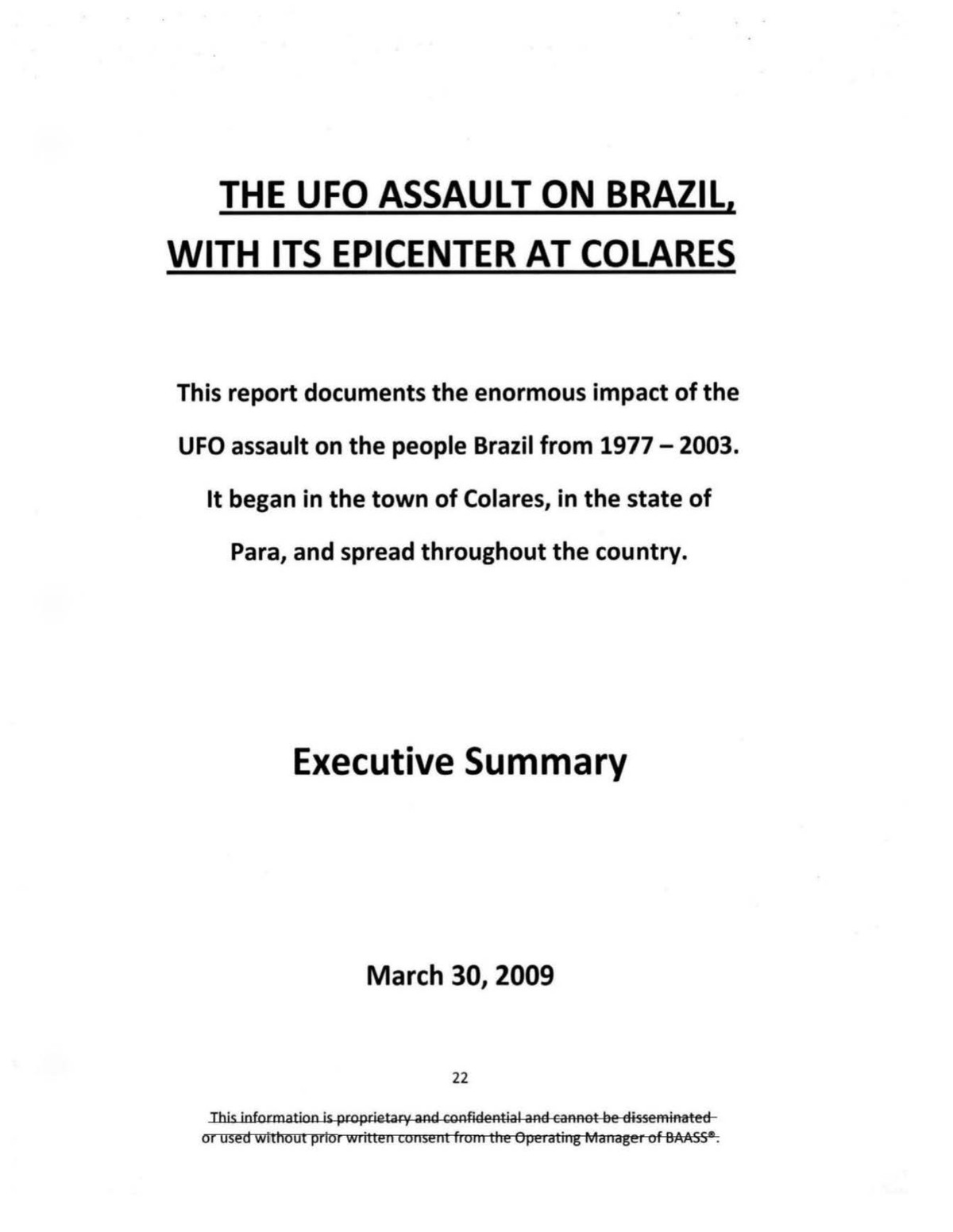
The summary is bound into the March 2009 monthly progress report of Bigelow Aerospace Advanced Space Studies, the contractor running the Advanced Aerospace Weapon System Applications Program for the Defense Intelligence Agency. The monthly report's own table of contents lists it alongside recruiting, security clearances, database development, the MUFON purchase and the company's study of records released by the British, Canadian and Danish governments. Its cover page states that the report documents the impact of the UFO assault on the people of Brazil from 1977 to 2003, that it began in the town of Colares in the state of Pará, and that it spread throughout the country. The cover line actually reads "the people Brazil", which is the document's own slip and is reproduced here only so the page can be matched.
The author is identified on the following page as a Senior Scientist at Bigelow Aerospace Advanced Space Studies, with the name withheld. The opening paragraph sets the register of the whole document: "The world is full of many terrors. This study is about one of them, a terror that comes from some place other than Earth. It is a terror that the world's governments have completely ignored or claim doesn't exist, perhaps because they know of no way they can protect their citizens from it."
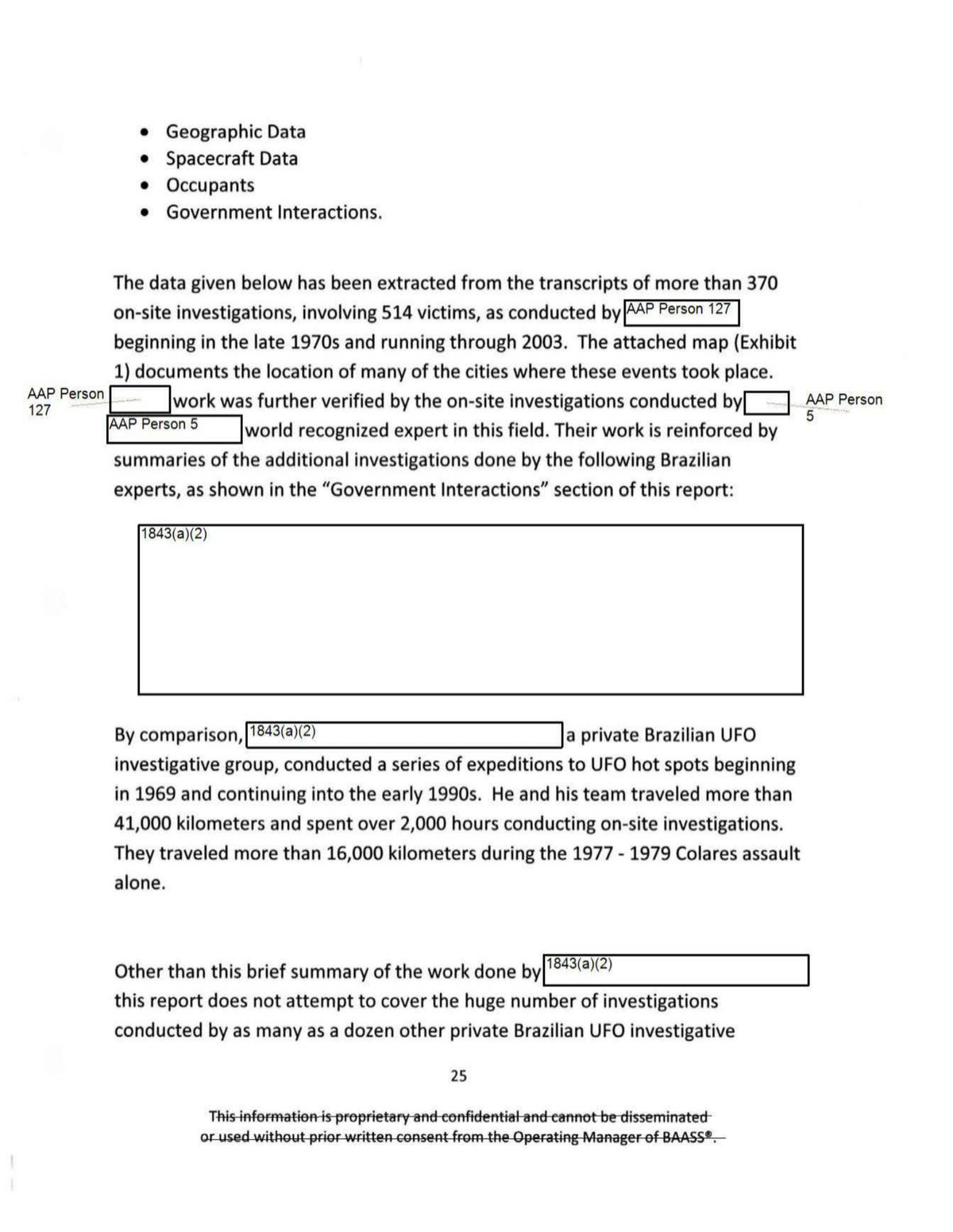
The report states where its material came from. The accumulated work of a private investigator, whose name is withheld, had been organised for BAASS into eight three ring notebooks an inch and a half thick, amounting to several thousand pages of data, and the executive summary exists to reduce that mass to a readable record. The figures are drawn from the transcripts of more than 370 on site investigations involving 514 victims, conducted from the late 1970s through 2003, and the report says that work was further verified by on site investigations conducted by an eminent scientist from the United States described as a world recognised expert in the field. A separate Brazilian investigative group is cited for comparison: expeditions to UFO hot spots beginning in 1969 and continuing into the early 1990s, more than 41,000 kilometres travelled and over 2,000 hours of on site work, of which more than 16,000 kilometres were covered during the 1977 to 1979 Colares assault alone.
The body is organised under five headings: Human Effects, Geographic Data, Spacecraft Data, Occupants and Government Interactions.
The human effects section is a tally of claims rather than a clinical series. Twenty eight people said they felt enveloped in a pocket of cold air during the event. Thirty six were ill for long periods ranging from months to years, and the report says the deaths it records came from that group. Three people were found to be anaemic in the period after an encounter, with the note that most victims were never tested for anaemia, and two further women with anaemia had their condition verified by a physician for the Legal Medicine Institute in Belém after each reported being engulfed by a beam of light that burned her. Two people reported extensive weight loss. Eighteen claimed to have been abducted, most of them found afterwards somewhere other than where the encounter began. Four hundred and twenty three said they were terrified by the close encounter and the physiological effects that followed. Injured people described the object as having been as close as two to four metres above their heads, while unaffected observers were between 200 and 6,000 metres away.
The geographic section quantifies the spread. Incidents are counted by state, with Pará at 92, which is where Colares and Belém are, Rio Grande do Norte at 121, Ceará at 48, Minas Gerais at 44, São Paulo at 20, Maranhão at 17, Rio de Janeiro at 11, and smaller counts for Paraíba, Paraná, Rio Grande do Sul and Marajó, for a total of 371 locations. Terrain is split 281 on land, 38 on water and 52 unspecified. The report says the activity may have started in northern Maranhão as early as April 1977, continued there for four months, then moved to the Colares region for much of the rest of the year, and it is explicit that nobody has fully recorded when the activity began or how much of Brazil it covered. Among the people reporting incidents, farmers and students dominate at 168 and 167, followed by 76 business owners and workers, 65 spouses, 61 fishers, 48 professionals, 16 hunters and 10 unemployed.
The occupants section is the thinnest and the report says so, because most incidents happened at night and features were rarely visible. Fifty one reports described figures about three feet tall, ten about four feet, thirty five of adult human size and one animal like. Sixteen described special clothing, eight normal human features, seven large eyes, seven a frail body and two a big head.
The government interactions section is where the Brazilian Air Force appears. The report describes an intelligence operation led by an officer identified only as a graduate of the National School of Intelligence in Brasília, supported by First Air Force Command sergeants serving as technicians and photographers, and says the team interviewed around three hundred people who had had close encounters, including dozens of men and women who had been burned. It records the team leader saying that his team photographed many UFOs, that at one point they photographed a craft a hundred metres long from which smaller craft emerged and returned, and that "we took about 300 photographs of eight different shapes of UFOs". It counts 56 military individuals, 10 police, 3 state officials, 6 city and village officials, 48 doctors and 13 aviation officials as having been involved, and it notes that only seven photographs came from the private investigator's own interviewees because very few of them owned cameras.
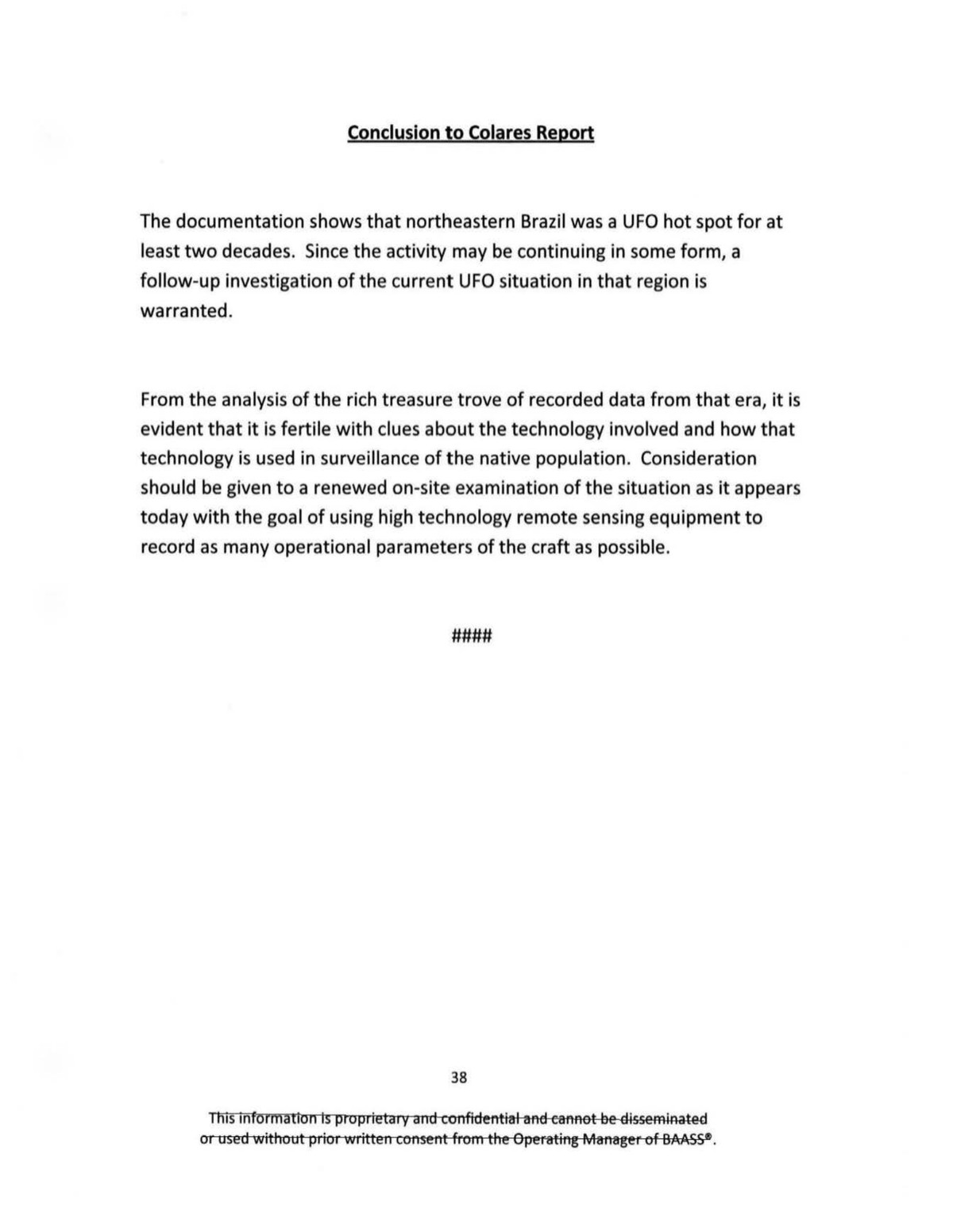
The report closes by recommending more work. Its conclusion states that northeastern Brazil was a UFO hot spot for at least two decades, that a follow up investigation of the current situation in the region is warranted, and that consideration should be given to a renewed on site examination using high technology remote sensing equipment to record as many operational parameters of the craft as possible.
More footage and images of this sighting
What is the official explanation?
There is no United States government assessment of the Colares flap in this release, and no evaluation of the contractor's summary by the Defense Intelligence Agency has been published. The report is a contractor product delivered under a programme, not an agency finding.
The record is DOW-UAP-D169, listed in the PURSUE manifest as "BAASS Monthly Report, March 2009" with an incident location of Las Vegas, Nevada and an incident date of 10 April 2009, which is the filing date rather than the date on the Colares summary itself. The PDF is 42 pages and opens with a text layer intact. It was published on 23 October 2026 in Release 07, one of 28 records in that tranche and one of four BAASS monthly reports in it, covering March, April, June and November 2009. The Department's standard blurb for the group describes the Advanced Aerospace Weapon System Applications Program as a Defense Intelligence Agency administered programme active from 2008 to 2012, whose official scope of work identified twelve technical research areas relating to potential aerospace threats over a time horizon of more than forty years.
Two features of the released document are worth stating precisely, because neither has been reported.
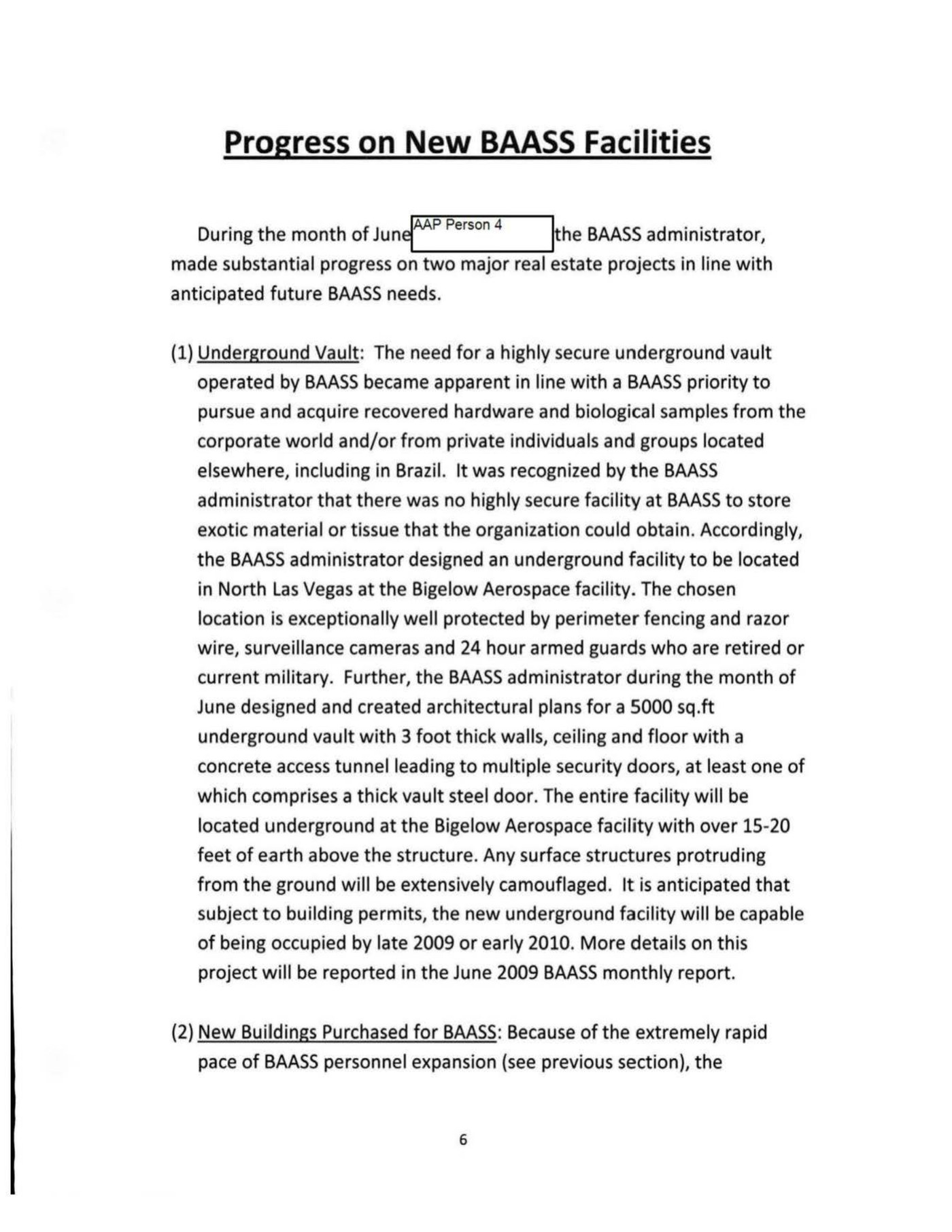
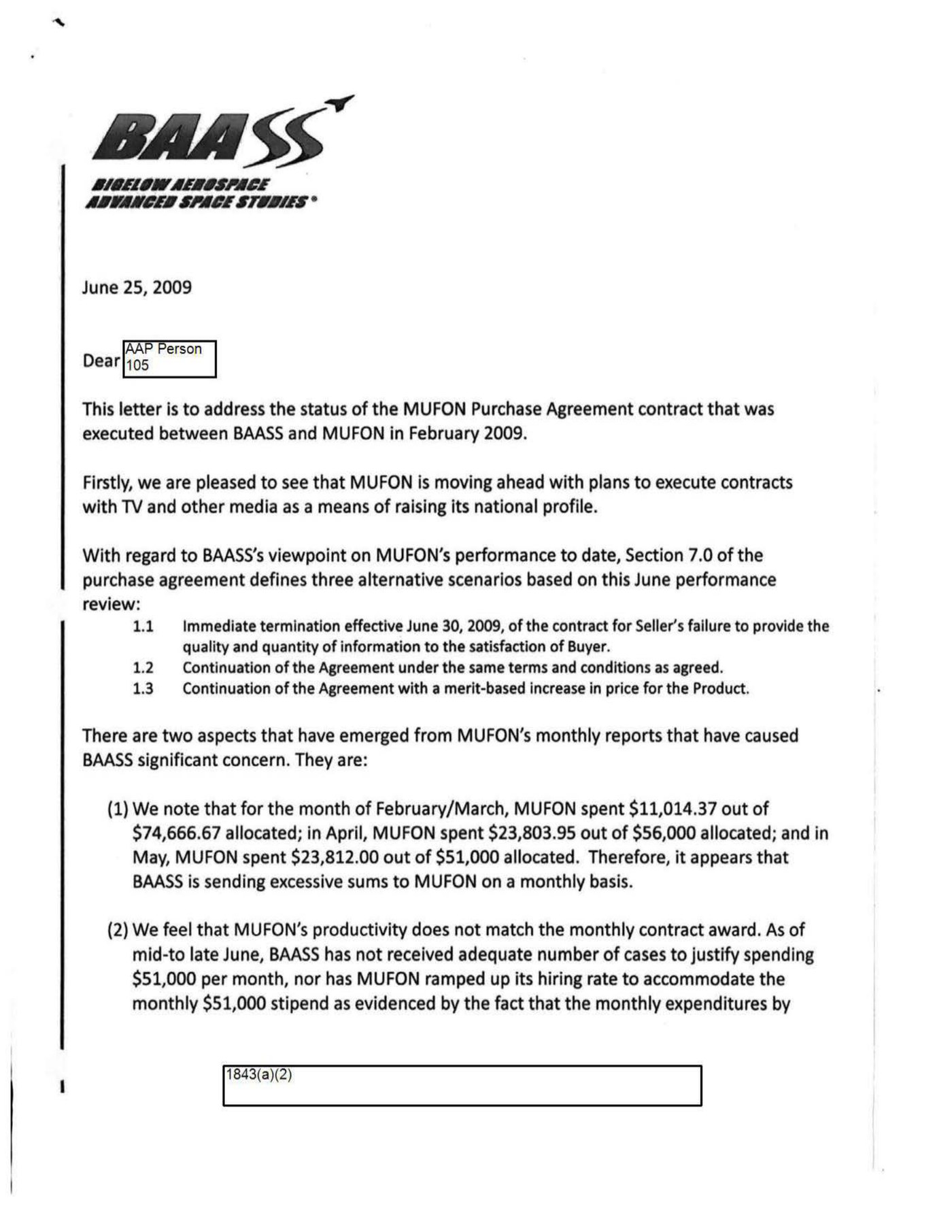
The first concerns the redactions. Every withheld name in the Colares summary is boxed with the code 1843(a)(2). Section 1843 of the UAP Disclosure Act, enacted as part of the National Defense Authorization Act for Fiscal Year 2024 at Public Law 118-31, sets out four grounds on which public disclosure of a UAP record may be postponed, and ground (a)(2) is the one that applies when disclosure "would violate section 552a of title 5, United States Code (referred to as the 'Privacy Act of 1974')". The Privacy Act defines its own subject narrowly: at 5 U.S.C. 552a(a)(2) the term individual covers only a citizen of the United States or an alien admitted for permanent residence. The names withheld under that code in this document include a Brazilian Air Force intelligence officer, Brazilian military photographers and sergeants, a physician in Belém, Brazilian municipal officials and Brazilian witnesses. A redacted document cannot be used to establish any particular person's nationality, and the same code is also stamped over the American investigator and the American scientist, for whom the ground fits without difficulty. The observation is narrower and checkable: Section 1843 offers a separate ground at (a)(3) for public disclosure that could reasonably be expected to constitute an unwarranted invasion of personal privacy, which carries no citizenship limit, and the Department cited the one that does.
The second concerns the footer. Every page of the BAASS material carries the line that the information is proprietary and confidential and cannot be disseminated or used without prior written consent from the Operating Manager of BAASS, and on the released pages that line is struck through.
The Brazilian side of the record is older and separately documented. Operação Prato, the Brazilian Air Force field investigation at Colares and Vigia, is covered on this archive's own page for the 1977 flap, and the Brazilian Air Force files were released in Brazil through the Arquivo Nacional long before the Department of War published this contractor summary.
What did the witnesses think it was?
The witness material in this document is second hand by design. Nobody at the contractor interviewed the people of Colares; the summary condenses interview transcripts gathered by others, and the names of the interviewers and the interviewed are withheld.
The most vivid testimony in it is the Brazilian Air Force team leader's own. He told an interviewer that he was badly frightened on one occasion: "I was terrified. They could have done anything they wanted to with us. It was about seven o'clock, just after sunset. We never saw anything approaching. Suddenly a big disc-shaped object thirty meters in diameter and fifty meters high was hovering exactly above us. It was emitting a yellow glow that would grow and dim, grow and dim every two or three seconds. And after the fifth time, the lights turned light blue, dimmed, and then it disappeared with incredible speed toward the sea."
The same officer and his team are quoted on the state of the town: "The town of Colares, Para, lives in a state of 'collective hysteria.' The inhabitants don't sleep, nor fish (which is their main occupation). As soon as night falls, bands of 20-30 people, mostly men circulate around the town. The population lives in a state of terror." The report adds that the objects were described by the Air Force team as covering Brazilian airspace in strips, much the way an aerial photographer would, and that each strip could cover dozens to hundreds of villages.
The clinical testimony comes from a physician in Belém whose name is withheld. She treated approximately forty injured people during the 1977 incidents at Colares. Most had burns on the chest and throat, the burns healed fairly quickly and the skin peeled, a few people were left with significant scarring, and two small puncture wounds were almost always found at the centre of the burned area. She ran blood tests on the burn patients and the report records that all of them had low levels of haemoglobin.
One municipal official is described watching rather than fleeing. In November 1977, at six in the evening, with most shops closed and many people gone, she, the sheriff and the priest were the only officials left in town. She was down by the beach, the object was about 200 metres away, people were imploring her to leave with them, and she stayed because she found it beautiful as it circled in the sky.
The witnesses also describe things the report does not resolve. Villagers said beams would pass through tiled roofs as if they did not exist and then circle inside the houses as though searching. Eleven people said a car or motorcycle engine died and would not restart while the object was present. One radar record is counted in the entire corpus, and the report explains that plainly: people living in rural areas and villages had no access to radar information.
Is the Pentagon Contractor Report on Colares: The UFO Assault on Brazil, 30 March 2009 real? The two-pass assessment
Pass one, the deflating reading. This document is a summary of a summary. It is a contractor's condensation of one private investigator's field notes, cross referenced against a second investigator's work, with every underlying transcript withheld and every name redacted. Its numbers are tallies of what people said, not measurements, and the report never claims otherwise. The categories are not independent: an investigator who spent decades returning to the same region collected a self selecting population of people who already believed they had been hurt by something in the sky, which is the ordinary shape of any long running field study of a flap and is the reason the counts cannot be read as incidence rates. The report presents no physical evidence at all. Seven photographs are counted across the whole private corpus. The three hundred Air Force photographs are described at second hand and none are reproduced in this document. The single reported radar record is attributed to nobody.
The prose is also advocacy, and it reads as advocacy. A technical assessment does not open by telling the reader that the world is full of many terrors. The document was written by a contractor whose task order was being renewed, and its conclusion is a proposal for the contractor to do more work, specifically a renewed on site examination using high technology remote sensing equipment. That is a commercial interest sitting at the end of a scientific document and it belongs in any honest reading of why the report is shaped the way it is.
Pass two, what survives that. Nothing in this file establishes that anything unusual happened at Colares, and that is not what makes it worth a page. What it establishes is procedural and it is checkable. A Defense Intelligence Agency contractor, working under a programme the Department itself describes as addressing potential aerospace threats, acquired and assessed the Brazilian flap corpus in 2009, treated it as a technology demonstration rather than as folklore, and recommended going back. The Brazilian Air Force's own conduct in the matter is recorded inside a United States government record rather than only in Brazilian ufology, which is a different kind of citation from the one this case usually attracts.
The redaction point stands on its own. The Department invoked, over Brazilian names, the ground that depends on a statute whose own definition of a protected individual reaches only United States citizens and permanent residents, when a second ground written for unwarranted invasions of personal privacy, with no citizenship limit, sat immediately below it in the same section. That is an observation about the fit of a cited authority, not an allegation, and it is verifiable from the two texts.
The tier is Unknown. There is no official narrative to weigh here, because no agency has assessed either the flap or the contractor's reading of it. The underlying 1977 events are assessed separately on this archive's Colares page and nothing in this document changes that assessment.
What would move it. The release of the eight notebooks the summary was drawn from, of the 370 interview transcripts, or of any Defense Intelligence Agency comment on the report, would turn a condensation back into evidence. The Department has released four of the twelve 2009 BAASS monthly reports, so the record of what happened next is incomplete by construction.
Sources
- www.war.gov/medialink/ufo/release-07/documents/DOW-UAP-D169-BAASS_Monthly_Report-March_2009.pdf
- www.war.gov/medialink/ufo/release-07/documents/DOW-UAP-D171-BAASS_Monthly_Report_June_2009.pdf
- www.war.gov/Portals/1/Interactive/2026/UFO/uap-data.csv
- www.war.gov/UFO/
- www.cnnbrasil.com.br/ciencia/pentagono-tentou-obter-investigacao-militar-brasileira-sobre-serie-de-ovnis-em-colares-no-para-revelam-novos-documentos/
- www.govinfo.gov/content/pkg/PLAW-118publ31/html/PLAW-118publ31.htm
- www.govinfo.gov/content/pkg/USCODE-2023-title5/html/USCODE-2023-title5-partI-chap5-subchapII-sec552a.htm
- documents.theblackvault.com/documents/MUFON/Pratt/prato.pdf
More cases from this region: UFO sightings in Brazil