The Las Garcitas OVNI Report: Police Chase a White and Red Light Over Rural Chaco, Argentina (25 August 2026)
Neighbours in the rural belt outside Las Garcitas called the police about an object crossing the sky on the night of Tuesday 25 August 2026. A patrol drove out to Provincial Route 9, saw the light themselves, and filed a signed report calling it a probable satellite. The astronomy does not support that answer, and it points somewhere else.
What did witnesses see at Las Garcitas?
At about 22:30 on the night of Tuesday 25 August 2026, residents of the rural zone outside Las Garcitas, a town of a few thousand people in the Sargento Cabral Department of Chaco Province, began calling the police to report what they described as an unidentified flying object crossing the local airspace.
The calls came in one after another. A patrol from the local police station, vehicle PT-621, drove out to check. Officers ran what the report calls intensive sweeps of the area around Provincial Route 9, the road named for Juana Azurduy, and the neighbouring rural tracks, working westward.
During that patrol the officers saw it themselves. The report describes a light of very small apparent size that changed from white to red in a matter of seconds, seen with the naked eye. They judged it to be at great height and far from the built-up area, and after establishing that, the patrol resumed its normal preventive rounds. No incidents were recorded in the town that night.
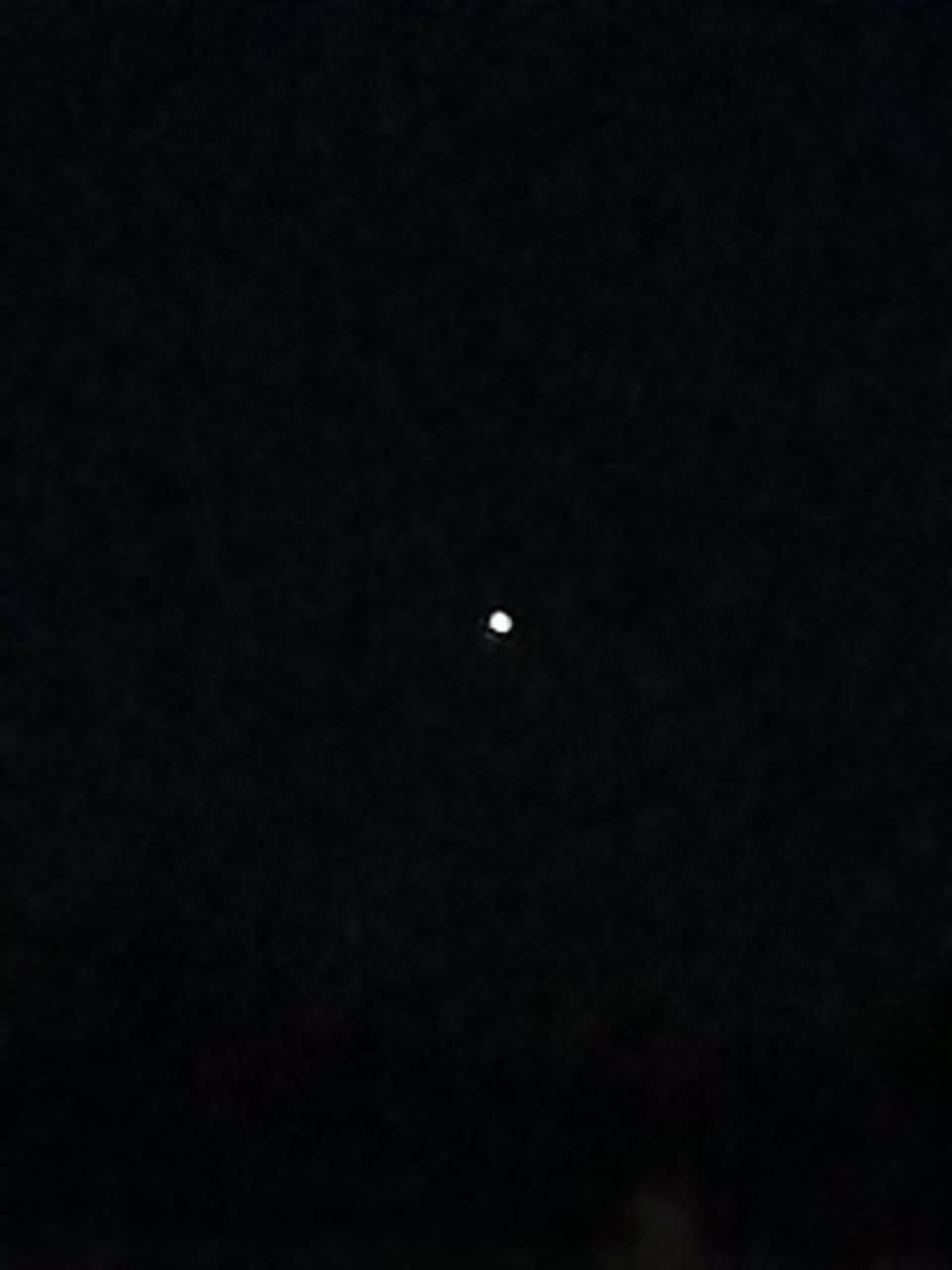
One photograph has been published, by the Sáenz Peña outlet SPNoticias. It is a phone image showing a single small round white point against an otherwise black frame, slightly out of focus, with no horizon, no landscape and no reference object anywhere in the picture. Nothing in the image itself fixes what it shows, where it was taken from, or which direction the camera was pointing.
What is the official explanation?
This is one of the relatively rare sightings where an official narrative exists in writing on the same night as the event, and it is not a dismissal issued later by a press office. It is a police unit's own operational report.
The report was signed by Subcomisario Fernando Raúl Bordón, the officer in charge of the unit. Its assessment is that, given the distance involved and the visual characteristics of the light, the object could be the passage of a satellite, and that it was not a drone and not any other kind of craft operating close to the urban area. The wording is conditional in the original Spanish, and it is worth keeping it that way: the report says the light could be a satellite, not that it was one. Several of the Argentine outlets that picked the story up preserved that hedge, and one, Noticiero 9, put the open question straight into its headline.
The story was carried on 26 August 2026 by at least five separate Argentine outlets: SPNoticias, Noticiero 9, Diario Chaco, Alerta Urbana and Diario TAG. These are independent regional publishers rather than one syndicated wire item under a shared byline, though all of them are plainly working from the same police report and none adds independent reporting of its own.
No Argentine aviation or defence authority has commented. There is no radar data in the public record, and no indication that the report was referred beyond the local station.
What did the witnesses think it was?
There are two separate witness groups here, and they carry different weight.
The first is the neighbours in the rural zone, who are unnamed in the coverage and whose accounts reach the public only through the police report's summary of why they called. Nothing is known about how many of them there were, where each was standing, what direction they were facing, or how long they watched.
The second group is the police officers themselves, and they are the reason this case is worth recording. Serving officers on a callout, driving a marked patrol vehicle, looked at the object directly and wrote down what they saw within hours. Their description is specific and it is unusually restrained: a very small light, alternating between white and red within seconds, high and distant. They did not report structure, they did not report shape, they did not report sound, and they did not report any movement against the sky. That last omission matters, and it is the single most useful thing in the document.
The photograph published by SPNoticias arrived through WhatsApp, which is how almost all citizen imagery reaches Argentine regional newsrooms. The file name carries the date 25 August 2026, which is consistent with the night of the sighting, but a file name is a claim rather than a verification. Nobody in the coverage is identified as the photographer, and no one has stated that the image shows the same light the officers saw.
Is the Las Garcitas OVNI Report: Police Chase a White and Red Light Over Rural Chaco, Argentina (25 August 2026) real? The two-pass assessment
Pass one, how this could be ordinary. The police offered a satellite, and that is the answer worth testing first, because it is testable.
It does not survive the test well. Using the town centre coordinates published by Argentina's own national geographic reference service, 26.6181 degrees south and 59.7990 degrees west, the US Naval Observatory places sunset at 18:44 and the end of civil twilight at 19:07 that evening. By 22:30 the sky had been fully dark for over three hours. A query to NASA JPL's Horizons system for that exact moment puts the Sun 50.9 degrees below the horizon. A satellite is visible only because it is catching sunlight while the observer stands in darkness, so it has to be above the Earth's shadow. With the Sun 50.9 degrees down, an object at the zenith has to be higher than roughly 3,730 kilometres to still be in sunlight. Starlink satellites orbit near 550 kilometres. The International Space Station is near 400. Essentially the entire low Earth orbit population was deep inside the Earth's shadow over Chaco at that hour and could not have been shining. This is why satellite spotting is a dusk and pre-dawn activity. The report's own conditional wording suggests the officers were offering a reasonable guess rather than a determination, and the guess does not hold.
What does hold is simpler and it is in the same set of numbers. At 22:30 local, Horizons puts Saturn 10.3 degrees above the horizon in the east at magnitude plus 0.5. That is the exact geometry that produces violent colour scintillation: a bright point source low enough that its light is crossing a long, turbulent, refracting slab of atmosphere, which smears it into rapidly shifting flashes of white, red and blue. A very small light that alternates between white and red within seconds, sits high and distant, shows no structure and is not described as travelling anywhere is a textbook description of a bright celestial object scintillating near the horizon. No other naked eye planet was up: Venus was 5.6 degrees below the horizon, Jupiter 71 degrees below, Mars 74.7 degrees below. The Moon was 94 percent illuminated and 75 degrees high, an hour short of transit, which had washed the sky out and would have left only the very brightest points visible, narrowing the field of candidates considerably.
A high altitude aircraft is the other ordinary candidate and cannot be excluded, since a red anti-collision beacon alternating with white strobes is precisely a light that changes from white to red in seconds. The officers ruled out a drone or a craft near the town, but they were addressing proximity, not aircraft at cruising altitude.
Pass two, if it was something else. Very little supports that reading, and the honest reason is that the observation itself is thin. There is no reported motion, no structure, no duration, no bearing and no elevation angle. The one photograph shows a defocused dot with no context and cannot be tied to the officers' observation at all. An unidentified object and an unremarkable object look identical through this little information.
What the record does establish is narrower and still worth having: on the night of 25 August 2026 a police unit in rural Chaco was called out by multiple residents, saw a colour changing light for itself, and documented it in a signed report the same night. That is a real, dated, officially attended sighting, and it belongs in the archive. The reason it sits in Strongly Disputed rather than Unknown is not that officials explained it away, because their explanation is the part that fails. It is that a different and better supported prosaic candidate was sitting 10 degrees above the eastern horizon at the time, and the case as reported contains nothing that argues against it.
Weather adds little either way. The nearest station in the Iowa Environmental Mesonet international archive is Resistencia, 118 kilometres to the southeast, which logged 10 kilometres visibility and a light easterly wind of 2 to 3 knots through the 21:00 to 23:00 window. Its sky cover fields are not populated, so cloud over Las Garcitas itself is unconfirmed, and at that distance the station would not settle it anyway.
Sources
- spnoticias.com.ar/avistamiento-de-un-ovni-movilizo-a-la-policia-en-la-zona-rural-de-las-garcitas/
- www.noticiero9.com.ar/
- apis.datos.gob.ar/georef/api/localidades?nombre=Las%20Garcitas&provincia=Chaco
- aa.usno.navy.mil/api/rstt/oneday?date=2026-08-25&coords=-26.6181,-59.7990&tz=-3
- ssd.jpl.nasa.gov/horizons/
- mesonet.agron.iastate.edu/request/download.phtml?network=AR__ASOS
More cases from this region: UFO sightings in Argentina