The Sky Canada Project: Canada’s Chief Science Advisor Reports on UAP Reporting (June 2025)
Canada spent forty five years collecting public UFO reports through three different departments, then stopped in 1995 and told nobody what to do instead. In June 2025 the Office of the Chief Science Advisor published the audit of what was left, found the reports scattered across agencies that mostly do not read them, and recommended fourteen fixes beginning with the most basic one: pick somebody to be in charge.
What happened
This entry is a document rather than a sighting, and it belongs in this archive because it is the most complete public account any government has published of how its own UAP reporting system actually works, including the parts that do not.
The document is titled "Management of Public Reporting of Unidentified Aerial Phenomena in Canada: Report of the Sky Canada Project from the Office of the Chief Science Advisor of Canada." It is dated June 2025 on its own cover, runs to fifty nine pages, and carries the Government of Canada catalogue number Iu37-59/2025E-PDF and ISBN 978-0-660-78645-2. It is published in English and in French, under the French title "Gestion des signalements publics de phenomenes aeriens non identifies au Canada."
The Sky Canada Project was created in 2022 by the office of Mona Nemer, Canada's Chief Science Advisor. Its brief was narrow and deliberately unglamorous. It was not asked what UAP are. It was asked how reports of them are handled in Canada, what happens to a member of the public who files one, and how other countries do it. The team consulted federal departments and agencies, worked in the National Research Council archives in Ottawa, spoke to citizen led research groups, and commissioned a national survey of public views.
The findings on scale are worth stating precisely because they are usually reported loosely. The report says that some public sources estimate Canadians report somewhere between 600 and 1,000 UAP sightings annually. It records that the longest running Canadian collection is the Canadian UFO Survey, produced by the Manitoba based volunteer group Ufology Research under Chris Rutkowski, which tallied 570 reports in 2023 and has catalogued over 24,000 Canadian reports since 1989. In its commissioned survey, one respondent in four said they had personally witnessed a UAP in their lifetime, only ten percent of witnesses reported what they saw, and forty percent said they would not know whom to contact.
The report then names five gaps in its own government's handling, in its own words: a lack of a cohesive and standardized system for reporting and follow up, an absence of public engagement, limited analysis of reports, insufficient scientific involvement, and insufficient efforts to enhance science literacy. On the second point it is blunt: "There is no official, accessible platform for Canadians to report UAP sightings, obtain potential explanations or review reliable information about UAPs. This situation contributes to the proliferation of misinformation and disinformation."
Documents and images
What is the official position?
The historical section is the part of this document that most repays reading, because it is the Canadian government describing its own forty five year retreat from the subject.
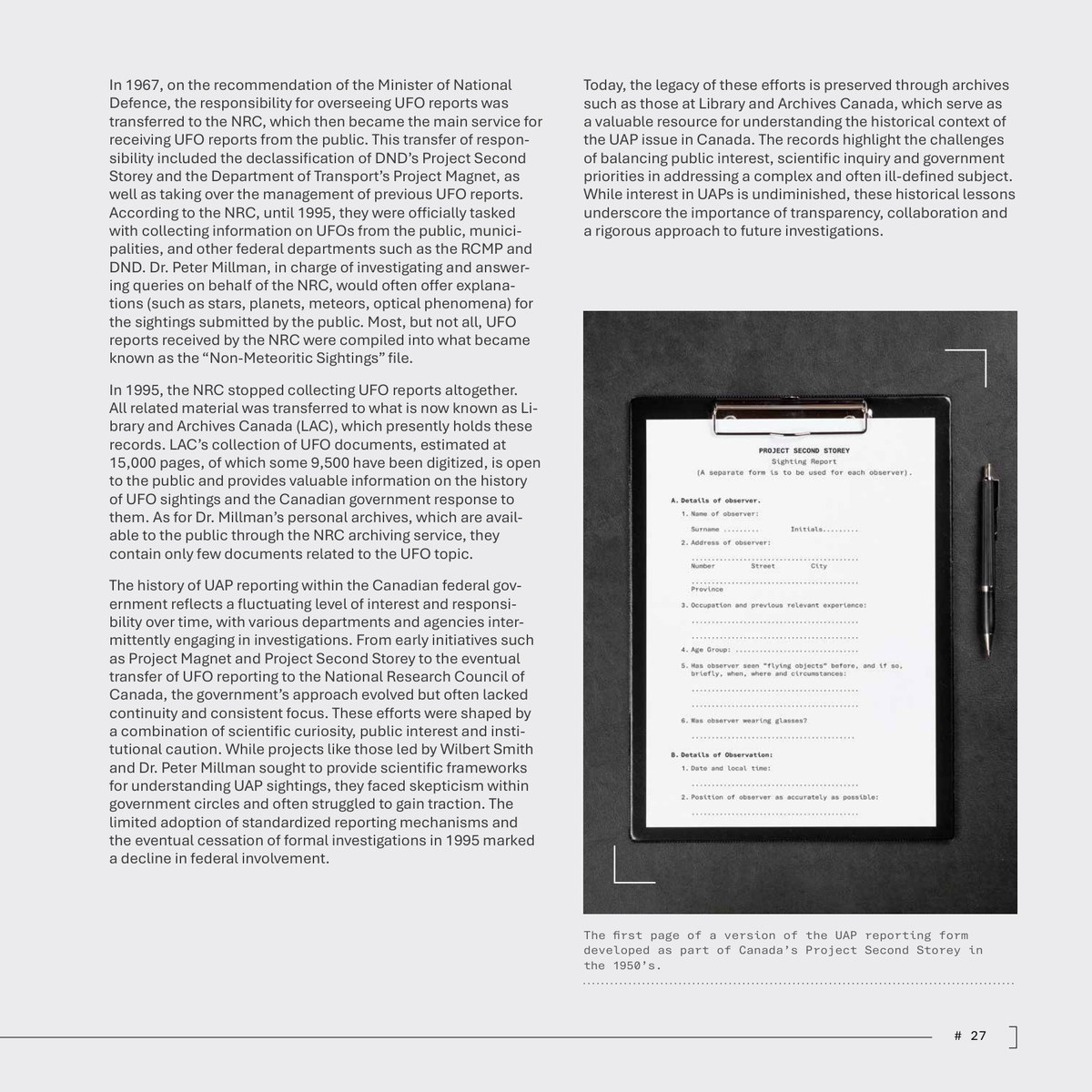
In 1950 the Department of Transport gave one of its engineers, Wilbert Smith, permission to research part time whether some UFOs might use the Earth's magnetic field for propulsion. That was Project Magnet, and Smith gradually widened it to investigate the validity of the observations themselves. The Department of National Defence ran its own effort, Project Second Storey, chaired by the National Research Council astronomer Dr. Peter Millman, which produced a standardized sighting report form. The report reproduces the first page of one version of that form, a typed sheet headed "PROJECT SECOND STOREY, Sighting Report," with a note that a separate form is to be used for each observer and fields running from the observer's name and occupation through whether they had seen flying objects before and whether they were wearing glasses.
In 1967, on the recommendation of the Minister of National Defence, responsibility for UFO reports moved to the National Research Council, which became the main service receiving reports from the public. The transfer included declassifying Project Second Storey and Project Magnet. Millman, answering queries on the NRC's behalf, would often supply explanations involving stars, planets, meteors and optical phenomena, and most of the reports were compiled into a file that became known as the "Non-Meteoritic Sightings" file.
In 1995 the NRC stopped collecting UFO reports altogether. The material went to what is now Library and Archives Canada, which holds an estimated 15,000 pages of UFO documents, of which some 9,500 have been digitized and are open to the public. The report's own summary of the arc is unsparing: the federal approach "evolved but often lacked continuity and consistent focus," the projects "faced skepticism within government circles and often struggled to gain traction," and "the eventual cessation of formal investigations in 1995 marked a decline in federal involvement."
What replaced it is fragmentary. Transport Canada maintains the Civil Aviation Daily Occurrence Reporting System, CADORS, which records incidents affecting aviation safety and does capture some UAP sightings; a pilot who sees something reports it to air traffic control, the unit files an Aviation Occurrence Report with NAV CANADA, and that reaches the CADORS team. The Royal Canadian Air Force and the Department of National Defence monitor aerospace activity and may receive reports through operational networks. Police forces receive them too. The report found that most of these organizations do not compile what they receive, "making it difficult to provide information on the number of reports or the type of responses given to witnesses," and that few investigate a sighting unless it touches national security, transportation safety or public safety.
What the people involved say
The report's fourteen recommendations are grouped under four headings, and they are reproduced here in the report's own numbering because they are the operative content of the document.
Reporting and data oversight. One, identify a lead: a federal department or agency responsible for managing public UAP data should be identified. Two, establish a dedicated service that would collect testimonies, investigate cases and post its analyses publicly. Three, enhance reporting capacity in civil aviation, with Transport Canada encouraging pilots, cabin crews and air traffic controllers to report sightings "without fear of stigmatization," and analysing those reports with NAV CANADA to track trends and give pilots explanations.
Communications. Four, support public dialogue through a proactive transparency strategy. Five, promote intra-governmental collaboration by internal directive. Six, improve media relations, with the lead organization responding to public and media inquiries and documenting common misinterpretations. Seven, set up a multidisciplinary expert panel to advise on countering misinformation and disinformation.
Research. Eight, facilitate open access and open data. Nine, conduct periodic surveys of Canadians. Ten, support citizen science. Eleven, provide publicly accessible digital and portable tools for standardized data collection. Twelve, build on Canada's strength in astronomy and aerospace research by bringing that community into the public dialogue.
International collaboration. Thirteen, information sharing, with the lead organization establishing partnerships with AARO and NASA in the United States, GEIPAN in France and SEFAA in Chile. Fourteen, cooperation in research and communication with international partners.
The comparative survey behind recommendation thirteen is the report's quiet argument. It examined how other countries handle the same problem and singled out three as coordinated, transparent and scientifically driven. In the United States the Department of Defense All-domain Anomaly Resolution Office, established in 2022, has structured approaches for collecting and investigating data, and NASA created a Director of Unidentified Anomalous Phenomena Research after its September 2023 independent study. In France, GEIPAN has operated under the space agency CNES since 1977, takes public reports through an online form, investigates them with more than twenty trained volunteers, and publishes its findings. In Chile, SEFAA sits inside the General Directorate of Civil Aeronautics as the official body for collecting and studying the phenomena. The report notes, carefully, that while causation is hard to establish, "there are indications that in France, UAP-related conspiracies are decreasing and are less prevalent compared with other countries."
The counter examples are equally pointed. The United Kingdom's Ministry of Defence investigated from 1950 to 2009, published annual sighting lists from 1997, then closed the programme, leaving British witnesses with local authorities or the British UFO Research Association. Germany has no state body at all: for over fifty years the contact point has been the GEP, a Ludenscheid based non-profit that received an average of 342 reports per year from 2022 to 2024 and explains over ninety percent of them by conventional causes, the remainder being unexplained "due to insufficient data."
Is the Sky Canada Project: Canada’s Chief Science Advisor Reports on UAP Reporting (June 2025) real? The two-pass assessment
Pass one, the deflationary reading, and it accounts for a good deal of this.
This is an advisory report from a science advisor's office, not a policy, a budget line or a statute. Its recommendations are framed as "proposed for consideration by the Government of Canada." No lead agency has been named as a result of it, no dedicated service exists, and a reader looking for a Canadian AARO will not find one here. The Office of the Chief Science Advisor has no authority to create any of the fourteen items it lists. Canada has been here before: Project Magnet and Project Second Storey both began with scientific framing and both petered out, and the NRC's forty five year collection ended not with a finding but with a filing cabinet moved to the archives.
The report is also, on its own terms, uninterested in the question most readers arrive with. Its stated objectives are to improve coordination of reports, promote public trust, mitigate disinformation, and enhance scientific rigour. It does not claim any sighting is unexplained. Several of its own illustrations are captioned as the very misidentifications that generate reports, including a photograph of Venus and one of a contrail, the latter captioned as a normal atmospheric phenomenon "frequently linked with conspiracy theories."
Pass two, what makes it matter anyway.
The value of this document is evidentiary rather than revelatory. It is a government auditing its own record and putting the findings in a catalogued, ISBN bearing publication that can be cited. Three of its findings are load bearing for anyone assessing the reliability of national UAP data. First, that Canadian reports are "scattered across multiple government and nongovernment organizations" with little coordination, which means any statistic drawn from a single Canadian source undercounts by an unknown factor. Second, that only ten percent of Canadian witnesses report at all, and forty percent would not know where to, which is a measured figure for the reporting gap rather than an assumed one. Third, that most receiving departments do not compile what they get, which means the absence of a report in a federal system is not evidence that nothing was reported.
There is also an institutional signal worth logging. The report recommends that Canada partner with AARO, NASA, GEIPAN and SEFAA, and it does so after describing the French and Chilean models approvingly. That is a science advisor's office arguing, in public and in a numbered government publication, that the serious handling of UAP reporting is normal state practice in allied countries and that Canada is the outlier for not doing it.
The tier is Unknown, which for a document case in this archive means the government has stated no position on the phenomena themselves. The report's own conclusion is the fairest summary of what it does claim: that a structured approach "would enhance transparency and combat disinformation" and would "position Canada alongside some of its allies as leaders in the global effort to elucidate the nature of UAPs." Whether any of it is implemented is a matter for later runs of this archive to record.
Sources
- science.gc.ca/site/science/en/office-chief-science-advisor/sky-canada-project/management-public-reporting-unidentified-aerial-phenomena-canada
- science.gc.ca/site/science/sites/default/files/documents/sky-canada-report.pdf
- ised-isde.canada.ca/site/science/en/office-chief-science-advisor/sky-canada-project
- www.cbc.ca/lite/story/1.7586922
- www.newsnationnow.com/space/ufo/canada-report-creation-ufo-office/
- thehill.com/policy/international/5404623-canada-uap-ufo-reporting-office/
- www.canadianuforeport.com/survey/essay/Surveyessay2023.pdf
More cases from this region: UFO sightings in Canada