Project Sign (1947 to 1949): The Air Force's First UFO Study and the "Estimate of the Situation"
It began with Kenneth Arnold in June 1947 and a general's secret memo three months later stating the objects were something real and not visionary. Project Sign was the U.S. Air Force's first UFO study, run out of Wright-Patterson from 1948, and by some accounts its own investigators concluded the discs were interplanetary before the Chief of Staff overruled them and the project was folded into a debunking successor. On 10 July 2026 the Pentagon finally released Sign's 1948 progress report, a catalogue of about 100 early sightings. The interplanetary Estimate has never resurfaced, and the Air Force says it never existed.
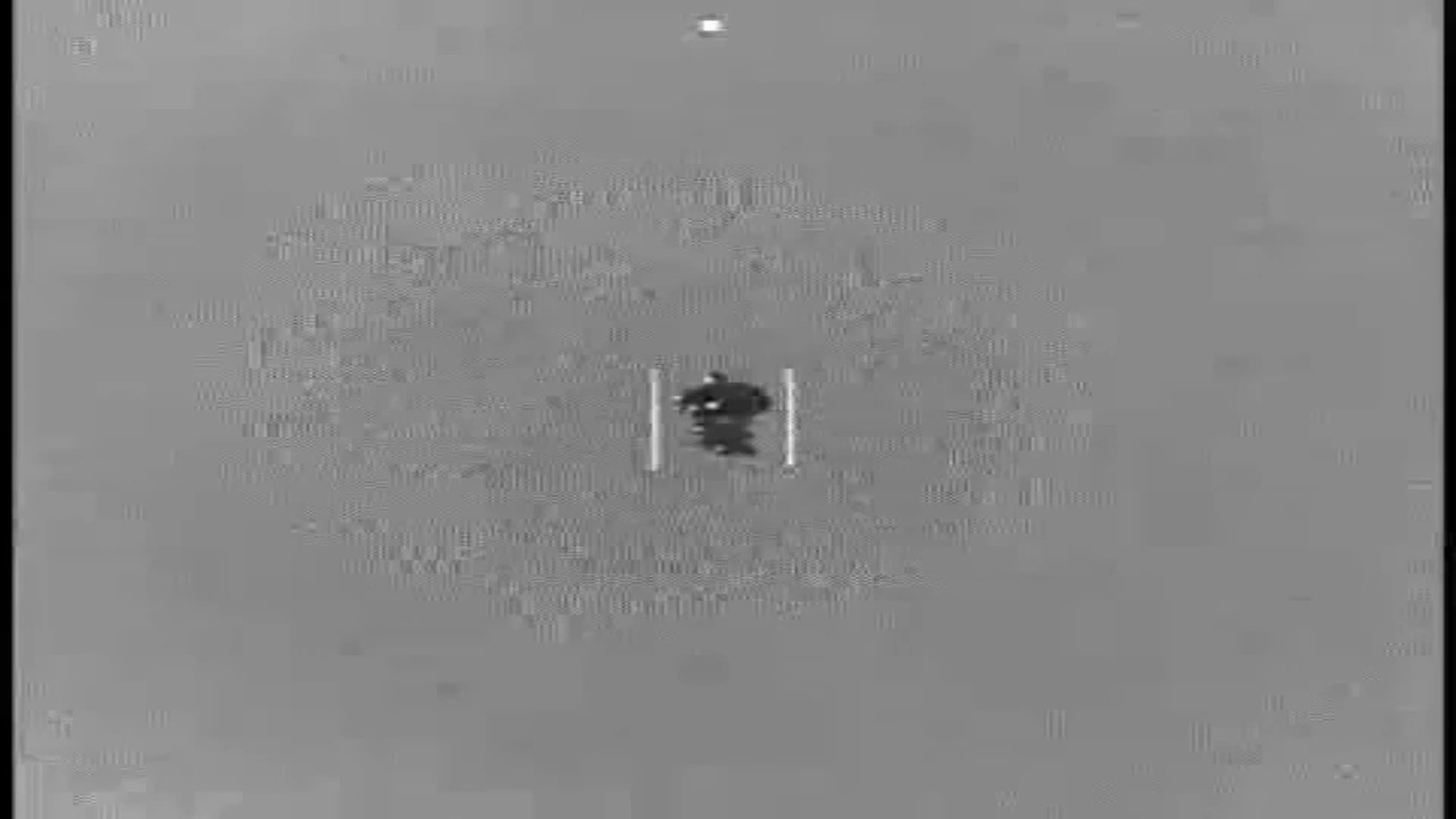
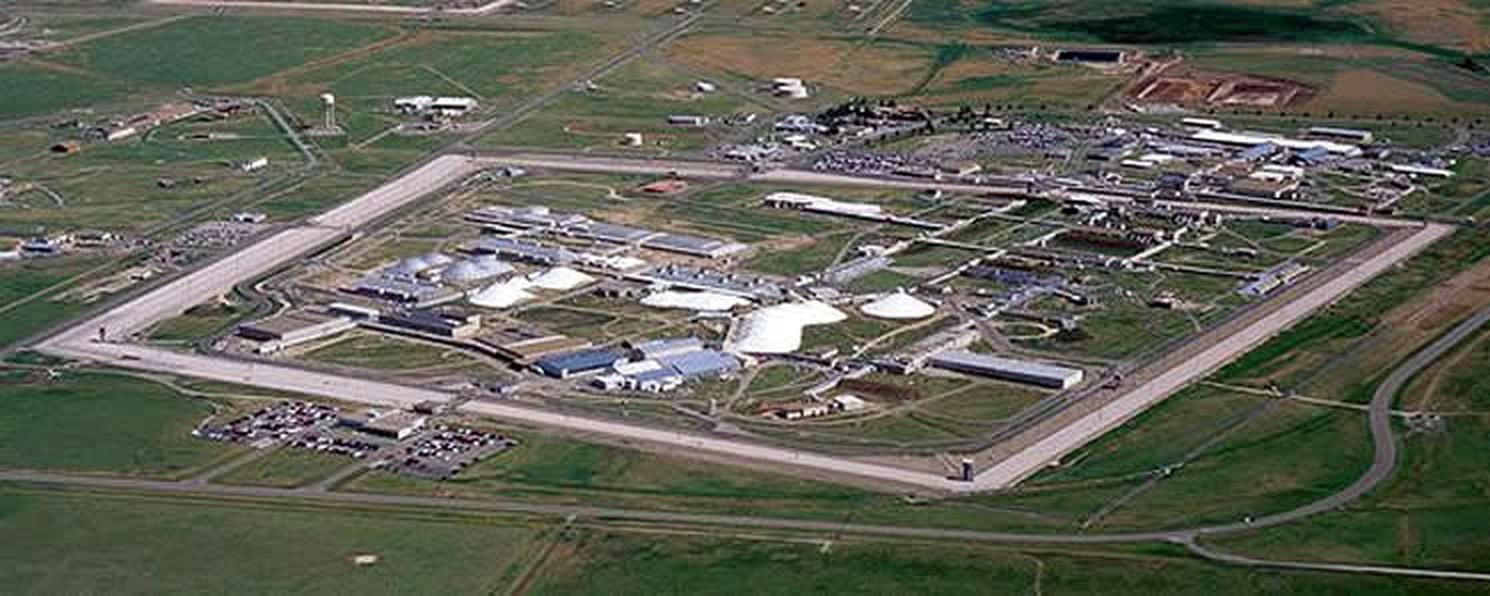
What did witnesses see at Air Materiel Command?
Project Sign was the first formal investigation into unidentified flying objects ever undertaken by the United States military. It grew directly out of the summer of 1947, when the modern flying-saucer era opened over the Cascade Mountains. On 24 June 1947 the civilian pilot Kenneth Arnold reported nine bright objects flying in formation near Mount Rainier, Washington, and his description of their motion as skipping like a saucer across water gave the press the phrase flying saucer. Within weeks hundreds of sightings were logged across the country, and the newly independent Air Force, established in September 1947, found itself under pressure to explain a phenomenon its own pilots and radar operators were reporting.
The decisive internal document came on 23 September 1947, when Lieutenant General Nathan F. Twining, commander of Air Materiel Command at Wright Field, sent a now famous secret memorandum titled AMC Opinion Concerning Flying Discs to the Air Staff. Twining stated flatly that the phenomenon reported is something real and not visionary or fictitious, that there were objects probably approximating the shape of a disc, of such appreciable size as to appear to be as large as man-made aircraft, and that their reported performance, including extreme rates of climb, maneuverability, and evasive motion, suggested some were controlled either manually, automatically, or remotely. He recommended a detailed study. That recommendation became Project Sign.
More footage and images of this sighting
What is the official explanation?
On 30 December 1947 Major General L. C. Craigie, Director of Research and Development, issued the directive establishing the study, and it became operational at the start of 1948 under Air Materiel Command's Technical Intelligence Division at Wright-Patterson. It carried the internal office designation MCIAXO-3 and a high priority. Though the working codename was Sign, its existence leaked, and the press and public came to know it by the semi-official name Project Saucer. Its charter was to collect, collate, evaluate, and distribute all information concerning aerial phenomena that could be construed to concern national security.
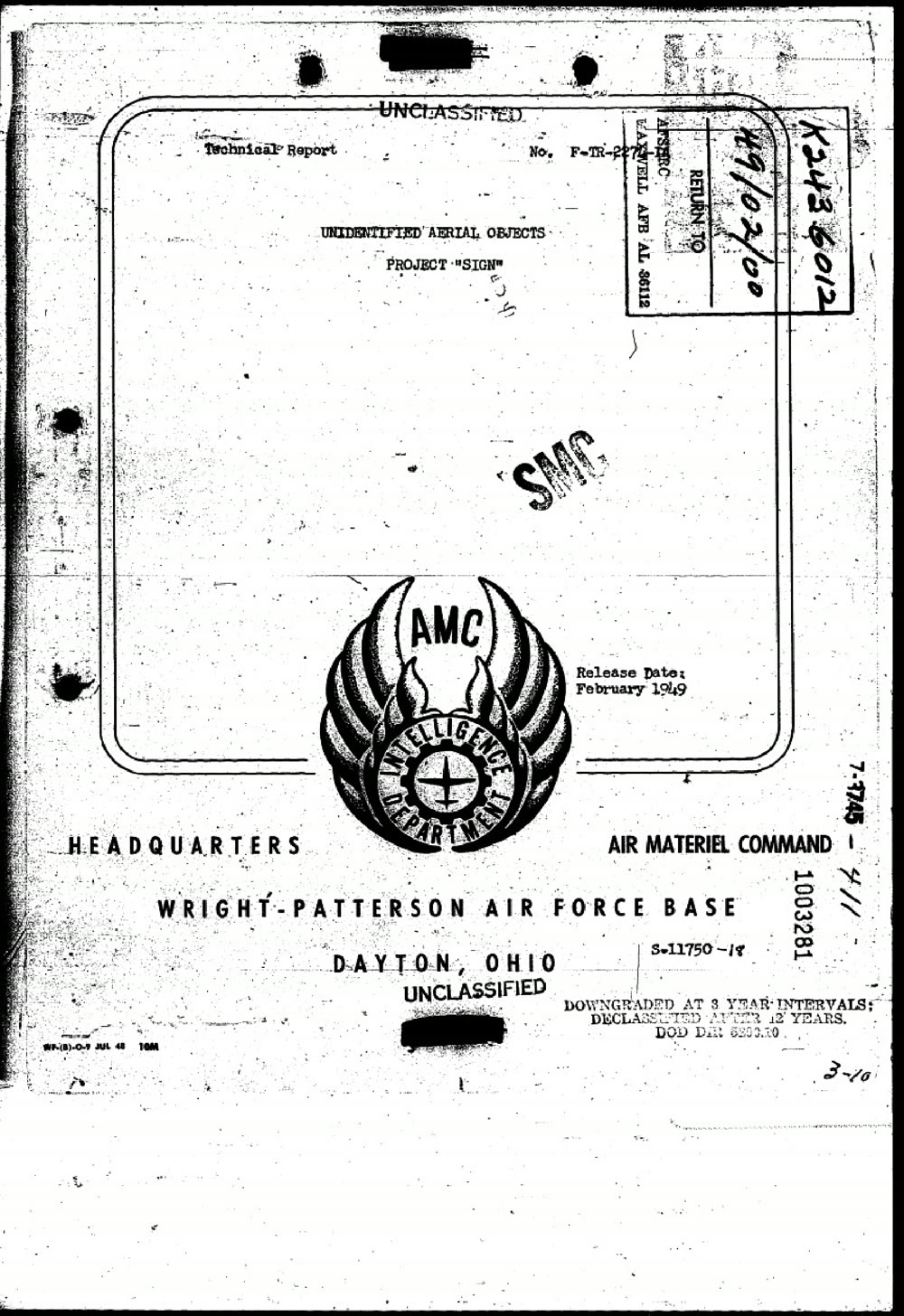
Sign operated for roughly a year and produced its classified final report, Air Materiel Command Technical Report No. F-TR-2274-IA, in February 1949. According to the U.S. government's own 2024 AARO Historical Record report, Sign evaluated 243 reported sightings. Its central conclusion was deliberately non-committal: no definite and conclusive evidence is yet available that would prove or disprove the existence of these unidentified objects as real aircraft of unknown and unconventional configuration, adding that proof of non-existence is equally impossible to obtain unless a reasonable and convincing explanation is determined for each incident. Most cases were attributed to misidentification of balloons, aircraft, and astronomical objects, while a residue stayed unexplained. An appendix by James Lipp of the RAND Corporation judged interplanetary visitation possible but very improbable.
By early 1949, with the most extraordinary conclusion rejected at the top, Sign was renamed Project Grudge and reoriented toward a skeptical, public-reassurance posture aimed at explaining reports away. Grudge later became Project Blue Book in 1952. The newest primary document in this chain surfaced only in 2026: on 10 July the U.S. Department of War published the previously classified 1948 Project Sign progress report as part of the fourth PURSUE release, a catalogue of roughly 100 sightings from 1947 and 1948 describing objects that climbed rapidly, hovered for extended periods, and ranged from near-stationary to allegedly supersonic, with oval, disc, and saucer shapes recurring throughout. The Harvard astronomer Avi Loeb, whose UAP Science Advisory Council had requested related records, called the Sign report a direct look at the first organized Air Force study.
A second, much larger tranche of Project Sign paperwork reached the public on 7 August 2026, when the Department of War published its fifth PURSUE release. The record catalogued as DOW-UAP-D100, "Air Materiel Command Report on Unidentified Flying Objects, 1947-1948", is not a single memorandum but a 245 page collection of correspondence, and UAP Globe obtained and read it in full. It closes a gap that the Sign literature has argued over for decades, because it contains the exchange in which the Air Force headquarters and its own technical command put their real conclusions to each other in writing.
The chain opens with a letter from Headquarters United States Air Force dated 3 November 1948, subject "Flying Object Incidents in the United States", addressed to the Commanding General of Air Materiel Command at Wright-Patterson. It records that the 30 December 1947 letter from the Director of Research and Development was what required that headquarters to establish Project Sign, and then states the position of the Air Staff without hedging: "The conclusion appears inescapable that some type of flying object has been observed. Identification and the origin of these objects is not discernible to this Headquarters." It calls for effort to establish whether the objects are of domestic or foreign origin to be increased until conclusive evidence is obtained, because "The needs of national defense require such evidence in order that appropriate countermeasures may be taken." The same letter is candid about the press, warning that "there has been too little data to present to the public. The press, however, is about to take it into its own hands and demand to be told what we do or do not know about the situation. Silence on our part will not long be acceptable."
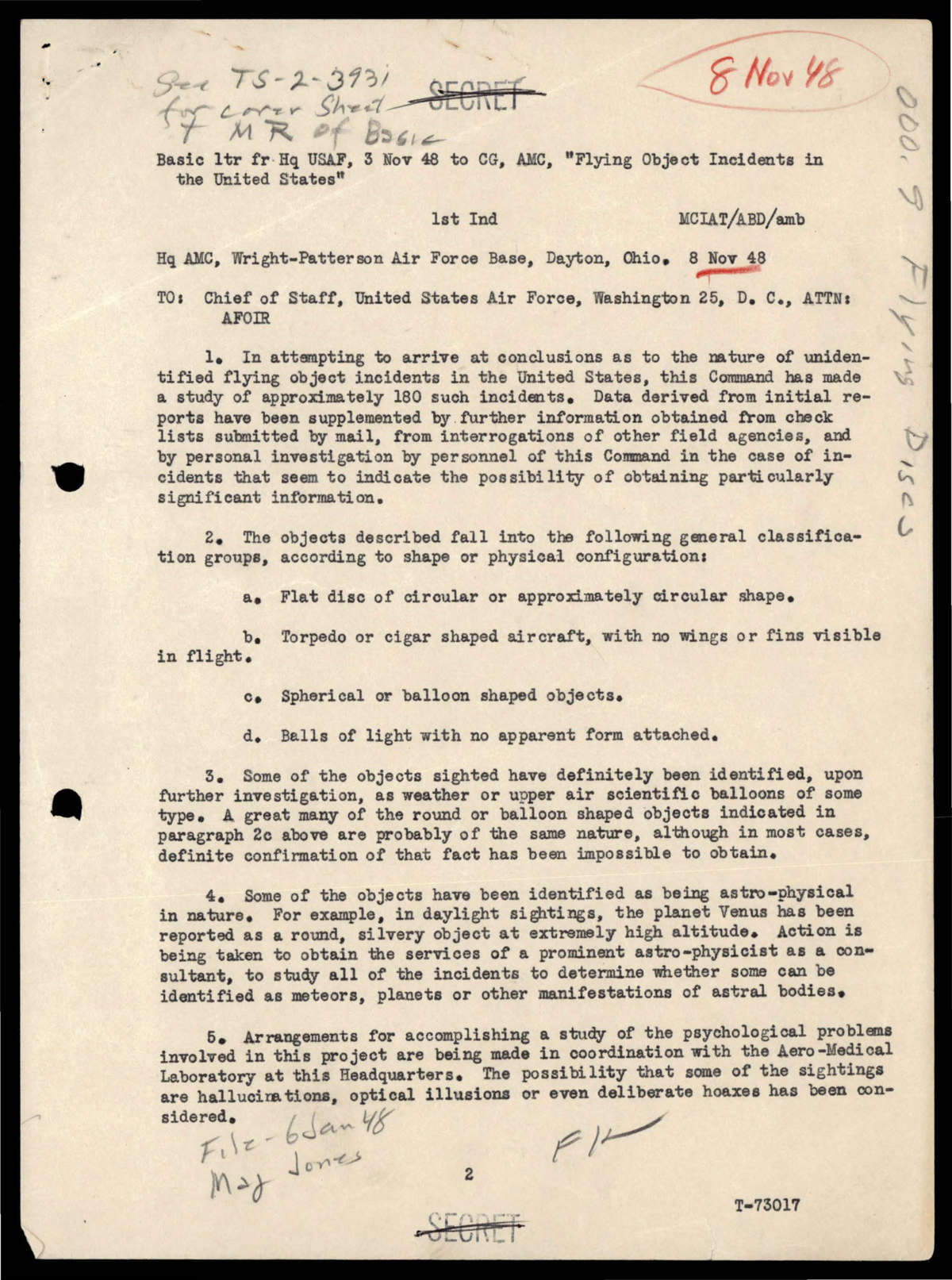
Air Materiel Command answered five days later. The first indorsement, dated 8 November 1948 and signed by Colonel H. M. McCoy, Chief of the Intelligence Department, reports that the Command had by then studied approximately 180 incidents, and sorts the objects into four groups by shape: flat discs of circular or approximately circular shape, torpedo or cigar shaped craft with no wings or fins visible in flight, spherical or balloon shaped objects, and balls of light with no apparent form attached. It concedes that many of the round objects are probably balloons, "although in most cases, definite confirmation of that fact has been impossible to obtain", and that some are astrophysical, noting that in daylight Venus had been reported as a round silvery object at extreme altitude. It records that the Command was moving to retain a prominent astrophysicist as a consultant, and that a study of the psychological aspects was being arranged with the Aero-Medical Laboratory, since "The possibility that some of the sightings are hallucinations, optical illusions or even deliberate hoaxes has been considered."
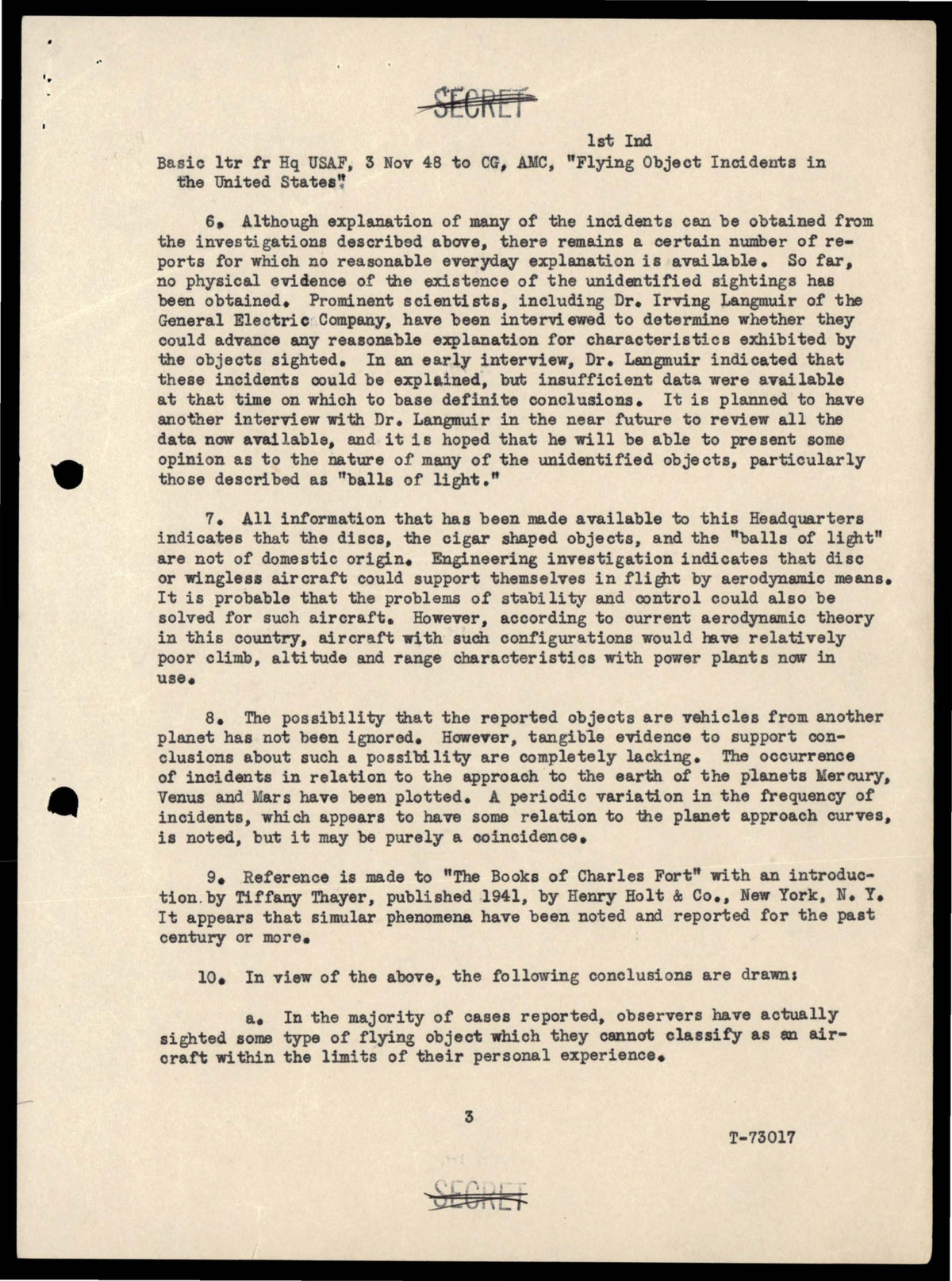
Then it says the part that matters. "Although explanation of many of the incidents can be obtained from the investigations described above, there remains a certain number of reports for which no reasonable everyday explanation is available. So far, no physical evidence of the existence of the unidentified sightings has been obtained." The Nobel laureate Irving Langmuir of the General Electric Company had already been interviewed and had said the incidents could be explained but that the data were insufficient to conclude anything definite. Paragraph seven goes further than any public Air Force statement of the period: "All information that has been made available to this Headquarters indicates that the discs, the cigar shaped objects, and the 'balls of light' are not of domestic origin."
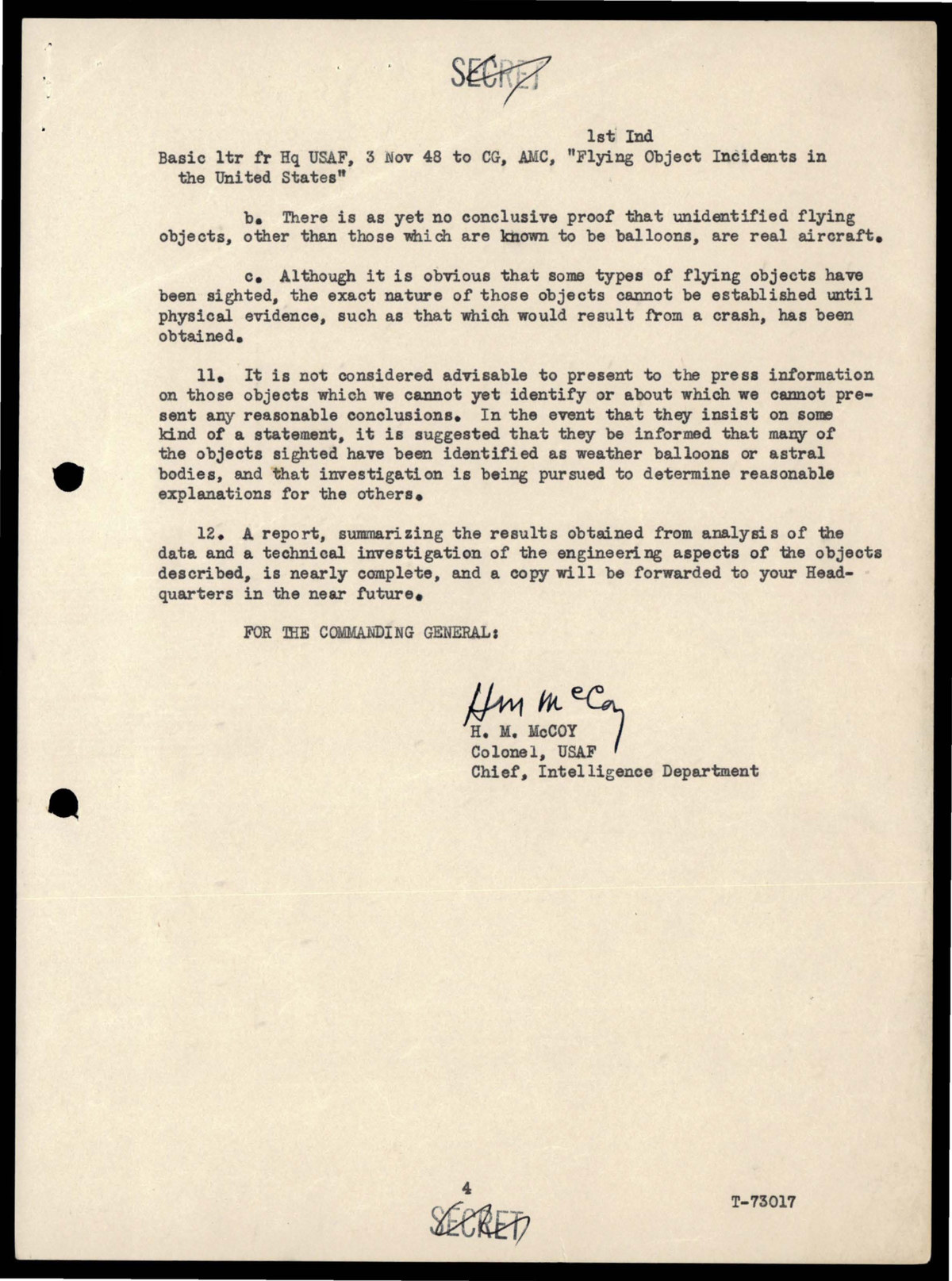
The indorsement also settles, in the Command's own words, what it thought of the interplanetary idea that sits at the centre of the Estimate of the Situation dispute. "The possibility that the reported objects are vehicles from another planet has not been ignored. However, tangible evidence to support conclusions about such a possibility are completely lacking." It adds that the Command had plotted the frequency of incidents against the approach of Mercury, Venus and Mars to the Earth and found a periodic variation that "appears to have some relation to the planet approach curves", while cautioning that it "may be purely a coincidence". Paragraph nine cites "The Books of Charles Fort" and observes that similar phenomena had been reported for a century or more. The formal conclusions are that in the majority of cases observers had actually sighted some type of flying object they could not classify within their own experience, that there was "as yet no conclusive proof that unidentified flying objects, other than those which are known to be balloons, are real aircraft", and that the nature of the objects could not be established "until physical evidence, such as that which would result from a crash, has been obtained".
The final recommendation is the one that speaks to how the era was managed. Asked what to tell the press, Air Materiel Command advised against disclosing the unexplained residue at all: "It is not considered advisable to present to the press information on those objects which we cannot yet identify or about which we cannot present any reasonable conclusions. In the event that they insist on some kind of a statement, it is suggested that they be informed that many of the objects sighted have been identified as weather balloons or astral bodies, and that investigation is being pursued to determine reasonable explanations for the others." Two documented positions therefore existed at the same moment in November 1948: internally, an intelligence chief writing that the discs were not American and that a residue had no everyday explanation, and externally, a recommended public line built entirely around the balloons and the stars.
What did the witnesses think it was?
Sign was directed from Wright-Patterson within the technical-intelligence structure, with Colonel Howard McCoy a central figure and Twining as its patron. The young Ohio State astronomer J. Allen Hynek was brought on as scientific consultant to weigh astronomical explanations, a role that would define the rest of his career. Three cases dominated the project's short life.
The first was the death of Captain Thomas Mantell on 7 January 1948. Godman Army Airfield at Fort Knox, Kentucky received reports of a large aerial object, and four F-51D Mustangs of the Kentucky Air National Guard were vectored to investigate. Mantell climbed in pursuit past 15,000 feet without oxygen equipment, lost consciousness, and crashed near Franklin, Kentucky, becoming the first person to die in connection with a UFO chase. An early claim that he had chased the planet Venus was rejected as inadequate; the more durable conclusion, developed later by Edward Ruppelt, was that Mantell had pursued a classified Navy Skyhook high-altitude research balloon, a program so secret in 1948 that he would not have recognized it.
The second was the Chiles-Whitted encounter of 24 July 1948. Around 2:45 in the morning, Eastern Air Lines pilots Clarence Chiles and John Whitted, flying a Douglas DC-3 near Montgomery, Alabama, reported a wingless, torpedo-shaped object roughly 100 feet long that shot past them with a double row of glowing windows and a trailing exhaust before pulling up into the clouds. The case made national headlines and pushed Sign's staff toward the interplanetary explanation. Hynek later argued the men had seen an unusually bright meteor.
The third was the Gorman dogfight of 1 October 1948. Second Lieutenant George Gorman, a World War II veteran flying an F-51 over Fargo, North Dakota, reported chasing a small, fast, bright light through tight maneuvers for about 27 minutes. Sign officers interviewed Gorman and the tower staff within hours. A lighted weather balloon released that evening became the official explanation, though Gorman remained unconvinced that a balloon could have dueled with him for that long.
Is the Project Sign (1947 to 1949): The Air Force's First UFO Study and the "Estimate of the Situation" real? The two-pass assessment
Pass one, the prosaic and skeptical reading. Every one of Sign's marquee cases has a conventional candidate. Mantell almost certainly died chasing a Skyhook balloon he could not identify, a tragedy of secrecy rather than of visitors. Chiles-Whitted fits a bright bolide meteor, exactly the kind of event that produces reports of a lit, windowed fuselage streaking past a cockpit at night. Gorman's maneuvering light matches a lighted balloon drifting while his own aircraft moved around it, a classic relative-motion illusion. The residual unexplained fraction reflects thin data and lost evidence as much as genuine mystery, exactly what Sign's own report warned when it said the paucity of reliable data prevented firm conclusions. And the single most sensational element, the interplanetary Estimate of the Situation, must be flagged honestly: the only public source for it is Captain Edward Ruppelt's 1956 book, where he described a thick, black-covered TOP SECRET document whose conclusion was that the objects were interplanetary, said Chief of Staff General Hoyt Vandenberg rejected it for insufficient proof, and said it was later declassified and sent to the incinerator. No copy of the Estimate has ever been produced, and the Air Force later denied it existed. That story is real history only as Ruppelt's testimony, and it cannot be treated as settled fact.
Pass two, if the phenomenon was real. Sign was not staffed by cranks. It was Air Materiel Command's own technical-intelligence arm, stood up as a priority project because a senior general had put in writing that the objects were real. If Ruppelt's account is accurate, the officers closest to the raw reports worked their way to the most extraordinary conclusion available and were prepared to sign their names to it, and were overruled not by better data but by a judgment that the data was not good enough. The newly released 1948 progress report shows why they leaned that way: a hundred cases of objects that hovered, climbed vertically, and outran pursuing fighters, seen repeatedly by trained military observers. The final report never disproved the objects; it said proof was unavailable in either direction. And there is a structural point that cuts against pure debunking. The Air Force did not ignore the phenomenon; it built an organization to study it, then built a successor organization specifically to explain it away. An institution does not spend years constructing a debunking apparatus for something it truly believes to be nothing.
The verdict is Unknown. No official narrative ever resolved Sign's residual cases; its own interplanetary estimate, if it existed, was rejected without being disproven, and a real fraction of its cases stayed unexplained. What is documented beyond dispute is that in 1947 and 1948 the United States government took the phenomenon seriously enough to argue about it at the level of the Chief of Staff, and then decided the public should hear the quieter answer.
One clarification became necessary in August 2026 and belongs here, because it will otherwise be misread for years. When the National Archives published its Department of the Air Force series inside Record Group 615, the Unidentified Anomalous Phenomena Records Collection, one of the thirty items was catalogued as Estimate of the Situation, September 8, 1948, National Archives Identifier 659965376. That is not the document Ruppelt described, and no part of the 2026 release recovers it. This archive downloaded the forty eight page scan and read it. It is a Headquarters Fifth Air Force theater intelligence estimate covering 7 August to 4 September 1948, twenty one internal pages on Japan, Korea, China, Turkey and French Indo-China, declassified in full on 5 May 2025 under case number 342UAP00005. The reason it sits in a UAP collection at all is a single section on page fourteen headed Spheroid Airborne Objects Sighted over Alaska, which this archive covers separately as the Fielding Lake sighting of 9 July 1948. The phrase estimate of the situation was ordinary military staff usage for a periodic theater assessment, which is exactly why the collision occurs. The Sign estimate remains unproduced.
Sources
- www.nicap.org/docs/SignRptFeb1949.pdf
- www.war.gov/ufo/
- www.war.gov/News/Releases/Release/Article/4539898/department-of-war-publishes-fourth-release-of-unidentified-anomalous-phenomena/
- skepticalinquirer.org/2020/03/general-nathan-f-twining-and-the-flying-disc-problem-of-1947/
- sohp.us/history-of-the-usaf-ufo-programs/4-project-sign.php
- www.army.mil/article/263119/questions_remain_75_years_after_mysterious_fort_knox_ufo_incident_downed_pilot
- www.history.com/articles/ufo-dogfight-gorman-us-plane-fargo
- avi-loeb.medium.com/highlights-from-the-fourth-uap-data-release-by-the-u-s-government-105a9b2561c7
- earthsky.org/human-world/pentagon-uap-files-4th-batch-ufos/
- archive.org/details/ProjectSIGN
- web.archive.org/web/20260807230006if_/https://www.war.gov/medialink/ufo/release_05/Aug_07/documents/DOW-UAP-D100_Air-Materiel-Command-Report-on-UFOs_1947-1948.pdf
- web.archive.org/web/20260808030643id_/https://www.war.gov/Portals/1/Interactive/2026/UFO/uap-data.csv?release=5
- catalog.archives.gov/id/659965376
- catalog.archives.gov/id/656595571
More cases from this region: UFO sightings in United States