White Light Orb Over Rabat, Morocco, 9 November 2026
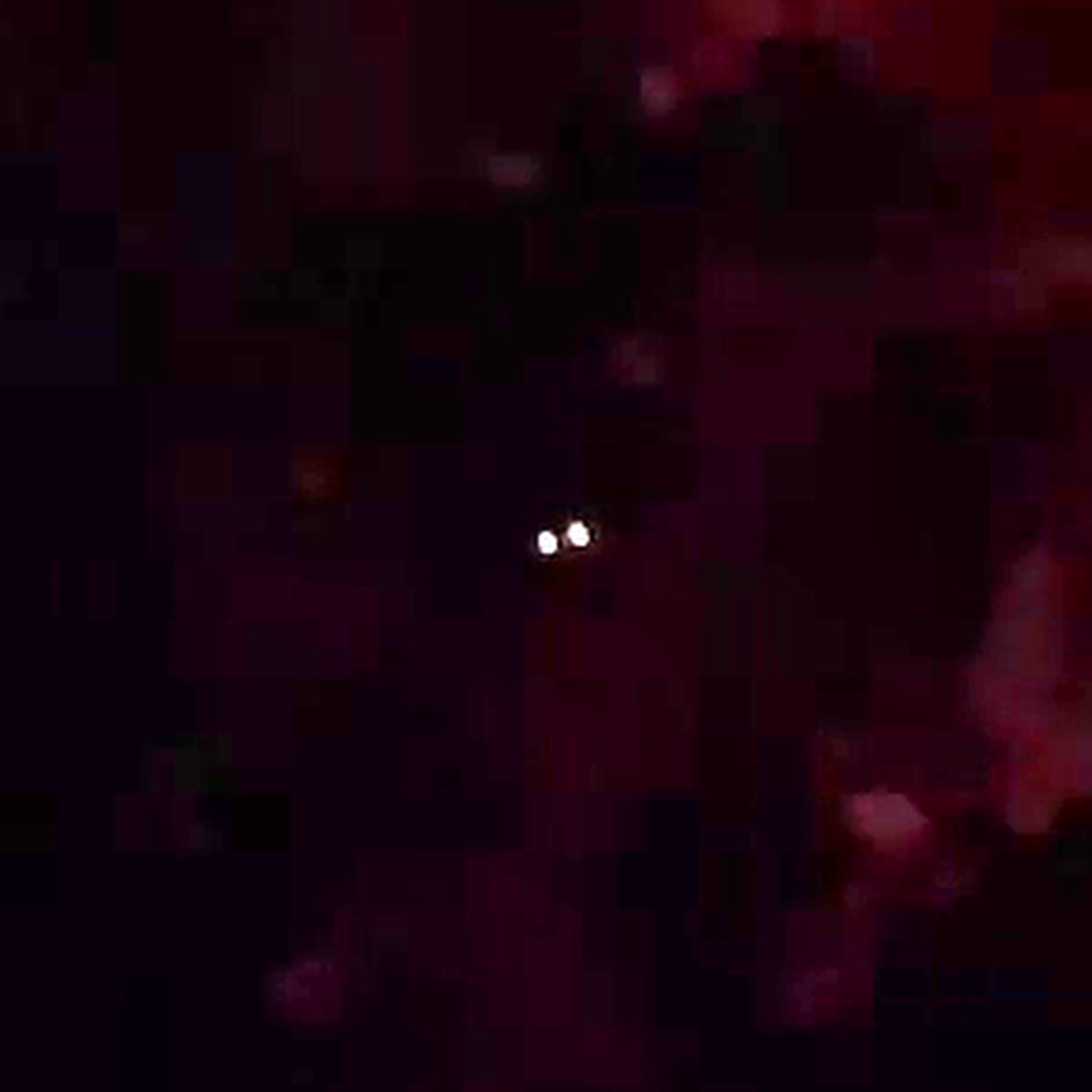
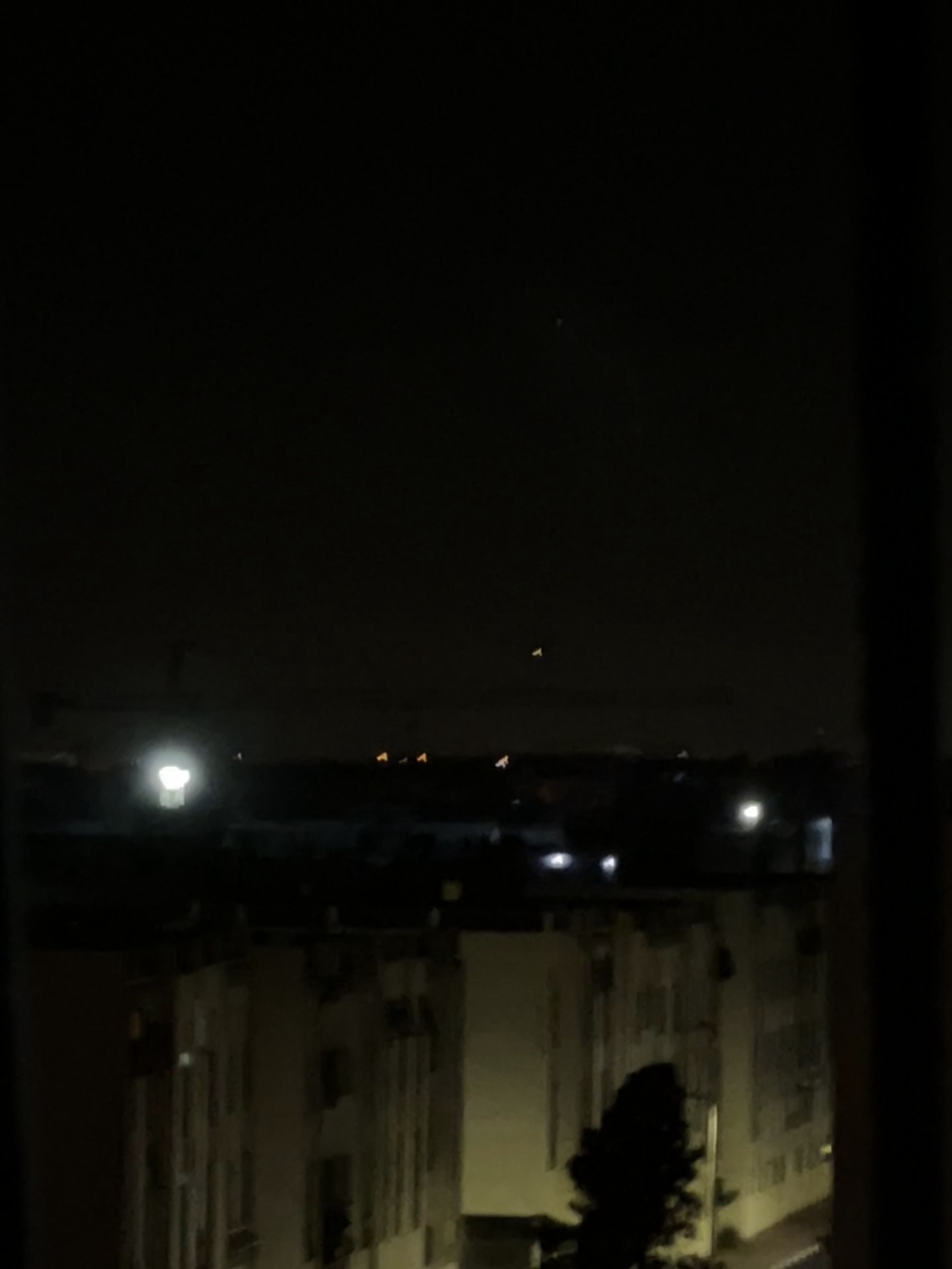
A phone video filed within the hour shows a single structureless white light moving across the southern sky over Rabat. The original file carries intact Apple metadata putting the recording at 23:20:03 UTC on 9 November 2026, which corroborates the filed time to within about a minute and reverses the usual pattern for reports of this kind, where the stated time is the first thing to fail. Measurement confirms a real light source at a median 12.8 sigma above the surrounding sky, and real object motion at roughly twice the camera operator's own hand travel. No star is recorded anywhere in frame, however, so no plate solve is possible and neither angular size nor angular rate can be recovered. That single gap is what keeps the case open. The leading prosaic candidate, a distant aircraft showing landing lights, survives this file intact and is arguably strengthened by it. The Rabat-Sale runway axis runs 031 and 211 degrees true, which sweeps the extended centreline across the southern sky as seen from central Rabat, and the official aerodrome observation for 23:00 UTC reports 5000 metres visibility with scattered cloud at 1500 feet. Certified minimum navigation light intensity is 40 candela ahead and 5 candela on the beam, so in that air the red and green points would be extinguished at range while a landing light of tens of thousands of candela punched through as a diffuse halo, which is exactly what the footage shows. No ADS-B playback has been performed against the device-authenticated minute. That is the single check that would close this case in either direction, and until someone runs it the object has a verified time, a verified reality, and no identity.
What did witnesses see at Rabat?
A single white light crossed the southern sky over Rabat shortly before midnight. The witness filmed it for roughly one minute on an iPhone 13 Pro Max, then filed a structured report the same night to the archive at ufosighting.report, which issued it as report 13248 and relayed it automatically to r/UFOs through the account u/ufosightingsbot. The reporter posts as u/Mundaneayx and was verified by the filing site through a one-time link. The report page gives the time as 2026-11-09 23:21 in the Africa/Casablanca zone and the location as Rabat in the Rabat-Sale-Kenitra region.
The filed observation set is narrow and internally consistent. One object. Shape recorded as light. Closest distance given as as high as a plane. Apparent size at arm's length given as larger. Movement given as random and smooth. Observer facing south. Duration one minute. Against the five observables the reporter answered no wings, no rotors, no exhaust plume, no noise, unsure on sudden extreme acceleration, no on extreme speed without signatures, yes on being hard to observe clearly, unsure on movement between air, water or space, and yes on flight without visible means of lift. Asked why it was not a common object the reporter wrote, verbatim, that he did check flightradar24 and found nothing, no commercial plane nor a drone or a helicopter.
The archive's own automated screen, which the site says cross-checks satellite passes computed from historical orbital data, Starlink train detection, ISS visibility and rocket launches whose twilight plumes are routinely reported as unidentified objects, returned a negative. Its block reads that no bright satellites were visible overhead, computed from orbital data in the 2026-11-09 catalog. That negative is independently supported below.
THE ORIGINAL FILE. The strongest fact in this case is not in the imagery, it is in the container. The untouched original served by the archive's own media subdomain is a QuickTime .mov of 43,342,422 bytes, which is the 41.3 MB the report page advertises once the binary prefix is read correctly. It is 1920 by 1440 at 24.83 frames per second with an uncompressed pcm_s16le mono audio track at 44100 Hz. Uncompressed audio in a 1920 by 1440 container is the signature of a file straight off the device rather than one that has been through a messaging app or a re-encode, both of which would have stripped the audio to a lossy codec and rescaled the video.
The container tags are genuine Apple and have not been rewritten. The major brand is qt. The Apple QuickTime make tag reads Apple, the model tag reads iPhone 13 Pro Max, and the software tag reads 18.7.8. The container creation_time is 2026-11-09T23:20:06 UTC and the com.apple.quicktime.creationdate tag is 2026-11-09T23:20:03 with a zero offset. The camera's own clock therefore places the recording at 23:20:03 UTC on 9 November 2026, about one minute before the reporter filed the sighting as 23:21. This is a device-level authentication of the filed time. In this archive's experience that is the exception rather than the rule, because a wrong or drifting stated time is normally the first thing to fail on a structured filing, and it is what lets a prosaic identification be dismissed on the wrong grounds. Here the time holds.
A CONTRADICTION WORTH REPORTING. The report page carries a badge reading no capture metadata, and the relay comment on Reddit states, verbatim, that the video carries no creation timestamp and may have been re-encoded, downloaded or re-saved. The same comment also states that metadata was withheld, and that the file contained device and camera settings and a capture date and time that the reporter chose not to publish. Those two claims contradict each other, and the original file served by the archive's own media subdomain contradicts the first of them outright, because it carries the full Apple make, model, software and creation-date tags listed above. The most likely reading is that the publishing pipeline strips metadata from the copy it displays and then mislabels the stripped copy, while continuing to serve the intact original for download. This file does not treat the badge as evidence about the video. It treats the original file as the evidence, and notes the discrepancy because a reader comparing the two pages will otherwise conclude that one source is lying.
OBJECT MEASUREMENTS. The object was tracked across 652 samples. It is unambiguously a real light source and not a compression artifact: it sits 66.8 grey levels above a sky annulus measured at three to five object radii, a median detection significance of 12.8 sigma. Apparent area averages 342 pixels with a standard deviation of 191, a coefficient of variation of 55.8 percent, and the fitted aspect ratio wanders between 0.40 and 2.57. That instability should not be read as a changing physical shape. It is what an unresolved, locally saturated point source does in a hand-held phone video subject to rolling shutter, focus hunting and exposure adaptation, and it is the reason no shape claim is drawable from this footage.
The distance test is the informative one. The correlation between apparent area and contrast is positive at +0.602. Broken into deciles, the lowest-area tenth of samples carries a contrast of 44.7 grey levels while the highest-area tenth carries 85.5. Brightness rises with apparent size. For a light source that means the range is changing, approaching or receding, because flux and apparent blob size fall off together with distance. It is not the signature of a body at fixed distance presenting different faces, which would decouple brightness from extent or anti-correlate the two. This archive ran the identical test on the Jinzhou and Hawaii cases, where a near-zero correlation pointed to rotation at roughly constant range. Rabat runs the other way, and a range change is precisely what an aircraft on a departure climb or an approach would produce. The test does not resolve the sign, so it does not say whether the light came closer or went away.
Camera motion is measurable here, which is unusual for this kind of clip and matters for what follows. Phase correlation with the object masked out retained a median peak of 0.503 against 0.751 unmasked, so the registration is locked onto genuine background structure rather than onto the object itself. Masked cumulative camera travel came to 675 pixels in x and minus 311 pixels in y. The object travelled 1422 pixels in x and 703 pixels in y over the same interval. The object's displacement in frame is therefore roughly double the operator's own hand travel and in a different direction, which establishes that this is real motion of the light across the sky and not handheld shake misread as flight.
THE LIMIT THAT DECIDES THE TIER. A star-presence test on the background-subtracted frames peaked at a median of 0.75 against a per-pixel noise floor of 0.81. There is no static celestial reference anywhere in frame. No plate solve is possible. The direct consequence is that no angular size and no angular rate can be derived from this video, which means the reported distance of as high as a plane is untestable from the footage, and so is any speed. Without an angular rate there is no way to separate an airliner at eight kilometres from a drone at four hundred metres, and that is why this case cannot be closed on the imagery alone. The measured weather, below, explains why no stars were captured.
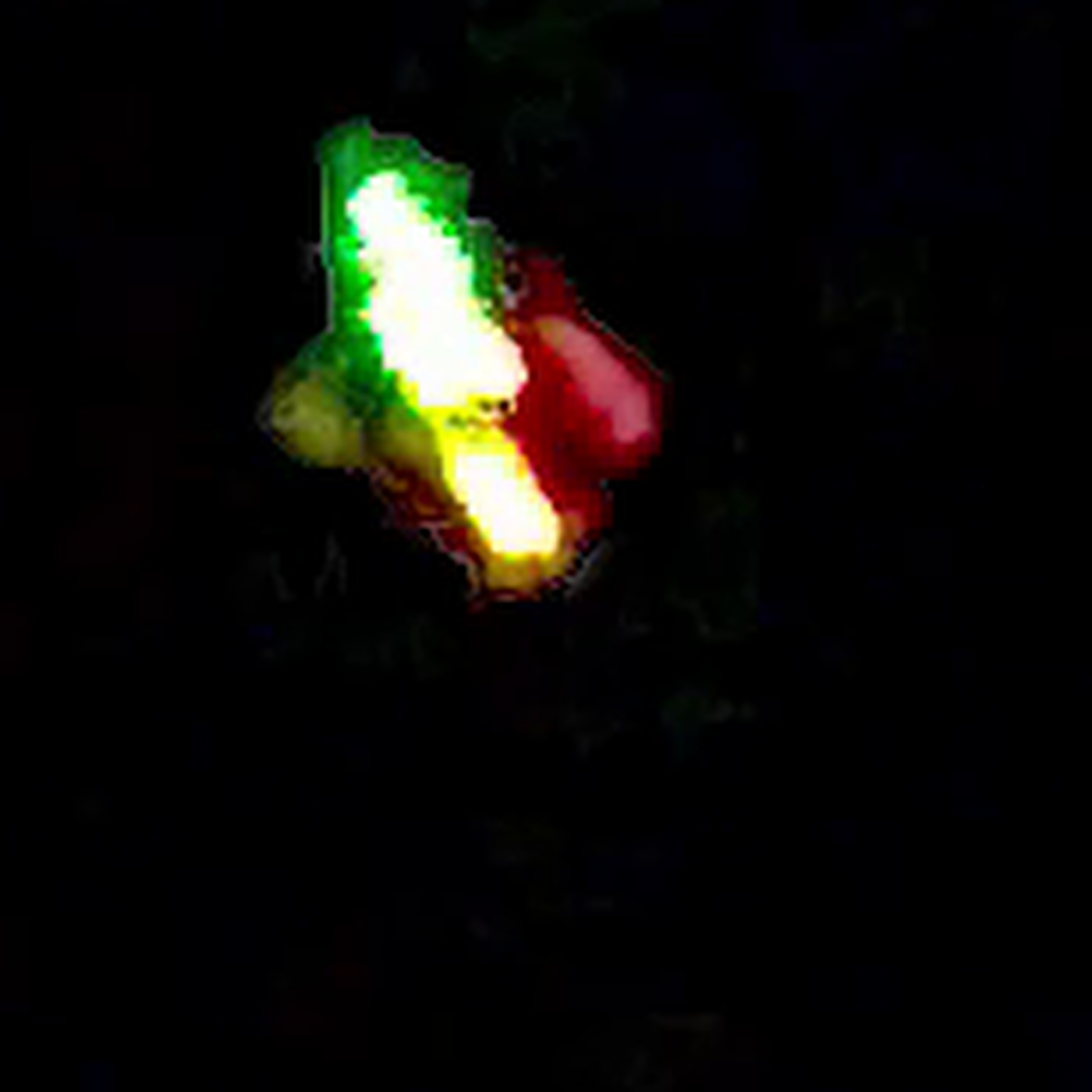
At eight times enlargement the object is a soft, diffuse, unresolved white glow with no internal structure and no red or green points anywhere on it. A second bright source sits near the frame edge. The witness's observation that there were no navigation lights is therefore confirmed as far as the footage goes. It is also, and this is the uncomfortable part, exactly what the landing-light explanation predicts, because a landing light pointed anywhere near the observer overwhelms the navigation lights beside it.
The uncompressed audio track measures a mean volume of minus 51.6 dB with a maximum of minus 19.7 dB. That is a very quiet recording and it is consistent with the reporter's answer of no noise. The honest limit must be stated with it: a quiet track does not establish that the object was silent. An aircraft several miles away is routinely inaudible from the ground, and a phone microphone is not a calibrated instrument.
LOCAL TIME, CORRECTED. The filing is stamped plus zero, and that is right, though for a reason that is easy to get wrong and that this file had to verify rather than assume. Morocco spent eight years on UTC plus one, suspending to UTC during Ramadan, under Decree 2.18.855 of 26 October 2018. Decree 2.26.530 of 25 June 2026 repealed it. Clocks went back sixty minutes at 02:00 on Sunday 20 September 2026 and the Kingdom returned to Greenwich Mean Time permanently, with no summer time and no Ramadan exception. On 9 November 2026 Morocco was on UTC. Local civil time in Rabat at 23:20 UTC was therefore 23:20 on the same evening, 9 November, not 00:20 on the 10th as the pre-2026 rule would have given. The report page's own Africa/Casablanca stamp of 23:21, the filed plus zero, and the camera's 23:20:03 UTC all agree. Note for anyone re-deriving this: a machine with a time zone database older than mid-2026 returns UTC plus one for this date and will put the local time out by an hour.
THE SKY. JPL Horizons was queried for the observer's coordinates at 34.0209 north, 6.8416 west at 23:15 and 23:30 UTC on 9 November 2026. The Moon was 69.8 degrees below the horizon at azimuth 294. Mercury was 68.1 degrees below the horizon, Venus 65.5 degrees below, Mars 10.7 degrees below at azimuth 62.8, and Jupiter 13.3 degrees below at azimuth 63.0. None of them was in the sky. Saturn was the sole naked-eye planet above the horizon, at azimuth 216.6 and elevation 51.1 degrees at 23:15, moving to azimuth 221.6 and elevation 49.2 by 23:30, at visual magnitude plus 0.5. That places Saturn in the south-southwest, high up, in the half of the sky the observer was facing. Saturn cannot be the moving object: it is fixed to the sidereal frame, its drift across one minute is a fraction of an arcminute, and the masked registration shows the light moving at twice the camera's travel. It is, however, a reasonable candidate for the second bright source near the frame edge. With no plate solve available that identification cannot be confirmed, and it is offered here as a possibility, not a finding.
THE WEATHER, AND WHY IT MATTERS MORE THAN IT USUALLY DOES. The official aerodrome observation for Rabat-Sale, station GMME, is on the international circuit and was retrieved for the exact window. The 23:00 UTC report reads calm wind, 5000 metres visibility, scattered cloud at 1500 feet and 2000 feet, temperature 19 with dewpoint 18, pressure 1018, no significant change expected. The 23:30 report is the same except for a 4 knot southerly and 18 over 18. Three consequences follow, and all three cut in the same direction. First, 5000 metres visibility with the temperature and dewpoint one degree apart is a hazy, nearly saturated night, which is a complete explanation for why the star-presence test found nothing and why no plate solve is available. Second, that same air turns any point light into a soft diffuse halo, which is a complete explanation for the unresolved morphology at eight times enlargement. Third, and most important for the assessment, 5000 metres is 3.1 statute miles, which is the very range at which navigation lights are specified to be seen.
That third point can be made with a hard number rather than an impression. Certified minimum position light intensity for a transport aeroplane is 40 candela for the forward red and green between dead ahead and 10 degrees, 30 candela between 10 and 20 degrees, and 5 candela across the broad 20 to 110 degree sector, with 20 candela for the rear white. Those are small sources. The beam-on sector, 5 candela, is the geometry of an aircraft crossing the observer's southern sky. A landing light runs to tens of thousands of candela. In air with 3.1 miles of visibility and relative humidity in the nineties, a 5 candela red or green point is extinguished well inside the range at which a landing light still reads as a bright diffuse blob. The absence of red and green points in this video is therefore the expected result for a lit aircraft in the measured conditions, not an anomaly. This is the archive deriving the top commenter's argument independently, from a meteorological record and a certification standard he did not cite.
AIR TRAFFIC GEOMETRY, THE DECISIVE RESEARCH TASK. The intuition that Rabat-Sale lies away from the southern sky is wrong, and the Moroccan aeronautical information publication is explicit enough to settle it. The aerodrome reference point for GMME is 34 degrees 03 minutes 05 seconds north, 6 degrees 45 minutes 06 seconds west, at 83 metres elevation, and the publication states its own position relative to the city as 068 degrees, 7 kilometres from Rabat. So the field is east-northeast of the observer. The runway, however, is a single 3500 by 45 metre strip designated 03 and 21, with published true bearings of 031.32 and 211.33 degrees, and local magnetic variation of zero. It is the runway axis and not the airport's position that determines where the traffic appears, and that axis points southwest straight back over the city.
Sampled along the 211.33 degree extended centreline and measured from the Hassan Tower, the corridor crosses into the southern sky at about four nautical miles out and stays there: bearing 172.8 degrees at 5 nautical miles, 181.1 degrees at 6, 190.6 degrees at 8, and 195.7 degrees at 10, with heights on a three degree slope of roughly 1590, 1910, 2550 and 3180 feet respectively. The extended centreline passes within 4.0 kilometres of the Hassan Tower and 5.2 kilometres of the medina. Both runway configurations put a light southward. Runway 21 is the instrument runway and carries the field's only ILS, rated CAT I and II, with the locator 14.3 kilometres out on the northeast final; runway 03 has no instrument procedure and its approach lighting is listed as nil. With runway 21 in use, arrivals come in from the northeast but departures roll southwest on 211 degrees and climb out directly across the southern sky. With runway 03 in use, arrivals fly final from the southwest through that same south to south-southwest corridor at 1500 to 6000 feet. Air traffic service at the field is H24, and the publication's night-stopover permission requirement explicitly exempts scheduled traffic and State aircraft, so a movement near midnight needs no special explanation. The surface wind was calm at 23:00 and a light southerly at 23:30, which leaves the choice of runway free and favours the instrument runway at night.
There is also a published departure gate due south. The waypoint BISMI sits at 33 degrees 38 minutes 50 seconds north, 6 degrees 53 minutes 37 seconds west, which is 189.0 degrees true and 42.4 kilometres from central Rabat, essentially due south. It lies on ATS route R975 and inside the Casablanca terminal area, and it is served by the published Rabat departures BISMI 5D and BISMI 1A off runway 03 and BISMI 1B off runway 21. Casablanca Mohammed V, GMMN, is at 33 degrees 21 minutes 51 seconds north, 7 degrees 34 minutes 54 seconds west, bearing 224.0 degrees true and 101.6 kilometres from Rabat, with parallel runways on 164 and 344 degrees true. At that range its own circuits and finals are below the horizon from Rabat, but the corridor traffic between the two cities is not: an aircraft over the BISMI gate sits 1.2 degrees above the southern horizon at 3000 feet, 4.1 degrees at 10,000 feet and 12.2 degrees at 30,000 feet. So the southern sky from Rabat is routinely occupied by traffic at low elevation angles.
One piece of this geometry cuts the other way and is worth stating plainly, because it bears on what the witness could have checked. A sweep of the aerodrome tables for everything within 160 kilometres found nothing at all in the Temara, Skhirat and Bouznika coastal corridor south of Rabat, no airfield, no airstrip and no heliport, with the nearest facility to the south-southwest being Benslimane at 222.1 degrees and 55.1 kilometres. There is accordingly no infrastructure south of the city that could account for a light loitering in one place. Kenitra air base, correctly identified as GMMY and GMMP rather than the GMMX that is Marrakesh, lies at 034.2 degrees and 37 kilometres, due northeast, and is excluded as a southern source. A further point matters for the flightradar24 check: GMME is a joint-use field, operated by the civil authority together with the Royal Moroccan Air Force, whose 1st Air Base parks on it. Military movements and any aircraft with its transponder off do not appear on a public ADS-B feed. The reporter's negative search is therefore weaker as an exclusion than it reads, and in a direction that keeps a prosaic aircraft alive rather than ruling one out.
CORROBORATION. There is none, and the search for it was thorough enough that the absence is itself reportable. No Moroccan outlet carried anything of the kind on 9, 10 or 11 November 2026. Searches were run in Arabic, French and English across hespress in all three editions, le360 in French and Arabic, yabiladi, Morocco World News and the state agency MAP, using the working search endpoints in each case rather than the obvious ones, several of which silently return the entire archive. All came back empty of any 2026 sighting story. No second witness appeared: the Reddit thread carries ten upvotes and exactly two comments, the automated relay and one skeptic, with no one reporting having seen the same thing. Filtered to 9 and 10 November 2026 across every country, the filing archive holds only two records worldwide, this one and a cross-shaped object over Canyon Country, California at a different hour on a different continent, which is not corroboration. Filtered to Morocco the archive holds six entries in its entire history. The National UFO Reporting Center holds twenty-nine Morocco records, the most recent occurring on 24 July 2026 and nothing for 9 or 10 November, though its index had ingested nothing at all past 1 November when checked, so that leg is a coverage gap rather than a clean negative. UFO Stalker's recent list stops at 8 November and holds no Morocco entry. The MUFON public database is behind a login and could not be checked. Reddit's own search is inaccessible to every route tried, so the no-second-post finding there is a qualified negative, although the subreddit's new feed and the Morocco subreddit's new feed were both read directly and contain nothing.
THE LAUNCH AND REENTRY CHECK, WHICH IS A CLEAN EXCLUSION. A twilight rocket plume or a deorbit burn is the single most common cause of a smooth, silent, structureless light reported by many people at once, so it was checked against the launch log rather than assumed. Querying the window from 7 November to 11 November 2026 returns exactly four events worldwide: a Falcon 9 from Vandenberg on 7 November at 00:48 UTC, a Soyuz from Plesetsk on 7 November at 13:22, a Long March 12 from Wenchang on 8 November at 20:24, and a Long March 2D from Jiuquan on 11 November at 11:40. Nothing on Earth launched within roughly twenty-seven hours before or three and a half hours after 23:21 UTC on 9 November. There was no Starlink launch that day and no eastbound second-stage deorbit over the eastern Atlantic. The Long March 12 of 8 November is the rocket behind the widely shared Malaysian space jellyfish footage, which a date-only search surfaces as a false lead; it is twenty-seven hours earlier and on the opposite side of the planet. The Falcon 9 carrying USSF-627 slipped to 10 November and was a southbound Pacific trajectory in any case. The archive's own automated launch and satellite screen independently flagged nothing. A dedicated reentry-prediction source could not be read, so an uncatalogued fragment reentry remains formally unexcluded, but no notice for the eastern Atlantic or North Africa that night was found.
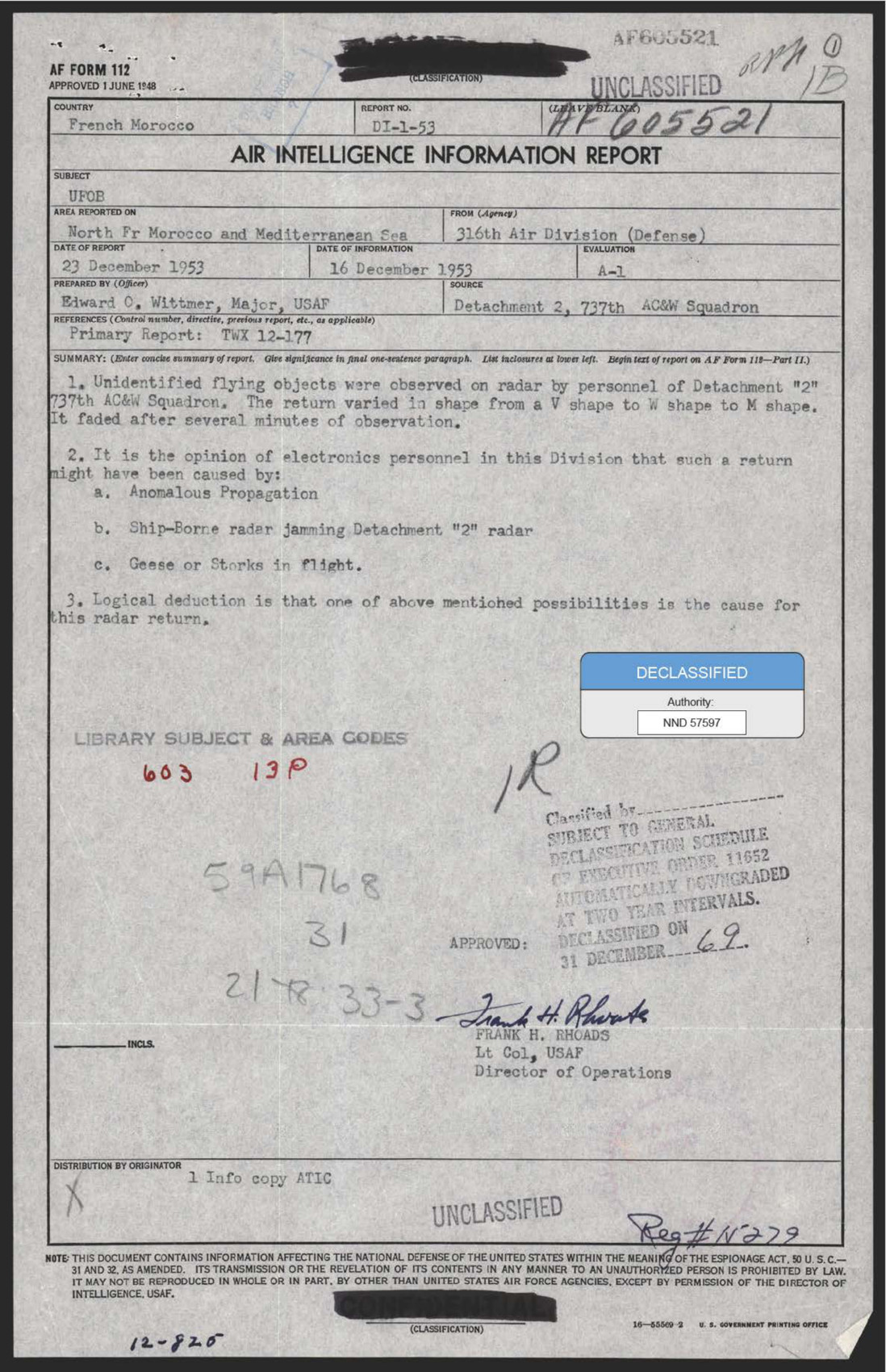
ARCHIVE NOTE. This is only the second Morocco entry in the collection and the first modern one. The existing Moroccan case is morocco-radar-1953, a radar event from 16 December 1953, which leaves a gap of seventy-three years with nothing in between.
More footage and images of this sighting
What is the official explanation?
There is no official file on this event, and no indication that any authority has looked at it.
No Moroccan government body, aviation authority or military command is known to have examined the sighting, commented on it, or acknowledged a report. Morocco maintains no public civil channel for unidentified aerial phenomena reports, so there is no register in which a Moroccan citizen filing would appear and no office to which this footage was submitted. The archive made no approach to the National Airports Office or to the Moroccan civil aviation directorate before publication, and none is recorded by anyone else.
The official records that do bear on the case are not about the sighting at all. They are routine instruments that happen to constrain it, and they were obtained directly rather than through any intermediary. The aeronautical information publication for Rabat-Sale, published by the National Airports Office, supplies the aerodrome reference point, the 031.32 and 211.33 degree runway bearings, the single ILS serving runway 21, the nil approach lighting on runway 03, the H24 service hours, the night-stopover exemption for scheduled and State aircraft, and the joint civil and Royal Moroccan Air Force operation of the field. The same publication's en-route section supplies the BISMI waypoint on route R975 due south of the city. The 23:00 and 23:30 UTC aerodrome weather observations for station GMME are official Moroccan meteorological reports transmitted on the international circuit and retrieved here from the Iowa Environmental Mesonet archive. The time zone question is settled by Moroccan Decree 2.26.530 of 25 June 2026 as announced by the Head of Government, repealing Decree 2.18.855 of 26 October 2018. The ephemeris is from the Jet Propulsion Laboratory's Horizons system. The navigation light intensity figures are the certification minimums in the United States Federal Aviation Regulations for transport category aeroplanes, cited here as the engineering standard those airframes are built to rather than as Moroccan law.
The decisive official check has not been made. No ADS-B or radar playback has been performed for the airspace south of Rabat at 23:20:03 UTC on 9 November 2026, which is now a known minute rather than an approximate one. A commercial ADS-B archive query, or a request to the National Airports Office for recorded traffic in the Rabat control zone and the southern corridor in that minute, would either place an aircraft on the line of sight or fail to, and either outcome would move this case off Disputed. The reporter's own negative check of a live flight tracker is not a substitute, both because a public feed omits military and non-transponding traffic over a joint-use field and because a live display is not a playback.
What did the witnesses think it was?
There is one witness. He posts as u/Mundaneayx, was verified by the filing site through a one-time link, and gave a short account that is notable for conceding more than it claims.
On the object itself he wrote, verbatim: "Normally navigation lights are mandatory for conventional manned aircraft and drones, but this one didn't have any red/green lights or anything. First time I catch something like this on camera." On why it was not something ordinary he wrote, verbatim: "I did check flightradar24, nothing. No commercial plane nor a drone or a helicopter."
The filing itself is restrained in a way that is worth crediting. Asked about sudden extreme acceleration he answered unsure rather than yes. Asked whether the object moved between air, water or space he answered unsure rather than yes. Asked whether it was hard to observe clearly he answered yes, which is an admission against the strength of his own report. He claimed only two of the five observables outright, low observability and flight without visible means of lift, and the second of those is what any distant light looks like regardless of what is carrying it. He did not claim a shape, recording it only as light. He did not claim extreme speed. A reporter inclined to inflate would have had easy opportunities here and did not take them.
THE LEADING PROSAIC CASE, FROM THE THREAD ITSELF. The top comment on the Reddit relay, from u/R2robot at four upvotes, is the strongest challenge on the record and deserves to be engaged rather than noted. He argues that the light "Seems like a plane with landing lights", and gives three reasons the navigation lights would not be seen: that red and green lights are "only required to be visible for 2-3 miles", that "the landing lights are far brighter and will over power them", and that observers check too small an area, since "The planes are usually much farther away than people realize". He adds a fourth point about the flight tracker check, that people often look at the wrong time because "Flight data is recorded in UTC time, not your local time", and links three examples of distant aircraft photographed as hovering orbs.
Three of those four arguments survive this file's scrutiny and two of them are strengthened by it. The intensity argument is correct and can be given a number he did not cite: certified minimum position light intensity is 40 candela forward and 5 candela across the broad beam-on sector, against tens of thousands of candela for a landing light, and the measured visibility at the aerodrome that night was 5000 metres, or 3.1 statute miles, with the dewpoint one degree off the temperature. His two to three mile figure is close to the real specified range, and the measured air was at exactly that limit. The overpowering argument is correct and is consistent with the eight times enlargement, which shows a diffuse halo and no colour points. The search-radius argument is correct and is reinforced by the geometry established here, since the Rabat to Casablanca corridor traffic that crosses the southern sky does so at one to twelve degrees of elevation and at ranges of tens of kilometres.
His fourth argument is the one that fails, and it fails on a fact that almost everyone would get wrong. Morocco returned to Greenwich Mean Time permanently on 20 September 2026, seven weeks before this sighting. On 9 November 2026 Moroccan local time was identical to UTC. There was no offset for the reporter to be confused by, so a flight tracker checked at local time was being checked at the correct UTC time. The reporter's negative search fails for a different reason than the one proposed: a public ADS-B feed does not show military or non-transponding traffic, and Rabat-Sale is a joint civil and air force field. The correction does not rescue the sighting. It relocates the weakness in the witness's exclusion from the time axis to the coverage axis.
No second witness has come forward. The thread drew ten upvotes and two comments in total, one of them the automated relay. A city of well over a million people produced a single report of a light that was reportedly larger than a plane at arm's length and visible for a full minute in the direction of its own airport corridor. That silence is a real datum and it does not favour the extraordinary reading.
Is the White Light Orb Over Rabat, Morocco, 9 November 2026 real? The two-pass assessment
PASS ONE: HOW THIS IS MUNDANE.
The mundane account is coherent, quantitative, and better supported after this file's research than before it. Take the aircraft hypothesis in full. The runway at Rabat-Sale is a single strip on 031 and 211 degrees true, and the extended southwest centreline passes within four kilometres of the Hassan Tower and lies in the south to south-southwest sky from roughly four nautical miles out. Air traffic service runs around the clock and scheduled night movements are explicitly exempt from the field's night-stopover permission rule. The surface wind was calm at 23:00 and four knots southerly at 23:30, which leaves runway selection open and favours runway 21, the only runway with an instrument approach, on a hazy night. A runway 21 departure climbs southwest across exactly the sky the observer was facing, and a Casablanca-bound one tracks to a published gate 42 kilometres due south. A runway 03 arrival flies final through the same corridor at 1500 to 6000 feet. Corridor traffic between Rabat and Casablanca sits one to twelve degrees above the southern horizon all night. The observer faced south. The object was in the south.
The weather closes the loop on the one detail the witness considered decisive. He reasoned that the absence of red and green lights ruled out a conventional aircraft or drone. The official observation for that half hour reports 5000 metres visibility with the temperature and dewpoint one degree apart. Certified minimum navigation light intensity is 40 candela ahead and 5 candela on the beam. In that air those points are extinguished at range while a landing light of tens of thousands of candela still reads as a bright diffuse blob. The witness's key anomaly is the predicted result of the conditions, and he had no way to know it.
The imagery is consistent throughout with a distant lit aircraft. The brightness to size correlation of plus 0.602 says the range was changing, which is what a climb-out or an approach does and what a hovering craft does not. The soft unresolved halo at eight times enlargement is what a point light does through nearly saturated air. The wildly varying blob area and aspect ratio are the artifacts of an unresolved saturated source in a hand-held phone video, not a shapeshifting object. The quiet audio track is what an aircraft several miles away sounds like from the ground. The one minute duration is unremarkable for traffic crossing a sector of sky. The witness himself answered yes to the object being hard to observe clearly.
Two secondary prosaic candidates remain open and should not be dismissed. A small drone carrying a single white light and no navigation lights would look like this, would not appear on a public flight tracker, and is entirely common; the reporter ruled drones out by assumption rather than observation. A sky lantern or similar is less likely given the measured motion, but is not excluded. Astronomy is excluded as the source of the moving light, since the Moon and every planet except Saturn were below the horizon and Saturn is fixed to the sidereal frame while this light moved at twice the camera's hand travel. A rocket or deorbit plume is positively excluded, with nothing launching anywhere on Earth in the twenty-seven hours before or three and a half hours after. And the reporter's own negative flight tracker check carries less weight than it appears to, because Rabat-Sale is a joint civil and air force field whose military movements never reach a public ADS-B feed.
Finally, the social evidence is as mundane as evidence gets. One witness, one report, ten upvotes, two comments, no second account, nothing in any Moroccan outlet in three languages, nothing in any other sighting database on that date anywhere in Morocco.
PASS TWO: WHAT SURVIVES IF IT IS NOT.
Three things survive, and they are not nothing.
The first is the timestamp, and it is the reason this case is filed rather than discarded. The original file carries genuine, unrewritten Apple container tags naming an iPhone 13 Pro Max on software 18.7.8, with uncompressed audio and a native 1920 by 1440 frame, placing the recording at 23:20:03 UTC on 9 November 2026. The reporter filed at 23:21. That is a device-level authentication of a stated time to within about a minute, and it is the single most common point of failure in structured filings of this kind. It also makes the case falsifiable in a way that most are not: there is now a specific minute, a specific observer position and a specific compass sector against which a traffic playback can be run. The archive notes, and the reader should weigh, that the publishing pipeline simultaneously claimed this file had no creation timestamp and that a capture time had been withheld, which means the strongest fact in the case was obscured by the site that hosts it.
The second is that the object is real and that its motion is real. A median 12.8 sigma detection against a measured sky annulus is not a compression artifact, not a hot pixel and not a lens reflection. The masked phase correlation, holding a median peak of 0.503 on background structure with the object removed, establishes that the 1422 by 703 pixel displacement is roughly double the operator's own 675 by 311 pixel hand travel and in a different direction. Whatever this was, it moved across the sky. That rules out the lazy dismissals, a reflection on glass, a stuck pixel, a smudge, shake misread as flight.
The third is the shape of the remaining gap, which is specific rather than vague. The case is undecided for one measurable reason: there is no static celestial reference in frame, the star test peaking at 0.75 against a 0.81 noise floor, so no plate solve is possible, so no angular size and no angular rate exist. Without an angular rate an airliner at eight kilometres and a drone at four hundred metres are indistinguishable in this footage, and the reported distance of as high as a plane is untestable. The weather explains why the stars are missing, which is satisfying as physics and unhelpful as evidence.
WHERE THAT LEAVES IT. A real, moving, structureless light, at a device-authenticated time, in a sky sector that the local runway axis and the Casablanca corridor both routinely occupy, on a night whose measured visibility would have hidden the navigation lights the witness looked for, filmed by one person whom nobody else corroborates. The prosaic explanation is live, specific and unrefuted. It is also unproven, because no one has run the playback. This file does not assert that an aircraft was there, and it declines to treat a strong prosaic candidate as a demonstrated one; a hypothesis consistent with the evidence is not the same as a hypothesis checked against the record. The tier is Disputed on exactly that basis, and the case would be discredited or elevated by a single piece of work: an ADS-B and radar playback of the airspace south of Rabat for the minute beginning 23:20:03 UTC on 9 November 2026, read against the observer's line of sight. Until that is done, what this archive holds is a verified time, a verified object, and no identity.
Sources
- ufosighting.report/sighting/13248/white-light-orb-moved-smoothly-and-randomly-above-rabat-moro
- www.reddit.com/r/UFOs/comments/1xs867m/white_light_orb_moved_smoothly_and_randomly_above/
- www.cg.gov.ma/en/node/13036
- raw.githubusercontent.com/eggert/tz/main/africa
- ssd.jpl.nasa.gov/api/horizons.api
- mesonet.agron.iastate.edu/cgi-bin/request/asos.py
- siamaroc.onda.ma/eAIP/AD/AD2GMME.pdf
- siamaroc.onda.ma/eAIP/AD/AD2GMMN.pdf
- siamaroc.onda.ma/eAIP/ENR/ENR4.4.pdf
- siamaroc.onda.ma/eAIP/cartes/AD2GMME/AD2GMME39-2-1.pdf
- www.ecfr.gov/api/renderer/v1/content/enhanced/current/title-14?part=25§ion=25.1391
- davidmegginson.github.io/ourairports-data/airports.csv
- skyvector.com/airport/GMME
- ll.thespacedevs.com/2.2.0/launch/
- nuforc.org/subndx/?id=all
- www.ufostalker.com/
More cases from this region: UFO sightings in Morocco