A Shape-Changing Radar Return over Northern French Morocco on 16 December 1953
The men at the radar could offer no cause for what they had tracked. The three explanations in the file came from staff officers at divisional headquarters who were not there.
What did witnesses see at USAF aircraft control and warning radar site?
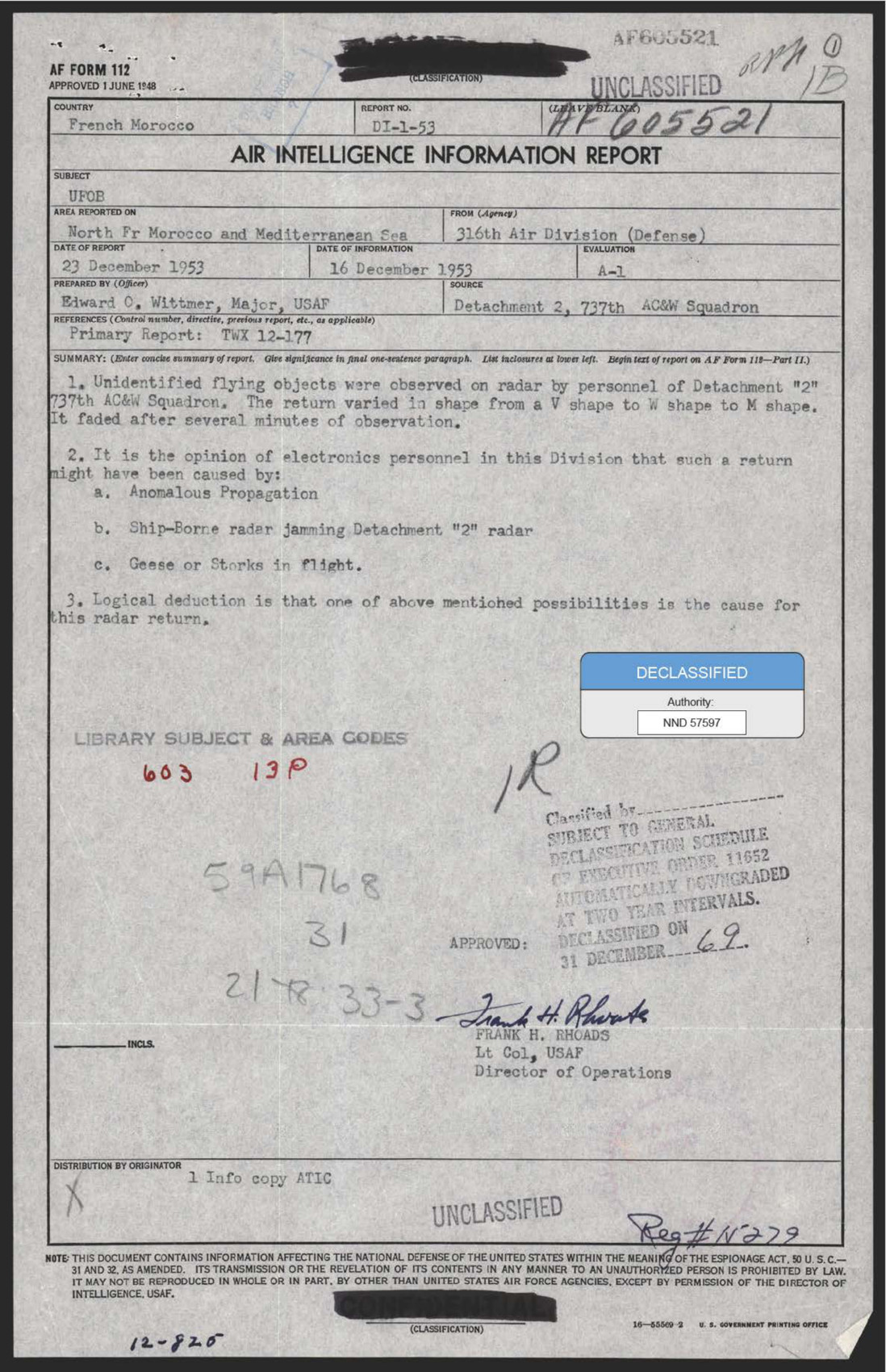
A ground radar crew in northern French Morocco tracked a return that kept changing shape. The United States Air Force recorded the event on an Air Intelligence Information Report, AF Form 112, released to the public on 23 October 2026 in the seventh PURSUE tranche as DOW-UAP-D160.
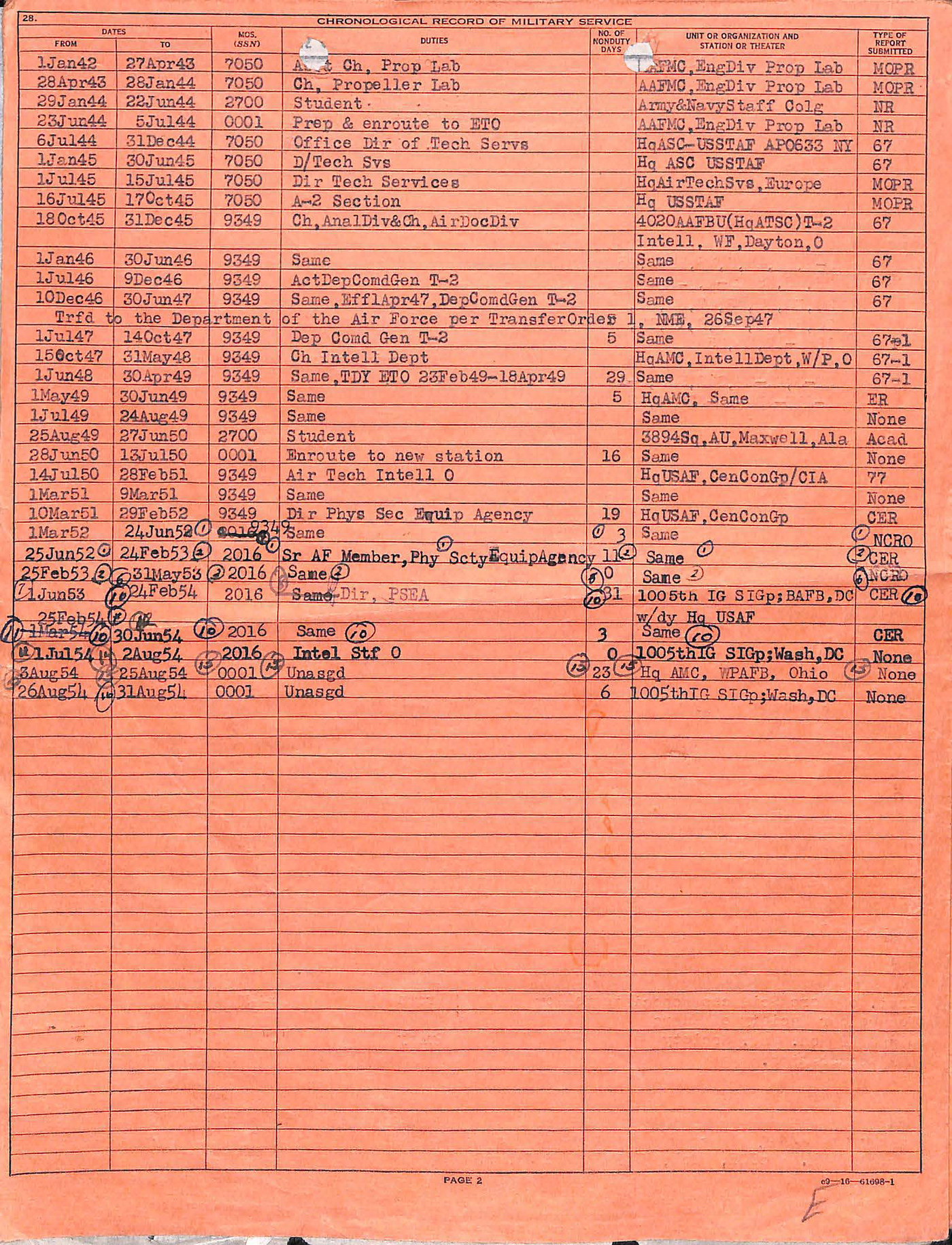
The form carries report number DI-1-53 and control number AF605521. Its subject line is the single word UFOB. The area reported on is "North Fr Morocco and Mediterranean Sea", the originating agency is the 316th Air Division (Defense), the date of information is 16 December 1953 and the date of report 23 December 1953. It was prepared by Major Edward O. Wittmer, Director of Intelligence, approved by Lieutenant Colonel Frank H. Rhoads, Director of Operations, and the source is given as Detachment 2, 737th Aircraft Control and Warning Squadron. The primary report behind it is a teletype numbered TWX 12-177.
The evaluation block reads A-1. On the Air Force's two-part scale that is the highest grade available, a completely reliable source carrying information confirmed by other sources, and it is an uncommon mark to find on a UFOB report.
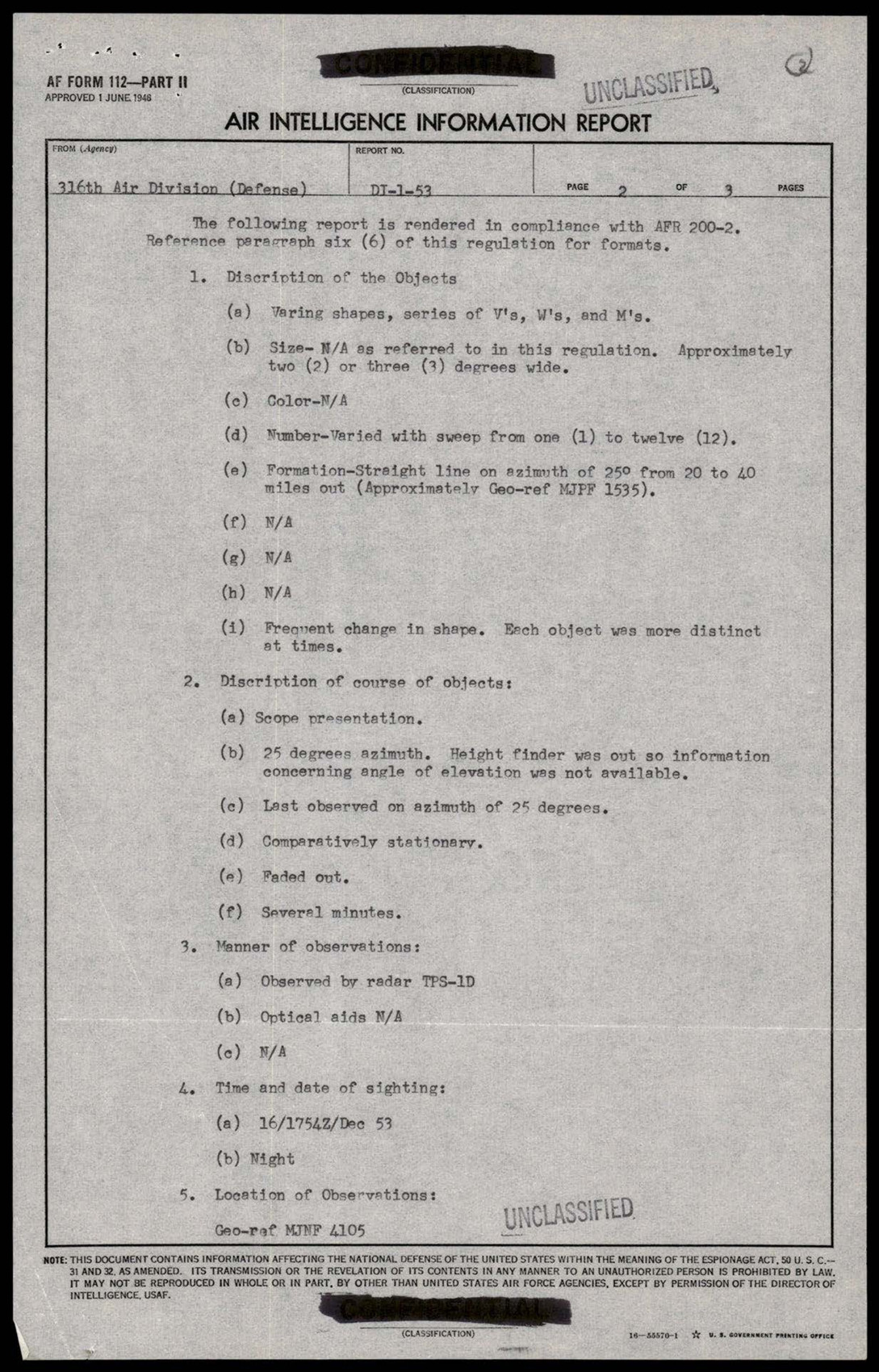
The event itself is timed 16/1754Z December 1953, at night. The description is given in the form's numbered fields and is worth reading as written: "Flaring shapes, series of V's, W's, and M's", approximately two or three degrees wide, colour not applicable, and a count that "Varied with sweep from one (1) to twelve (12)". The formation is recorded as a straight line on an azimuth of 250 degrees at 20 to 40 miles out. The form notes "Frequent change in shape" and that "Each object was more distinct at times". The targets were comparatively stationary, were observed for several minutes, and then faded out.
The set was a TPS-1D. One line in the form decides how much can ever be known about this event: "Height finder was out so information concerning angle of elevation was not available."
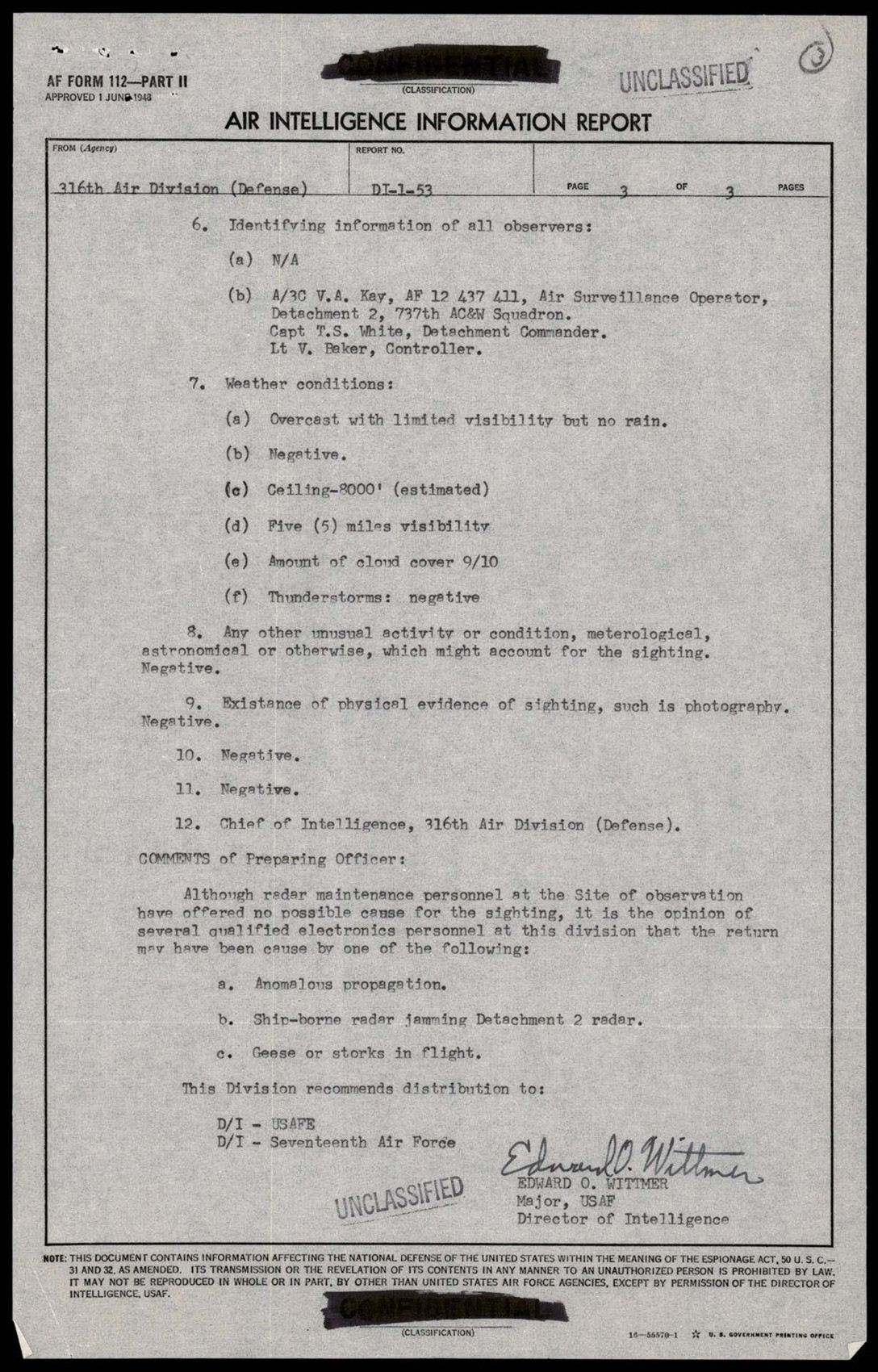
Three men are named: Airman Second Class V. A. Kay, serial AF 12 457 411, Air Surveillance Operator, Detachment 2; Captain T. S. White, the Detachment Commander; and Lieutenant V. Baker, the Controller.
The weather block records an overcast with limited visibility but no rain, an estimated ceiling of 8,000 feet, five miles visibility, nine tenths cloud cover and no thunderstorms. There was no photography and no physical evidence.
More footage and images of this sighting
What is the official explanation?
This file is the official narrative, and its most interesting property is that it contains two of them.
Field 8 of the form asks for "Any other unusual activity or condition, meteorological, astronomical or otherwise, which might account for the sighting". The answer entered is "Negative".
The preparing officer's comment at the end of the report then says something different, and the order of its clauses is the whole point: "Although radar maintenance personnel at the Site of observation have offered no possible cause for the sighting, it is the opinion of several qualified electronics personnel at this division that the return may have been cause by one of the following: a. Anomalous propagation. b. Ship-borne radar jamming Detachment 2 radar. c. Geese or storks in flight."
The summary on page one compresses that into a flat conclusion: "Logical deduction is that one of above mentioned possibilities is the cause for this radar return."
So the people who operated and maintained the radar, who had seen the scope, offered no explanation at all. The three candidate explanations were supplied by electronics staff at divisional headquarters, who had not. The file recommends distribution to the Director of Intelligence, United States Air Forces in Europe, and to the Director of Intelligence, Seventeenth Air Force, with an information copy to the Air Technical Intelligence Center.
What did the witnesses think it was?
There are no visual witnesses. This is a scope-only event, and the three named men are the entire human record: the surveillance operator watching the display, the controller, and the detachment commander.
Nothing in the released file records what any of them said beyond their names and appointments, and no interview, statement or follow-up is attached.
Is the A Shape-Changing Radar Return over Northern French Morocco on 16 December 1953 real? The two-pass assessment
Pass one, how could this be mundane. The file hands over its own three candidates and they deserve to be taken seriously, because two of them are strong.
Anomalous propagation is the leading one and the weather block quietly supports it. A nine-tenths overcast with an estimated 8,000 foot ceiling and visibility down to five miles over a coastal site is the kind of layered, humid air in which a radar beam can be bent downward and return ground or sea clutter from far beyond the normal horizon. Ducted returns characteristically appear at a fixed range band, sit comparatively stationary, break into irregular arcs that look like letters on a scope, vary in number between sweeps and then fade when the layer shifts, which is a close match to every behaviour the form records. Notably, the form's own field 8 says nothing meteorological could account for the sighting, while its weather block describes conditions that could.
Ship-borne jamming is plausible in context. The report covers the Mediterranean approaches at the height of the Cold War, Soviet and other vessels operated there, and deliberate interference would produce bright, shifting, geometrically odd painting on a scope at a consistent bearing.
Birds are the weakest of the three. The Strait of Gibraltar is one of the great migratory corridors, so the division's instinct is not unreasonable, but a flock at 20 to 40 miles on a TPS-1D showing two to three degree wide flaring shapes that hold a straight line and stay comparatively stationary for several minutes is a poor fit, and mid December is late for the main stork passage.
Pass two, if it is not that. The honest answer is that the file cannot be pushed further, and the reason is one broken instrument. The height finder was out of service, so no elevation was obtained for any of the returns. Elevation is the single measurement that separates a ducted ground or sea return, which arrives at effectively zero or negative elevation angle, from an airborne target at altitude. Without it, candidate (a) can be neither confirmed nor excluded, and neither can anything else. A structured, A-1 evaluated, multi-observer radar report is rendered untestable by a piece of equipment being down on the night.
The tier is Unknown. There is no settled official narrative, only a divisional guess recorded over the silence of the men who watched it, and the one measurement that would decide between the candidates was never taken.
Three readings in this case had to be corrected by rendering the scanned pages as images rather than trusting the released document's text layer, which is a standing hazard with this collection. The squadron is the 737th and not the 37th, the ceiling is 8,000 feet and not 0,000, and the division named in field 12 is the 316th and not the 116th.
Sources
More cases from this region: UFO sightings in Morocco