The Space Vehicle Fragments File: Interagency Rules for Objects That Fell From the Sky, 1962 to 1964
A seventy-two page Executive Office file sets out who in Washington would receive, analyse and keep any object that fell from the sky. It was drafted in public and classified versions on the same day, and the two do not say the same thing.
What happened
A seventy-two page file of Executive Office correspondence describes how the United States planned to handle objects that fell out of the sky. It was published on 23 October 2026 as USG-UAP-D002, part of the seventh PURSUE tranche, and it carries a prefix, USG, that had not appeared in any earlier release. The file is not a sighting report. It is the paper trail of an interagency negotiation that ran from 2 October 1962 to 26 May 1964 over a deceptively narrow question: when something falls from space onto the ground, who picks it up, who takes it apart, who keeps it, and who tells the public.
The documents come from the Lyndon B. Johnson Library, National Security File, Files of Charles E. Johnson, in a folder titled "Space Vehicle Fragments - Responsibilities and Procedures", Box 018. The file opens with the library's own withdrawal sheets listing items closed under Executive Order 13292 and under the donor's deed of gift, several of them struck through by hand and marked "open" with a 2014 date, so the released file is itself a record of what was withheld and later let go.
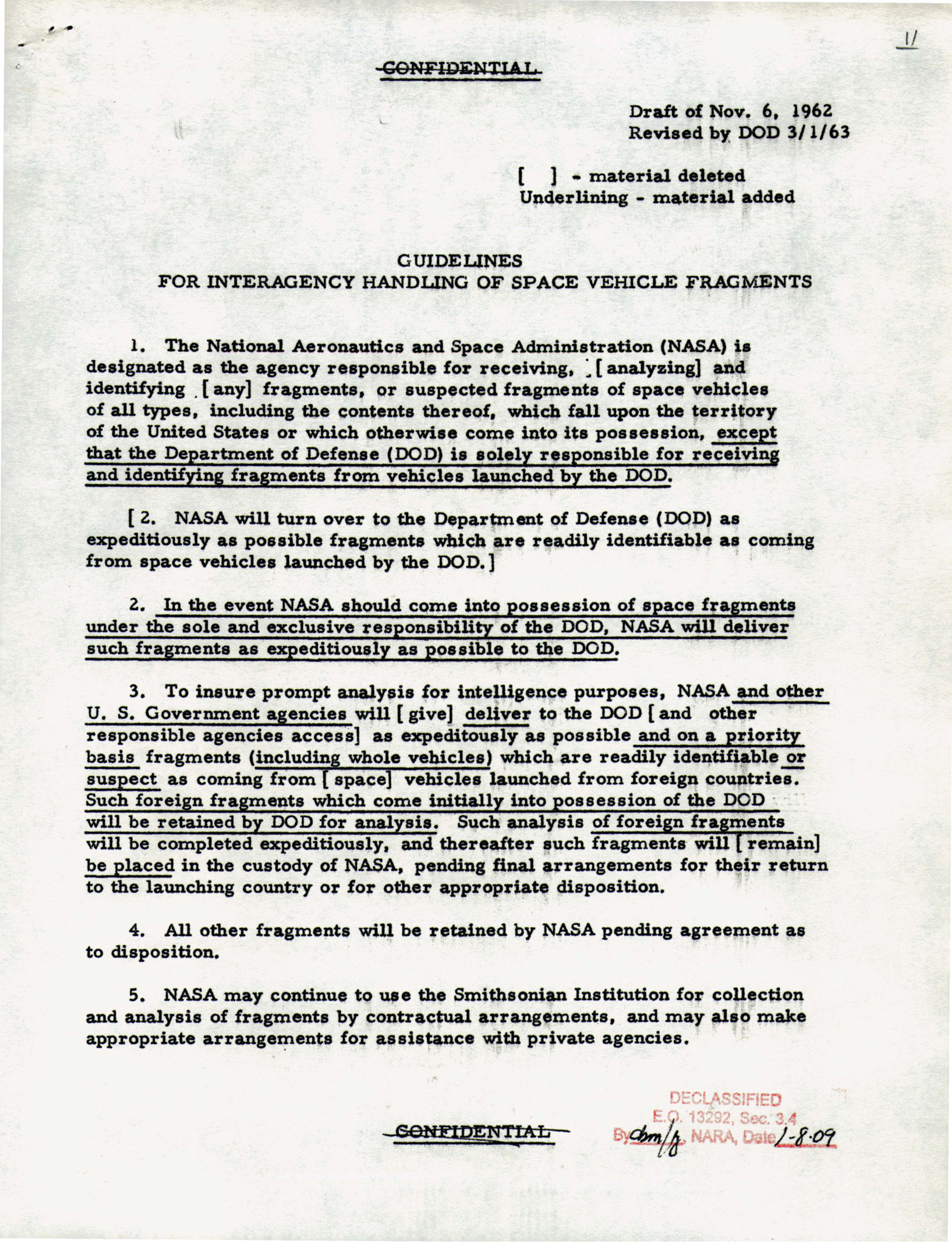
The central artefact is a one page paper headed "GUIDELINES FOR INTERAGENCY HANDLING OF SPACE VEHICLE FRAGMENTS", carried in the file in several versions. The copy at page 11 is marked CONFIDENTIAL and headed "Draft of Nov. 6, 1962, Revised by DOD 3/1/63", with a key stating that square brackets mark deleted material and underlining marks added material. That convention is what makes the file readable as a negotiation rather than as a position.
Its first paragraph designates NASA as the agency responsible for receiving and identifying "fragments, or suspected fragments of space vehicles of all types, including the contents thereof, which fall upon the territory of the United States or which otherwise come into its possession". The phrase "including the contents thereof" is in the original. The Department of Defense added, in underlined text, an exception making itself solely responsible for fragments from vehicles it had launched, and deleted the word "analyzing" from NASA's listed functions, leaving NASA to receive and identify but not to analyse.
Paragraph 3 is the one that matters most and the one with no public counterpart. It reads: "To insure prompt analysis for intelligence purposes, NASA and other U. S. Government agencies will deliver to the DOD as expeditously as possible and on a priority basis fragments (including whole vehicles) which are readily identifiable or suspect as coming from vehicles launched from foreign countries. Such foreign fragments which come initially into possession of the DOD will be retained by DOD for analysis." The misspelling of "expeditously" is in the document. The DoD revision also struck the words "and other responsible agencies access", narrowing the delivery from a shared arrangement to a handover to the Department alone.
The remaining paragraphs distribute the rest. The Atomic Energy Commission participates where radioactive or special nuclear materials are suspected. The Department of State provides policy guidance on returning foreign material and assistance acquiring fragments that fall on foreign territory. NASA may use the Smithsonian Institution under contract and may arrange assistance with private agencies. Paragraph 9 makes NASA "the focal point for the coordination and release of public information on fragments", except for DoD launches, which the Department handles itself.
Documents and images
What is the official position?
The file contains its own public statement, which is what makes it testable rather than merely interesting.
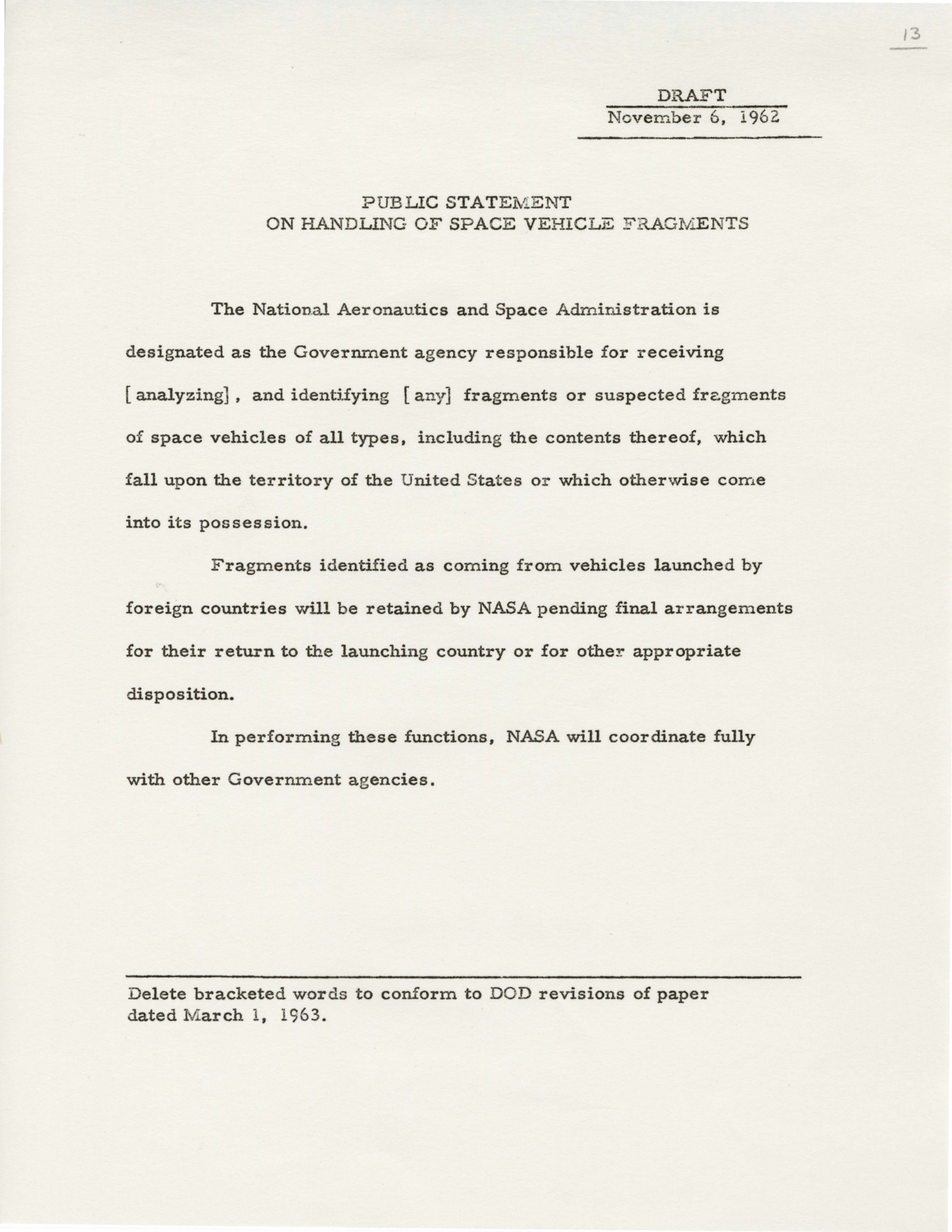
At page 13 sits a separate sheet headed "DRAFT, November 6, 1962, PUBLIC STATEMENT ON HANDLING OF SPACE VEHICLE FRAGMENTS". It carries the same date as the classified guidelines, the same bracket convention, and the same footnote instruction, "Delete bracketed words to conform to DOD revisions of paper dated March 1, 1963", so the two texts were drafted and edited as a matched pair. That pairing is the reason a comparison between them is a measurement rather than an insinuation.
The public statement runs to three paragraphs. Its first reproduces the classified paragraph 1 almost word for word, with one omission: the Department of Defense exception is absent. Its second paragraph reads in full: "Fragments identified as coming from vehicles launched by foreign countries will be retained by NASA pending final arrangements for their return to the launching country or for other appropriate disposition." Its third reads: "In performing these functions, NASA will coordinate fully with other Government agencies."
Set the two side by side and the difference is specific rather than atmospheric. The classified paragraph 3 and the public paragraph 2 describe the same category of object, foreign launched material, and the public version preserves only the tail of the classified one. The classified text routes that material to the Department of Defense first, on a priority basis, for intelligence analysis, and places it in NASA custody afterwards. The public text begins at the custody step and says NASA will retain it. The words "Department of Defense", "intelligence", "priority" and "analysis" do not appear anywhere in the public statement. Neither does the Atomic Energy Commission, nor the Department of State's role in acquiring fragments abroad.
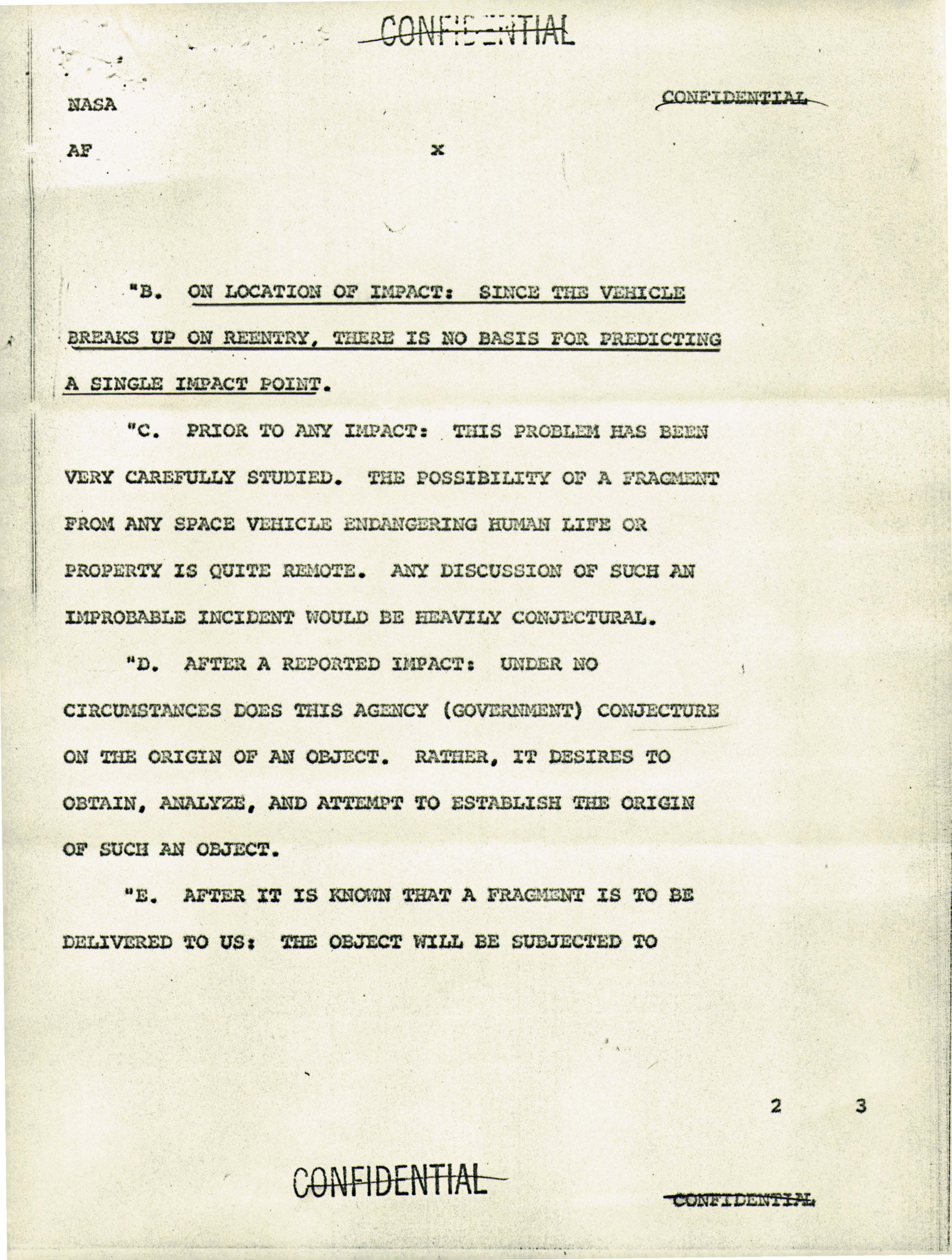
A second document in the file shows the same posture applied to a live event. Pages 2 and 3 carry a NASA message, routed to the Manned Spacecraft Center for Dr. Gilruth, Marshall Space Flight Center for Dr. von Braun, and the Kennedy Space Center, stating the approved response to queries about possible Earth impacts of fragments from the orbiting SA-6 booster. It is dated 26 May 1964 and routed through William F. Hausman. It instructs that no information is being volunteered, that the response was coordinated with the State Department, and that any answer beyond the approved text may come only from the Administrator, the Deputy Administrator or the Associate Administrator.
Its item D is the sharpest line in the file: "AFTER A REPORTED IMPACT: UNDER NO CIRCUMSTANCES DOES THIS AGENCY (GOVERNMENT) CONJECTURE ON THE ORIGIN OF AN OBJECT. RATHER, IT DESIRES TO OBTAIN, ANALYZE, AND ATTEMPT TO ESTABLISH THE ORIGIN OF SUCH AN OBJECT." The parenthetical "(GOVERNMENT)" is in the original, widening the rule from NASA to the government as a whole. A companion sheet dated 8 April 1964 provides longer background answers for the same officials, covering impact probability, fragment dispersal and lethality, and noting that an abbreviated guideline had already been supplied by Mr. Scheer.
What the people involved say
The participants are named, and the roster is heavier than the subject matter would suggest.
A memorandum of 24 October 1963 from the Executive Secretary of the National Aeronautics and Space Council, Executive Office of the President, is addressed to Secretary of State Dean Rusk, Director of Central Intelligence John A. McCone, Deputy Secretary of Defense Roswell L. Gilpatric, Director of the Office of Science and Technology Jerome B. Wiesner, NASA Administrator James E. Webb, and Special Assistant to the President McGeorge Bundy. It is signed E. C. Welsh, that is Edward C. Welsh. It records that draft language had been circulated, that agreement "was initially obtained", that "some variations in preferred language developed", and that there had been "more than sufficient time elapsed since this matter was first examined for the interested agencies to agree upon a responsible position". Welsh calls a meeting for 6 November at 10 o'clock in Room 213 of the Executive Office Building.
The same memorandum records a congressional trigger. In response to an inquiry from Chairman Miller of the House Science and Astronautics Committee about legislation introduced on the subject, the Administrator of NASA had replied that he did not believe legislation was needed "at this time, as the question of responsibility for receiving, analyzing, and identifying fragments and suspected fragments was being considered within the Executive Branch". Welsh notes drily that this "was presumably a reference to the meetings and drafts developed under our auspices". So Congress was told the Executive Branch had the question in hand, and the file is what the Executive Branch actually had in hand.
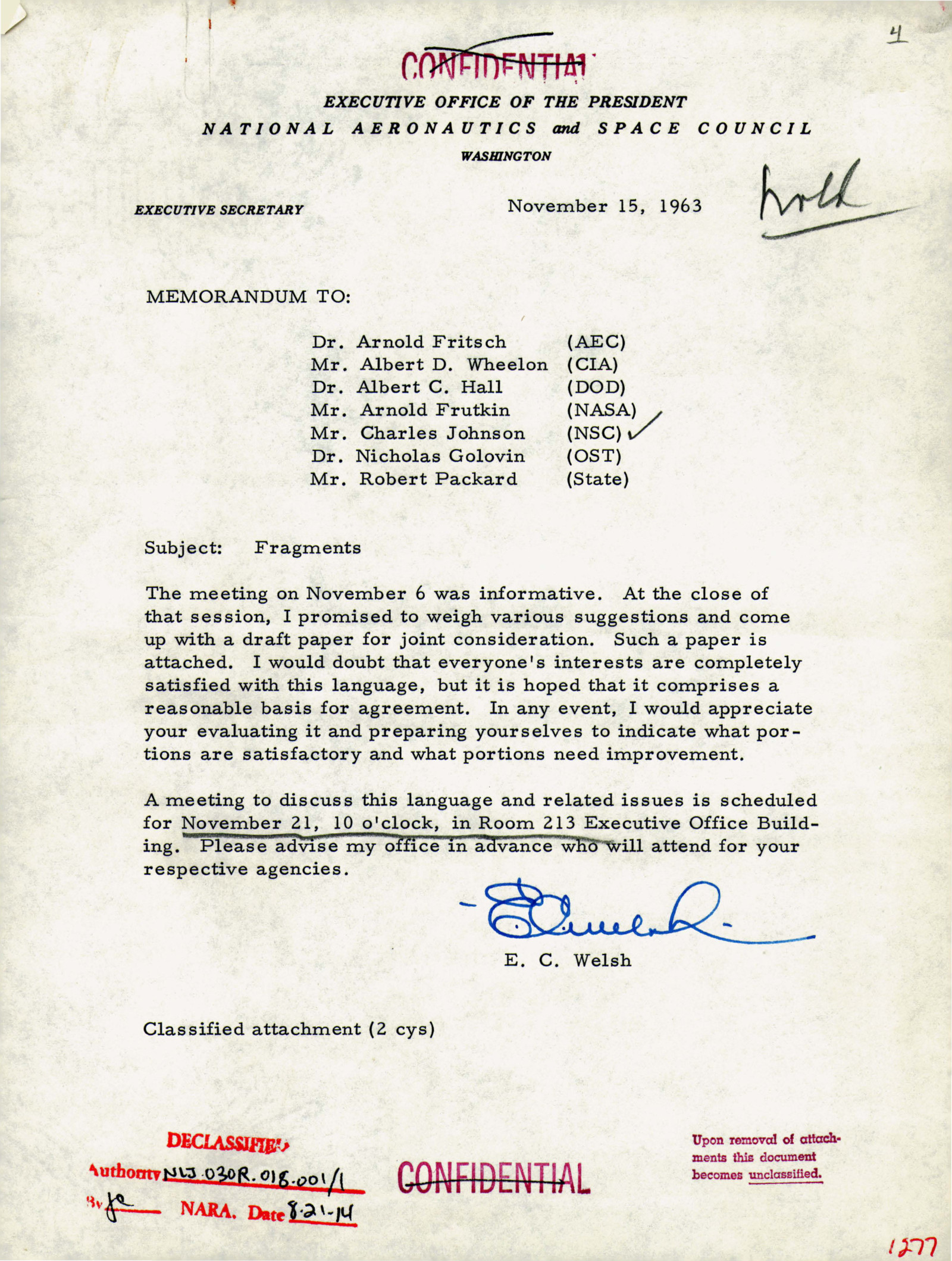
A follow up memorandum of 15 November 1963, also signed E. C. Welsh, goes to the working level and names the ad hoc committee: Dr. Arnold Fritsch (AEC), Mr. Albert D. Wheelon (CIA), Dr. Albert C. Hall (DOD), Mr. Arnold Frutkin (NASA), Mr. Charles Johnson (NSC), Dr. Nicholas Golovin (OST) and Mr. Robert Packard (State). Welsh writes that the 6 November meeting "was informative", encloses a draft paper, allows that "I would doubt that everyone's interests are completely satisfied with this language", and schedules the next meeting for 21 November at 10 o'clock in Room 213. Albert D. Wheelon was at that date the Central Intelligence Agency's first Deputy Director for Science and Technology, so the Agency's representative on a debris handling committee was its senior science and technology officer.
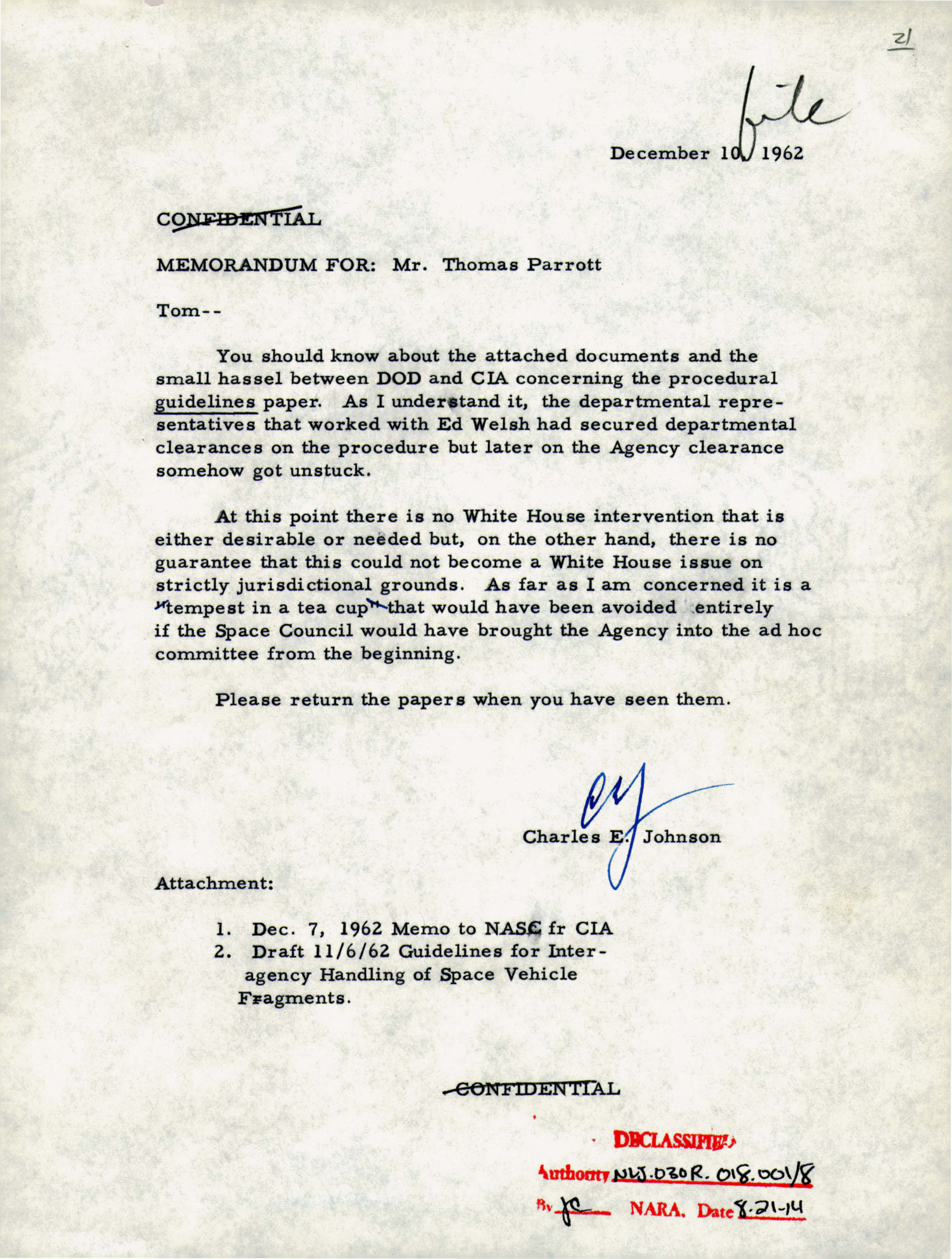
The CIA had not been there at the start. A memorandum of 10 December 1962 from Charles E. Johnson to Mr. Thomas Parrott, written for the file, is blunt about it: "You should know about the attached documents and the small hassel between DOD and CIA concerning the procedural guidelines paper. As I understand it, the departmental representatives that worked with Ed Welsh had secured departmental clearances on the procedure but later on the Agency clearance somehow got unstuck." Johnson judges that "there is no White House intervention that is either desirable or needed", while warning "there is no guarantee that this could not become a White House issue on strictly jurisdictional grounds", and concludes: "As far as I am concerned it is a 'tempest in a tea cup' that would have been avoided entirely if the Space Council would have brought the Agency into the ad hoc committee from the beginning." The misspelling of "hassel" is his. His attachments are listed as a 7 December 1962 memorandum to NASA from CIA and the 6 November 1962 draft guidelines.
Read in order, the arc is plain. A policy is drafted without the CIA in the room, the CIA pulls its clearance, the Space Council spends a further year trying to close the gap, and by November 1963 the Agency is represented by its Deputy Director for Science and Technology. The last dated item in the file is the NASA routing slip of 26 May 1964.
Is the Space Vehicle Fragments File: Interagency Rules for Objects That Fell From the Sky, 1962 to 1964 real? The two-pass assessment
Pass one, the deflating reading, and it is the correct starting point. Nothing in this file is about unidentified objects in the sense this archive usually means. The word "unidentified" appears zero times across the whole text layer, as do "saucer", "UFO" and "anomalous". The subject is orbital debris, in a period when the United States and the Soviet Union were putting hardware into orbit faster than either could reliably predict its return, and when a Saturn booster coming down somewhere unplanned was a real diplomatic and public-safety problem. The agency behaviour the file documents is ordinary interagency boundary drawing: NASA wants the civil role, the Department of Defense wants first access to anything foreign, the AEC wants the nuclear material, State wants control of anything that touches another government. That is what bureaucracies do, and reading conspiracy into a jurisdiction fight is the commonest error available here.
The caution extends to the Department of War's own summary. Its manifest blurb for this record says the correspondence "described a parallel plan to exploit such materials for technical analysis". The word "exploit" appears zero times in the document. The document's own word is "analysis", and its own stated purpose is "intelligence purposes". The substance of the blurb is fair; its vocabulary is not the file's, and the file is more precise than the summary of it.
Pass two, what survives that reading. Three things do, and they are narrow and checkable.
The first is the diff itself. Two texts bearing the same date, the same subject, the same editing convention and an instruction tying one to the other's revisions, differ in a way that is not random. The classified text sends foreign material to the Department of Defense first, on a priority basis, for intelligence analysis. The public text says NASA will retain it. A reader of the public statement in 1962 would have had no way to know that the Department of Defense was in the chain at all, let alone first in it. That is not a conspiracy; it is a drafting decision, made deliberately by people who were editing both documents at once, and the file preserves the evidence of it.
The second is the scope of paragraph 1. The guidelines cover "fragments, or suspected fragments of space vehicles of all types, including the contents thereof". The qualifier "suspected" does real work. It means the policy was written to cover objects whose origin was not yet established, which is precisely the category this archive exists to document, and it means the recovery and analysis chain for such an object was defined, staffed and argued over in 1962. The file does not say any object of unknown origin was ever recovered. It establishes that the machinery for handling one existed and that four agencies and the White House staff spent nearly two years deciding who would operate it.
The third is the public-affairs instruction, which is the most quotable line in the release and cuts in both directions. "UNDER NO CIRCUMSTANCES DOES THIS AGENCY (GOVERNMENT) CONJECTURE ON THE ORIGIN OF AN OBJECT. RATHER, IT DESIRES TO OBTAIN, ANALYZE, AND ATTEMPT TO ESTABLISH THE ORIGIN OF SUCH AN OBJECT." As a statement of method it is defensible and even admirable: do not speculate in public, recover the thing and find out. As a public-information posture it guarantees that the government's answer to "what was that" will be silence until an internal process concludes, and the same file shows that process beginning, for foreign material, inside the Department of Defense. The sentence immediately above it is "NO QUERIES HAVE BEEN RECEIVED" and "NO INFORMATION IS BEING VOLUNTEERED".
The honest verdict is that the negotiation never finished. Welsh was still calling meetings in November 1963 over language first drafted in October 1962, the Agency clearance had come "unstuck", and the Department of War's own summary states that these deliberations "did not produce a settled policy framework". The file is therefore evidence of intent and of institutional appetite, not of an operating system. Tiered Unknown, because there is no official narrative resolving what was finally adopted, and because the documents support a precise claim about drafting and a much weaker one about practice.
What would close it: the 7 December 1962 CIA memorandum to NASA named as Johnson's first attachment is not reproduced in this release, and neither is any final signed version of the guidelines. Both would be worth a targeted request.
Sources
- www.war.gov/UFO/
- www.war.gov/medialink/ufo/release-07/documents/USG-UAP-D002-Interagency_Correspondence_Concerning_Space_Fragments-1962_1964.pdf
- www.war.gov/Portals/1/Interactive/2026/UFO/uap-data.csv
- www.discoverlbj.org/
- www.archives.gov/research/topics/uaps
More cases from this region: UFO sightings in United States