A Light on Soviet Big Diomede: The Little Diomede Air Intelligence Report of 8 October 1953
A fourteen year old Inupiaq boy kept his own nightly watch on Soviet territory two and a half miles away, and one night he saw a light there. The United States Air Force filed his account as a UFOB report and sent it to ten commands.
What did witnesses see at Little Diomede Island?
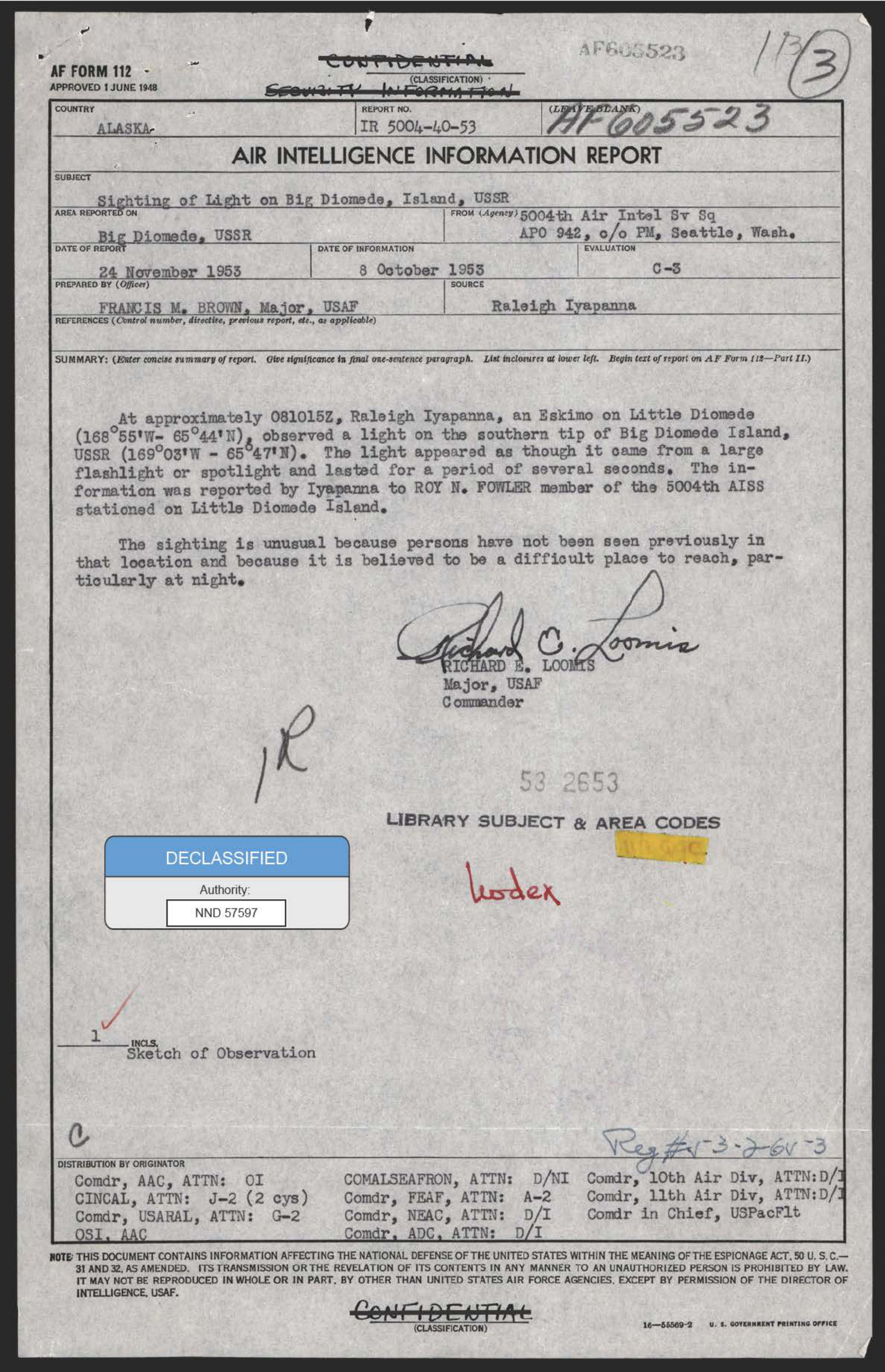
On an October night in 1953 a fourteen year old boy on Little Diomede Island watched a light appear on Soviet territory. He had been keeping watch on his own initiative, every night for a week. The resulting document was released on 23 October 2026 as DOW-UAP-D161, in the seventh PURSUE tranche, and it is an Air Intelligence Information Report on AF Form 112, numbered IR 5004-40-53, filed by the 5004th Air Intelligence Service Squadron at APO 942, care of the Postmaster, Seattle, Washington.
The form's country field reads ALASKA and its subject line reads "Sighting of Light on Big Diomede Island, USSR". The evaluation is C-3, which on the standard Air Force scale means a fairly reliable source reporting information judged possibly true. The preparing officer is a Major, USAF, and the declassification authority stamped on the file is NND 57597.
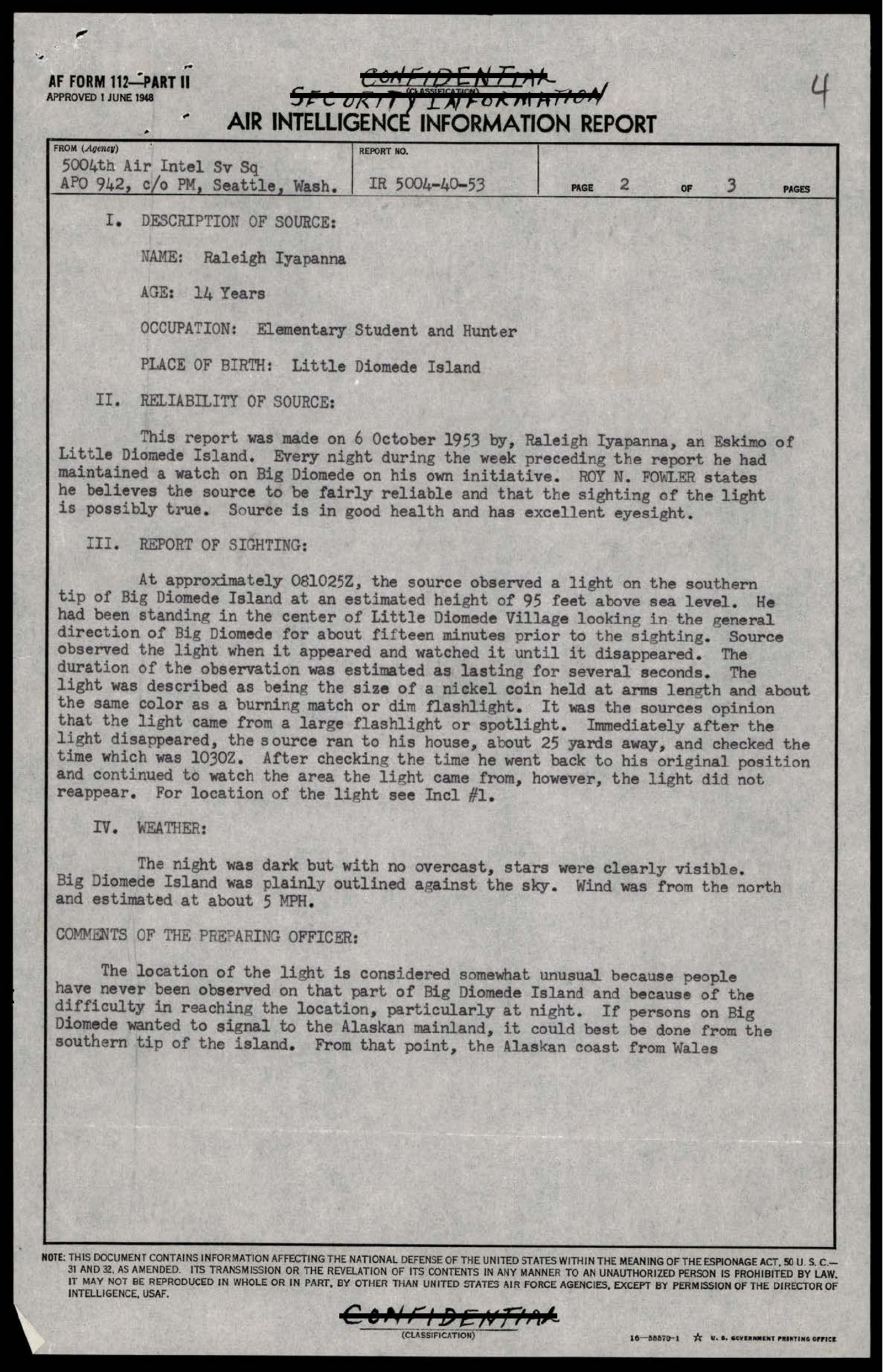
The source is named in full and described without euphemism. Part II opens: "NAME: Raleigh Iyapanna. AGE: 14 Years. OCCUPATION: Elementary Student and Hunter. PLACE OF BIRTH: Little Diomede Island." The reliability section states that the report was made by Iyapanna, "an Eskimo of Little Diomede Island", that "Every night during the week preceding the report he had maintained a watch on Big Diomede on his own initiative", and that Roy N. Fowler, a member of the 5004th AISS stationed on Little Diomede, "believes the source to be fairly reliable and that the sighting of the light is possibly true". It adds that the source "is in good health and has excellent eyesight".
The observation itself is brief and precisely recorded. The boy had been standing in the centre of Little Diomede Village, looking toward Big Diomede for about fifteen minutes, when a light appeared on the island's southern tip at an estimated ninety five feet above sea level. He watched it from the moment it appeared until it vanished, a matter of several seconds. The report describes it as "the size of a nickel coin held at arms length and about the same color as a burning match or dim flashlight", and records his own view that it came from a large flashlight or spotlight. Immediately afterwards he ran the twenty five yards to his house and checked the time, which was 1030Z, then returned to his position and watched the same spot. The light did not reappear.
The weather block is unusually good for a case of this kind: "The night was dark but with no overcast, stars were clearly visible. Big Diomede Island was plainly outlined against the sky. Wind was from the north and estimated at about 5 MPH." The island being plainly outlined matters, because it fixes the light against a known silhouette at a known range rather than against empty sky.
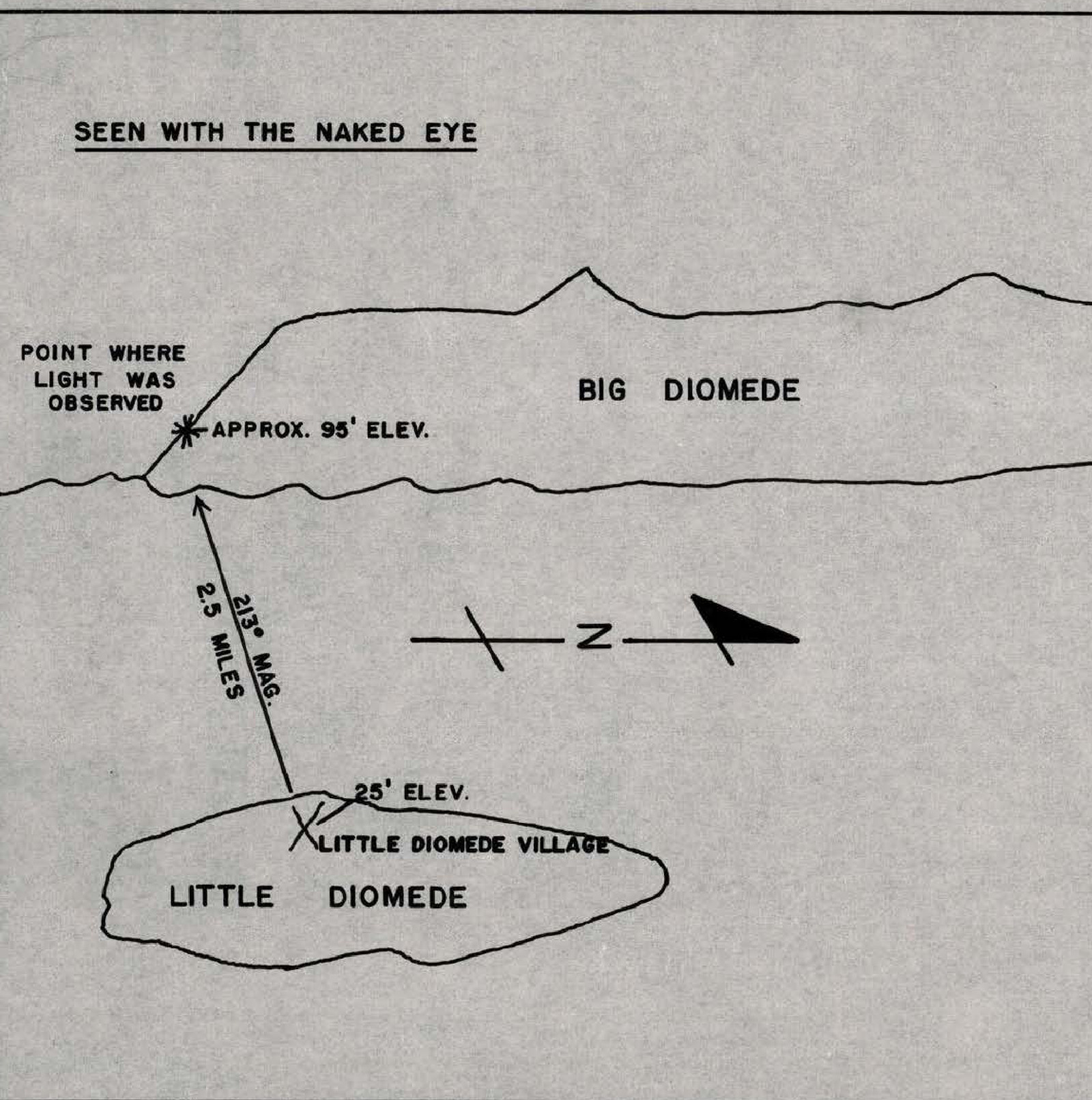
Inclosure 1 is a hand drawn map, and it carries three things the text does not. It gives the bearing from Little Diomede Village to the observed point as 213 degrees magnetic and the range as 2.5 miles, it marks the village at 25 feet elevation and the observed point at approximately 95 feet, and it is headed "SEEN WITH THE NAKED EYE". The sketch is internally consistent with the narrative: north points to the right of the drawing, so the plotted line runs to the southwest, which is where the southern tip of Big Diomede lies from the village.
More footage and images of this sighting
What is the official explanation?
There is no resolution of this report in the released file, and no later evaluation accompanies it.
What the file does carry is its distribution list, and it is the most revealing single element of the document. The report was sent by the originator to the Commander, Alaskan Air Command, attention Office of Intelligence; the Commander, Alaskan Sea Frontier, attention Director of Naval Intelligence; the Commander, 10th Air Division; the Commander in Chief, Alaskan Command, attention J-2, two copies; the Commander, Far East Air Forces, attention A-2; the Commander, 11th Air Division; the Commander, U.S. Army Alaska, attention G-2; the Commander, Northeast Air Command; the Commander in Chief, U.S. Pacific Fleet; and the Commander, Air Defense Command. That is ten commands across three services for a light lasting several seconds, which is a measure of how seriously any activity on Big Diomede was taken in 1953 rather than of how seriously the light itself was taken.
The preparing officer's own comments are the closest thing to an official assessment, and they are a model of restraint that deserves quoting in full rather than paraphrase. "The location of the light is considered somewhat unusual because people have never been observed on that part of Big Diomede Island and because of the difficulty in reaching the location, particularly at night. If persons on Big Diomede wanted to signal to the Alaskan mainland, it could best be done from the southern tip of the island. From that point, the Alaskan coast from Wales to approximately Tin City could be seen when visibility was good. This stated only to mention the possibility however slight it may be. There is no evidence to support a conclusion that this was the purpose of the light."
The officer raises the signalling hypothesis, states the geography that would support it, and then disowns it in the same paragraph. That last sentence is the document doing exactly what this archive asks of its own writing.
One discrepancy in the file should be stated rather than smoothed over. The form's date of information field reads 8 October 1953 and the sighting is timed at approximately 081025Z, with the boy's clock check at 1030Z, so the event fields agree on the eighth. The reliability paragraph on the same form, however, opens "This report was made on 6 October 1953". The Department of War's published manifest adopts the sixth, giving the incident date as 6 October 1953. The two dates cannot both describe the same sequence, since the narrative has the report following a week of watching and the sighting. This archive has dated the case 8 October 1953 on the strength of the form's own date of information and time group, and records the conflict here because the primary document carries both and resolves neither.
What did the witnesses think it was?
Raleigh Iyapanna is the whole of the witness testimony, and the file treats him better than such files usually treat the people in them.
He is named, aged, located and given an occupation. He is described as being in good health with excellent eyesight. His own interpretation is recorded as his, that the light came from a large flashlight or spotlight, rather than being overwritten by the officer's view. His estimate of apparent size is preserved in the unit he offered, a nickel coin held at arm's length. The detail that he ran twenty five yards home to check the clock and then went back out to keep watching is the kind of thing a report invents only if it is copying a real account.
The most striking fact about him is in the reliability paragraph and is easy to read past. He had been keeping a nightly watch on Big Diomede for the week before the sighting, "on his own initiative". Little Diomede and Big Diomede are separated by about two and a half miles of the Bering Strait, and the international boundary and the date line run between them. In October 1953, with the Korean armistice three months old, a fourteen year old on the American island was conducting his own unprompted surveillance of the Soviet one, and the United States Air Force had a man, Roy N. Fowler of the 5004th AISS, stationed on an island of a few hundred people to receive what he saw.
What he actually described is modest and worth keeping modest. A dim, steady, match coloured light, low on a known shoreline, lasting several seconds, in clear air with the island silhouetted against stars. Nothing in the report describes motion, shape, sound, or anything in the sky. The boy did not claim to have seen a craft and the form does not claim it for him.
Is the A Light on Soviet Big Diomede: The Little Diomede Air Intelligence Report of 8 October 1953 real? The two-pass assessment
Pass one, how could this be mundane, and here the honest answer is that it very probably is.
A dim light the colour of a burning match, appearing for several seconds at about ninety five feet above sea level on the shoreline of an island two and a half miles away, is consistent with a person with a lamp. That is the witness's own reading and the preparing officer's leading candidate. Big Diomede in 1953 was Soviet territory with a border garrison presence, so a light on it is unremarkable in itself; the officer's point is narrower, that this particular spot was one where people had not previously been observed and which is hard to reach at night. Other prosaic candidates fit the description without strain: a vessel standing close inshore and showing a light, which is precisely the explanation the companion report from Gambell two months later reaches for, or a brief reflection. The report offers no motion, no shape, no duration beyond seconds and no second witness, so there is very little for an exotic reading to fasten onto.
It should also be said plainly that this is not a UFO case in the usual sense of the term, and the archive should not pretend otherwise. The object was on the ground, on a known island, at a measured bearing and range. It qualified for a UAP document collection because it was filed on the form the Air Force used for unidentified aerial object reports and because its subject was an unexplained light, not because anyone at the time thought it was aerial. Readers arriving from the headline coverage of PURSUE Release 07 should know that before they read further.
Pass two, what remains if the mundane reading is set aside for a moment. Not much about the light, and quite a lot about the system that recorded it.
The light itself stays unexplained in the narrow sense that no one established what it was. The file contains no follow up, no corroboration, no second observation on subsequent nights despite the boy continuing to watch, and no later evaluation. The C-3 grade is the Air Force saying, at the time, that it considered the source fairly reliable and the content possibly true, and nothing in the released record revisits that.
The genuinely interesting content is procedural. A single unexplained light, reported by a fourteen year old civilian, was written up on the Air Force's intelligence reporting form, given a report number, graded on the standard reliability scale, illustrated with a surveyed sketch giving bearing and range, classified, and distributed to ten commands including the Pacific Fleet and Air Defense Command. Seventy three years later it was declassified and published by the Department of War inside a collection about unidentified anomalous phenomena. The same squadron's report from Gambell on 1 December 1953, released as DOW-UAP-D162, shows the same machinery running again two months later on a similar light with a similar lack of resolution.
Tiered Unknown. There is no official explanation in the record, the leading prosaic candidate is reasonable but undemonstrated, and the document's own preparing officer declined to conclude. Following him in that is the correct treatment.
What would close it: the 5004th AISS held a continuous intelligence presence on Little Diomede, so contemporaneous reporting from Roy N. Fowler, or the squadron's own files for October 1953, would establish whether the sighting was ever followed up or whether anything was observed on the southern tip of Big Diomede in the days afterwards.
Sources
- www.war.gov/UFO/
- www.war.gov/medialink/ufo/release-07/documents/DOW-UAP-D161-Air_Intelligence_Information_Report_Alaska-1953.pdf
- www.war.gov/Portals/1/Interactive/2026/UFO/uap-data.csv
- www.archives.gov/research/topics/uaps
More cases from this region: UFO sightings in United States