The Luminous Sphere over Sassari, Sardinia, 27 August 1952
A professor in Sardinia watched a green blue sphere cross the sky in a few seconds, and reasoned his way to an altitude by working out where the Earth's shadow ended. A US Air Attache interviewed him sixteen months later and filed the result to Project Blue Book.
What did witnesses see at Sassari?
A professor of letters in Sardinia watched a luminous sphere cross the sky in about four seconds. He published his own account in the local newspaper the next morning, and sixteen months later the United States Air Attache in Rome interviewed him and filed the result as an Air Intelligence Information Report. That report was released on 23 October 2026 as DOW-UAP-D157, in the seventh PURSUE tranche.
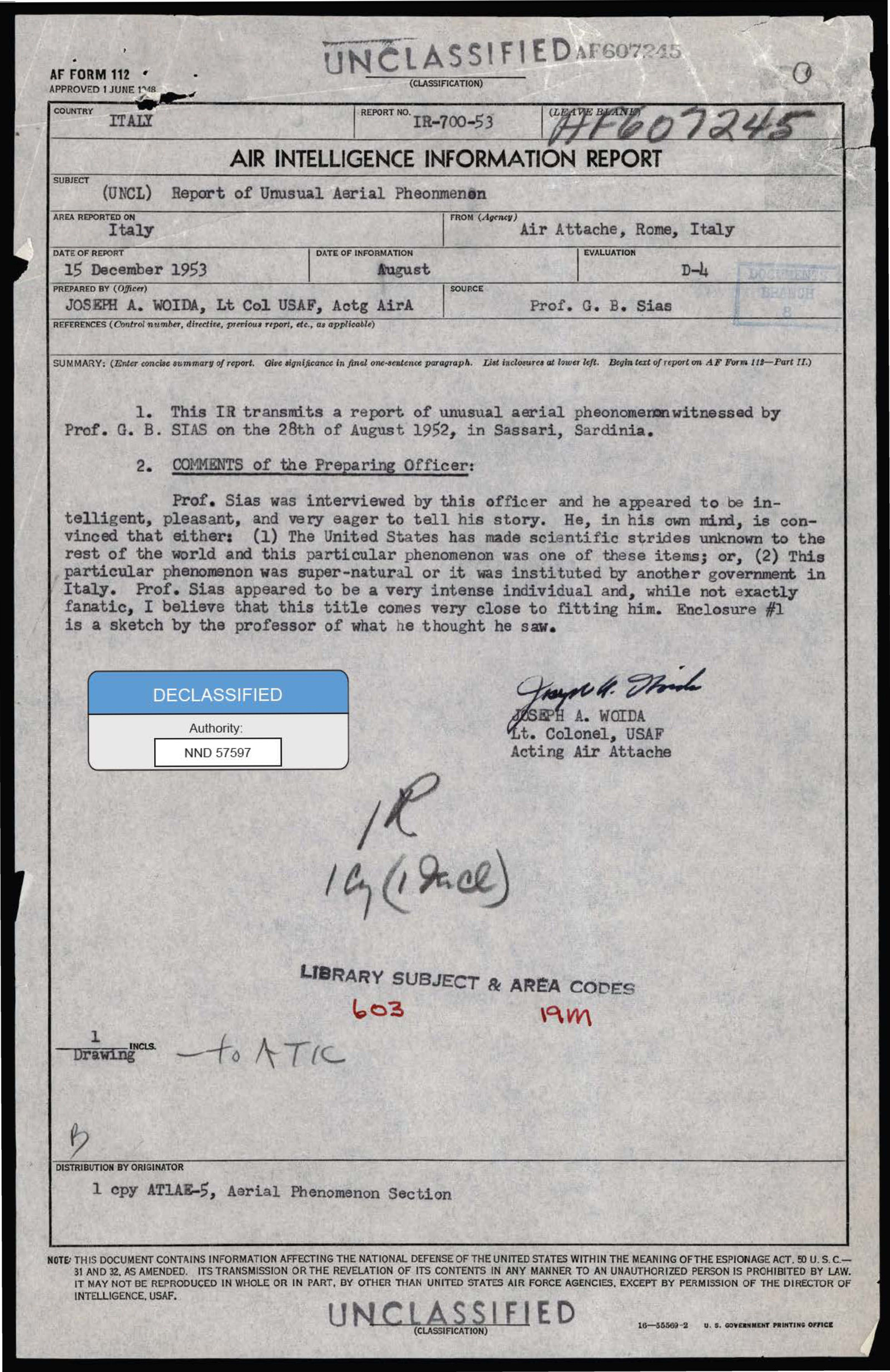
The document is AF Form 112, report number IR-700-53, from the Air Attache, Rome, Italy, dated 15 December 1953, prepared by Joseph A. Woida, Lt Col USAF, Acting Air Attache. The country field reads ITALY and the subject reads "Report of Unusual Aerial Phenomena". The evaluation is D-4. On the standard Air Force scale that is a markedly low grade, indicating a source regarded as not usually reliable and information judged doubtful, and it is worth setting beside the C-3 carried by the Little Diomede report in the same tranche.
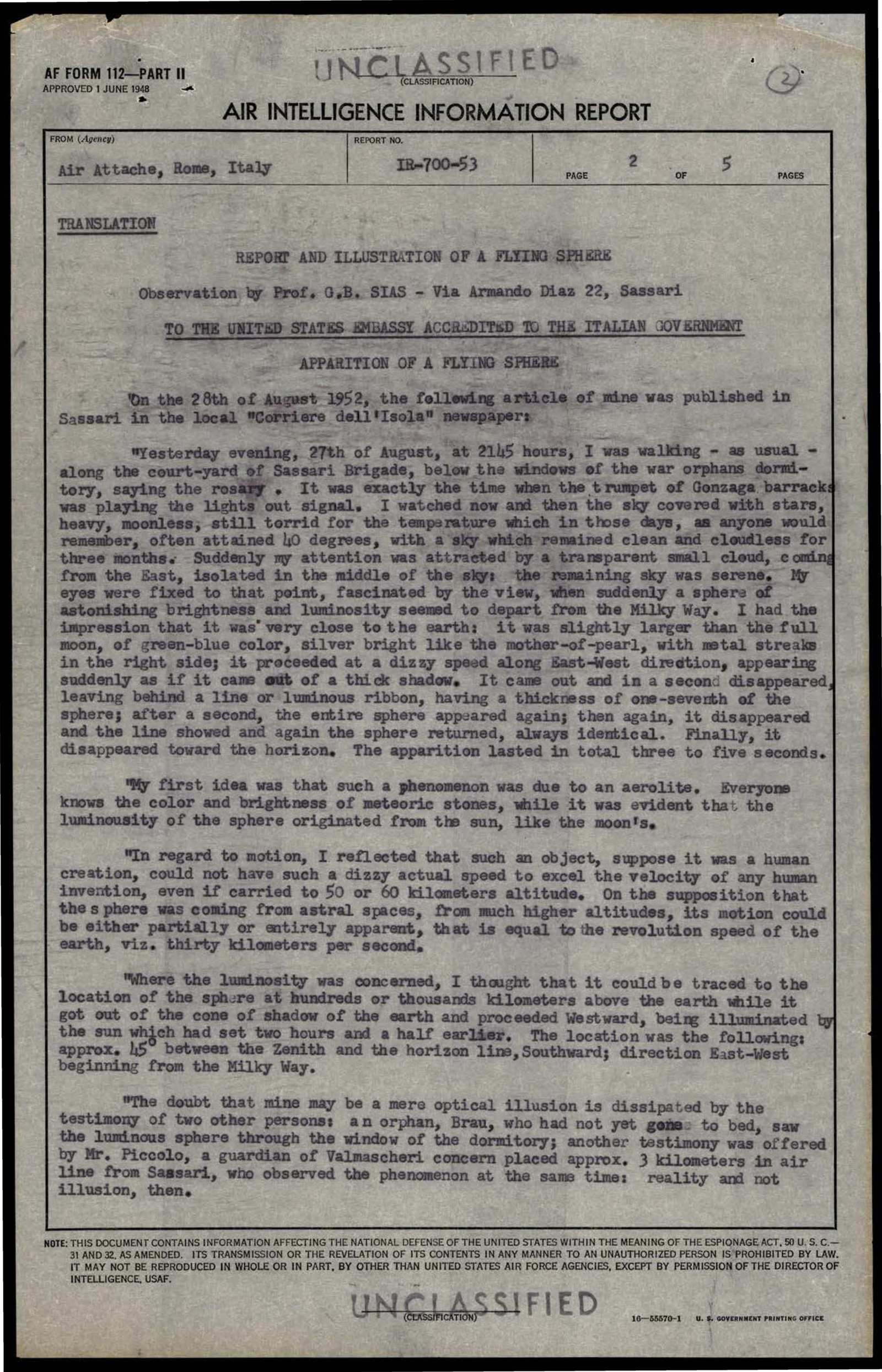
The witness is named and his address is given: Professor Giovanni Battista Sias, Via Armando Diaz 22, Sassari. The body of the report is a translation of a statement Sias wrote out and signed at Sassari on 19 November 1953, which itself quotes in full an article he had published in the local paper Corriere dell'Isola.
His account, as translated, runs as follows. On the evening of 27 August 1952 at 2145 hours he was walking, as usual, along the courtyard of the Sassari Brigade below the windows of the war orphans dormitory, saying the rosary. It was the hour when the trumpet of the Gonzaga barracks was sounding lights out. The sky was clear, moonless and heavy with stars, after a spell of weather in which temperatures had often reached forty degrees and the sky had stayed cloudless for three months.
His attention was caught by a small transparent cloud, isolated in the middle of an otherwise clear sky. While his eyes were fixed on it, a sphere "of astonishing brightness and luminosity" seemed to depart from the Milky Way. He had the impression it was very close to the Earth. He describes it as slightly larger than the full moon, green blue in colour, "silver bright like the mother of pearl, with metal streaks in the right side", proceeding at great speed from east to west. It appeared suddenly as if coming out of a thick shadow, then went out and within a second disappeared, leaving behind a thin luminous ribbon with a thickness of one seventh of the sphere. After a second the whole sphere appeared again, then disappeared again leaving the line, then returned once more, "always identical". Finally it disappeared toward the horizon. He gives the total duration as three to five seconds, and places the object at roughly halfway between the zenith and the horizon to the south, travelling east to west beginning from the Milky Way.
More footage and images of this sighting
What is the official explanation?
The preparing officer's comments are the part of this file that has been reported selectively, so they are worth setting out whole.
Lieutenant Colonel Woida wrote: "Prof. Sias was interviewed by this officer and he appeared to be intelligent, pleasant, and very eager to tell his story. He, in his own mind, is convinced that either: (1) The United States has made scientific strides unknown to the rest of the world and this particular phenomenon was one of these items; or (2) This particular phenomenon was super-natural or it was instituted by another government in Italy. Prof. Sias appeared to be a very intense individual and, while not exactly fanatic, I believe that this title comes very close to fitting him. Enclosure #1 is a sketch by the professor of what he thought he saw."
The Department of War's published manifest summarises that passage as: "The preparing officer characterized Professor Sias as intelligent, pleasant, and eager to share his account." That is accurate as far as it goes and it stops exactly where the assessment turns. Woida's next sentence is the one that explains the D-4 evaluation, and a reader given only the manifest blurb would not know the officer had reached for the word "fanatic" at all. The blurb is not false; it is the first half of a two part judgement presented as the whole of it.
The distribution block is short and pointed: one copy to ATIAE-5, Aerial Phenomenon Section. That is the Air Technical Intelligence Center office that ran the Air Force's unidentified flying object investigation, so this report went to Project Blue Book and to nothing else. Against the ten command distribution of the Little Diomede report in the same release, the contrast shows the Air Force sorting its unexplained lights by whether they had a security dimension or only a phenomenological one.
Two gaps in the released file should be recorded. First, Enclosure 1, the sketch by Sias of what he saw, is listed on the form and is referred to in Woida's comments, but it is not present in the released PDF, which runs to five pages and ends with Sias's signature block. Second, there is no evaluation by ATIC, no Blue Book case number and no disposition anywhere in the file, so what the Aerial Phenomenon Section made of it is not established by this document.
One date correction belongs here rather than in the assessment, because it is a plain reading error with a documentary fix. The report's own summary paragraph states that the phenomenon was "witnessed by Prof. G. B. SIAS on the 28th of August 1952". Sias's own text, inside the same report, says that on 28 August 1952 his article was published, and that the article described what he saw "Yesterday evening, 27th of August, at 2145 hours". The summary has taken the publication date for the sighting date. The Department of War's manifest gets this right, giving the incident date as 27 August 1952 and noting the press report "the following day", so on this point the finding aid is more accurate than the document it describes.
What did the witnesses think it was?
Sias did not simply report the sighting. He tried to solve it, and the reasoning he set down in 1953 is the most interesting thing in the file.
His first thought, he writes, was a meteor, and he rejected it on colour and on the character of the light: "Everyone knows the colour and brightness of meteoric stones, while it was evident that the luminosity of the sphere originated from the sun, like the moon's." He then considered whether it could be a human construction, and concluded that no human invention could achieve such an apparent speed even at fifty or sixty kilometres altitude. He reasoned that if the object were at a much greater altitude its motion could be partly or wholly apparent.
Then he arrives at the argument that matters. He writes that the luminosity "could be traced to the location of the sphere at hundreds or thousands kilometers above the earth while it got out of the cone of shadow of the earth and proceeded Westward, being illuminated by the sun which had set two hours and a half earlier".
That is the sunlit satellite argument, set out in Sassari in 1952, five years before anything artificial was in orbit. It is the same geometry this archive uses routinely to test modern night light cases: an object above the Earth's shadow cone catches sunlight after local sunset, and the depth of the solar depression sets the minimum altitude at which it can still be lit. Sias had the mechanism, the direction of travel, the time since sunset and the inference to high altitude, and he worked it out from first principles.
He also recorded the limits of his own case, and he did it unprompted. In a section headed with the mystery of the line and the luminous sphere, he notes that neither he nor an astronomer he consulted found any hypothesis "entirely satisfactory", and offers as a "quite reasonable" possibility that the discoid sphere presented its fully illuminated surface to the sun alternately along its path, which would account for the appearing and disappearing. He is explicit that his seeing it was accidental: "I must categorically affirm that the vision of the sphere on my part was casual", prompted by the small cloud that drew his eye, and he declines to make a stronger claim, saying it would be presumption on his part.
He names two corroborating witnesses. One is an orphan named Brau, who had not yet gone to bed and saw the luminous sphere through the dormitory window. The other is a Mr. Piccolo, a guardian at the Valmascheri concern approximately three kilometres in a straight line from Sassari, who Sias says observed the phenomenon at the same time. Sias offers them against the charge of optical illusion: "reality and not illusion, then."
Neither witness was interviewed by the Air Attache, and neither gives an independent account in the file. They are named within the statement of the primary witness, which is weaker than independent corroboration and stronger than nothing.
Is the Luminous Sphere over Sassari, Sardinia, 27 August 1952 real? The two-pass assessment
Pass one, how could this be mundane.
The strongest prosaic candidate is the one Sias considered first and dismissed, and his grounds for dismissing it are not as firm as he thought. A bright meteor, specifically a slow bolide with a terminal flare, accounts for most of the account directly: a duration of three to five seconds, motion from east to west across a high portion of the sky, an apparent size judged larger than the full moon, which observers routinely overestimate for bright fireballs, and a persistent luminous train, which is what his "line" or "ribbon" of one seventh the sphere's thickness most plainly describes. The repeated disappearance and reappearance of the sphere while the line remained is consistent with a fragmenting fireball flaring in stages, a common and well documented behaviour. Late August is also within the tail of the Perseid period, though the shower's radiant is in the north east and his object was to the south.
Sias's objection, that the light looked solar rather than meteoric, is a judgement about colour and quality made by eye in a few seconds and is not strong evidence. His calculation about Earth's shadow is elegant and correct as geometry, but it is an inference built on the prior assumption that the object was sunlit, so it cannot be used to establish that it was.
The date adds a further consideration. The last week of August 1952 falls inside the great European sighting wave of that summer, with heavy press coverage in Italy and France, so an observer primed by that coverage reporting an unusual light is the ordinary case rather than the exceptional one. Sias was also publishing in a newspaper the next morning, which is not a neutral act.
Pass two, if the account is taken as given. What survives is thin but not empty. Two additional people are named as having seen it, one of them about three kilometres away, which if true would place the object well beyond local atmospheric effects or anything in the courtyard. The behaviour he describes, a body that extinguishes and re-lights several times while leaving a persistent narrow line, is not the most natural description of a simple bolide, though it is not inconsistent with one. And his own altitude argument, whatever its circularity, is a serious attempt by the witness to constrain his own observation rather than to inflate it.
Against that stands the file's own assessment. Woida graded it D-4, interviewed the man, found him intense to the edge of fanatic, and sent it to the Aerial Phenomenon Section with no recommendation. That officer had the witness in front of him and this archive does not.
A word about how the witness is handled. The archive's standing rule is that a witness is not on trial and that a hostile characterisation is a claim with its own weight, not a verdict. Woida's "very close to fitting" the title of fanatic is a single officer's impression of a man recounting a sixteen month old sighting he had already published and clearly thought about a great deal, and an observer being intense about his own experience is not evidence that the experience did not happen. It is recorded here because it is in the primary document, because it explains the D-4, and because the Department's summary left it out. It is not treated as settling anything.
Tiered Unknown. There is no official explanation in the record, the meteor hypothesis is strong but was never tested and cannot now be tested against a three to five second naked eye account from 1952, and the file closes without a disposition.
What would close it, or come closest: the Corriere dell'Isola issue of 28 August 1952 would give Sias's account in its original Italian and at its original length, a day after the event rather than fifteen months later, and would show whether the paper carried any other reports from the same evening. The Centro Italiano Studi Ufologici holds Italian case files for this period and is an open surface. Any Project Blue Book record keyed to IR-700-53 would show what ATIAE-5 did with it.
Sources
- www.war.gov/UFO/
- www.war.gov/medialink/ufo/release-07/documents/DOW-UAP-D157-Air-Intelligence_Information-Report-Italy-1953.pdf
- www.war.gov/Portals/1/Interactive/2026/UFO/uap-data.csv
- www.cisu.org/
- www.archives.gov/research/topics/uaps
More cases from this region: UFO sightings in Italy