The Florence Stadium Sighting and Angel Hair Fall of 27 October 1954
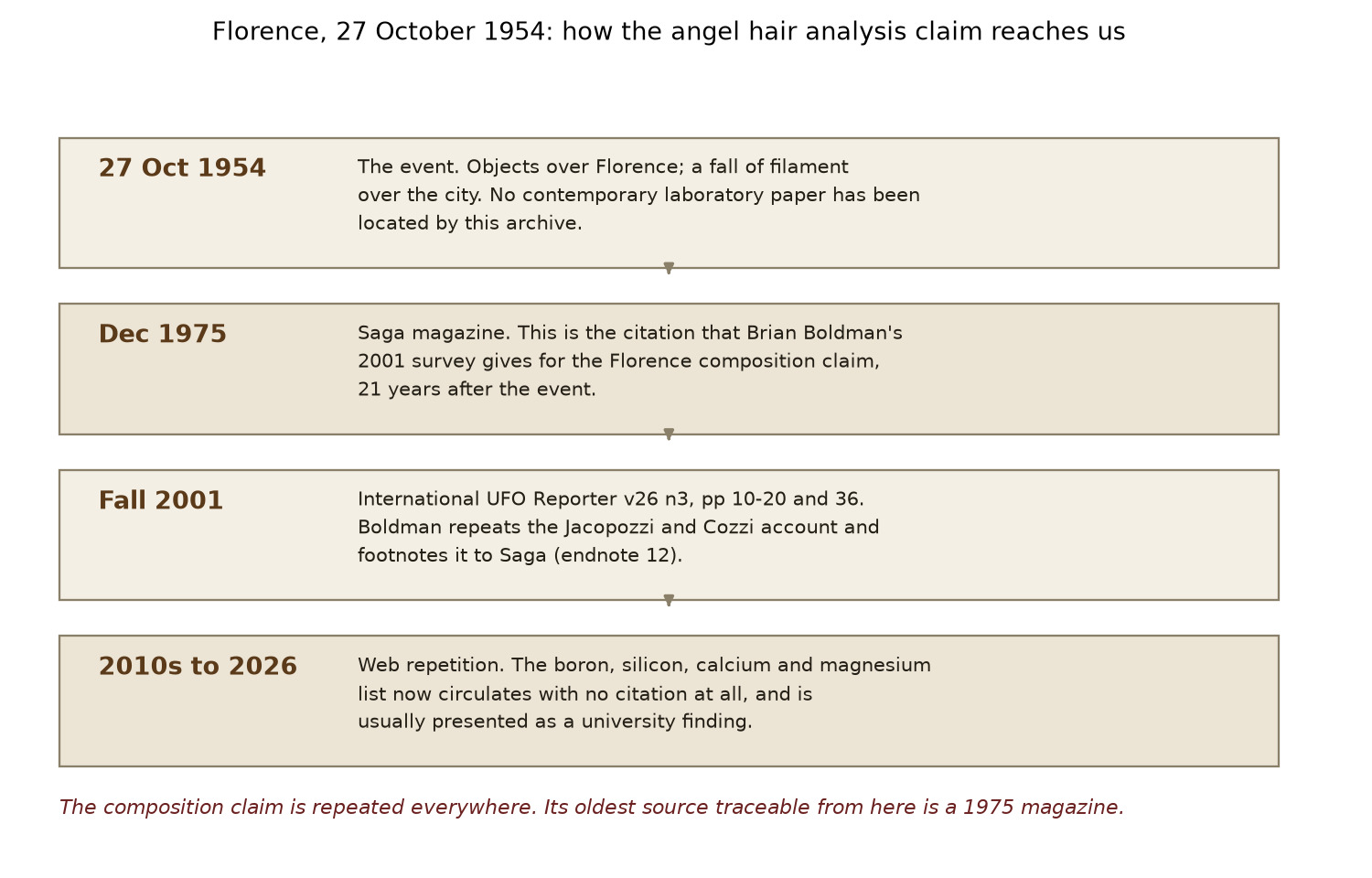
Everyone repeats that a Florence university laboratory found boron, silicon, calcium and magnesium in the filament. The oldest source this archive can actually reach for that claim is a 1975 magazine.
What did witnesses see at Stadio Comunale (now Stadio Artemio Franchi) and the city centre?
On the afternoon of 27 October 1954 a football match in Florence was halted while players and crowd watched objects overhead. A fall of fine white filament followed over the city, and it is the filament, not the objects, that has carried the case for seventy-two years.
The match was a friendly between Fiorentina and Pistoiese at the Stadio Comunale, the ground now called the Stadio Artemio Franchi. The accepted crowd figure is about 10,000. Play stopped for several minutes while spectators and players looked up.
The best-known witness is Ardico Magnini, then a Fiorentina defender who had been in the Italy squad at the 1954 World Cup. In interviews given over many years he described it consistently: "I remember everything from A to Z. It was something that looked like an egg that was moving slowly, slowly, slowly. Everyone was looking up and also there was some glitter coming down from the sky, silver glitter. We were astonished, we had never seen anything like it before. We were absolutely shocked." Other accounts describe forms closer to cigars that moved quickly and then stopped.
The fall of filament is reported over the stadium and over the city centre including the area of the cathedral, and is described as sticky, white, thread-like and short-lived, breaking down soon after it was handled. In Italian the material is called bambagia silicea or capelli d'angelo; in English it is angel hair, and it is a recurring and much older feature of this phenomenon rather than something peculiar to Florence.
The date places the event inside the great European flying saucer wave of autumn 1954, which is the densest reporting period in the continent's record and the context in which every element of this case has to be read.
What is the official explanation?
There is no official narrative. No military or civil investigation of the Florence events has been published, no file number attaches to them, and the Italian state has never issued a finding.
What stands in place of an official narrative is a laboratory claim, and the condition of that claim is the central problem of this case. The standard account is that a young engineering student, Alfredo Jacopozzi, gathered a sample of the filament into a jar before it disintegrated and carried it to the University of Florence, where it was examined at the chemistry institute, with Professor Giovanni Canneri named as the institute's director and Professor Danilo Cozzi as the chemist who ran the tests. The reported result is that the material contained boron, silicon, calcium and magnesium, and that on heating it darkened, evaporated and left a transparent residue which then melted away.
This archive has not been able to reach a contemporary laboratory document, a published paper, or any 1954 record of that analysis. The most carefully sourced English treatment available is Brian Boldman's survey "An Analysis of Angel Hair 1947-2000", published in the International UFO Reporter in autumn 2001, volume 26 number 3, pages 10 to 20 and 36. Boldman gives the Florence entry in almost exactly the words that circulate today, and his endnote for it, number 12, is "Saga, December 1975". Saga was a popular American men's magazine, and that citation sits twenty-one years after the event.
So the chain this archive can verify runs: the event in 1954, a magazine account in 1975, a researcher's survey repeating it in 2001, and uncited web repetition since, by which point it is usually presented as a university finding. The names and the result may well be accurate. They are not, from here, traceable to a primary document, and the case page says so rather than passing the claim along a fifth time.
What did the witnesses think it was?
Magnini's account is the spine of the witness record and it has an unusual quality for a case of this age: he repeated it publicly for decades, in his own name, without materially changing it or expanding it, and without recanting. He was a professional athlete with a public reputation and no apparent interest in the subject.
The crowd figure of around 10,000 is what makes the case famous, but it should be read carefully. A large crowd establishes that many people saw something at the same time and that the event was public and unconcealed. It does not multiply the evidential weight, because what survives is not 10,000 independent statements but a small number of recollections gathered long afterwards, within a strong shared narrative, in the middle of a national newspaper wave.
The material is the other witness. Several people are reported to have handled it, and its most consistently reported property, that it disintegrated or sublimated within a short time, is the reason no sample survives to be tested now.
Is the Florence Stadium Sighting and Angel Hair Fall of 27 October 1954 real? The two-pass assessment
Pass one, how could this be mundane. There is a strong and specific candidate, and it is not a dismissal: ballooning spiders.
Many spider species disperse by releasing silk threads that lift them on rising air, and mass ballooning events drape large quantities of fine silk over the landscape and across cities, with the strands catching sunlight in a way that is routinely described as glittering and falling from a clear sky. Autumn is the season for it in temperate Europe. The skeptic Joe Nickell and others have argued the spider reading for angel hair generally, and the Italian skeptical organisation CICAP has published its own treatment of the Florence case. This archive could not read that article directly, because queryonline.it returns a Cloudflare challenge to every automated client from this machine, so it is listed as a source for the reader and nothing in this assessment rests on its contents.
The spider reading explains the quantity, the season, the stickiness, the thread form, the city-wide distribution and the public spectacle. The argument raised against it is precisely the chemical analysis, since spider silk is a protein and would not be reported as boron and silicon. That is a real objection if the analysis happened as described. It is also the exact claim whose sourcing collapses on inspection, which is why this case is not a contest between an official explanation and an anomaly, but a case where the single piece of physical evidence rests on an untraceable report.
One observation does survive the sourcing problem and is worth recording, because it is checkable and it was made by a named researcher with his endnotes shown. Boldman's survey points out that the same element list, silicon, calcium, magnesium and boron, is reported for angel hair recovered in Victoria, Australia in October 1953 and in Entre Rios province, Argentina in January 1963, and he notes that while silicon, calcium and magnesium are common in the Earth's crust, boron is not, at 3 to 10 parts per million. Whether that pattern reflects a real shared composition or simply a single description being copied between cases across decades is not something this archive can currently decide, and both readings are live.
Pass two, if it is not that. The objects and the filament are separate claims and should be tiered separately in the reader's mind. The filament is the weaker of the two: the chemistry is untraceable, no sample exists, and a well-understood natural process produces the same appearance.
The objects are the part that the spider reading does not touch. Ballooning silk does not stop a football match, and Magnini described a shaped body moving slowly across the sky before the fall began, not a shimmer of threads. Whether that body was a genuinely unidentified object, or one of the many prosaic things a crowd in October 1954 was already primed to see as a flying saucer, cannot be decided from the surviving record.
The tier is Unknown. There is no official narrative to weigh, the physical evidence is gone and its only description is untraceable, there is a strong natural candidate for the fall and no decisive candidate for the objects. The archive's contribution to this case is not a verdict but a correction: the chemical analysis that every account of Florence 1954 leans on should stop being quoted as a university finding until somebody produces the 1954 document.
Sources
- www.nicap.org/articles/IURV26No3.htm
- www.queryonline.it/2014/11/10/1954-ufo-e-bambagia-silicea-su-firenze/
- www.ilfaroonline.it/2024/10/31/capelli-dangelo-e-ragnatele-nel-cielo-tra-spider-ballooning-e-avvistamenti-ufo/593597/
- www.cisu.org/
More cases from this region: UFO sightings in Italy