Four Lights Over the Sinop Region: The Trafego Hotel Report Filed With CINDACTA IV (6 August 2025)
Brazilian outlets reported four OVNIs over Sinop, seen by an airline captain at 41,000 feet. The Air Force form underneath that story says something narrower and stranger. It records a Learjet 45 on an import ferry into Brazil, sitting on radial 174 at 130 miles from the Alta Floresta VOR, with three lights holding a triangle below the jet and a fourth circling above them for eighteen minutes, and nothing to show for it afterwards but the captain's word.
What did witnesses see at Santa Carmem?
The primary document exists, it is public, and this archive has read it. Dossier BR DFANBSB ARX.0.0.918 in the Arquivo Nacional's Objeto Voador Nao Identificado fund is four handwritten pages of a form headed ANEXO C, MODELO DE FICHA DE CONTROLE DE TRAFEGO HOTEL, issued under COMANDO DA AERONAUTICA and COMANDO DE OPERACOES AEROESPACIAIS and carried in NOSDA VIG 06 of 6 December 2017. Every page is stamped MATERIAL DE ACESSO RESTRITO, Art. 44, 45 E 46 do Decreto n 7.845, de 14 de novembro de 2012, NIVEL 1.
The occurrence block is unambiguous. Data 07/08/25. Hora 00:30 Z. Tempo de duracao: 0027Z to 0045Z, eighteen minutes exactly. Mato Grosso keeps UTC minus four, so in local time the sighting ran from 20:27 to 20:45 on the evening of 6 August 2025. Under Local da ocorrencia the position is given in navigation terms rather than place names, RDL 174/130NM ATF (SBAT), followed by the note Aeronave estava no FL410. The Municipio and UF fields are struck through and left empty. Tipo: Avistamento. Observacao feita com equipamentos: N. Existem registros ou provas fisicas: N. Visibilidade: ceu limpo.
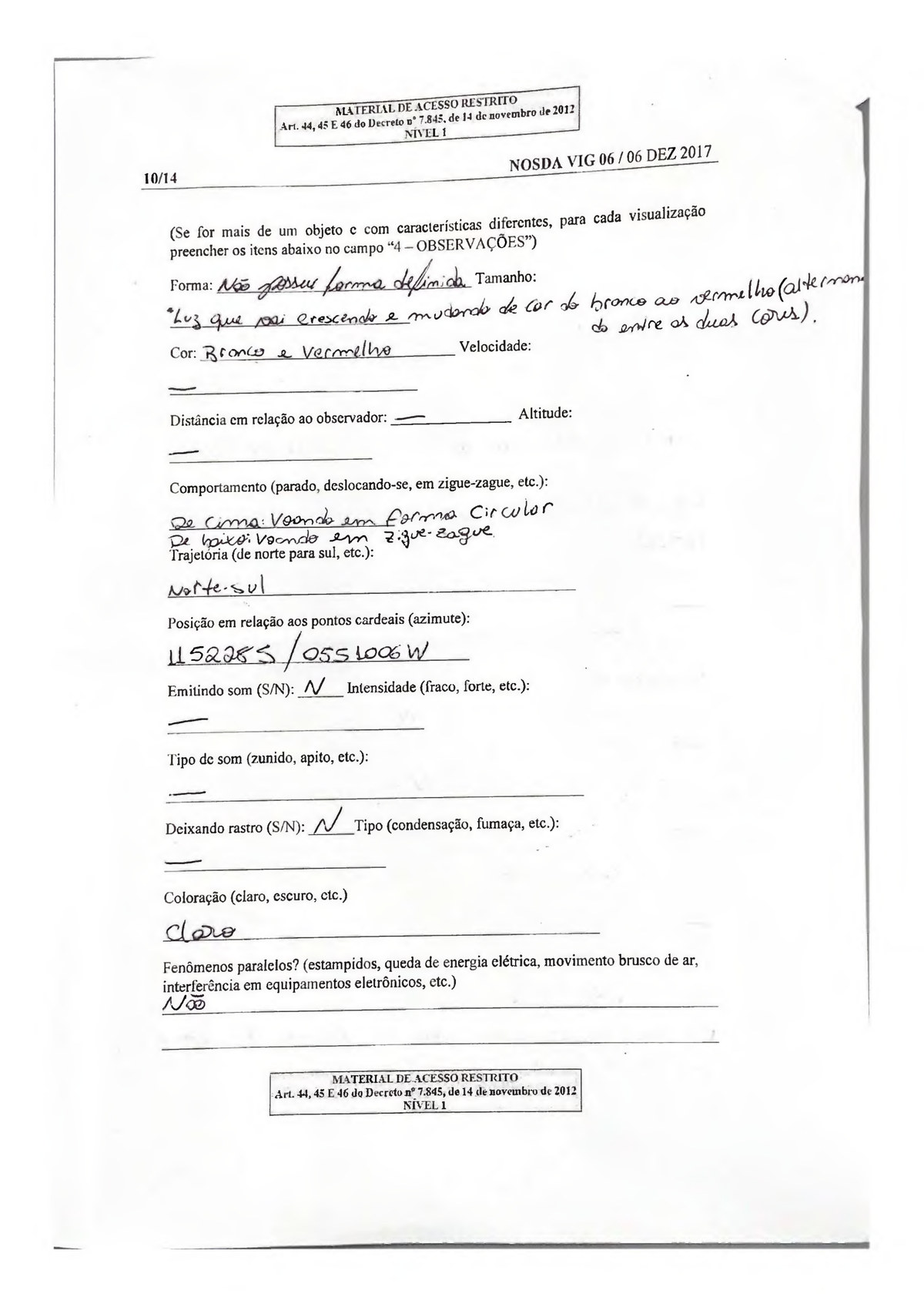
The object block is the heart of it. Quantidade: 04. In the space asking how far apart they were, the pilot wrote two lines instead: 03 abaixo, aparentavam estar em formacao (formato triangular), and 01 acima, voando em circulo. Forma: nao possui forma definida. Where the form asks for size he described behaviour instead, a light that keeps growing and changing colour from white to red, alternating between the two. Cor: branco e vermelho. Speed, distance and altitude are all blank, which is honest of him, because from a dark cockpit there is no way to fill them. Comportamento answers in two registers, de cima, voando em forma circular, and de baixo, voando em zigue-zague. Trajetoria: norte-sul. Emitting sound: N. Leaving a trail: N. Coloracao: claro. Fenomenos paralelos, the field that would catch electrical interference or a violent movement of air: Nao.
The field headed Posicao em relacao aos pontos cardeais (azimute) does not hold an azimuth. It holds a latitude and a longitude, written 1152 25 S / 055 10 06 W. That one line is where the published version of this case goes wrong, and it is worth settling, because it moves the sighting about fifty kilometres.
What is the official explanation?
Trafego Hotel is the Air Force's own name for unidentified traffic, Hotel being the phonetic letter that marks a contact as unknown, and the form belongs to COMAE, the Comando de Operacoes Aeroespaciais. Section 4, Da comunicacao a uma organizacao militar (OM) da Aeronautica, is filled in: Data da comunicacao 07/08/25, Hora 00:30 Z, OM: CINDACTA IV, COPM. CINDACTA IV sits in Manaus and controls the Amazon airspace, and its operations centre logged the call within three minutes of the sighting ending. The rank and name of the officer who took it are blacked out.
Brazil is unusual in having a settled civilian route for this material, and the route is written down. Portaria do Comando da Aeronautica number 551/GC3 of 9 August 2010 governs the forwarding of aerial phenomena reports received by COMAE to the Arquivo Nacional, where they form the fund Objeto Voador Nao Identificado, reference BR DFANBSB ARX. The archive's own description of the fund lists relatos, questionarios sobre ocorrencias, correspondencias, fotografias, desenhos, videos, audios e recortes de jornais. The fund has grown far past the 743 records that description still quotes: working the archive's image server directly, this archive found live dossiers running from ARX.0.0.1 to ARX.0.0.932 and nothing above 932.
The 2025 material arrived as one batch and can be dated to the minute. Each of the eighteen dossiers from ARX.0.0.915 to ARX.0.0.932 carries a PDF creation timestamp of 11 August 2026 between 16:54 and 16:56, and each names the same Air Force sergeant as author. Eighteen is exactly the number that then went into the press. CNN Brasil published first at 18:48 on 12 August 2026, counting eighteen Brazilian reports for 2025 with Londrina in Parana holding five and Ceara four, and printing cropped scans of several forms including this one. Mato Grosso outlets named Sinop from 13 August and G1 Mato Grosso ran it on 14 August.
What the state has actually said is narrow. The FAB told G1 that it merely catalogues and forwards the reports it receives, without carrying out investigations, and that it nao realiza estudos e analises acerca do tema, apenas cataloga as informacoes prestadas por terceiros e as remete, periodicamente, ao Arquivo Nacional. That is a statement about filing, not about this sighting. Nobody at the Aeronautica, DECEA or CINDACTA IV has commented on ARX.0.0.918. The form has no conclusion field, no evaluation box and no investigating officer's finding, nothing like the verdict line on a Blue Book record card, and no radar note or controller statement is attached. LATAM commented publicly on a different record in the same batch, a captain's report near Guarulhos on 1 September 2025. On this one the state has recorded and filed, and that is all.
What did the witnesses think it was?
Section 3, Dos observadores, is the most heavily redacted page. The number of observers is blank, so it cannot be said whether the first officer saw anything. The name line reads Aeronave, a black bar, an arrow, Piloto em Comando, then another black bar. Profissao: Piloto Comercial. Conhecimentos tecnicos de aviacao: Sim. Conhecimentos tecnicos sobre meteorologia: Sim. The two questions that would flag an enthusiast, whether he has knowledge of OVNI and whether he belongs to any organisation that studies them, are both left empty.
The Observacoes page is where the case stops being anonymous. The call sign is blacked out and almost nothing else is: Codigo de chamada, redacted, SSR 6114 as far as the ink allows, tipo da ANV LJ45, de SBEG para SBKP, decolado as 2257Z e reportado as 0027Z na RDL 175/130NM ATF (SBAT). Below it the officer copied the filed flight plan remarks verbatim, including PBN/A1B2C2D2L1O2S2 DOF/250806 EET/SBBS 0155 OPR/SAVIXX COMERCIO INTERNACIONAL S/A ORGN/SBEG YOYX PER/C RMK/AVANAC, a redaction, then DAT SBEG 25000905 CFM FAA PTC 1663609 SIC 4160251 SBAE CFM FROM TBPB REG/N612YM.
Read field by field, the flight resolves. SBEG is Manaus Eduardo Gomes and SBKP is Campinas Viracopos, so the route the press reported is right. DOF/250806 is the date of flight, 6 August 2025, fixing the date a second time from an independent field. LJ45 is a Learjet 45, a light business jet. REG/N612YM is the registration, and the United States registry answers to it: a Learjet 45, serial 248, built 2004, held by Bank of Utah as trustee, certificate issued 24 July 2025, registration cancelled on 14 August 2025 as exported to Brazil. Savixx Comercio Internacional S/A, named as operator, sells itself as an importer of executive aircraft. AVANAC is the authorisation ANAC requires of a foreign registered aircraft operating in Brazil, and TBPB is Grantley Adams in Barbados, a standard staging point on a ferry south. So this was an American registered light jet being delivered into Brazil under an import authorisation, eight days before it left the United States register. It was not a scheduled airline service, and the airline captain of the headlines is a reading of Piloto Comercial, a licence grade in Portuguese, as airline pilot.
The coordinate deserves the same treatment. Every outlet that printed a position printed 11 52 25 S and 55 40 06 W, identically, and that figure is what put the sighting inside the municipality of Sinop and generated the headline. The handwriting does not say that. The digit after 055 is formed exactly like the writer's ones elsewhere and nothing like his fours, which he closes into a triangle, as in FL410 on page one. Better, the form settles it against itself. DECEA lists ATF as the VOR/DME at Alta Floresta on 113.4, at 09 52.10 S and 056 06.30 W. With the current IGRF declination there of minus 18.87 degrees, radial 174 at 130 nautical miles lands at 11 49 53 S, 055 10 30 W. Run it the other way and the coordinate on the form sits at radial 174 and 132 miles from ATF, which is the number the pilot wrote two fields earlier. The published coordinate sits at radial 187 and 123 miles, which is not. Read as 055 10 06 W the document agrees with itself twice; read as 55 40 it does not agree with itself at all. That reading puts the point inside the municipality of Santa Carmem under the IBGE boundaries, about 36 kilometres east of Sinop city, still in the Sinop region and still inside the airspace CINDACTA IV controls. Nobody could check the transcription, because the only scan any outlet published is CNN's crop of page two, which stops one line above the coordinate.
Is the Four Lights Over the Sinop Region: The Trafego Hotel Report Filed With CINDACTA IV (6 August 2025) real? The two-pass assessment
Pass one. How could this be ordinary?
Other aircraft is the strongest candidate and explains a surprising amount. A light that grows and alternates white and red is the signature of a white strobe and a red anticollision beacon on a machine slowly changing aspect. A Learjet 45 at FL410 sits above almost all the airline traffic on the Manaus corridor, which normally cruises between FL340 and FL400, so traffic below is the expected sight rather than the strange one. The horizon dip from 12.5 kilometres is 3.6 degrees, so anything near the visible horizon genuinely appears below the aircraft. Three jets on nearby tracks can hold an apparent triangle for many minutes while the geometry changes slowly, and apparent zigzag is what the eye does with a distant point and no fixed reference. Against it, a fourth light circling above an aircraft already at FL410 is much harder to place, and eighteen minutes is a long time for a professional crew to watch three contacts without deciding they were traffic. The form has no field for what the collision avoidance system showed, and that silence is the biggest hole in the record.
Satellites and Starlink trains can be ruled out on geometry rather than waved away. JPL Horizons, queried for this exact fix at 12.5 kilometres altitude, puts the Sun 43.5 degrees below the horizon on azimuth 281 through the window. At that depression the Earth's shadow reaches roughly 2,410 kilometres directly overhead, and even down at the horizon toward the sunset azimuth the floor for sunlight is about 500 kilometres. Starlink flies near 550. Nothing in low orbit was lit in that sky except within a few degrees of the western horizon, and these objects were below the aircraft on a north to south track.
Planets fit one detail and fail the rest. Horizons for the same site and minutes puts Venus 74 degrees below the horizon and Jupiter 69 below, both out of play. Mars was setting in the west, from 4.4 degrees up to 2.9 down on azimuth 270 at magnitude 1.5, and Saturn rising in the east from 6.2 down to 1.2 up on azimuth 92 at magnitude 0.77. A planet seen through that much slant atmosphere scintillates violently and flashes colour, a fair match for a light that grows and swaps between white and red. It is not a match for four of them, neither body was in the north, and the Moon was 63 to 68 degrees up at magnitude minus 11.95, two nights from full, so the sky was bright and only an obvious light would have held a crew's attention.
The burn season deserved a real check, because northern Mato Grosso in August is one of the most fire covered places on Earth. INPE's national hotspot record for August 2025 logs 7,311 detections within 200 kilometres of this fix across the month. In the eight hours from 20:00Z on 6 August to 04:00Z on 7 August it logs none within 200 kilometres, and the nearest detection anywhere in the window was 225 kilometres away. The geostationary GOES-19 sensor, which scans continuously, recorded 238 detections within 300 kilometres over the course of 6 August, so the instrument was watching the ground beneath this aircraft and found nothing burning under it that night.
Balloons, drones, meteors and re-entries fail on duration or geometry. A balloon drifts with the wind and does not hold formation while a companion circles. Drones do not work the flight levels 240 kilometres from the nearest sizeable airport. A meteor lasts seconds and a re-entry a couple of minutes, not eighteen.
Pass two. What is left standing?
A contemporaneous filing on the state's own form, made by a licensed professional in the moment, logged at CINDACTA IV within three minutes of the event ending, giving the position twice in independent notation and internally consistent once somebody checks it. That is a better class of record than most of what this archive handles. The witness reported four discrete objects in two layers behaving differently, held them for eighteen minutes on a clear night, and answered no to sound, no to trails and no to interference, which are exactly the fields an inventor tends to fill in.
What is missing is severe. There is no photograph, no video and no physical trace, and the pilot marked all three fields no himself. No radar correlation is recorded, no second observer is named, and the witness is redacted, so the report cannot be followed up. Brazilian ufology has not touched it: neither Revista UFO nor OVNI Hoje has published on the case, nobody on the ground in Sinop, Santa Carmem, Claudia or Alta Floresta has come forward, and the only picture circulating with the story is an artificial illustration on one regional site, worth naming so that nobody mistakes it for evidence. The published account has already gone wrong twice, on the aircraft and on the longitude, which is a fair measure of how fast a filing like this drifts once it leaves the folder.
There is no official explanation, no named analyst has published a method that accounts for these four lights, and the Air Force catalogues these reports without adjudicating them. The honest tier is Unknown.
Sources
- imagem.sian.an.gov.br/acervo/derivadas/BR_DFANBSB_ARX/0/0/0918/BR_DFANBSB_ARX_0_0_0918_d0001de0001.pdf
- www.gov.br/arquivonacional/pt-br/canais_atendimento/imprensa/noticias/conheca-o-fundo-sobre-ovnis-do-arquivo-nacional
- www.cnnbrasil.com.br/ciencia/pilotos-e-controladores-relataram-18-casos-de-ovnis-no-brasil-em-2025/
- g1.globo.com/mt/mato-grosso/noticia/2026/08/14/piloto-relata-ter-visto-4-ovnis-em-formacao-triangular-durante-sobrevoo-em-mt.ghtml
- ndmais.com.br/ciencia-e-espaco/ovnis-brasil-relatos-pilotos-controladores-2025/
- www.expressaonoticias.com.br/piloto-relata-quatro-ovnis-sobre-sinop-tres-luzes-formavam-triangulo/
- www.nortaomt.com.br/piloto-de-voo-comercial-relata-quatro-ovnis-sobre-sinop-tres-luzes-teriam-formado-triangulo/
- www.sonoticias.com.br/geral/piloto-de-aviao-comercial-relata-a-aeronautica-avistamento-de-ovnis-sobre-sinop/
- www.estadaomatogrosso.com.br/cidades/piloto-relata-ter-visto-4-ovnis-em-formacao-triangular-durante-sobrevoo-em-mt/144039
- nativanews.com.br/geral/piloto-de-aviao-comercial-relata-avistamento-de-quatro-ovnis-sobre-sinop/
- www.powermix.com.br/sinop/piloto-relata-quatro-ovnis-sobre-sinopmt-tres-luzes-formavam-triangulo/56161
- aisweb.decea.mil.br/?i=aerodromos&codigo=SBAT
- registry.faa.gov/AircraftInquiry/Search/NNumberResult?nNumberTxt=612YM
- lp.savixx.com.br/importacao-de-aeronaves
- ssd.jpl.nasa.gov/api/horizons.api
- dataserver-coids.inpe.br/queimadas/queimadas/focos/csv/mensal/Brasil/focos_mensal_br_202508.csv
- servicodados.ibge.gov.br/api/v1/localidades/municipios/5107248
More cases from this region: UFO sightings in Brazil