The Black Object That Passed a Flight Deck Over Stamford Hill, 1 June 2026
An airliner descending into Heathrow had a black object pass the flight deck by a few metres, close enough that the captain ducked, and radar held nothing at all.
What did witnesses see at Stamford Hill?
At 1032 UTC on 1 June 2026 an Airbus A320 was descending through roughly 6,500ft over north London. It was downwind for runway 27R at Heathrow, in Class A airspace of the London Terminal Control Area, above Stamford Hill.
The Board's record of the pilot's report is brief and unusually physical. A black object passed to the left of the flight deck by no more than a few metres. The first officer was heads down at the time and saw only a black streak out of the corner of an eye. The captain was the pilot flying, and the object's proximity caused him to duck. Neither pilot was able to see any detail within the object.
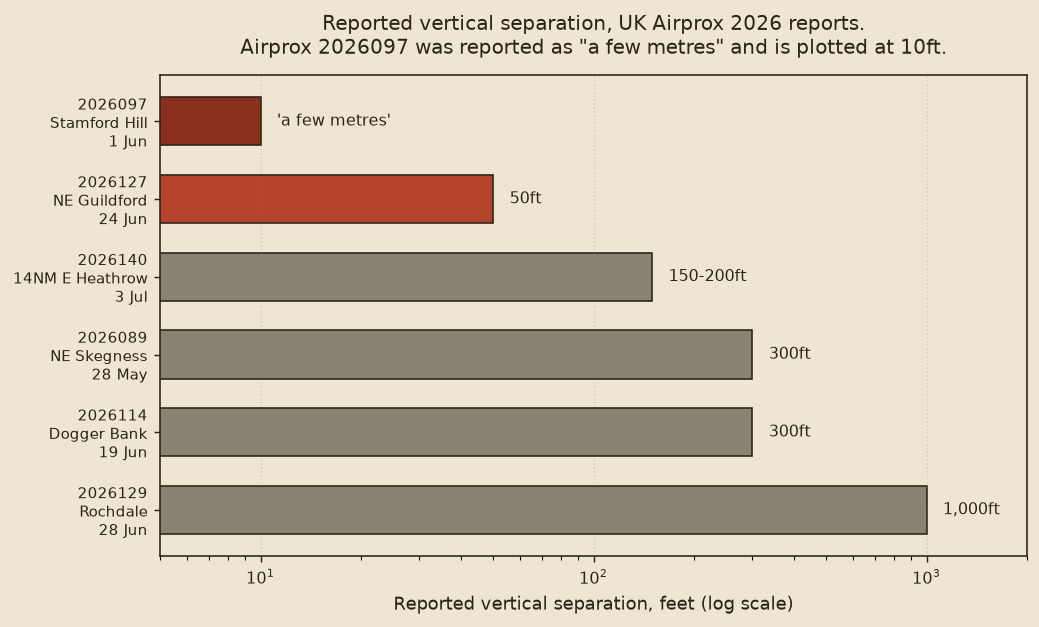
The reported separation is entered as "a few metres" and the reported risk of collision as High. That is the closest reported separation in any UK unknown-object Airprox of 2026, closer than the fifty feet reported by the British Airways 777 crew over Guildford three weeks later.
The NATS investigation reported that analysis of the radar by Safety Investigations indicated there were no associated primary or secondary contacts visible at the approximate time of the event.
What is the official explanation?
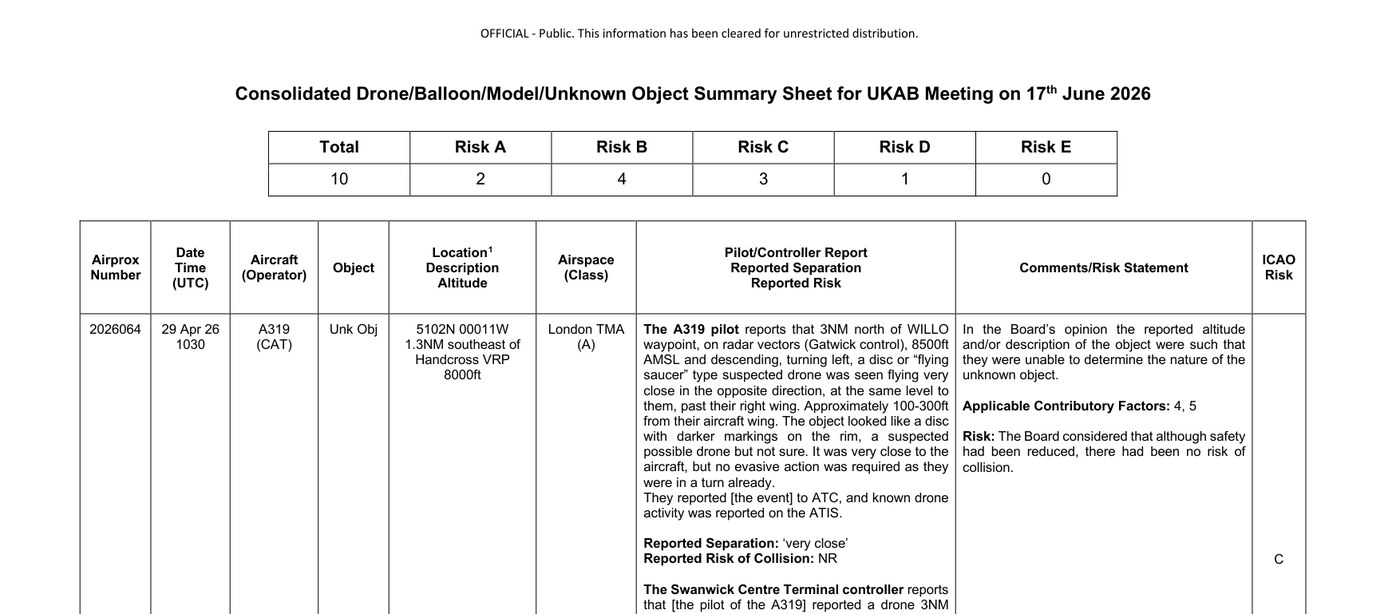
The UK Airprox Board assessed the report at its meeting of 15 July 2026, where it appears in the consolidated drone, balloon, model and unknown-object summary sheet as Airprox 2026097, with the object column reading "Unk Obj".
The Board's finding is its unknown-object formula: "In the Board's opinion the reported altitude and/or description of the object were such that they were unable to determine the nature of the unknown object." The applicable contributory factors are recorded as 4 and 6, factor 6 being the Board's code for a near collision with an unpiloted airborne object rather than the separate drone code.
On risk the Board was unambiguous: "The Board considered that providence had played a major part in the incident and/or a definite risk of collision had existed." That is ICAO Category A, the most serious grade available, and it is the same grade the Board would later give the British Airways 777 over Guildford.
There is no further official narrative. No agency has identified the object, no operator has been traced, and no explanation has been offered on the record by NATS, the Civil Aviation Authority or the airline.
What did the witnesses think it was?
What the crew reported is strikingly thin in description and strikingly strong in geometry, and the two things are connected.
They could describe almost nothing about the object. It was black. It had no resolvable detail. One pilot registered it only as a streak. That is exactly what a close pass at high relative speed produces: an aircraft descending through 6,500ft on a downwind leg is covering ground fast enough that an object a few metres away is present in the visual field for a fraction of a second.
The detail that carries the most weight is behavioural rather than descriptive. The captain, who was hand-flying the aircraft at the time, ducked. A reflexive flinch from a trained pilot at the controls of a passenger jet is not a considered judgement about distance, but it is a real datum about how close the object appeared, and it is recorded in the official file rather than told to a reporter afterwards.
It is also worth noting what the crew did not claim. They did not describe a craft, assert a shape, estimate a size, or offer any interpretation at all. The file records a black object, a few metres, no detail. That restraint is part of why the Board could not resolve it, and it is also why nothing in this file supports any exotic reading.
Is the Black Object That Passed a Flight Deck Over Stamford Hill, 1 June 2026 real? The two-pass assessment
Pass one, how could this be mundane. A drone remains the obvious candidate and nothing here excludes it. The absence of a radar return is not evidence against a drone, since small multirotors routinely leave no primary or secondary contact, and this was a busy period for drone reports in exactly this airspace. The reason the Board did not reach its drone finding is not that a drone was ruled out but that the crew could not describe the object well enough to support any identification, which is what its formula actually says.
A bird is a serious candidate here in a way it is not for the Guildford case, and it deserves more weight than the coverage of these reports usually gives it. The object was black, structureless at close range, and seen for a fraction of a second at around 6,500ft over a major city. Large birds reach and exceed that altitude. Nothing in the file excludes a bird, and the file itself does not raise it.
A balloon is possible but fits less comfortably. The object was black rather than reflective, and the two other crews in these batches who raised the foil-balloon possibility did so precisely because what they saw was metallic and bright.
The weather neither helps nor hurts the crew. Heathrow reported NCD, no cloud detected, with the maximum reportable visibility at both 1020 and 1050 UTC, and a surface wind from 230 degrees at 11 to 12 knots. So the sky was clear, the object was seen in good daylight conditions, and there is no cloud deck to constrain its height.
Pass two, if the prosaic answers do not hold. The honest position is that this case is a near miss with something nobody has identified, and that the evidentiary basis is two pilots' recollection of a fraction of a second. The Board, holding the same material, rated it a definite risk of collision and declined to name the object. This archive records it as Unknown on the same grounds.
The limitation is severe and is stated rather than minimised: there is no imagery, no radar track, no third-party observation, and almost no description. A case can be officially serious and evidentially thin at the same time, and this is one. What makes it worth a page is not that the object was strange but that the official record says, in its own words, that the United Kingdom's air safety adjudicator could not determine what an airliner full of passengers came within a few metres of over north London.
Sources
- www.airproxboard.org.uk/media/l3tl1jvt/july-2026-drone-summary-sheet.pdf
- www.airproxboard.org.uk/reports-and-analysis/monthly-airprox-reviews/airprox-reports-2026/july/
- www.airproxboard.org.uk/reports-and-analysis/individual-airprox-reports/2026/
More cases from this region: UFO sightings in United Kingdom