The Turner Report: Australia's Joint Intelligence Organisation Assessment of the UFO Problem, 27 May 1971
An allied intelligence service put in writing, in 1971, the claim that Project Blue Book was a deliberate facade of ridicule. The document is free to read, and almost nobody has read it.
What happened
A 1971 Australian intelligence assessment called Project Blue Book a deliberate facade. Its author was Oliver Harry Turner, head of the Nuclear Branch of Australia's Joint Intelligence Organisation, and he set the claim down in a Department of Defence minute paper dated 27 May 1971 under the title Scientific and Intelligence Aspects of the UFO Problem. The file sits in the National Archives of Australia as series A13693, control symbol 3092/2/000, barcode 30030606, with an access status of open. It runs to 59 scanned pages, and the assessment itself occupies pages 7 to 18 of that scan.
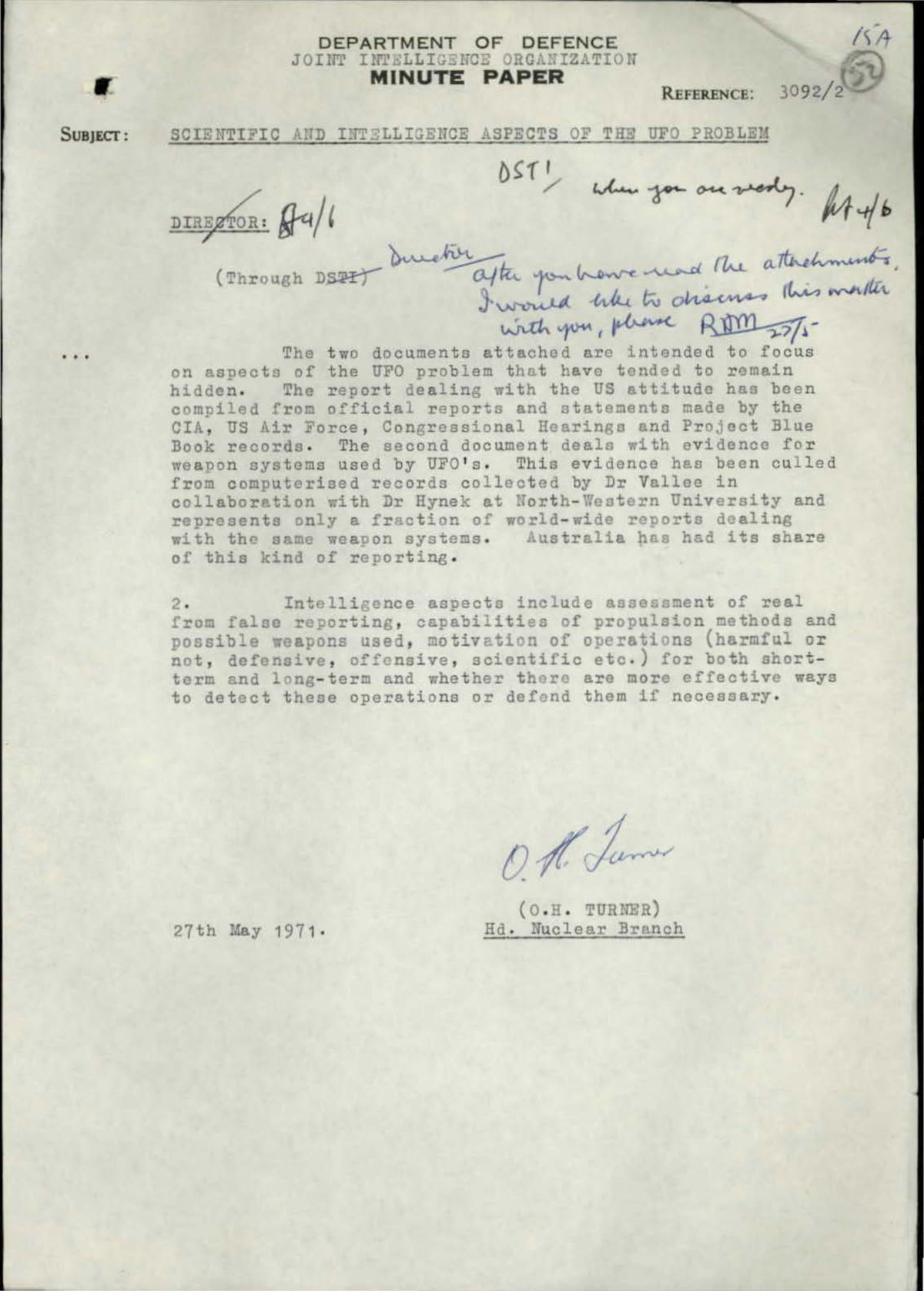
Turner's covering minute states the scope plainly. The two documents attached are intended, he wrote, to focus on aspects of the UFO problem that have tended to remain hidden. He describes the first as compiled from official reports and statements made by the CIA, US Air Force, Congressional Hearings and Project Blue Book records, and the second as dealing with evidence for weapon systems used by UFOs, culled from computerised records collected by Dr Vallee in collaboration with Dr Hynek at North-Western University. The minute is signed in type as (O. H. TURNER), Hd. Nuclear Branch.
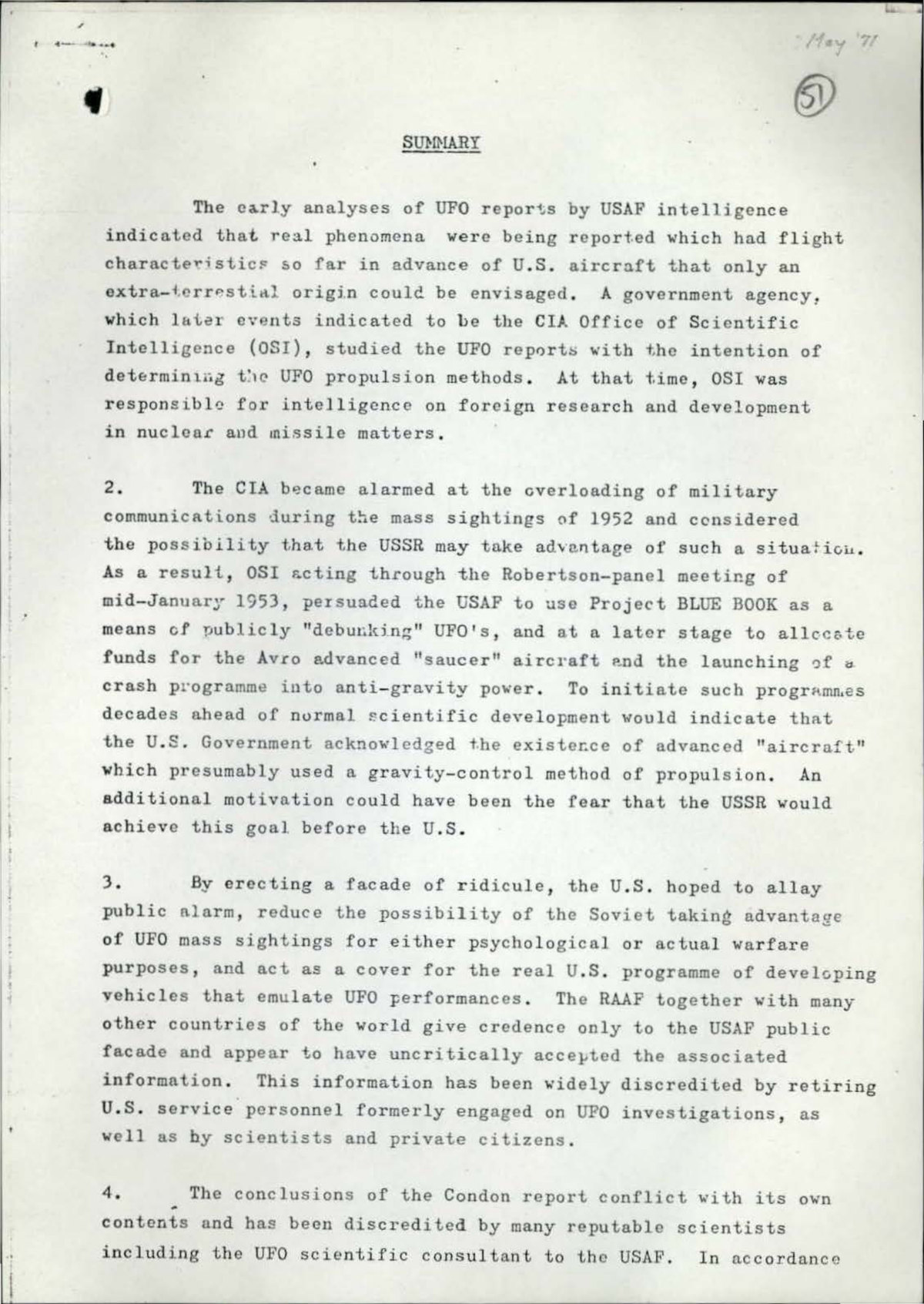
The summary page is the passage that has carried the document into the present. Turner writes that the early analyses of UFO reports by USAF intelligence indicated that real phenomena were being reported which had flight characteristics so far in advance of U.S. aircraft that only an extra-terrestial origin could be envisaged, keeping the original's own spelling. He continues that a government agency, which later events indicated to be the CIA Office of Scientific Intelligence (OSI), studied the UFO reports with the intention of determining the UFO propulsion methods.
The central allegation follows in his paragraph 2. The CIA, he writes, became alarmed at the overloading of military communications during the mass sightings of 1952, and as a result OSI acting through the Robertson-panel meeting of mid-January 1953, persuaded the USAF to use Project BLUE BOOK as a means of publicly "debunking" UFO's, and at a later stage to allocate funds for the Avro advanced "saucer" aircraft and the launching of a crash programme into anti-gravity power. Paragraph 3 gives the phrase the document is now known for: By erecting a facade of ridicule, the U.S. hoped to allay public alarm, reduce the possibility of the Soviet taking advantage of UFO mass sightings for either psychological or actual warfare purposes, and act as a cover for the real U.S. programme of developing vehicles that emulate UFO performances. He then turns the charge on his own side, writing that the RAAF together with many other countries of the world give credence only to the USAF public facade and appear to have uncritically accepted the associated information.
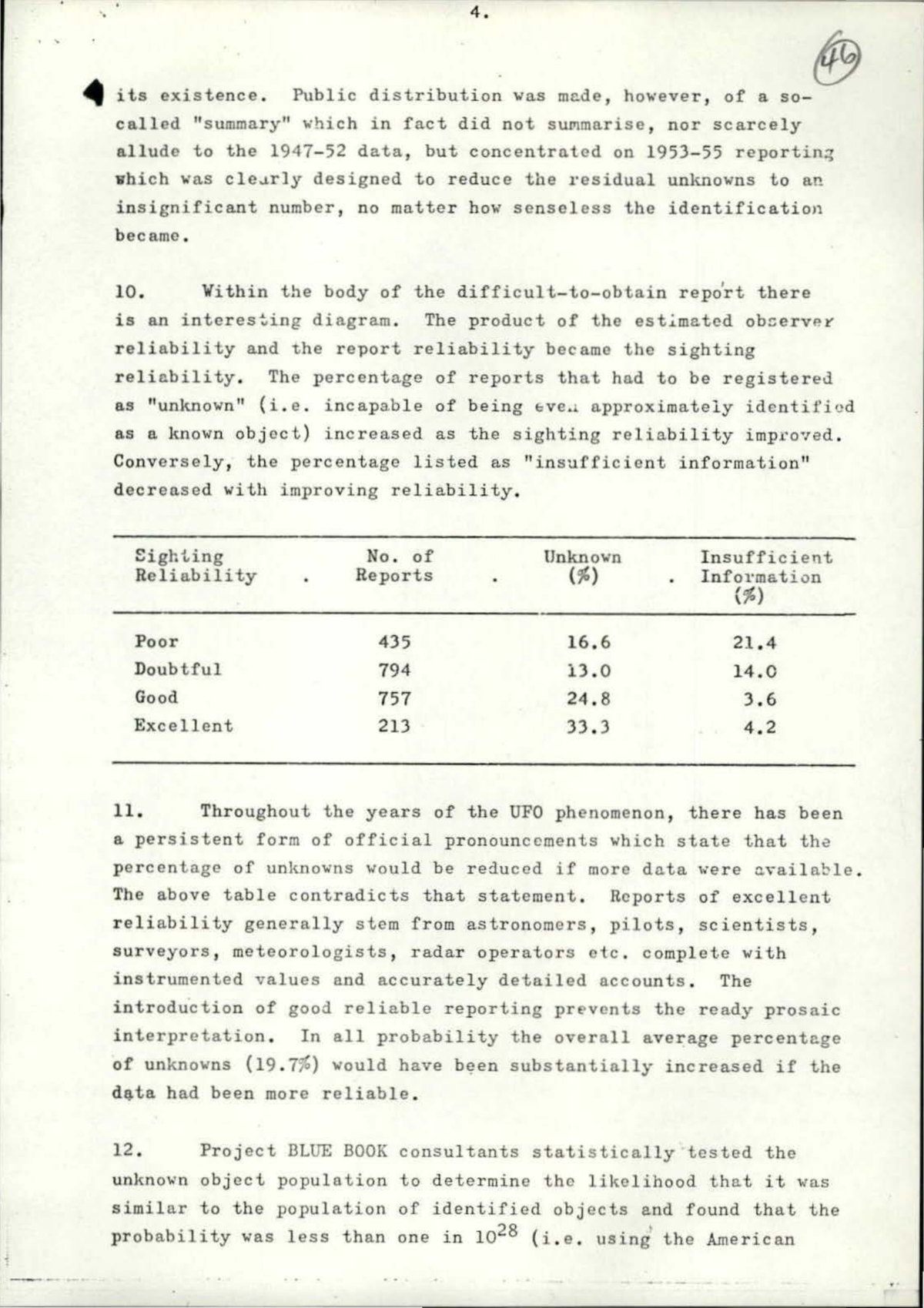
Two quantitative passages matter more than the rhetoric, because they can be checked. The first is a table Turner reproduces from Project Blue Book Special Report No. 14, a 316 page study whose body, he notes, was not released to the public other than as a copy to be consulted. Blue Book had graded each sighting for reliability, and the table records how the proportion of cases left as unknown moved with that grade: Poor, 435 reports, 16.6 per cent unknown and 21.4 per cent insufficient information; Doubtful, 794 reports, 13.0 and 14.0; Good, 757 reports, 24.8 and 3.6; Excellent, 213 reports, 33.3 and 4.2. The pattern runs the opposite way to the official line. As Turner puts it, there has been a persistent form of official pronouncements which state that the percentage of unknowns would be reduced if more data were available, and the above table contradicts that statement. Better reports produced more unknowns, not fewer, and the overall average he gives is 19.7 per cent.
The second is the significance test. Turner records that Project Blue Book consultants statistically tested the unknown object population to determine the likelihood that it was similar to the population of identified objects, and found that the probability was less than one in ten to the power twenty-eight. He notes that the consultants had arbitrarily classed all green fireballs and night-time sightings under five seconds as known astronomical objects, so the test was rerun with astronomical identifications removed, which reduced the odds to ten trillion trillion to one. His verdict on what was then done with that result is the sharpest line in the document: the analysts could not find a way to reduce those odds sufficiently further to warrant additional testing, and irrationally considered the results to be inconclusive.
Documents and images
What is the official position?
There is no official Australian narrative about this document, because the document is itself the official narrative, written inside the intelligence service and never intended for release. What the file does contain is the institution's answer to Turner, and it is not supportive.
Bound into the same file, ahead of the 1971 assessment in the scan, is a Joint Intelligence Bureau minute sheet dated February 1970 in which the recipient sets out why the organisation will not take the work on. He records that he has discussed the paper with Mr Turner, and that his views from a scientific intelligence point of view are that the present establishment of DSTI has been designed to meet the research demands arising from studies of defence science in countries in the Far East and South East Asia, that there is no surplus research capacity within the establishment that could be diverted to problems such as the investigation of UFO reports, and that he is not convinced that there is a sufficient scientific intelligence component in the UFO problem such as to warrant any diversion of Australia's very limited resources for scientific intelligence research. He allows only that it is evident that there is still considerable controversy concerning UFOs and this will undoubtedly continue until the subject is fully examined by some competent authority, and that such an examination would require a considerable effort.
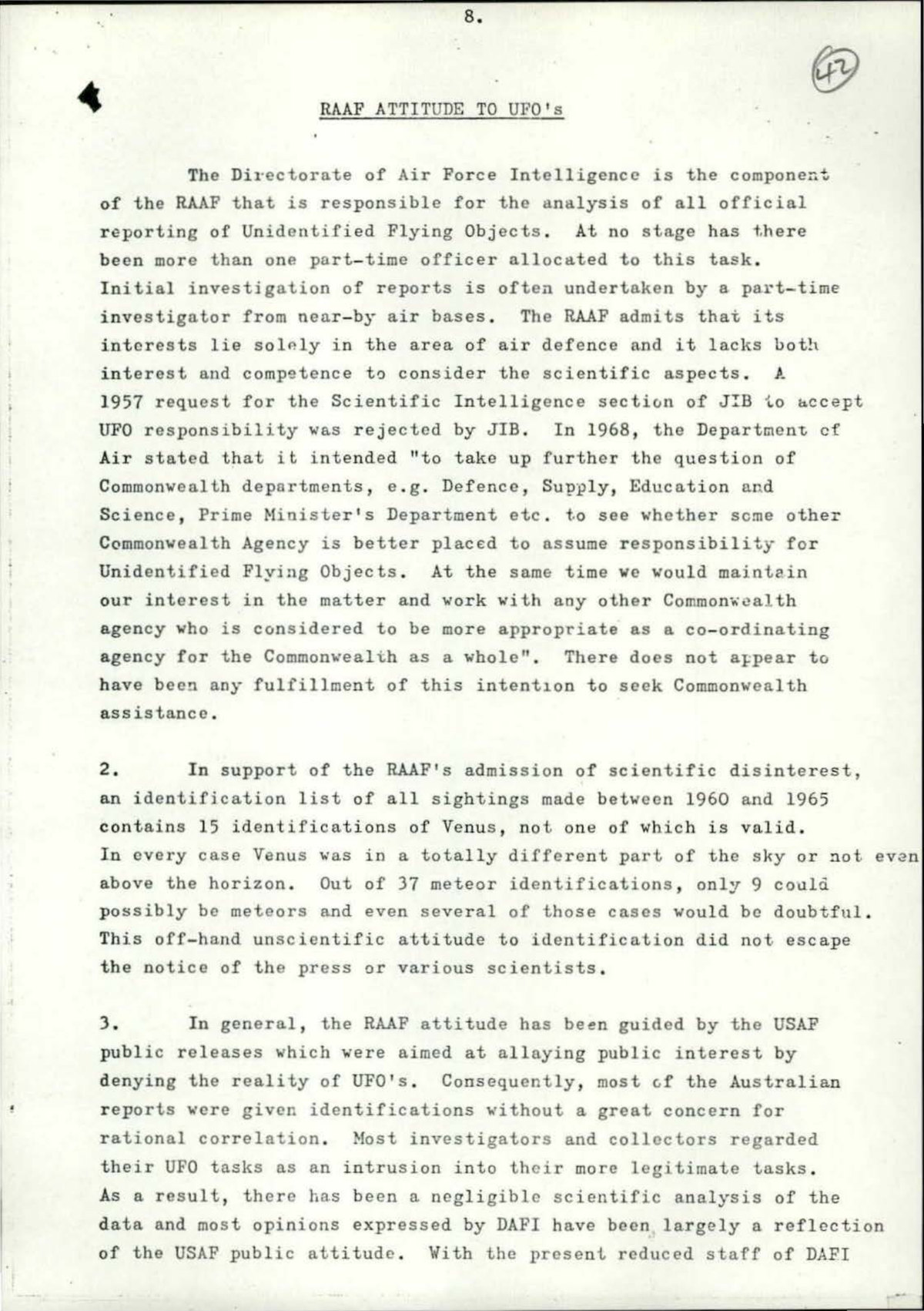
Turner's own section on the RAAF is where the assessment does original work rather than restating American history. He records that the Directorate of Air Force Intelligence was the component responsible for analysing all official UFO reporting in Australia and that at no stage has there been more than one part-time officer allocated to this task, with initial investigation often undertaken by a part-time investigator from a nearby air base. He states that the RAAF admits that its interests lie solely in the area of air defence and it lacks both interest and competence to consider the scientific aspects, that a 1957 request for the Scientific Intelligence section of JIB to accept UFO responsibility was rejected by JIB, and that a 1968 Department of Air intention to find another Commonwealth agency appears never to have been acted on.
He then audits the identifications themselves, and the result is the single most concrete finding in the file. An identification list of all sightings made between 1960 and 1965, he writes, contains 15 identifications of Venus, not one of which is valid. In every case Venus was in a totally different part of the sky or not even above the horizon. Out of 37 meteor identifications, only 9 could possibly be meteors and even several of those cases would be doubtful. His conclusion is that most of the Australian reports were given identifications without a great concern for rational correlation, and that with the reduced staff of DAFI it is unlikely that UFO reports will receive any treatment beyond filing.
Turner's recommendation closes the assessment. It would appear wrong, he writes, for Australia to remain ignorant of the true situation, and it may be preferable to act independently of the U.S. and initiate a programme that is scientifically sound and intellectually honest towards unravelling the UFO mystery, adding that in such a venture it may be worthwhile working somewhat closer to the public than is usual in the U.S. and U.K. No such programme was created.
What the people involved say
Turner is identified on the document only as head of the Nuclear Branch. The fuller biography comes from the Australian researcher Bill Chalker, who interviewed him, and from a profile published by the journalist Ross Coulthart for Advena Research on 12 May 2026, and those claims are attributed here rather than asserted as established fact.
That profile gives his name as O.H. (Oliver Harry) Turner and places him at the British nuclear test programme in Australia, which ran open air tests at the Montebello Islands and in South Australia between 1952 and 1963, with Turner there from 1956 to 1964. It reproduces a contemporary file description of him as a health physics officer, who possesses an inquiring mind, made an independent investigation and extensive calculations, recorded in the context of a sighting he refused to treat as natural. By 1971 he was head of the Nuclear Branch of the Joint Intelligence Organisation.
The same profile records that the proposal attached to Turner's work went further than analysis. He wanted a rapid intervention team to investigate cases where UFOs had left physical evidence, and asked that the scientific team have an aircraft on standby, with interest reported from the Atomic Energy Commission, the National Standards Laboratory, the Defence Department's Science and Technology division and the Chief Defence Scientist Arthur Wills. It states that JIO's director Robert Furlonger was by 1971 convinced of the need for a UAP investigation team but did not want to have to pay for it, and that the submission to the Defence Department proposed transferring UFO investigation away from the Air Force.
The counterweight is in the same source and should be read with equal weight. Turner's superior Bob Mathams, JIO's Director of Scientific Intelligence, told Chalker that he did not encourage Turner's UFO interests and that JIO's dance with UFOs was almost entirely driven by Turner's interest. The profile also records that Turner's criticisms of the RAAF's DAFI investigators, following an investigation of mid-1969 sightings in Western Australia, eventually led to his access to the DAFI UFO files being withdrawn. On that account the assessment is the work of one determined officer operating against the grain of his own organisation, and it was answered by the removal of his access rather than by the creation of the programme he asked for.
The document returned to public attention in 2026 through David Grusch, who cited it at the United States Capitol in June 2026 and again on The Joe Rogan Experience episode 2560, recorded and published on 30 September 2026, where he described it at around the one hour fifty-nine minute mark. A Reddit user posting as /u/Superslyye published a page by page video breakdown on 2 October 2026 and gave the archive reference, which is how this archive reached the file. One detail from that discussion is worth recording because it is a small correction rather than a dispute: the breakdown notes that Grusch described the assessment as pages 7 through 18, and that the assessment proper runs to page 16 of the scan, with the appendices following. Reading the released scan confirms the narrower range for the assessment text, with the chronology appendix beginning on page 19.
Is the Turner Report: Australia's Joint Intelligence Organisation Assessment of the UFO Problem, 27 May 1971 real? The two-pass assessment
Pass one, how could this be mundane. The most important thing to be clear about is what this document is and is not. It is a genuine, declassified, openly accessible Australian government intelligence paper, and its provenance is not in question. It is not evidence that UFOs are extraterrestrial craft, and it is not an Australian government finding. It is one senior officer's assessment, written for internal circulation, and the file itself records that his organisation declined to act on it.
Its central claim about the CIA and Project Blue Book is also, importantly, not based on Australian intelligence. Turner says so himself in the covering minute: the report dealing with the US attitude was compiled from official reports and statements made by the CIA, US Air Force, Congressional Hearings and Project Blue Book records. So this is an informed foreign analyst reading the American public and declassified record of the day and drawing a conclusion from it. It carries the weight of a professional intelligence officer's judgement, and it does not carry the weight of independent Australian collection. Anyone citing it as proof that Australia knew something separate is overreading it.
Several of its assertions are inferences stated with more confidence than their evidence supports. The reading that the United States funded the Avro saucer and a crash anti-gravity programme because it privately accepted that UFOs used gravity control is a motive attributed from a pattern of spending, and Turner himself concedes the alternative in the same paragraph, writing that an additional motivation could have been the fear that the USSR would achieve this goal before the U.S. The Avro Canada VZ-9 Avrocar, for its part, is a documented and unsuccessful programme, and its existence does not require an exotic explanation. The gravity research he catalogues, including the Babson Gravity Research Institute and the named university programmes, is real but was not uniformly secret, and general relativity research is a sufficient reason for several of those names to appear.
Pass two, if the document is taken seriously, what does it establish. Three things survive scrutiny, and they are the reason this file is worth a page in this archive.
The first is the Venus audit, and it is the cleanest finding in the document because it is a check anyone can repeat. Turner went through the RAAF's own identifications for 1960 to 1965 and found 15 attributions to Venus, none of which worked, with the planet either elsewhere in the sky or below the horizon, and 37 meteor attributions of which at most 9 were possible. That is not a claim about alien craft. It is a measurement of how a national air force was actually disposing of reports, and it establishes that the Australian official record of that period cannot be read as the output of a process that checked anything. This archive runs exactly that check, with ephemeris queries, on modern cases, and it regularly finds that the planet genuinely does explain a sighting. The point is that the check has to be run, and the RAAF was not running it.
The second is the reliability table. If the data Turner reproduces from Special Report No. 14 is accurate, then the rate of unexplained cases rose from 16.6 per cent among the poorest reports to 33.3 per cent among the best, which is the opposite of what the misidentification hypothesis predicts. Better observers, better instruments and better documentation should strip out mundane explanations and shrink the residue. Here the residue doubles. That does not identify what the residue is, and a sceptic can reasonably argue that higher-grade reports attracted more careful scrutiny and so resisted casual labelling for procedural reasons rather than physical ones. It nonetheless undercuts the specific official claim Turner names, that more data would reduce the unknowns.
The third is the document's standing as institutional evidence. This archive's standing position is that an official attempt to discredit a phenomenon is an indicator that the phenomenon was taken seriously internally, and that such an attempt is never in itself a counter-claim against a case. The Turner assessment is a contemporaneous, independent, allied-service statement of that same reading, written in 1971 by someone with a security clearance and no public audience, and it names the mechanism, the agency and the date. It does not prove the mechanism operated as described. It does establish that the reading is not a later invention of the UFO literature, which is how it is often characterised.
The honest limits should be stated alongside those three points. Turner was an advocate, his own Director of Scientific Intelligence said the organisation's interest in the subject was essentially his alone, and he lost access to the RAAF files after criticising their investigators, so this is a contested voice inside his own service rather than a settled institutional view. The weapon systems document attached to the assessment rests on the Vallee and Hynek case catalogue and inherits whatever weaknesses that catalogue has. And the key American claims can be tested against American records independently of Turner, which is the proper next step for anyone working on this file rather than treating his summary as the end of the inquiry. The tier here is Unknown because there is no official narrative to weigh, in either direction, about a document whose own government shelved it.
Sources
- documents.theblackvault.com/documents/ufos/australia/A13693_3092-2-000_30030606.pdf
- recordsearch.naa.gov.au/SearchNRetrieve/Interface/ViewImage.aspx?B=30030606
- www.advenaresearch.com/articles/harry-turner
- www.uapcheck.com/news/id/2023-03-29-declassified-documents-the-harry-turner-bombshell/
- americanalchemymagazine.substack.com/p/the-turner-report-what-is-actually
- disclosure.org/news/1971-australian-ufo-assessment-us-intelligence
More cases from this region: UFO sightings in Australia