The USS Kirk USO Encounter
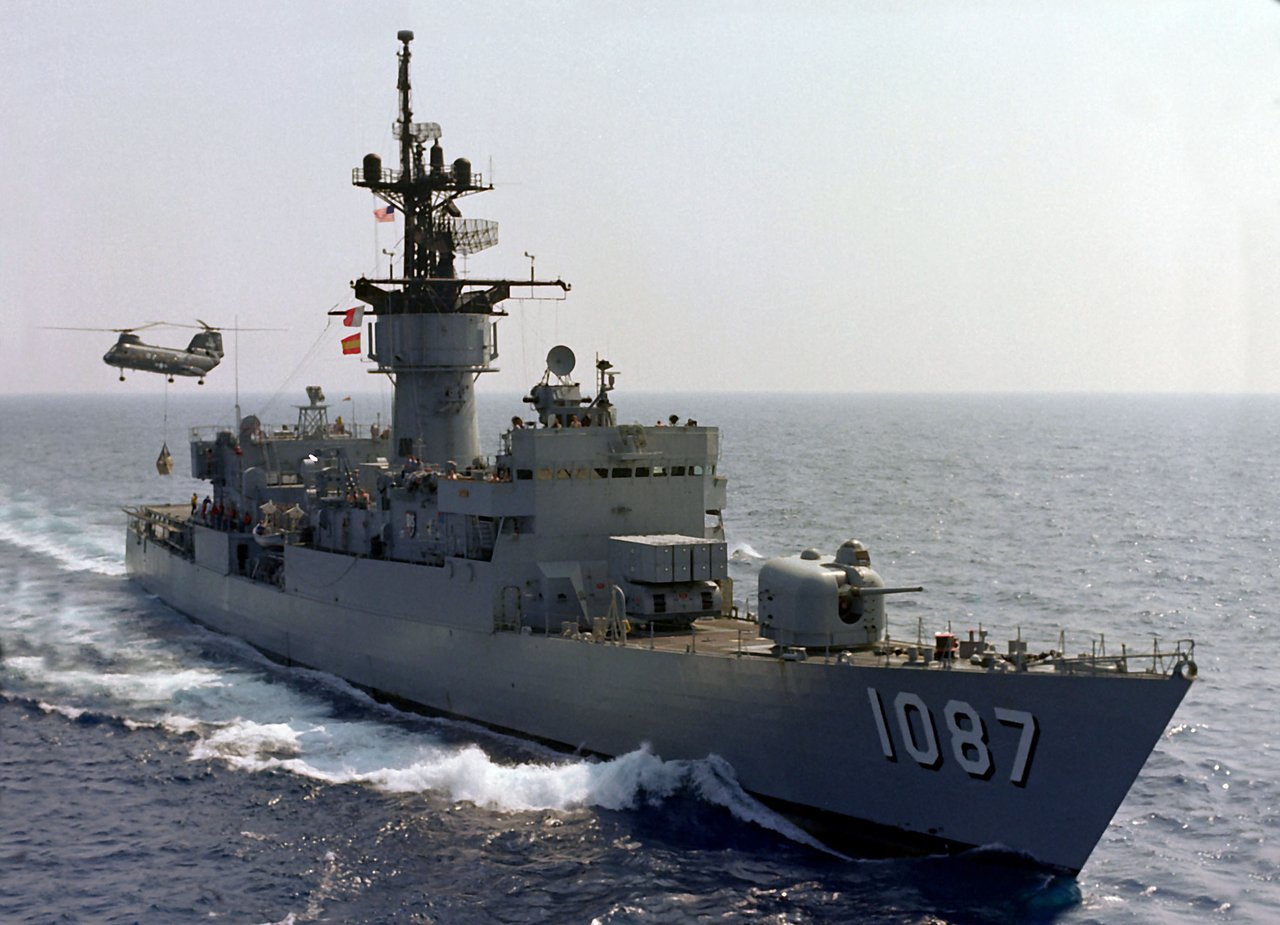
The account comes from a single named source who signed himself only as "GMV," an operations and intelligence petty officer (a Navy Operations Specialist) who says he served aboard the Knox-class frigate USS Kirk (FF-1087) from 1989 to 1992. This case file covers what witnesses reported, the official narrative, and a two-pass assessment with its evidence tier.
What did witnesses see at Eastern Pacific Ocean?
The account comes from a single named source who signed himself only as "GMV," an operations and intelligence petty officer (a Navy Operations Specialist) who says he served aboard the Knox-class frigate USS Kirk (FF-1087) from 1989 to 1992. By his telling, the ship was on a drug-interdiction deployment in the eastern Pacific off the west coast of South America, working as one of four US Navy vessels spread out about 150 nautical miles apart to screen for narcotics traffic moving up from Colombia, Panama and Guatemala. He places the event at roughly 0200 on what he remembers as 16 December 1991, with the Kirk steaming at about 12 knots some 350 to 400 nautical miles offshore.
According to GMV, the night was ordinary until "a huge flash of red glowing light" lit up the entire ship. He is specific about the geometry. The flash came from off the starboard bow, from sea level upward, and it lit only the Kirk and not the surrounding ocean. In his words, "It only lit up our ship, not the surrounding ocean, just our ship." It was a single brief flash, bright enough that he describes it washing the whole vessel in red.
He was not the only one who saw it. GMV says the officer of the deck, the navigator, the forward lookout and the aft lookout all witnessed the flash. He recalls the forward lookout's reaction over the circuit as something close to "YES, WHAT THE HELL WAS THAT?" He then contacted the Combat Information Center to ask what their sensors held. The reply, as he tells it, was that air and surface radars were "clear as a whistle," no aircraft and no surface ships, and that there was no submarine contact either. Nothing on any scope accounted for a light source close enough aboard to bathe a 438-foot frigate in red glare.
What happened next is the part GMV stresses as routine, which is itself part of the story. The officer of the deck decided not to wake the captain. After some back-and-forth on the bridge, the event was written up in the ship's deck log as an "unexplained phenomenon" and the watch carried on. There is no claim of a chase, a wake, a sonar return, or a second flash. It was one red pulse from the waterline off the bow, seen by several watchstanders, with nothing on radar or sonar to match it.
What is the official explanation?
There is no official UFO-program file on this event. It was never reported to Project Blue Book, which had closed in 1969, more than twenty years before the claimed date, and there is no NUFORC, MUFON, or Navy incident number attached to it. The only "official" paper the witness invokes is the ship's own deck log, in which he says the flash was recorded as an "unexplained phenomenon." That log entry, if it exists, has never been produced, photographed, or released, so it cannot be examined.
What can be checked against the documentary record is the ship and its movements, and here the official US Navy history is detailed. The Dictionary of American Naval Fighting Ships (DANFS), maintained by the Naval History and Heritage Command, confirms USS Kirk was a real Knox-class vessel, laid down at Avondale in Louisiana on 4 December 1970, launched 25 September 1971, and commissioned 9 September 1972, first as the destroyer escort DE-1087 and reclassified to frigate FF-1087 in 1975. DANFS records that she "got underway from Long Beach" on 3 December and "stopped in Guatemala for fuel, and became the first U.S. naval warship to refuel at Puerto Quetzal," spent "Christmas in Panama, and New Year's Day 1991 underway off Guatemala, conducting surface and air surveillance for narcotics trafficking groups." It then states plainly: "Kirk conducted counter-narcotics operations off South America (1-11 January 1991), before a short port visit to Puerto Quetzal (12-14 January)." This is the genuine deployment that matches the witness's described mission, theater, and four-ship interdiction posture almost exactly. The catch is that the official record dates it to December 1990 into January 1991, a full year before the date GMV gives.
The same DANFS narrative accounts for the Kirk through the rest of 1991 and does not place her back off South America on a drug run. After the early-1991 counter-narcotics work she returned to Long Beach, acted as plane guard for the carriers Abraham Lincoln (CVN-72) on 25 to 26 February and Independence (CV-62) on 28 May to 4 June, made port calls at Anchorage, Seattle, Esquimalt and Pearl Harbor, and was conducting sea trials out of Long Beach on 12 to 13 December 1991, three days before the claimed encounter. The ship's documented eastern-Pacific narcotics deployment is the 1990 to 1991 one, not a 1991 to 1992 one. DANFS closes the ship's American service by noting she "was decommissioned on 6 August 1993," was leased to Taiwan and "renamed ROCS Fong Yang (FF-934)," and was struck from the Naval Vessel Register on 11 January 1995.
What did the witnesses think it was?
The witness believed he had run up on a real, solid object sitting just under the surface. GMV's own reading is that the Kirk, steaming quietly at 12 knots in the dark, came almost on top of a submerged craft that did not realize the frigate was bearing down on it until the last moment. He thinks the red flash was that craft reacting, breaking away fast and trying to get a look at what had nearly run into it. In his words he had "no doubt that our ship came right up on a submerged unidentifiable aircraft," and he came away convinced "the event was extraterrestrial in nature." He frames himself as someone who had not been a believer beforehand, which is the usual shape of these first-person Navy submissions.
His corroboration is internal to the bridge and the lookout stations rather than independent. He names the officer of the deck, the navigator, the forward lookout and the aft lookout as fellow witnesses, and he reports the forward lookout blurting out a startled reaction in real time. He also leans on the negative sensor picture from CIC, the "clear as a whistle" radar and the absence of any submarine contact, as evidence that whatever lit the ship was not a conventional aircraft or vessel. None of these other watchstanders has been identified by name or has come forward separately, so the multiple-witness claim, while plausible for a flash that supposedly lit the whole ship, rests on GMV's single retelling.
The dispute
The central dispute is a documentary one and it is about timing. The witness, GMV, dates the encounter to 16 December 1991 and says the Kirk was then on a drug-interdiction deployment running October 1991 to January 1992 off the west coast of South America. The official US Navy history of the ship, the DANFS entry maintained by the Naval History and Heritage Command, tells a different timeline. It records that Kirk's counter-narcotics deployment to that exact theater, the one that matches the witness's described mission almost point for point, took place a full year earlier: underway from Long Beach on 3 December 1990, refueling at Puerto Quetzal in Guatemala, Christmas 1990 in Panama, and "counter-narcotics operations off South America (1-11 January 1991)." Nobody advanced this as a debunk on purpose; it is simply what the primary record says when you lay the witness's date next to it. The discrepancy is not trivial, because in mid-December 1991, the moment GMV pins the flash to, DANFS has the Kirk conducting sea trials out of Long Beach on 12 to 13 December 1991, not steaming 350 nautical miles off South America.
The most economical reading of that gap is that the witness misremembered the year by twelve months, which is an ordinary error in a recollection set down roughly two decades after the event and submitted from memory with no notes or log to check against. If that is what happened, the underlying event could still be entirely genuine; the sailor would simply have attached it to the wrong December. The dispute therefore weakens the account's evidentiary value, because it means the story cannot be tied to a verifiable date or cross-checked against any contemporaneous record, but it does not demonstrate that the flash never occurred.
What keeps this in the "barely" band rather than pushing it stronger is that the dispute is entirely about sourcing and dating, not about a shown method of how the sighting was faked or misidentified. No independent analyst has produced the ordinary object, the hoax prop, the misread instrument, or a witness who recanted. On the contrary, the strongest single fact in the whole file actually supports the witness's credibility: the deployment he describes is real and specifically documented, four-ship eastern-Pacific narcotics interdiction off South America out of Long Beach, which is not the kind of detail a casual fabricator would get right. So the case is left in an honest middle. A real ship, a real mission of exactly the type described, a vivid multi-watchstander account with no physical or sensor evidence, and a one-year date error against the official record that no one has resolved. That is a genuine but partial and contestable counter-explanation, which leaves the case standing, barely.
Is the USS Kirk USO Encounter real? The two-pass assessment
Pass one, how this could be entirely ordinary. The hard problem is that there is exactly one source, posted anonymously to a UFO website around two decades after the fact, with no log image, no sensor data, no second named witness, and no case number. A single bright red flash off the bow at 0200 has mundane candidates that a tired watch could misjudge: a meteor or bolide entering low on the horizon and appearing to flare near the waterline, distant lightning or a green-to-red sprite-like discharge, a flare or pyrotechnic from another vessel or aircraft beyond radar horizon, a brief electrical arc or fault aboard the ship itself reflecting off the superstructure, or even bioluminescence or a reflected navigation light misremembered years later. The detail that the flash "lit only the ship" is striking but is also exactly what you would expect from a light source very close to or aboard the vessel, which points as easily to something local as to something exotic. Most corrosive of all is the documentary mismatch: the official DANFS record shows Kirk's genuine counter-narcotics deployment off South America ran December 1990 to January 1991, not December 1991, and in mid-December 1991 the ship was doing sea trials out of Long Beach, nowhere near the position GMV describes. Either the witness has misremembered the year by twelve months, which is common in decades-old recollections, or the placement of the event is simply wrong. Memory error on the date does not by itself prove the flash did not happen, but it removes the ability to pin the account to a verifiable moment.
Pass two, if real, what is it. Set against the skeptical read is the fact that the witness did not invent a fantasy posting. The mission he describes, a four-ship eastern-Pacific drug-interdiction screen off South America run out of Long Beach and refueling through Central America, is a real and specific thing USS Kirk actually did, confirmed in detail by the Navy's own history, down to the four-ship interdiction posture and the South American operating area. That is unusual texture for a fabrication, and it reads more like a real sailor recalling a real deployment and getting the calendar year wrong than like someone making the ship up. If the core memory is sound, what remains is a brief, intense, localized light event at sea level close aboard, seen by several watchstanders, with no corresponding air, surface, or subsurface radar or sonar return, logged by the watch as unexplained. That is a textbook unidentified-submerged-object report: close, energetic, sensor-silent, and gone in an instant.
The tier is Barely Disputed. The dispute is real and specific, a one-year discrepancy between the witness's date and the official deployment record, plus the complete absence of any physical, photographic, or sensor evidence and any independent witness. But that dispute is a dating and sourcing problem, not a method-shown debunk. Nobody has produced the prop, the confession, the identified aircraft, or the demonstrated technique that would settle the case as ordinary, and the witness's account is anchored to a genuine documented Kirk deployment rather than contradicted by one. A weak, partial counter-explanation that mostly attacks the date leaves the case standing, just barely, which is exactly the Barely Disputed band.
Sources
- www.history.navy.mil/research/histories/ship-histories/danfs/k/kirk-de-ff-1087.html
- web.archive.org/web/20231209190711/https://www.ufocasebook.com/2011/1087.html
- www.thinkaboutitdocs.com/1991-possible-ufouso-encountered-by-uss-kirk-ff1087/
- www.navysite.de/ff/ff1087.htm
More cases from this region: UFO sightings in International waters (Eastern Pacific)