The Minsk Tu-134 Radar-Visual Case
In the pre-dawn hours of 7 September 1984, Aeroflot flight SU 8352, a Tupolev Tu-134A of the Estonian directorate running Tbilisi to Rostov-on-Don to Tallinn, was cruising at roughly 9,000 metres over the Byelorussian SSR near Minsk. This case file covers what witnesses reported, the official narrative, and a two-pass assessment with its evidence tier.
What did witnesses see at Near Minsk?
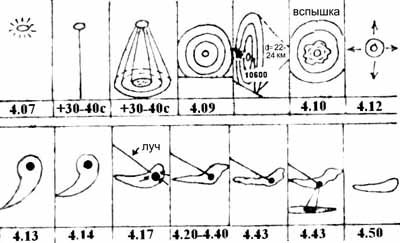
In the pre-dawn hours of 7 September 1984, Aeroflot flight SU 8352, a Tupolev Tu-134A of the Estonian directorate running Tbilisi to Rostov-on-Don to Tallinn, was cruising at roughly 9,000 metres over the Byelorussian SSR near Minsk. At 4:10 AM the second pilot, Gennady Lazurin, noticed a small yellow point of light off to the forward right. From it a sharp beam of light stabbed down toward the ground, broadened into a cone, and was joined by two more cones. Lazurin, by the crew's own account the calmest man aboard, took a notebook and began sketching the thing in real time, frame by frame, marking the minutes: 4.07, a star-like dot; 4.09, the cones and concentric rings; 4.10, a flash ("vspyshka"); then a long sequence as the object morphed.
The crew said the cones swept the landscape below and lit up ground features clearly, then one beam swung up and washed over the cabin. The point of light swelled into a greenish, phosphorescent luminosity several degrees across that paced the aircraft. Inside this glow the witnesses described lights of different colours and "fiery zig-zags." Over the next minutes, captured in Lazurin's drawings, the object grew an appendage and resolved into what the crew called a "wingless cloud-aircraft with a pointed tail," a green cloud that dropped below the aircraft, rose, slid left and right, and at one point seemed to sit directly across from the Tu-134. Lazurin reportedly shouted that the object was teasing them.
Commander Igor Cherkashin worked the radio. The Minsk air-traffic controller, as the airliner came into range, said he too could see the object, and a Minsk controller vectored a second aircraft toward it ("turn left, hold this course onto the object"). That second machine was board 7084, a Tu-134A flying Leningrad to Tbilisi in the opposite direction, commanded by Valeriy Gotsirdze with second pilot Yuri Kabachnikov. At first, with the two aircraft about 100 km apart, the 7084 crew saw nothing; only as the gap closed did they pick it up. Kabachnikov described "a cigar-shaped object of bright green colour with three bright beams of light coming out of it," and said the object threw a very bright light at their aircraft before withdrawing. Tallinn approach radar, where 8352 eventually landed (the green cloud reportedly trailing it most of the way), is said to have shown the airliner plus extra returns, a strange "double" object, and to have logged unusual radar interference.
More footage and images of this sighting


What is the official explanation?
The Soviet state's reaction was, by Cold War standards, extraordinary: first it printed the story, then it tried to bury it. The account reached the public on 30 January 1985, when Trud, the central trade-union daily, ran "Rovno v 4:10" by special correspondent V. Vostrukhin. Public appetite was enormous and the print run sold out. Within the apparatus the response was swift and punitive. As Trud itself later recounted, an official resolution declared "the publication of the article 'Rovno v 4:10' in the newspaper Trud by special correspondent V. Vostrukhin is to be recognised as erroneous and harmful." The editor-in-chief, Kravchenko, was given a severe reprimand and removed; reprimands also fell on the author Vostrukhin, science-desk editor Belitsky, and duty editor Yemelyanov. The Cherkashin crew, on return, faced lengthy debriefings, including a conversation with the KGB, though the pilots kept their jobs and flew on to retirement.
There was no public, method-shown Soviet scientific verdict on this specific flight. The often-repeated claim that "the USSR Academy of Sciences announced the crew had encountered something we call UFOs" traces to secondary retellings, not to a released primary document, and should be treated as unverified. The Academy's posture toward UFOs in this period was institutional skepticism; military-adjacent anomalous-phenomena monitoring did exist (the long-running "Setka" reporting programs), but no released file ties a named Setka analysis to flight 8352. What is documented is the suppression itself.
Western researchers later folded the case into their own canons. Jacques Vallee, in UFO Chronicles of the Soviet Union (Ballantine, 1992, pp. 128-129), wrote that "two military pilots saw an object that hit them with a beam of light. One of the pilots died; the other managed to land the plane, although he had also suffered psychological effects from the light," and on p. 201 he classed it as one of only three Russian "encounter" cases with witness injury or death, judging that "no natural explanation [was] possible, given the evidence." Vallee said he learned the story from Yevgeniy Kolessov in January 1990 at the Kosmos pavilion in Moscow. Soviet ufologist Vladimir Azhazha, in Soviet Soldier magazine (December 1991), pushed the harm claims further, reporting that crew commander "V. Gorridze" later died of cancer, that second pilot "Yu. Kabachnikov" suffered a serious mental derangement and an "unearthly" encephalogram, and that a flight attendant developed a skin disease. These injury claims are contested and partly garbled across sources (Azhazha even misdates it to "December 7"), and a Russian-press review notes that beyond Gotsirdze's later cancer, "no other pilot, not to mention any passengers, had any complaints," which it takes to mean any radiation exposure happened elsewhere.
What did the witnesses think it was?
The flight crews believed they had met something structured and intelligent that was reacting to them. Lazurin's running commentary, that the object was "teasing" the aircraft, and his frame-by-frame notebook sketches show a man convinced he was watching a craft maneuver, not a static light. The 8352 crew, commander Igor Cherkashin, second pilot Gennady Lazurin, plus the navigator and flight engineer, filed a formal report; pilots do not invite KGB interviews and career risk for nothing, and they stood by the account through years of official displeasure.
The strongest corroboration was the second, independent aircraft. Board 7084's crew (commander Valeriy Gotsirdze, second pilot Yuri Kabachnikov) initially saw nothing in the indicated direction, which actually strengthens their later sighting: they were not primed and only acquired the object as the geometry changed, then described a green, cigar-like form throwing beams, consistent with the 8352 crew's report. Ground controllers at Minsk added a third, non-airborne vantage by saying they could see it, and the Tallinn radar returns added an instrument layer. Soviet ufologists Vladimir Azhazha and Paul Stonehill treated the case as a flagship "encounter" with physiological harm; Jacques Vallee, a careful investigator and the model for the scientist in Close Encounters of the Third Kind, ranked it among the most serious incidents in Russian UFO history and concluded it had no natural explanation. That belief, sincerely held by experienced aviators and senior researchers, is the backbone of the case's reputation.
The dispute
The serious counter-explanation is named, detailed, and method-shown. James Oberg, a former NASA Mission Control space engineer and a specialist in identifying Soviet rocket and missile events behind "UFO" reports, took the case apart in the Skeptical Inquirer (January/February 2009, "The Minsk UFO Case: Misperception and Exaggeration") and in a 2008 MSNBC piece. The Soviet press had omitted the exact date, so Oberg first recovered it from Aeroflot schedules, pinning the event to the early morning of 7 September 1984. He then showed that the same morning produced a wave of identical "UFO" reports across Sweden and Finland, collected and published by experienced UFO-Sweden researcher Claus Svahn: truck driver Jan Ake Jansson near Orebro saw a "very strong globe of light," policeman Mikael Smitt had the light confirmed by the Swedish Air Force at Uppsala and by Arlanda airport, train engineer Ingvar Finer saw a high-altitude light that lit the ground ahead of him, and a Finnish annual report logged the same shape-shifting, colour-changing object seen from fifteen locations all over the country under clear skies. A single point source, seen from many directions at once, is the signature of a high-altitude rocket plume, not a local craft.
Oberg's decisive move was the sketches. He laid Lazurin's real-time, minute-marked drawings beside sketches that Scandinavian witnesses had made of events independently identified at the time as rocket launches. They showed the same sequence of shape-shifting visions: a rising point, expanding cones and rings, a luminous cloud, then an elongated "wingless" form with a spike, exactly the visual evolution of a nighttime ballistic-missile launch and staging viewed from off to the side and rear. His proposed stimulus is a naval missile test launched from the Barents or White Sea area near Murmansk (rocket launches in that northwestern corridor, including from Plesetsk and from submarines, routinely sparked such reports). The apparent intelligent behaviour, Oberg argues, is a known perceptual trap: pilots are trained for hair-trigger collision avoidance and systematically misjudge the range of distant lights, so a plume tens or hundreds of kilometres away reads as a nearby craft pacing and "teasing" them.
What keeps this from closing the case, and why the tier is Barely Disputed rather than discredited, is that the decisive link is inferred, not produced. Oberg identified a stimulus class, a missile exhaust, but never matched it to an actual launch. As he concedes in print, "even now, the case isn't quite closed. Until the Russians release the records for the test launch of a submarine-based missile, the answer to the mystery will remain technically unproven." No declassified Soviet or Russian launch record for that precise time and azimuth has been published, and research confirms none had surfaced as of 2025 to 2026. The model also leaves three things standing: the Tallinn radar interference and the reported "double" return, the genuinely independent second-aircraft sighting by board 7084 (which saw nothing at first and only acquired the object as the geometry changed), and the disputed crew-injury claims, none of which it explains in granular detail. The crew never recanted, and the Soviet state, though it suppressed the story, issued no method-shown scientific verdict on this flight. The explanation is strong, specific, and built from primary materials including the witness's own drawings, and the case largely yields to it, but with no confession, no recovered prop and no positive identification of the specific launch, it does not seal the core event.
Is the Minsk Tu-134 Radar-Visual Case real? The two-pass assessment
Pass one, the entirely ordinary reading. This has the strongest prosaic case of any Soviet "encounter" on record, and it is not a hand-wave. James Oberg, a former NASA Mission Control space engineer who specialises in finding the Soviet rocket and missile events behind "UFO" reports, recovered the suppressed date from Aeroflot schedules and pinned the event to the early morning of 7 September 1984. He then found that the identical object was reported the same pre-dawn across Sweden and Finland, collected by UFO-Sweden researcher Claus Svahn: a truck driver near Orebro, a policeman whose light was confirmed by the Swedish Air Force at Uppsala and by Arlanda, a train engineer who watched a high light brighten the ground ahead of him, and a Finnish report logging the same shape-shifting object from fifteen locations under clear skies. A single point source seen from many directions at once is the fingerprint of one very high, very distant light, which means a rocket, not a local craft. Oberg's decisive move was to lay Lazurin's own time-stamped notebook sketches beside Scandinavian drawings of events independently identified at the time as launches, and the sequence matched frame for frame: a rising point, expanding cones and rings, a luminous cloud, then an elongated "wingless" form with a spike, the visual evolution of a nighttime ballistic-missile launch and staging seen from off to the side and rear. On this reading the "intelligent" maneuvering is the classic pilot range-misjudgment error, the beams sweeping the ground are a plume catching sunlight or scanning illumination at altitude, and the green cloud that "paced" the airliner is the expanding, drifting exhaust. If a White Sea or Plesetsk launch log for that minute is ever released, this case is over.
Pass two, what survives. The launch reading explains a great deal, but it does not produce the thing that would close it, and several legs of the event still stand on their own. There is no released launch record for that precise time and azimuth, and research confirms none has surfaced as of 2025 to 2026, so the specific stimulus is inferred, never positively identified. The genuinely independent second aircraft, board 7084, saw nothing at first when 100 km away and only acquired the object as the geometry closed, then described "a cigar-shaped object of bright green colour with three bright beams" that threw a bright light at them and withdrew, a corroboration the side-on-plume model does not walk through in granular detail. The Tallinn radar returns, the reported "double" object and the logged interference are an instrument layer the model does not address, and the disputed crew-injury claims (Gotsirdze's later cancer, the contested Kabachnikov reports) sit outside it. The crew never recanted; commander Igor Cherkashin, second pilot Gennady Lazurin and the rest filed a formal report, endured KGB debriefings, and stood by the account to retirement. The Soviet state suppressed the story, reprimanding and removing the Trud editor, but issued no public method-shown scientific verdict on this flight that would have closed it from the inside.
The verdict. The debunk here is named, civilian, method-shown, and built largely from the witness's own contemporaneous drawings, exactly the kind of independent analysis that can move a case, and it moves this one a long way. It is not Strongly Disputed because nothing positively closes the core event: there is no confession or recantation (the crew stood by it for life), no recovered prop, and no positive identification of the specific real-world cause. Oberg identified a stimulus class, a missile exhaust, by inference, but never tied it to a declassified Soviet or Russian launch record matching the time and azimuth, and he concedes in print that the case "isn't quite closed" and stays "technically unproven" until those records are released. The decisive link is admittedly missing, and the independent second-crew sighting, the radar interference and the injury claims are left outside the model. That is the definition of a strong but not closing debunk. Tier: Barely Disputed.
Sources
- cdn.centerforinquiry.org/wp-content/uploads/sites/29/2009/01/22164446/p35.pdf
- www.trud.ru/article/28-12-2012/1287204_tak_chto_zhe_sluchilos_rovno_v_4_10.html
- www.kp.ru/daily/24355.5/542324/
- english.pravda.ru/science/109137-minsk_ufo_sighting/
- www.pbs.org/lifebeyondearth/listening/minskpop.html
- vadim-andreev.narod.ru/ufo/4-10-1.jpg
- archive.org/stream/B-001-002-573/B-001-002-573_djvu.txt
- www.trud.ru/article/27-05-2022/1416410_nlo_i_vse-taki_oni_letajut.html
More cases from this region: UFO sightings in USSR (present-day Belarus)