The White Sands Stallion Site UFO Sightings of 3 November 1957
Two United States Army military police patrols reported an unidentified object over the White Sands Proving Grounds on 3 November 1957. The Air Force concluded that one patrol had watched the Moon set and the other had watched Venus. An independent check of the 1957 sky confirms the first answer and refutes the second.
What did witnesses see at Stallion Site Camp and the Trinity site?
Two United States Army military police patrols reported an unidentified object over the White Sands Proving Grounds on 3 November 1957. The two sightings happened about seventeen and a half hours apart, and the Air Force investigated them together as one report.
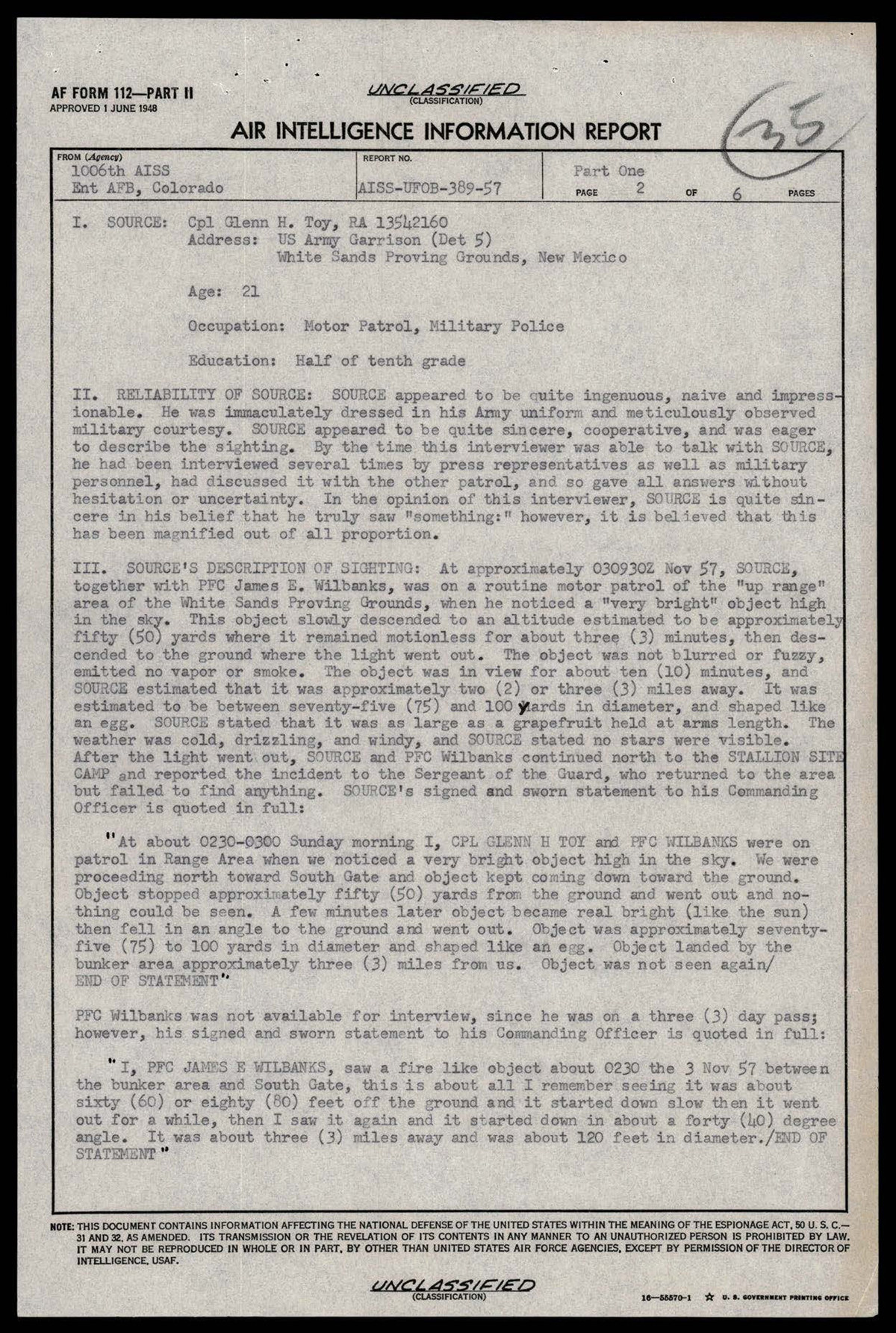
The first sighting is timed in the file at approximately 030930Z November 1957, which is 2:30 in the morning Mountain Standard Time. Corporal Glenn H. Toy, service number RA 13542160, aged 21, and Private First Class James E. Wilbanks were on a routine motor patrol of what the report calls the "up range" area, driving north toward South Gate. Toy told the investigator he noticed a very bright object high in the sky, that it slowly descended to an altitude he estimated at about fifty yards, that it remained motionless there for about three minutes, and that it then descended to the ground where the light went out. He said the object was not blurred or fuzzy and emitted no vapour or smoke, that it was in view for about ten minutes, that it was two or three miles away, that it was between seventy five and one hundred yards in diameter and shaped like an egg, and that it was as large as a grapefruit held at arm's length. He described the weather as cold, drizzling and windy, and said no stars were visible.
Toy's signed and sworn statement to his commanding officer is quoted in full in the file. It reads in part: "At about 0230-0300 Sunday morning I, CPL GLENN H TOY and PFC WILBANKS were on patrol in Range Area when we noticed a very bright object high in the sky. We were proceeding north toward South Gate and object kept coming down toward the ground. Object stopped approximately fifty (50) yards from the ground and went out and nothing could be seen. A few minutes later object became real bright (like the sun) then fell in an angle to the ground and went out. Object was approximately seventy-five (75) to 100 yards in diameter and shaped like an egg. Object landed by the bunker area approximately three (3) miles from us." The 3rd of November 1957 was indeed a Sunday.
Wilbanks was on a three day pass and was never interviewed. His account reaches the file only through a sworn statement given to his commanding officer: "I, PFC JAMES E WILBANKS, saw a fire like object about 0230 the 3 Nov 57 between the bunker area and South Gate, this is about all I remember seeing it was about sixty (60) or eighty (80) feet off the ground and it started down slow then it went out for a while, then I saw it again and it started down in about a forty (40) degree angle. It was about three (3) miles away and was about 120 feet in diameter."
The two men were in the same vehicle and their numbers do not agree. Toy put the object's hovering altitude at about fifty yards, which is a hundred and fifty feet, and its diameter at seventy five to one hundred yards. Wilbanks put the altitude at sixty to eighty feet and the diameter at about a hundred and twenty feet. They agree on the distance of three miles and on the sequence of a descent, an extinction, a return and a second descent at an angle.
After the light went out the two men continued north to the Stallion Site Camp and reported the incident to the Sergeant of the Guard, who drove out to the area and failed to find anything.
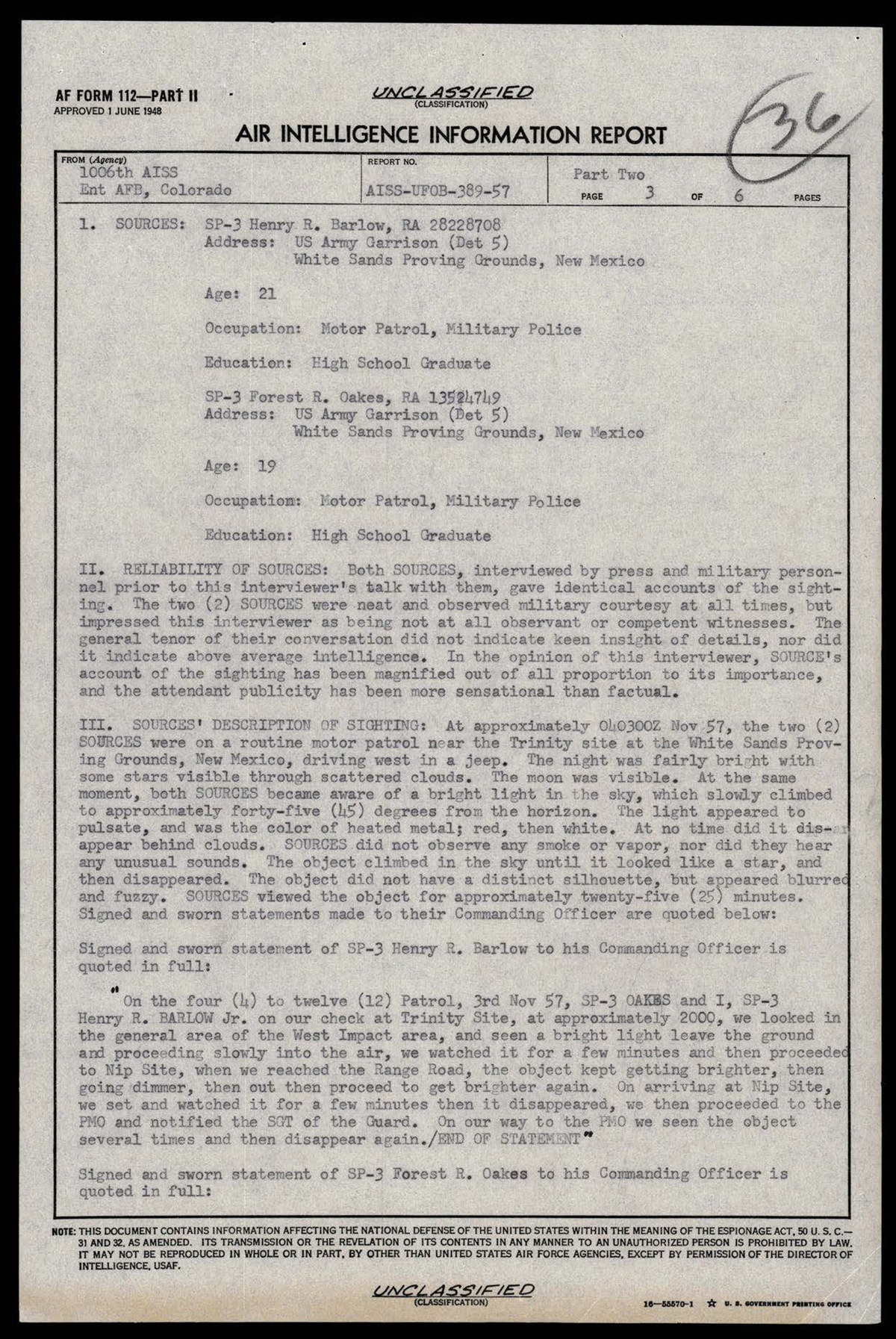
The second sighting is timed at approximately 040300Z November 1957, which is 8 o'clock on the evening of the same day, local time. Specialist 3 Henry R. Barlow Jr, service number RA 28228708, aged 21, and Specialist 3 Forest R. Oakes, service number RA 13524749, aged 19, were on the four to twelve patrol, near the Trinity site, driving west in a jeep. Both men were assigned, like Toy and Wilbanks, to the US Army Garrison Detachment 5 at White Sands.
Their description is different from the first patrol's in almost every respect that matters. The report records that the night was fairly bright with some stars visible through scattered clouds and that the Moon was visible. Both men became aware of a bright light in the sky which slowly climbed to approximately forty five degrees from the horizon. The light appeared to pulsate and was the colour of heated metal, red and then white. At no time did it disappear behind clouds. They observed no smoke or vapour and heard no unusual sounds. The object climbed in the sky until it looked like a star and then disappeared. The report states that the object did not have a distinct silhouette but appeared blurred and fuzzy. They watched it for approximately twenty five minutes.
Barlow's sworn statement adds the detail that matters most: "On the four (4) to twelve (12) Patrol, 3rd Nov 57, SP-3 OAKES and I, SP-3 Henry R. BARLOW Jr. on our check at Trinity Site, at approximately 2000, we looked in the general area of the West Impact area, and seen a bright light leave the ground and proceeding slowly into the air, we watched it for a few minutes and then proceeded to Nip Site, when we reached the Range Road, the object kept getting brighter, then going dimmer, then out then proceed to get brighter again. On arriving at Nip Site, we set and watched it for a few minutes then it disappeared, we then proceeded to the PMO and notified the SGT of the Guard."
So the first patrol described an object that came down from the sky, extinguished, and settled on the ground, with a sharp outline and no fuzziness, under drizzle and a starless sky. The second described an object that rose from the ground and climbed away until it looked like a star, blurred and without a distinct silhouette, under scattered cloud with stars and the Moon in view. These are not two views of one thing, and the file does not claim they are.
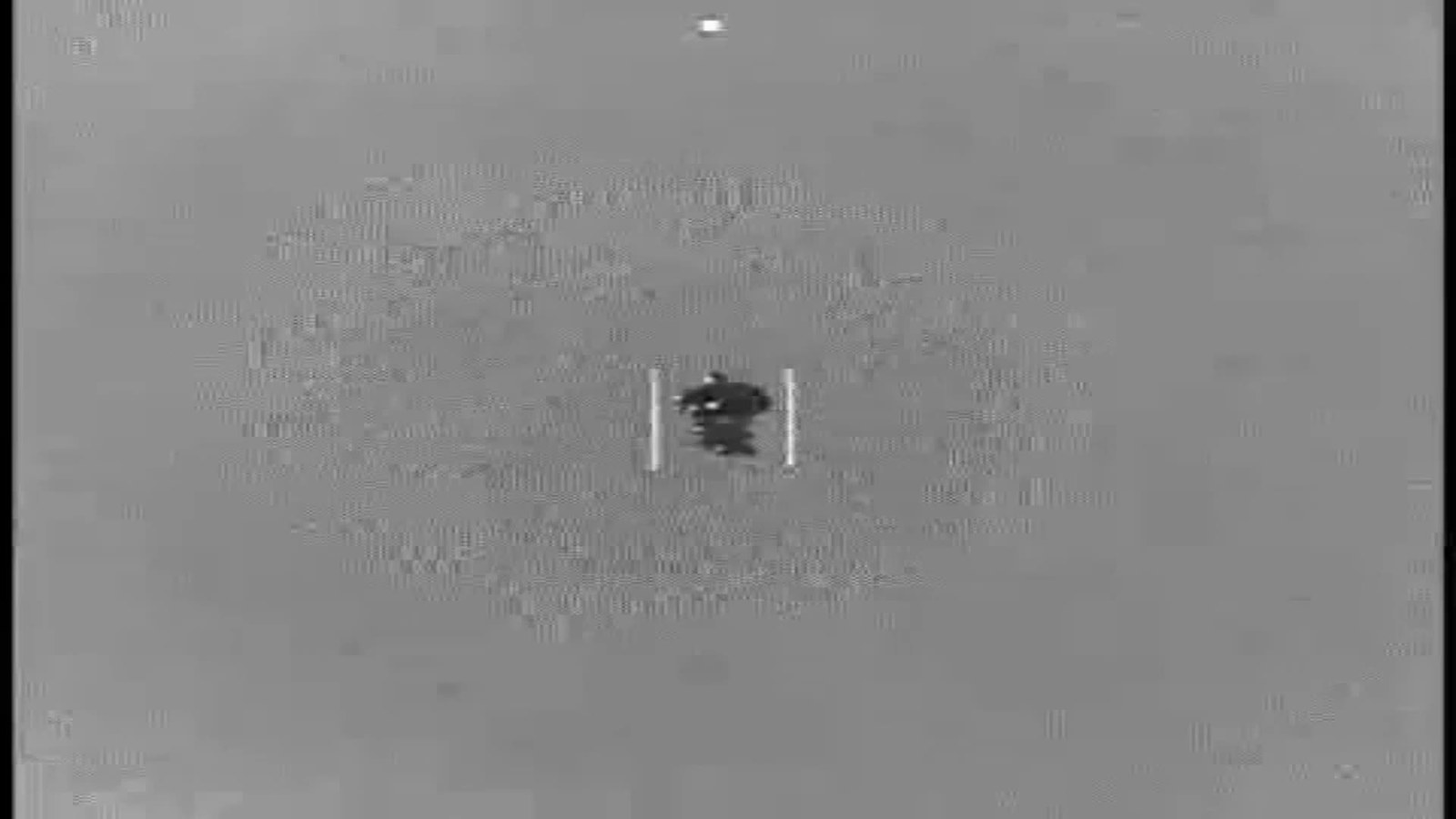
More footage and images of this sighting
What is the official explanation?
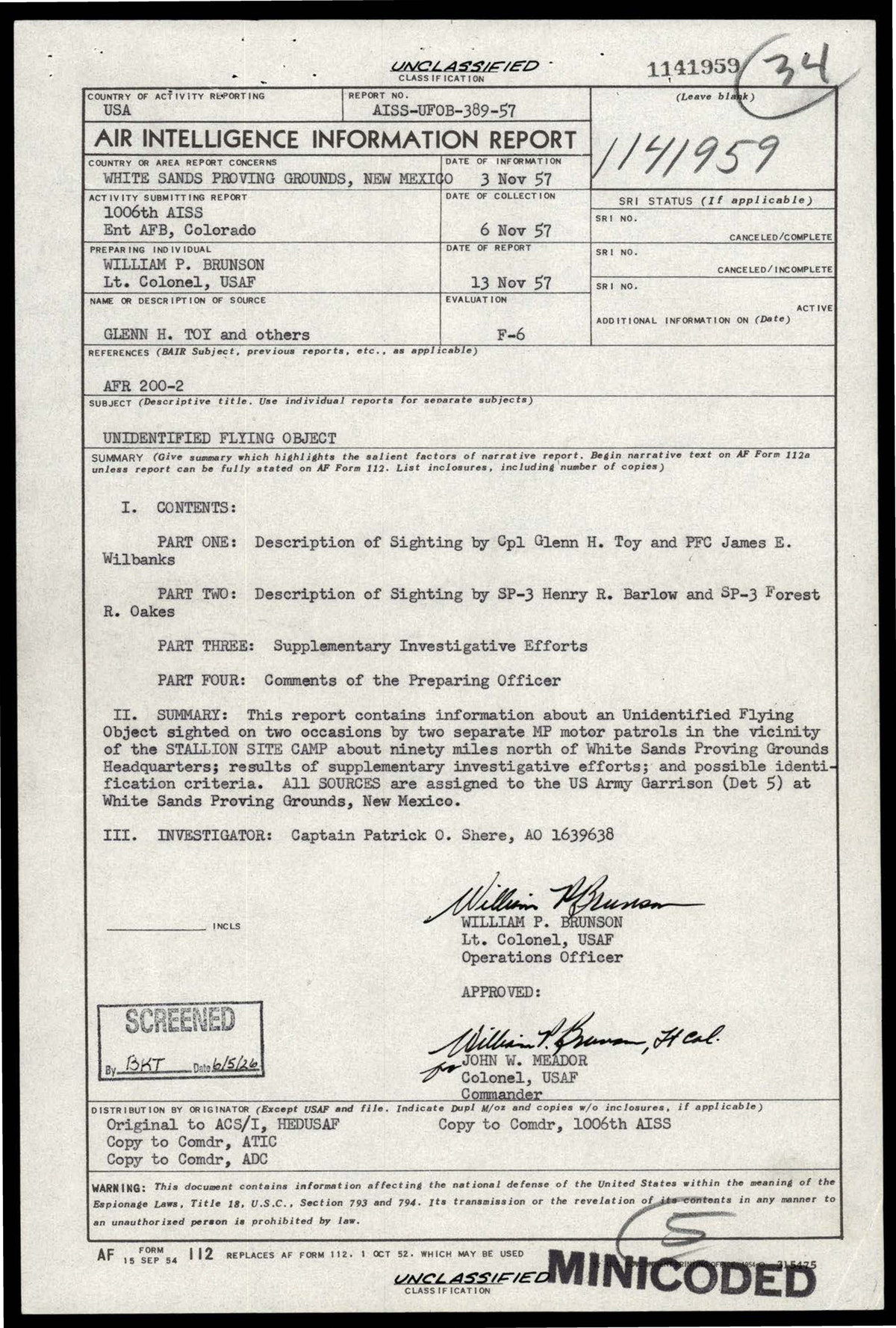
The document is an Air Intelligence Information Report on AF Form 112, report number AISS-UFOB-389-57, filed under Air Force Regulation 200-2. The submitting activity is the 1006th Air Intelligence Service Squadron at Ent Air Force Base, Colorado. The preparing individual is Lieutenant Colonel William P. Brunson, Operations Officer, and the approving officer is Colonel John W. Meador, Commander. The investigator named in the summary is Captain Patrick O. Shere, service number AO 1639638. The date of information is given as 3 November 1957, the date of collection as 6 November 1957 and the date of report as 13 November 1957.
The source evaluation on the form reads F-6. On the standard evaluation scale used on these reports, the letter grades the reliability of the source and the number grades the accuracy of the information, and F and 6 are the bottom of each scale, meaning that neither could be judged. It is the most non committal rating the form allows.
Part Three of the report, headed Supplementary Investigative Efforts, is three sentences long. It records that a check with Dr Lincoln LaPaz, Head of the Department of Meteoretics at the University of New Mexico, revealed that no unusual meteorological or astronomical phenomena occurred during this period. It records that weather records show the planet Venus at first magnitude at 2000 hours Mountain Standard Time, at 15 degrees elevation and an azimuth of 225 degrees. And it records that moonset on 3 November 1957 was at 0229 hours Mountain Standard Time at an azimuth of 270 degrees. LaPaz was the same University of New Mexico meteoriticist who had led the Air Force enquiry into the green fireballs over New Mexico from 1948, which this archive covers at /cases/new-mexico-green-fireballs-1949.
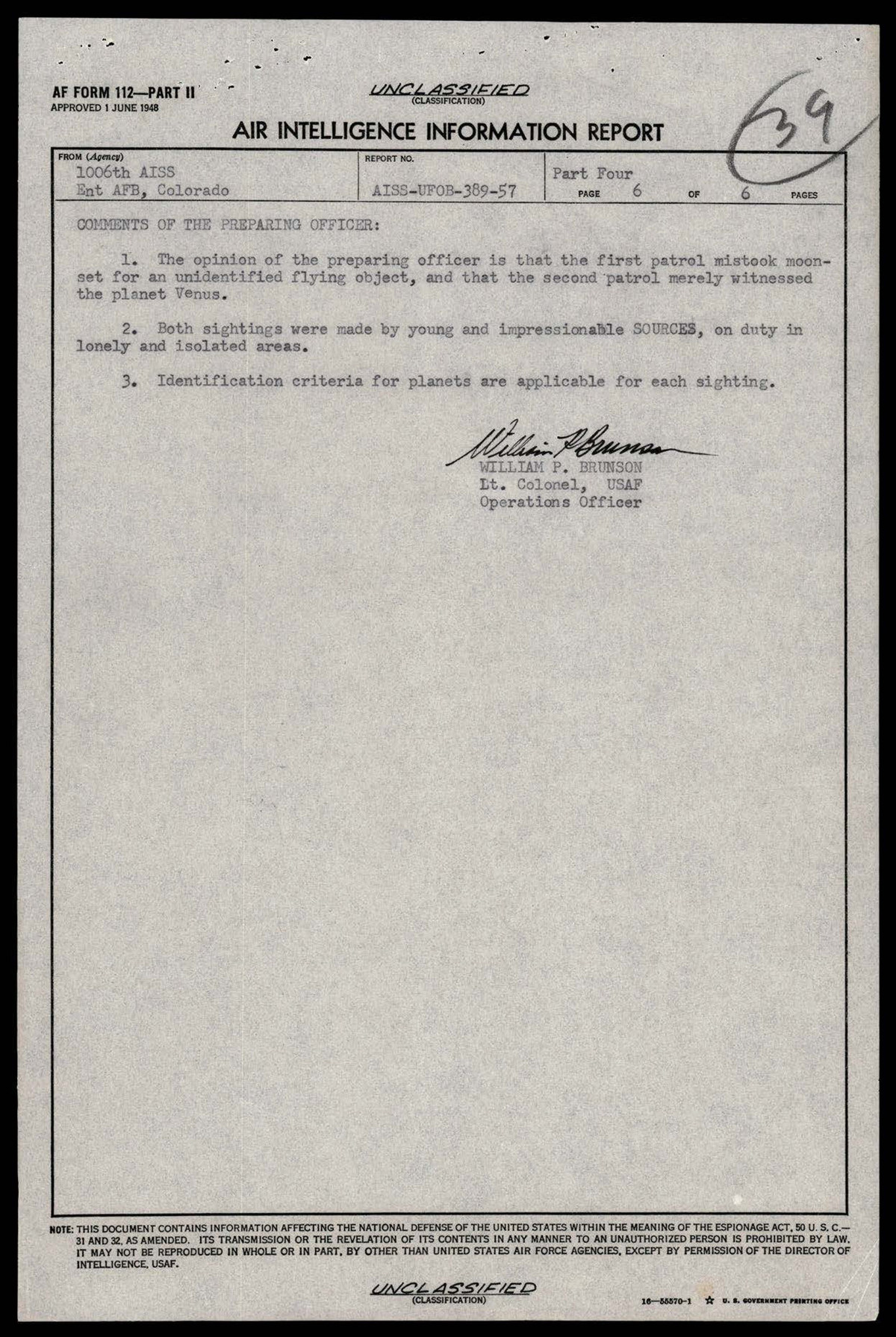
Part Four, headed Comments of the Preparing Officer, is the Air Force conclusion and is quoted here in full. "1. The opinion of the preparing officer is that the first patrol mistook moonset for an unidentified flying object, and that the second patrol merely witnessed the planet Venus. 2. Both sightings were made by young and impressionable SOURCES, on duty in lonely and isolated areas. 3. Identification criteria for planets are applicable for each sighting."
The file was declassified and released on 20 November 2026 in the eighth tranche of the Department of War PURSUE programme, catalogued as DOW-UAP-D193. It carries a screening stamp dated 5 June 2026. One correction to the Department's own finding aid is needed: the release manifest gives the incident date as 13 November 1957, which is the date the report was written. The form itself gives the date of information as 3 November 1957, both sworn statements name 3 November, and Toy's statement independently fixes it by calling it a Sunday. The event is 3 November 1957.
What did the witnesses think it was?
The most unusual material in the file is the investigator's written assessment of the men themselves, and it has two halves that point in opposite directions.
Of Corporal Toy the report says: "SOURCE appeared to be quite ingenuous, naive and impressionable. He was immaculately dressed in his Army uniform and meticulously observed military courtesy. SOURCE appeared to be quite sincere, cooperative, and was eager to describe the sighting." It then adds: "In the opinion of this interviewer, SOURCE is quite sincere in his belief that he truly saw 'something:' however, it is believed that this has been magnified out of all proportion."
Of the second patrol it is blunter. "The two (2) SOURCES were neat and observed military courtesy at all times, but impressed this interviewer as being not at all observant or competent witnesses. The general tenor of their conversation did not indicate keen insight of details, nor did it indicate above average intelligence. In the opinion of this interviewer, SOURCE's account of the sighting has been magnified out of all proportion to its importance, and the attendant publicity has been more sensational than factual."
Two things should be separated here, because the report runs them together. The first is a judgment about the men's schooling and perceived intelligence. Toy's education is recorded on the form as "Half of tenth grade"; Barlow and Oakes are recorded as high school graduates. What a witness scored at school is not evidence about what was in the sky, and this archive does not treat it as any. A reader should discount that part of Brunson's reasoning entirely.
The second is a genuine methodological observation and it is the most important sentence in the file. Of Toy the investigator writes that by the time he reached him, Toy "had been interviewed several times by press representatives as well as military personnel, had discussed it with the other patrol, and so gave all answers without hesitation or uncertainty." Of Barlow and Oakes he writes that both were "interviewed by press and military personnel prior to this interviewer's talk with them" and "gave identical accounts of the sighting."
That matters because the single strongest thing a case of this kind can offer is independent corroboration, and the report states plainly that these accounts were not independent by the time anyone official wrote them down. The patrols had talked to each other and to reporters first. Identical accounts obtained after the witnesses have compared notes are weaker evidence than two merely similar accounts obtained before. Any reading of this case that leans on the agreement between the four men has to carry that caveat, and the caveat comes from the Air Force's own investigator rather than from a later sceptic.
Is the White Sands Stallion Site UFO Sightings of 3 November 1957 real? The two-pass assessment
Pass one asks how this could be ordinary, and here the Air Force supplied its own answer in Part Three. Both halves of that answer can now be checked independently, which is worth doing because nobody has published the check and because the two halves do not fare the same.
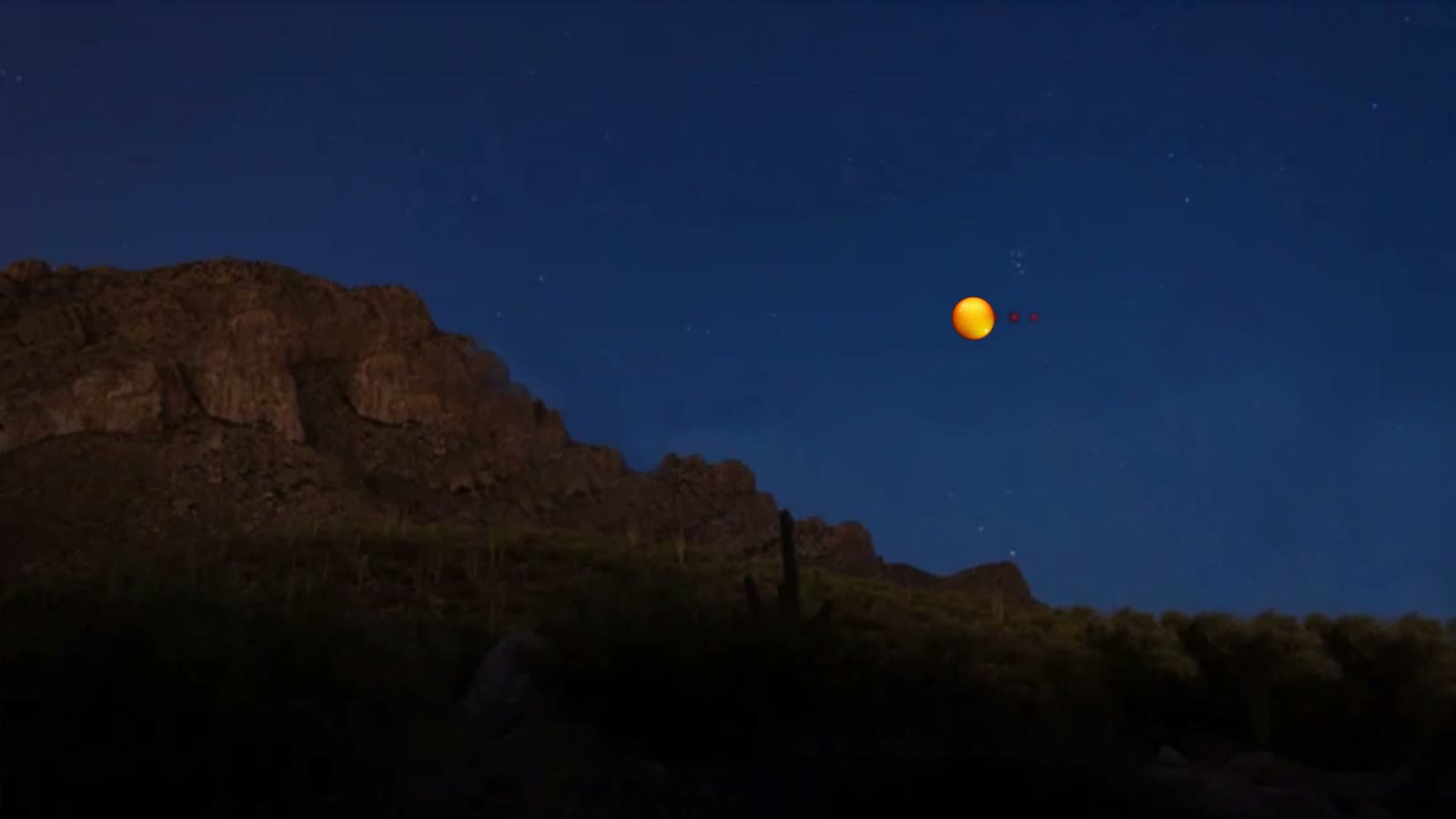
The lunar reading of the first sighting holds up. Computed from the JPL Horizons ephemeris for the Stallion Site Camp area at latitude 33.82 north and longitude 106.65 west, the Moon at 2:20 in the morning on 3 November 1957 stood at azimuth 267 degrees and elevation 5.5 degrees, was 83.5 per cent illuminated and shone at visual magnitude minus 11.4. Its geometric horizon crossing falls at about 2:47 in the morning at azimuth 270, due west. The 1957 report gives moonset as 0229 at azimuth 270. The azimuth agrees exactly and the time differs by about eighteen minutes, which is the ordinary size of a difference between horizon conventions, refraction assumptions and observing points on a range ninety miles long. Either figure puts a waxing gibbous Moon low in the west and setting within a quarter of an hour of the reported sighting, while the patrol drove north with the western horizon on its left.
That is a strong fit for what Toy described. A setting gibbous Moon descends, is cut out by low cloud, reappears brighter, and finally goes down. Toy's own report that no stars were visible supports the identification rather than weakening it, because in drizzle the Moon at magnitude minus 11.4 is routinely the only object in the sky bright enough to penetrate, which is precisely the condition in which it is most likely to be misread.
Two things cut the other way and should be stated. Toy insisted the object was not blurred or fuzzy, and a Moon seen through drizzle usually is. And his numbers do not cohere: seventy five to one hundred yards across at two to three miles gives an angular size of 0.8 to 1.6 degrees, a grapefruit held at arm's length is about 8 degrees, and the Moon is 0.52 degrees. Those three figures cannot all be right, and recalled angular size and distance are the least reliable fields on any sighting form.
The Venus reading of the second sighting does not hold up. The report places Venus at 15 degrees elevation and azimuth 225 at 2000 hours, the stated time of the second sighting. Computed for the same site and date, Venus at 2000 Mountain Standard Time stood at azimuth 239 degrees and elevation minus 2.3 degrees. It had already set. The figures quoted in the report are close to Venus's real position at about 6:16 in the evening, when it stood near 15 degrees elevation at azimuth 224, which is roughly an hour and three quarters before the time they are attached to. The report also calls Venus "first magnitude" when it was at magnitude minus 4.4, brighter than first magnitude by a factor of about one hundred and sixty. The planet was below the horizon for the whole twenty five minutes Barlow and Oakes say they watched their object, so it cannot be what they saw.
The Moon can be excluded for the second sighting too, and the witnesses excluded it themselves by reporting it separately as visible. For the record it stood at azimuth 144 and elevation 54 degrees at 8 in the evening, high in the south east, while the object they described climbed from the ground in the direction of the West Impact area.
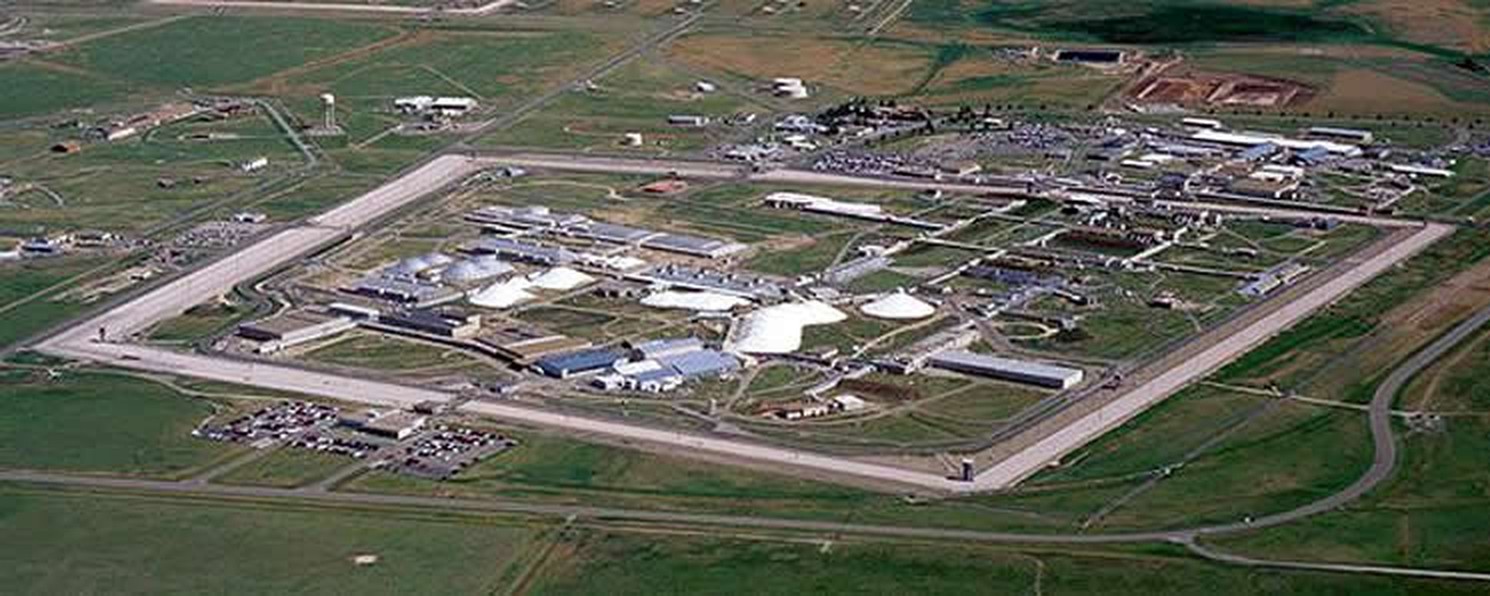
What the second sighting leaves is a light that Barlow says left the ground, climbed slowly over twenty five minutes, pulsated red and then white, showed no distinct silhouette, and receded until it looked like a star. That description belongs to the ordinary business of the place. White Sands Proving Grounds was the principal rocket and missile range in the United States, and the West Impact area is range ground. The striking omission in Part Three is that nobody appears to have asked. The supplementary investigation consulted an astronomer about meteors, tabulated two celestial objects, and contains no check of range activity, no query to the range schedule, and no mention of balloons, rockets or aircraft on a site whose entire purpose was to fly such things. That is the one check that could still close this case, and the file does not contain it.
Pass two asks what survives if the reports are taken at face value. Less than the case's reputation suggests. The first patrol's sighting has a good prosaic answer that the archive's own independent computation supports. The second patrol's sighting has no demonstrated answer at all, but an undemonstrated identification is not evidence of anything exotic, and the most likely remaining candidates are mundane and local. The detail that resists the easiest reading is that both men in the first patrol placed the object at a specific location on the ground, the bunker area about three miles off, and that the Sergeant of the Guard drove out and found nothing. A setting Moon has no landing site. Against that, a witness fitting a descending light onto a familiar landmark is among the most common things witnesses do.
The tier is Disputed. An official narrative exists, it is on the record in the officer's own words, and independent checking confirms one half of it and refutes the other half. Nothing in the file demonstrates an object of unknown origin, and nothing in it supports the Air Force's identification of the second sighting.
For context, this is the closing night of the Levelland wave in Texas, covered at /cases/levelland-1957, and the Kirtland Air Force Base sighting followed on the next evening at /cases/kirtland-afb-1957. The Air Force investigated all three within the same fortnight.
Sources
- www.war.gov/UFO/
- www.war.gov/medialink/ufo/docs-112026-release-08/DOW-UAP-D193-Air_Intelligence_Information_Report_New_Mexico-1957.pdf
- www.war.gov/Portals/1/Interactive/2026/UFO/uap-data.csv
- ssd.jpl.nasa.gov/horizons/
More cases from this region: UFO sightings in United States