The AATIP Restricted Special Access Program Request and the DIA Refusal
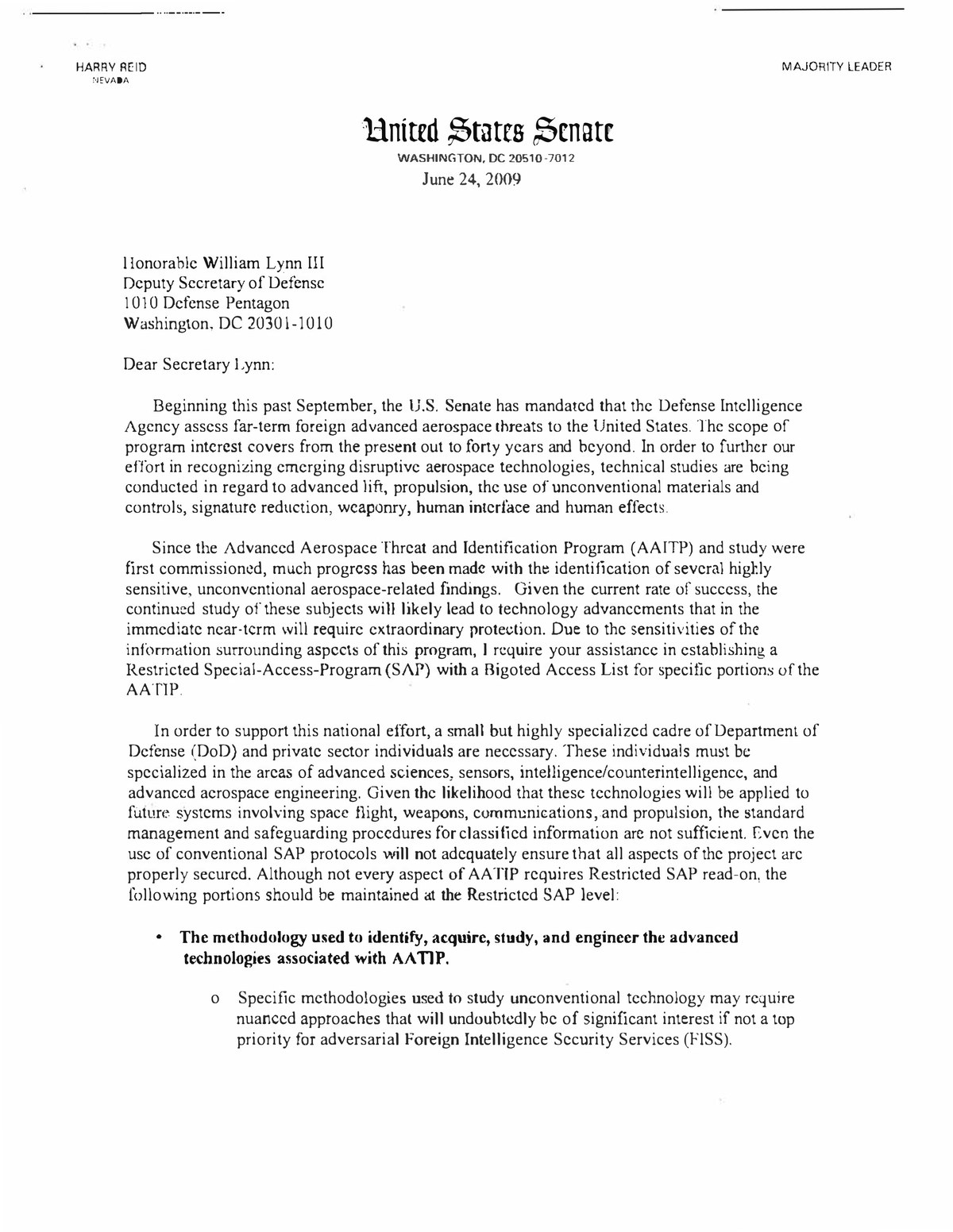
On 24 June 2009 Senator Harry Reid asked the Deputy Secretary of Defense to wall off parts of the Pentagon UFO programme inside a Restricted Special Access Program. In November 2009 the Defense Intelligence Agency refused, on the ground that it could not identify any damage that disclosure would cause. Both documents were released together on 20 November 2026.
What did witnesses see at Defense Intelligence Agency?
This case covers a set of government documents rather than a sighting of anything. The Department of War released seven of them together on 20 November 2026, in the eighth PURSUE tranche, and its manifest cross links them under a single tag.
Taken in order they are the solicitation that created the programme (DOW-UAP-D182, 18 August 2008), two talking papers prepared for the Director of the Defense Intelligence Agency ahead of meetings with Senator Reid (DOW-UAP-D187 of 2 January 2009 and DOW-UAP-D184 of 4 May 2009), Senator Reid's letter to the Deputy Secretary of Defense (DOW-UAP-D183, 24 June 2009), an internal review of the first year's contract deliverables (DOW-UAP-D188, 30 October 2009), the Defense Intelligence Agency's formal review of Reid's request (DOW-UAP-D185, 13 November 2009), and a retrospective memorandum from the Director of the agency (DOW-UAP-D186, December 2010). An eighth record, the BAASS ten month report of July 2009 (DOW-UAP-D172), was released alongside them.
The solicitation is the plainest of the set and the least discussed. It is a printout of the Federal Business Opportunities notice for solicitation HHM402-08-R-0211, posted 18 August 2008 with a response date of 5 September 2008. It describes the requirement as engineering services in the Washington DC area, classifies it under code B for "Special studies and analysis - not R&D", assigns NAICS code 541330 with a size standard of 25 million dollars, and issues it as a total small business set aside. One firm fixed price contract was anticipated on a best value basis, running from award through 30 September 2009 with four one year options out to 30 September 2013. The attached Statement of Objectives, dated 18 July 2008, sets the aim as understanding the physics and engineering of advanced aerospace weapon system applications "as they apply to the foreign threat out to the far term, i.e., from now through the year 2050", with primary focus on "breakthrough technologies and applications that create discontinuities in currently evolving technology trends" and the explicit note that "the focus is not on extrapolations of current aerospace technology".
The two talking papers were written so that the Director of the agency would not be caught unprepared if the Senator raised the subject. The January 2009 paper, prepared for Lieutenant General Michael Maples ahead of a 5 January visit, and the May 2009 paper, prepared for Lieutenant General Ronald Burgess, agree on the origin: "Senator Inouye (D-HI) and Senator Reid (D-Nev) sponsored language in the July 2008 Supplemental Appropriation bill for DIA to investigate foreign advanced aerospace weapon threats from the present out to 40 years in the future." Both record that the agency published its request for proposals on 18 August 2008, that "DIA received only one bid, from Bigelow Aerospace Advanced Space Studies (BAASS)", and that the contract was signed on 22 September 2008. Both list the twelve technical areas: lift, materials, propulsion, configuration and structure, control, power generation, armament, human effects, spatial and temporal translation, human interface, signature reduction, and technology integration.
The May 2009 paper reports that BAASS submitted programme management plans for all twelve areas on 21 November 2008, that the agency "reviewed the PMPs and rated them as very good to excellent", that roughly two detailed research reports per technical area were expected for that fiscal year, each "written by world-class technical experts in industry and academia", and that a university grant programme for the following year had been started. Its summary line is that the "Contract is on track", proceeding on schedule and within cost, and that "BAASS performance has been excellent".
Senator Reid's letter of 24 June 2009 is addressed to the Honorable William Lynn III, Deputy Secretary of Defense. It opens by describing the Senate mandate, then makes its claim: "Since the Advanced Aerospace Threat and Identification Program (AATIP) and study were first commissioned, much progress has been made with the identification of several highly sensitive, unconventional aerospace-related findings. Given the current rate of success, the continued study of these subjects will likely lead to technology advancements that in the immediate near-term will require extraordinary protection."
On that basis it makes its request: "Due to the sensitivities of the information surrounding aspects of this program, I require your assistance in establishing a Restricted Special-Access-Program (SAP) with a Bigoted Access List for specific portions of the AATIP." A bigoted access list is the term of art for a named, individually approved roster of people cleared into a compartment. The letter argues that "the standard management and safeguarding procedures for classified information are not sufficient" and that "even the use of conventional SAP protocols will not adequately ensure that all aspects of the project are properly secured", and it lists the portions it wants protected: the methodology used to identify, acquire, study and engineer the technologies; the allocation of personnel, support and oversight; and application and engineering. Under the last of those it refers to "associated exotic technologies" said to involve "extremely sophisticated concepts within the world of quantum mechanics, nuclear science, electromagnetic theory, gravities, and thermodynamics".
Worth noting in passing, because the naming has been argued over for years, is that the programme is called the "Advanced Aerospace Threat and Identification Program" in Reid's own letter, with an "and" that the commonly used expansion drops. The Defense Intelligence Agency's reply treats that name as the Senator's label for the contract it ran as AAWSAP, writing of "the Advanced Aerospace Weapon System Application Program Contract, referred to in Senator Reid's letter as the Advanced Aerospace Threat and Identification Program".
More footage and images of this sighting
What is the official explanation?
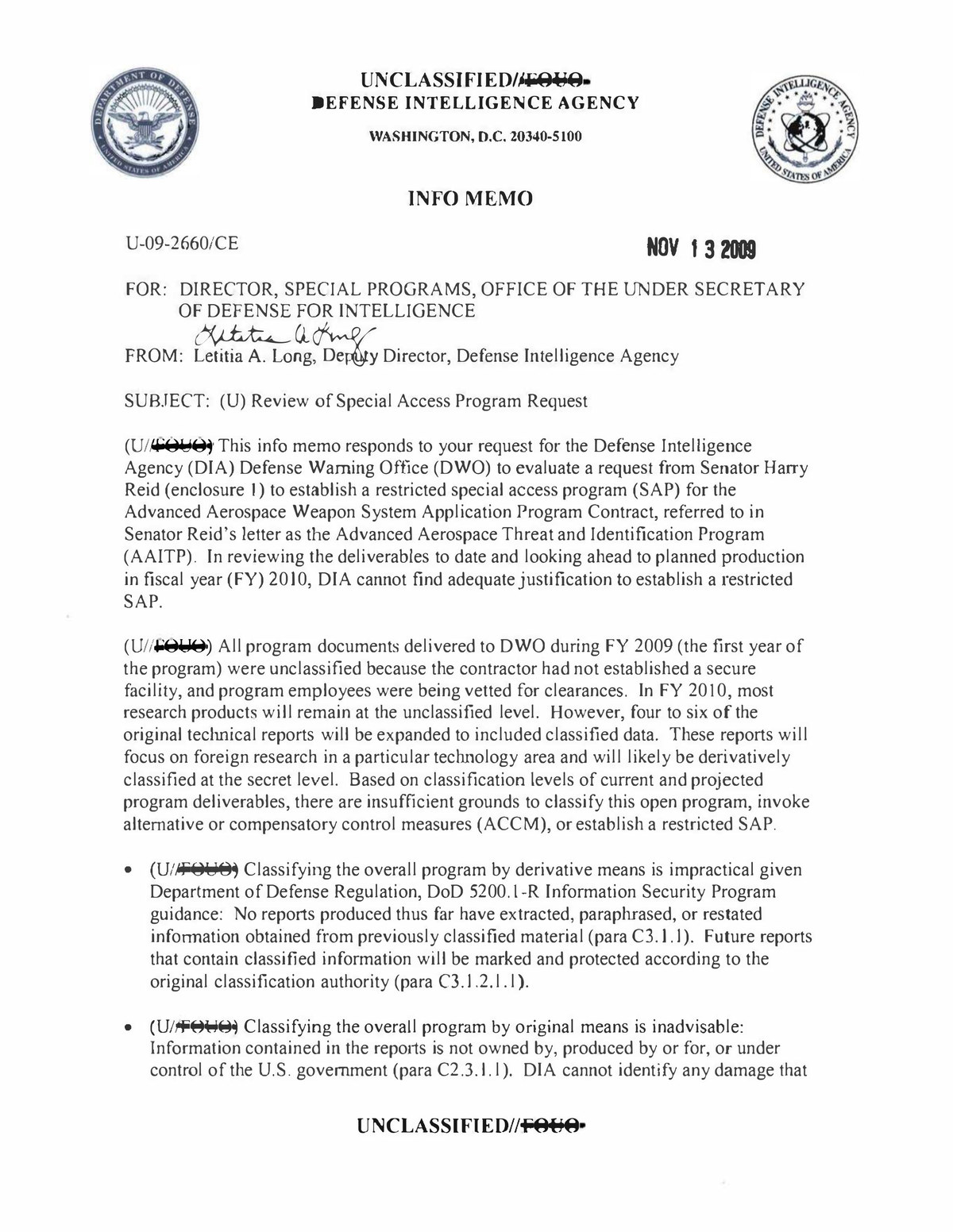
The Defense Intelligence Agency's answer is DOW-UAP-D185, an information memorandum numbered U-09-2660/CE and dated 13 November 2009, addressed to the Director of Special Programs in the Office of the Under Secretary of Defense for Intelligence. Its routing sheet shows it received on 4 November and logged on 5 November 2009.
Its finding is in the first paragraph: "In reviewing the deliverables to date and looking ahead to planned production in fiscal year (FY) 2010, DIA cannot find adequate justification to establish a restricted SAP."
The reasoning is specific and it is about paperwork rather than about phenomena. "All program documents delivered to DWO during FY 2009 (the first year of the program) were unclassified because the contractor had not established a secure facility, and program employees were being vetted for clearances. In FY 2010, most research products will remain at the unclassified level. However, four to six of the original technical reports will be expanded to included classified data." On that basis, the memorandum concludes, "there are insufficient grounds to classify this open program, invoke alternative or compensatory control measures (ACCM), or establish a restricted SAP."
It then works through the two routes to classification under Department of Defense Regulation 5200.1-R and closes both. Derivative classification is impractical because "No reports produced thus far have extracted, paraphrased, or restated information obtained from previously classified material". Original classification is inadvisable because "Information contained in the reports is not owned by, produced by or for, or under control of the U.S. government", and because "DIA cannot identify any damage that could result from unauthorized disclosure of publically available information". The misspelling is the document's own.
The retrospective memorandum of December 2010, DOW-UAP-D186, is signed by Ronald L. Burgess Jr, Lieutenant General, Director of the Defense Intelligence Agency, and addressed to the Under Secretary of Defense for Acquisition, Technology and Logistics. It is the most complete official summary of the programme in the set. It records that the effort "was first sponsored in the Fiscal Year (FY) 2008 Defense Supplemental Appropriation Act by Senators Reid and Inouye with a $10 million add", that the purpose was to investigate foreign advanced aerospace weapon threats out forty years "and to build an infrastructure to house a center of expertise on advanced aerospace technologies", and that the contract went to "the Bigelow Aerospace Advanced Space Studies LLC (BAASS), the only bid, headquartered in North Las Vegas, Nevada".
It records the output: twenty six technical reports produced by June 2009 and delivered by September 2009, with one of them, "Advanced Space Propulsion Based on Vacuum (Spacetime Metric) Engineering", published in March 2010 and attached as a sample. It records a further twelve reports under a 12 million dollar add in the FY 2010 Defense Appropriations Act.
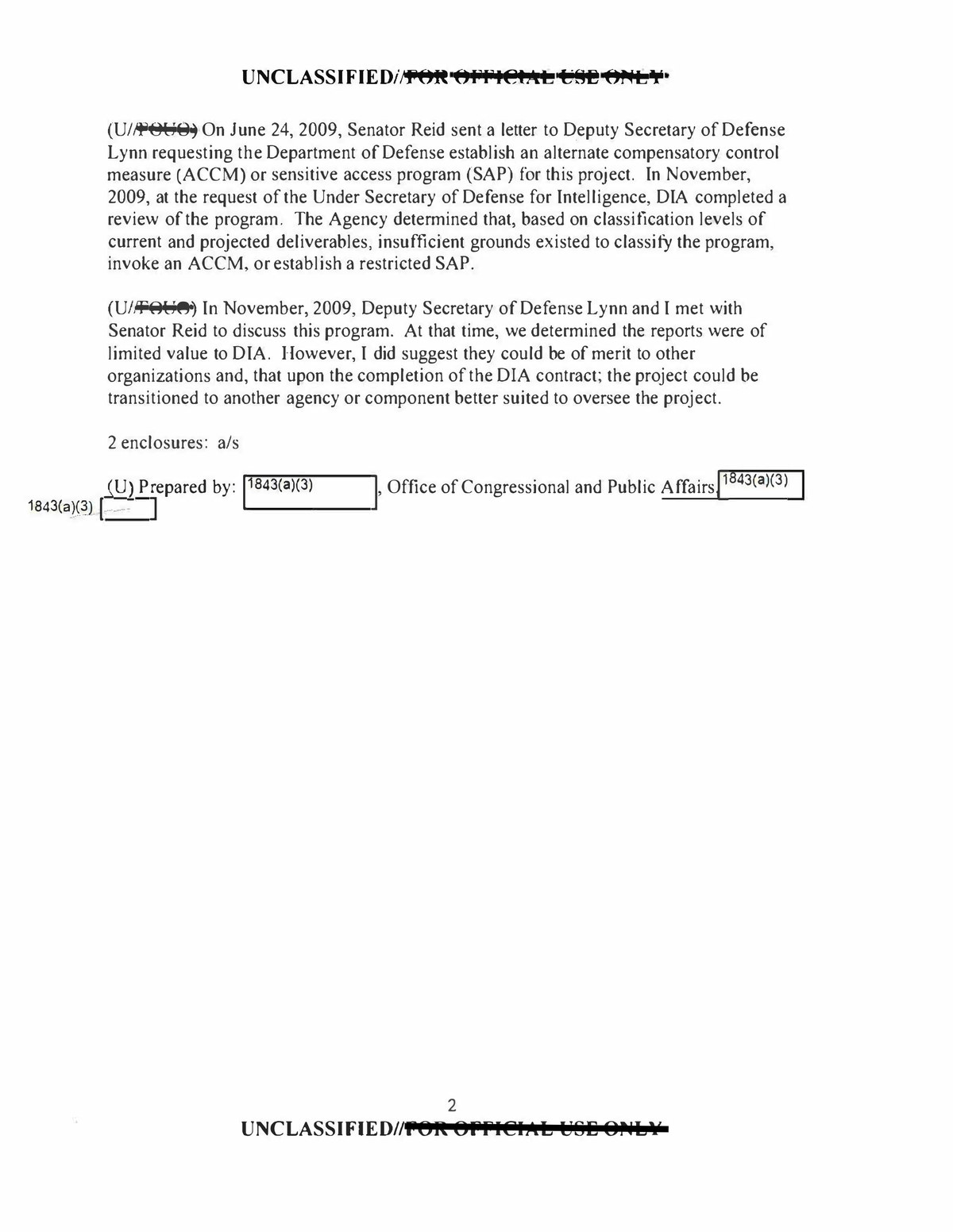
Its last two paragraphs are the ones that matter. The first confirms the refusal. The second reads: "In November, 2009, Deputy Secretary of Defense Lynn and I met with Senator Reid to discuss this program. At that time, we determined the reports were of limited value to DIA. However, I did suggest they could be of merit to other organizations and, that upon the completion of the DIA contract; the project could be transitioned to another agency or component better suited to oversee the project."
That is the Director of the Defense Intelligence Agency, in writing, recording that the programme's product was of limited value to his own agency and that he proposed moving it elsewhere.
What did the witnesses think it was?
The documents disagree with each other, and the disagreement is internal to the agency rather than between the agency and its critics.
Six weeks before the refusal, on 30 October 2009, the Defense Warning Office sent the Director its own review of the first year's technical reports (DOW-UAP-D188). The Director had asked for it during a 15 May 2009 meeting held, the memorandum notes, "after your meeting with Senator Harry Reid". Its verdict is warm. Of the twenty six reports delivered in fiscal year 2009, a subset was formally reviewed, with "eight reviews performed by other authors listed in the table" and "five performed by outside reviewers, including three research staff members at Sandia National Laboratories". The office reports that "all of the reviews were positive, some exceptionally so" and that "Even within the limitation of being able to conduct only unclassified research in the first contract year, the quality hoped for in the reports was achieved". It states an intention to publish them as Defense Intelligence Studies and to circulate them to Defense Department agencies, national laboratories and defence industries.
Fourteen months later the Director told the Under Secretary of Defense for Acquisition, Technology and Logistics that the reports "were of limited value to DIA".
Both statements can be true at once, and the likeliest reading is that they are measuring different things. The October 2009 review grades the reports as technical literature, judged by subject matter experts against the standard of a commissioned study. The December 2010 memorandum grades them as intelligence, judged by whether they told the agency anything about a foreign threat. A well written review of the physics of wormholes can be excellent as a paper and useless as warning intelligence. The set documents that distinction being drawn inside the agency, which is something no secondary account of this programme has been able to show.
It is also worth being precise about what the refusal did and did not address. Senator Reid's claim was about findings: that the programme had identified "several highly sensitive, unconventional aerospace-related findings". The Defense Intelligence Agency's answer was about deliverables: that the reports produced so far contained no previously classified material, that the information in them was not owned or controlled by the government, and that no damage could be identified from disclosing publicly available information. Those are answers to different questions. Nothing in the released set tests whether Reid's claim about findings was accurate, and nothing in it repeats that claim back as agreed fact.
Is the AATIP Restricted Special Access Program Request and the DIA Refusal real? The two-pass assessment
Pass one asks what the ordinary reading of this material is, and for once the ordinary reading is well documented.
On the paperwork, the programme looks smaller and more conventional than its reputation. It was solicited as a total small business set aside under a classification code that reads "Special studies and analysis - not R&D". It drew exactly one bid. Its first year product was a set of unclassified literature reviews written by academics and industry specialists, delivered by a contractor that did not yet have a secure facility or cleared staff. When a senator asked for the most restrictive protection the Department of Defense can apply, the Defense Intelligence Agency examined the actual deliverables and concluded that it could not identify any damage that would follow from publishing them. Fourteen months after that, the Director of the agency recorded that the reports were of limited value to his agency and suggested the project move elsewhere. Every one of those statements is a government document in this release.
Pass two asks what survives that reading, and three things do.
The first is that Reid's claim is still on the record and is still untested. A Senate Majority Leader wrote to the Deputy Secretary of Defense asserting in his own hand that the programme had produced "several highly sensitive, unconventional aerospace-related findings" and that continued study would "likely lead to technology advancements that in the immediate near-term will require extraordinary protection". The refusal does not say that was untrue. It says the documents the agency had in hand did not meet the criteria for classification. A reader is entitled to notice that these are not the same statement, and should resist the temptation to read the second as a rebuttal of the first.
The second is the shape of the request itself. A Restricted Special Access Program with a bigoted access list is not a routine administrative ask, and the letter's stated reasons for wanting one go beyond protecting research papers. It asks to protect "the methodology used to identify, acquire, study, and engineer the advanced technologies", the identities and affiliations of participating personnel and industry partners, and the "big picture" of the programme's overall intent. Acquire and engineer are transitive verbs with objects, and the letter does not name them.
The third is the transition. The December 2010 memorandum is the documented origin of the programme's move out of the Defense Intelligence Agency, in the Director's own account, offered by him rather than imposed on him. What the effort became after that point is outside this file.
The tier is Unknown, because this is a documentary record rather than a sighting and there is no observation to adjudicate. The honest summary is that the release settles several long argued questions of fact about how the programme was created, funded, named, staffed and judged inside the Pentagon, and settles nothing at all about whether anything unusual was ever found.
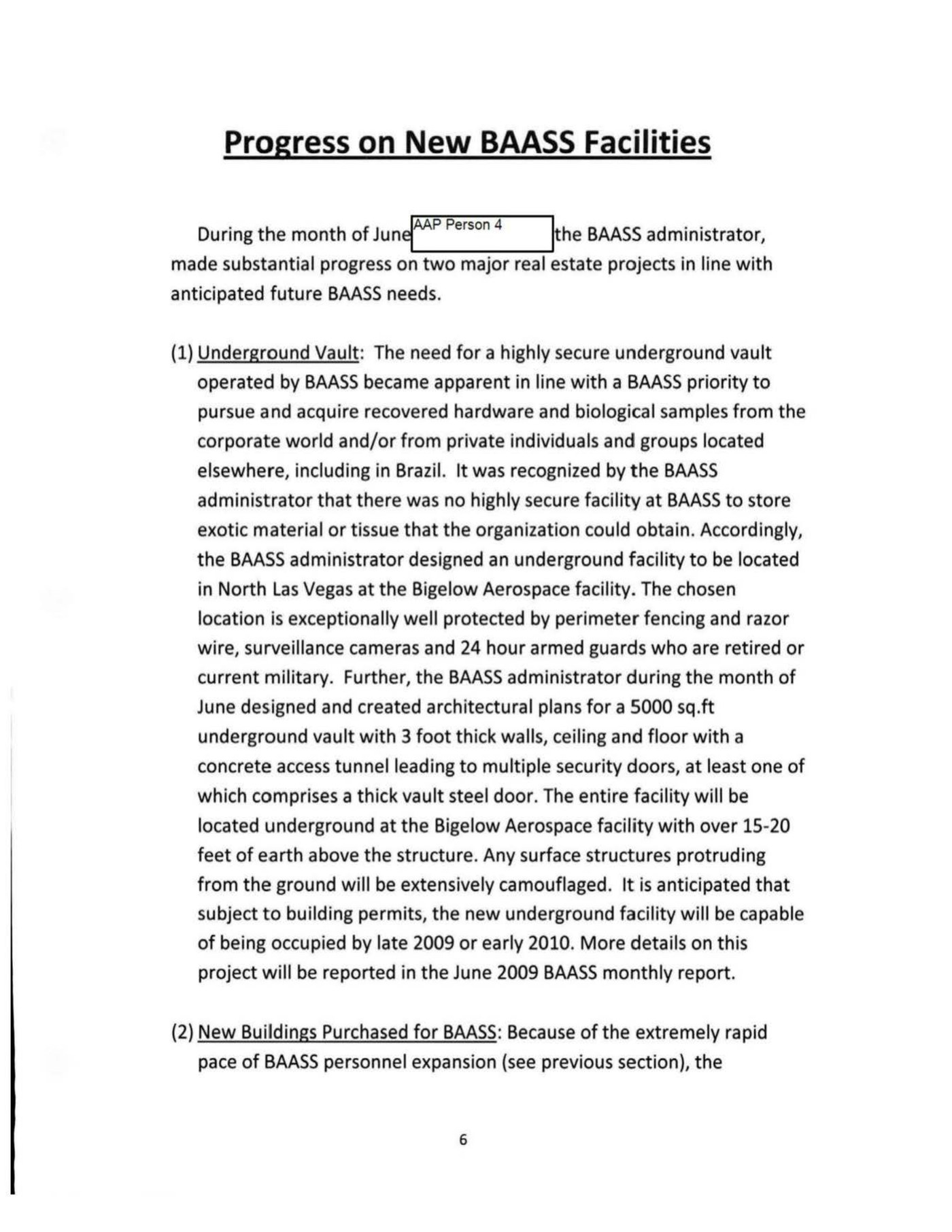
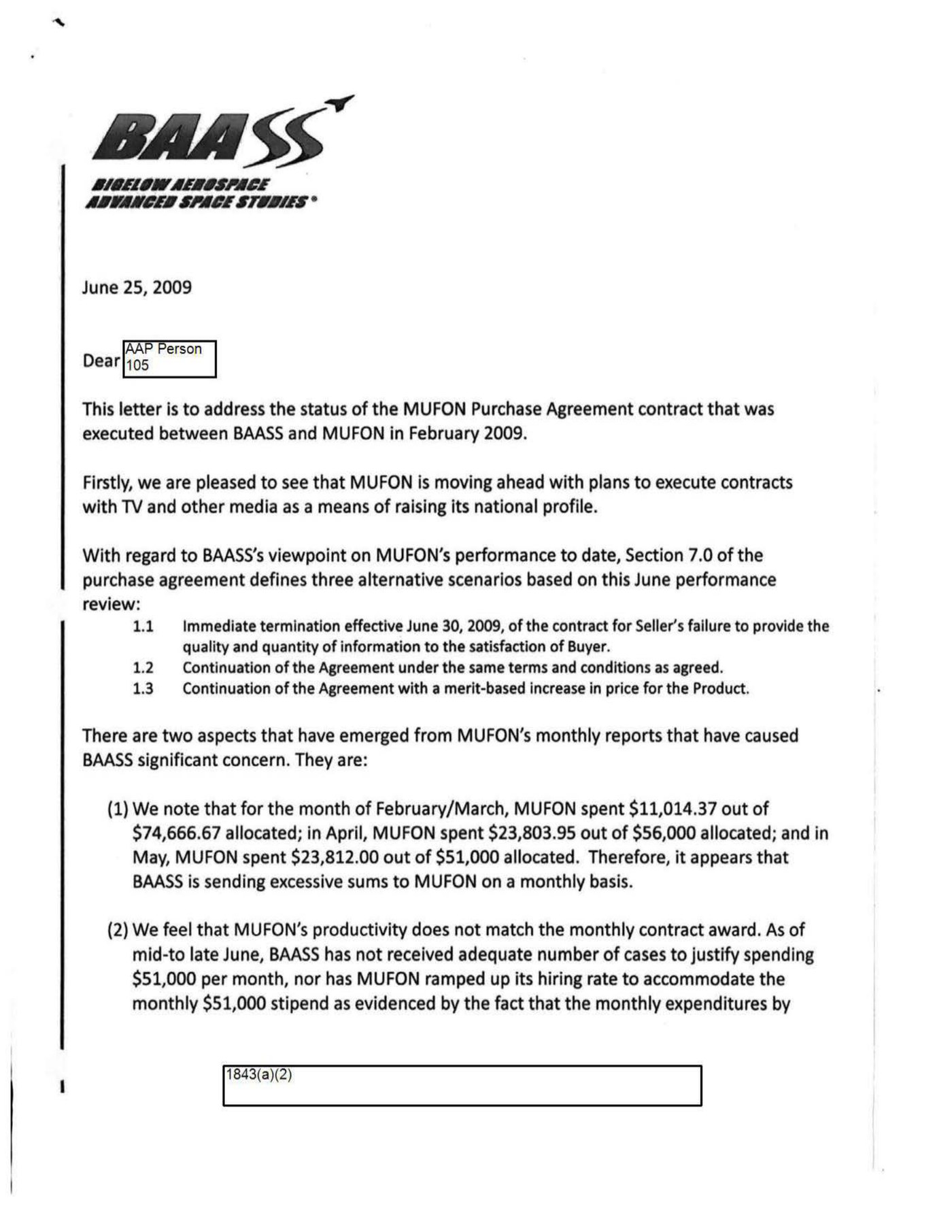
Related files in this archive: the original contract documents and the thirty seven Defense Intelligence Reference Documents are at /cases/aawsap-contract-file-2008, the contractor's own operational papers are at /cases/baass-records-2026, and the underground storage facility proposed at the contractor's Las Vegas site is at /cases/baass-underground-vault-2009.
Sources
- www.war.gov/UFO/
- www.war.gov/medialink/ufo/docs-112026-release-08/DOW-UAP-D183-Correspondence_from_Senator_Harry_Reid_June_24-2009.pdf
- www.war.gov/medialink/ufo/docs-112026-release-08/DOW-UAP-D185-Review_of_AAWSAP_Special_Access_Program_Request_November-2009.pdf
- www.war.gov/medialink/ufo/docs-112026-release-08/DOW-UAP-D186-DIA_Information_Memorandum_on_AATIP_AAWSAP_December-2010.pdf
- www.war.gov/medialink/ufo/docs-112026-release-08/DOW-UAP-D188-Review_of_AAWSAP_Contract_Deliverables_October-2009.pdf
- www.war.gov/medialink/ufo/docs-112026-release-08/DOW-UAP-D182-AAWSAP_Statement_of_Work_August-2008.pdf
- www.war.gov/medialink/ufo/docs-112026-release-08/DOW-UAP-D184-AAWSAP_Talking_Paper_for_Senator_Reid_Engagement_May-2009.pdf
- www.war.gov/medialink/ufo/docs-112026-release-08/DOW-UAP-D187-DIA_Talking_Paper_for_Senator_Reid_Engagement_January-2009.pdf
- www.war.gov/Portals/1/Interactive/2026/UFO/uap-data.csv
More cases from this region: UFO sightings in United States