DOW-UAP-PR100: Unresolved UAP Report over the Yellow Sea, 2023 (PURSUE Release 04)
A U.S. military platform tracked an area of contrast over the Yellow Sea for nearly five minutes in 2023, switching between infrared and day-television modes. AARO released the clip as DOW-UAP-PR100 in the fourth PURSUE tranche and left it unresolved. Analysts float balloons and range foulers; the sensor never resolves the object into anything.
What did witnesses see at Yellow Sea?
The footage is a single continuous clip captured in 2023 by an electro-optical and infrared sensor system aboard a U.S. military platform operating over the Yellow Sea. It is one of the longer video files in the entire PURSUE archive. AARO's own frame-by-frame caption opens by stating the U.S. Indo-Pacific Command submitted a report consisting of 4 minutes and 57 seconds of footage, while the clip as hosted on DVIDS runs to 04:45, ending with a final No content segment from 04:41 to 04:45. AARO warns up front that the overall quality of the video progressively degrades over its runtime.
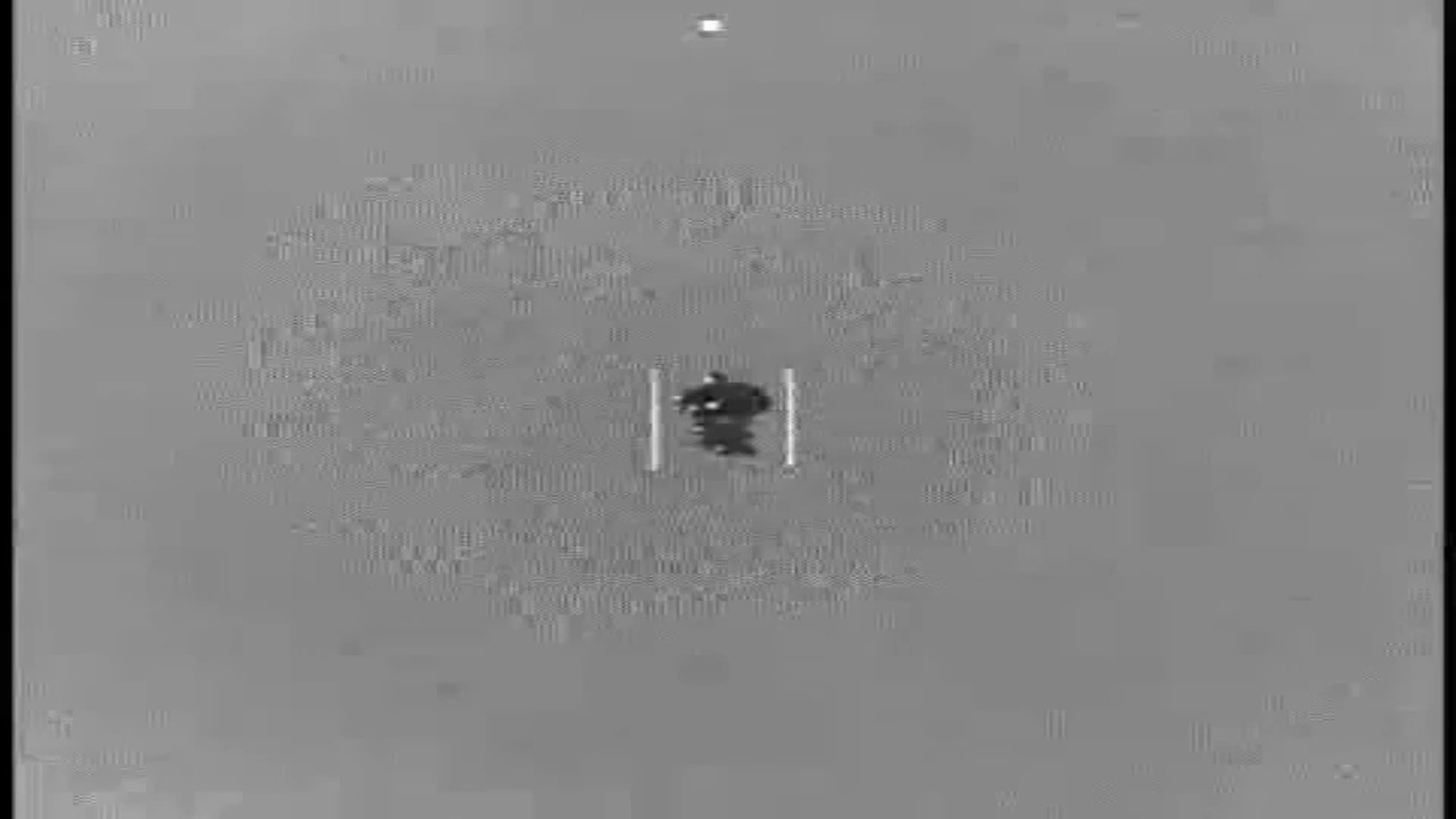
What the sensor actually shows is modest and repetitive rather than dramatic. From 00:01 the infrared channel tracks an area of contrast and holds it near the center of the frame, then zooms in on it through 01:03. At 01:04 the display switches to an electro-optical daytime television mode, described by AARO as a collection mode that displays visible and near infrared signatures, and here the object reads as a dark shape superimposed against a blue background. The feed reverts to infrared at 01:11, loses the target briefly, then reacquires and tracks it. Between 02:17 and 02:22, and again from 04:33 to 04:40, the area of contrast repeatedly leaves and re-enters the sensor field of view. At 03:28 to 03:32 the footage appears to skip or lose coherence before returning to its prior state.
What makes PR100 notable is not any single maneuver but its combination of length and dual-mode presentation. Analysts rarely get nearly five minutes of continuous tracking on an unresolved target, and the mid-clip switch between infrared and electro-optical day television offers two independent looks at the same area of contrast. That said, the object is never resolved into anything with clear structure. It remains an area of contrast, a dark object against blue, and its behavior across the clip is dominated by the sensor's own zoom, mode changes, and reacquisition rather than by anything the object is unambiguously doing.
AARO applied no shape, size, speed, altitude, or range figures to the object, and released no coordinates beyond the general Yellow Sea location and the year 2023. The record carries the reference designation DOW-UAP-PR100 and remains officially unresolved.
What is the official explanation?
The record was filed by U.S. Indo-Pacific Command and submitted to the All-domain Anomaly Resolution Office (AARO). It was published as DOW-UAP-PR100 in the fourth PURSUE tranche (Presidential Unsealing and Reporting System for UAP Encounters), a 40-file release of 19 videos, 14 documents, 3 images, and 4 audio files posted to war.gov/UFO on 10 July 2026, and mirrored on DVIDS as video 1014096 under VIRIN 230101-D-D0360-2389. AARO classifies the case as unresolved, meaning the office was unable to make a definitive determination about the nature of what the sensor recorded.
Crucially, AARO attaches a standing disclaimer to the caption. In its own words, the description is provided for informational purposes only, and readers should not interpret any part of it as reflecting an analytical judgment, investigative conclusion, or factual determination regarding the described event's validity, nature, or significance. In other words the narration describes pixels on a screen, not a finding about a craft. The Debrief's coverage of the fourth release stressed exactly this point, that the archived cases are unresolved and that clarity remains elusive even with the new footage in hand.
Outside analysts have offered prosaic candidates for this general class of long infrared tracking clips, and those reads should be treated as independent inference, not official conclusions. Harvard astrophysicist Avi Loeb, writing on Medium about the same fourth release, described a comparably ambiguous ocean case as resembling a large deformed balloon drifting with the wind, and separately noted that a star-like shape in one of the release videos was simply a diffraction pattern of the camera, an optical artifact rather than a real object. The recurring prosaic candidates raised in press and analyst commentary for footage like PR100 are balloons and range foulers, mundane objects or debris that intrude on a sensor's field. AARO itself endorsed none of these for PR100.
What did the witnesses think it was?
There is no named human witness attached to PR100. The only observer of record is the machine, an electro-optical and infrared sensor operated aboard a U.S. military platform, and whatever operator was cueing and zooming it. AARO released no aircrew statement, no pilot quote, and no ground-observer corroboration for this file, which sets it apart from other entries in the same tranche that do carry vivid human testimony.
The length and quality of the clip cut both ways for an analyst. Nearly five minutes of continuous tracking, with a switch between infrared and electro-optical day television, is far more data than a typical brief gun-camera snippet, and in principle allows study of the object's apparent motion, thermal contrast, and behavior across two sensor modes. But AARO explicitly notes the imagery degrades over its runtime, the target repeatedly drifts out of and back into the field of view, and the footage skips or loses coherence around the 03:30 mark. Without range, without a second sensor, and without slant-angle or platform-motion metadata, the video cannot by itself establish the object's true size, distance, or speed. It documents that something held the sensor's attention for five minutes. It does not, on its own, establish what that something was.
Is the DOW-UAP-PR100: Unresolved UAP Report over the Yellow Sea, 2023 (PURSUE Release 04) real? The two-pass assessment
Pass one, the prosaic reading. The leading ordinary candidate for a clip like this is a mundane object misjudged for range: a balloon, drifting debris, or a range fouler that wanders through a targeting sensor's field. Several features fit that frame. The object presents only as an area of contrast and a dark shape against blue, never resolving into structure. It repeatedly leaves and re-enters the field of view, consistent with a small nearby object and an operator struggling to keep lock rather than a fast distant craft. The apparent motion is dominated by the sensor's own zooming and mode-switching. Avi Loeb's balloon read of a sibling ocean case in the same release, and his reminder that a star-like shape elsewhere in the batch was just camera diffraction, both show how easily infrared optics manufacture the appearance of anomaly. On the prosaic account, PR100 is a long, degraded look at something ordinary that was never pinned down at the time.
Pass two, the anomalous reading and its honest limits. What keeps PR100 from being dismissed outright is that AARO, with access to the full sensor data and the submitting command's report, declined to resolve it and left it in the unresolved column. The dual-mode presentation gives two independent looks that a simple lens artifact would not necessarily survive, and nearly five minutes of tracking is a substantial amount of persistent contrast for a fleeting mirage. But the limits are real and disqualifying for any strong claim: no range, no corroborating sensor, no witness, degrading image quality, and a mid-clip loss of coherence. Nothing in the footage demonstrates anomalous performance. Its evidentiary weight is that a combatant command thought it worth reporting and that AARO could not close it, not that it shows something exotic.
The verdict is Unknown. AARO offered no narrative and no determination, attaching instead an explicit disclaimer that the caption reflects no analytical judgment. The prosaic candidates, balloon or range fouler, are plausible and unproven; the anomalous reading is unsupported by any hard performance data. On the available record the only honest classification is Unknown: a genuinely unresolved file whose chief value is its length and its dual-sensor presentation, not any established anomaly.
Sources
- www.dvidshub.net/video/1014096/dow-uap-pr100-unresolved-uap-report-yellow-sea-2023
- www.war.gov/News/Releases/Release/Article/4539898/department-of-war-publishes-fourth-release-of-unidentified-anomalous-phenomena/
- avi-loeb.medium.com/highlights-from-the-fourth-uap-data-release-by-the-u-s-government-105a9b2561c7
- thedebrief.org/pentagon-releases-new-batch-of-uap-videos-and-historical-files-but-clarity-remains-elusive/
- www.newsnationnow.com/space/ufo/pentagon-ufo-files-fourth-release/
More cases from this region: UFO sightings in International waters (Yellow Sea, between mainland China and the Korean Peninsula)