The Six-Pointed Star Over the Yellow Sea (PURSUE PR104)
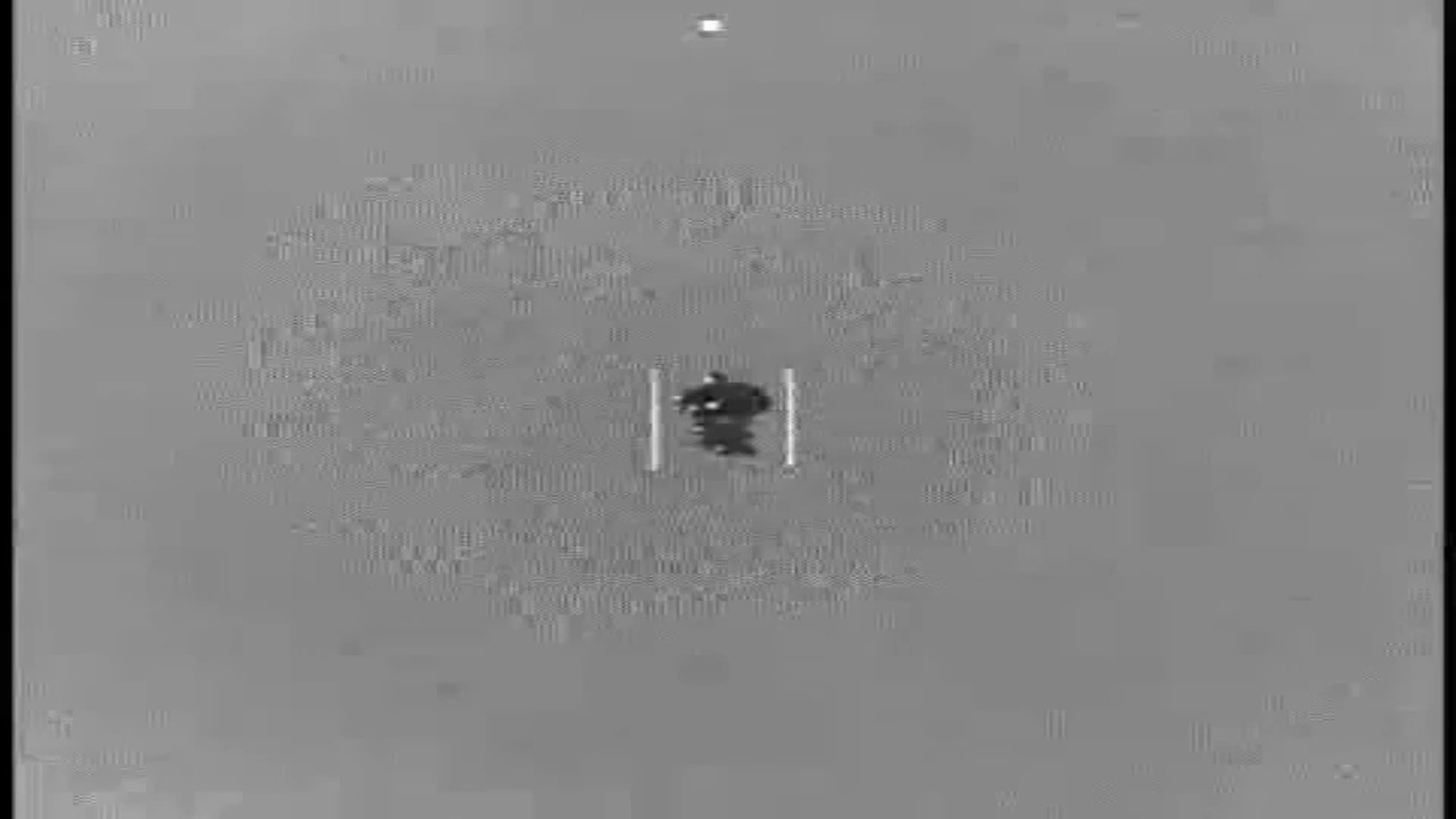
When the U.S. Department of War released its fourth batch of UAP files on 10 July 2026, one clip did most of the traveling on social media: a dark, sharp-edged shape hanging dead center in a military targeting reticle over the Yellow Sea, throwing off six clean rays like a Christmas star. Headlines called it a "star-shaped object." AARO gave it the flat designation DOW-UAP-PR104 and offered no conclusion at all. The people who study camera optics offered one immediately, and it is worth sitting with both the image and the explanation, because this case is a near-perfect lesson in how a sensor can manufacture a shape that the object never had.
What did witnesses see at Yellow Sea?
The video is short, about fifteen seconds, shot on an infrared sensor aboard a U.S. military platform over the Yellow Sea in 2025. AARO's own caption is almost clinical: "The sensor pans to track an area of contrast resembling a six-pointed star, keeping it generally centered within the center of the screen." That is the whole official description of what the footage shows.
On screen the effect is striking. A compact dark core sits inside the green tracking gate, and from it radiate six symmetrical spikes across the pale thermal field, with black redaction boxes masking the sensor's data strips at the edges. The "star" does not tumble or flap or change its geometry. It stays a star, centered, for the length of the clip, exactly as a fixed optical feature of the camera would.
What is the official explanation?
AARO released the clip with no analytical judgment attached, the same neutral posture it applied to the rest of the release. In the catalog it is DOW-UAP-PR104, one of nineteen unresolved infrared videos in the fourth PURSUE tranche, hosted at war.gov/UFO. "Unresolved" here means only that the office has not formally closed the file, not that it endorses any exotic reading.
The most substantive public analysis came from outside the government. Astrophysicist Avi Loeb, reviewing the release, wrote that the star shape is a diffraction pattern produced by the camera, an optical artifact and not the shape of the source. In plain terms, the six rays are made by the instrument, not by the thing being filmed. Loeb and others also noted the obvious family resemblance to an earlier release: an eight-pointed star recorded in 2013 and published in the Pentagon's very first PURSUE batch in May 2026, a case already in this archive.
What did the witnesses think it was?
There is no named witness and no quoted testimony in the PR104 file, only the sensor operator's implicit act of slewing the camera to keep the bright contrast centered. That absence is itself informative. Unlike the aviator behind PR112, no one here recorded a claim that the object maneuvered impossibly or defied explanation. What was submitted to AARO was raw sensor video of a persistent point of contrast, and the "witness" is essentially the targeting pod itself.
That makes PR104 a case about instrumentation rather than human perception. The question it raises is not "what did the crew see," but "what was the camera doing to a bright source in its field of view," which is a question with a well understood answer.
Is the Six-Pointed Star Over the Yellow Sea (PURSUE PR104) real? The two-pass assessment
Pass one, the mundane and most likely reading. A six-pointed star is a textbook diffraction signature. When a small, intense point source of light or heat is imaged through an optical system, the aperture and any internal support vanes spread its light into symmetrical rays, the same reason streetlights and bright stars grow spikes in photographs. Infrared sensors on military platforms have exactly the kind of fixed internal structure that produces clean, stable, multi-pointed spikes on a hot point source. The object never changes shape because the shape belongs to the camera, not to the object. The genuinely unknown part is only the mundane source underneath the glare: a distant aircraft, a drone, a hot reflection, or a light on the horizon.
Pass two, steelmanning the anomaly. AARO did leave it unresolved, and the source under the diffraction spikes is not identified in the file. A determined proponent can argue that a diffraction explanation accounts for the star geometry but not for what the point source was or how it behaved off camera. That is fair as far as it goes, but it is a much smaller claim than "star-shaped craft," and nothing in the fifteen second clip supports the larger one.
The verdict is Unknown, with a strong caveat. There is no official narrative, so the tier stays Unknown, but unlike most cases here the leading explanation is not exotic. The most defensible statement is that the six-pointed star is almost certainly an optical artifact of the sensor, and the only real open question is the identity of the ordinary source that produced it.
Sources
- www.dvidshub.net/video/1014101/dow-uap-pr104-unresolved-uap-report-yellow-sea-2025
- www.war.gov/News/Releases/Release/Article/4539898/department-of-war-publishes-fourth-release-of-unidentified-anomalous-phenomena/
- avi-loeb.medium.com/highlights-from-the-fourth-uap-data-release-by-the-u-s-government-105a9b2561c7
- thedebrief.org/pentagon-releases-new-batch-of-uap-videos-and-historical-files-but-clarity-remains-elusive/
More cases from this region: UFO sightings in International waters (between China and the Korean Peninsula)