The Line of Contrasts Over the South China Sea (PURSUE PR101)
Most of the videos in the fourth PURSUE release last only seconds. This one runs nearly two minutes, long enough to watch a strange, elongated smear of heat drift across a thermal sky and slowly lose itself in the distance. The U.S. Indo-Pacific Command filed it, AARO published it as DOW-UAP-PR101 on 10 July 2026, and the office was unusually explicit that it was not telling anyone what to think: the caption warns that no part of the description should be read as an analytical judgment. It is a rare, patient look at a UAP that is neither an orb nor a saucer, but a line.
What did witnesses see at South China Sea?
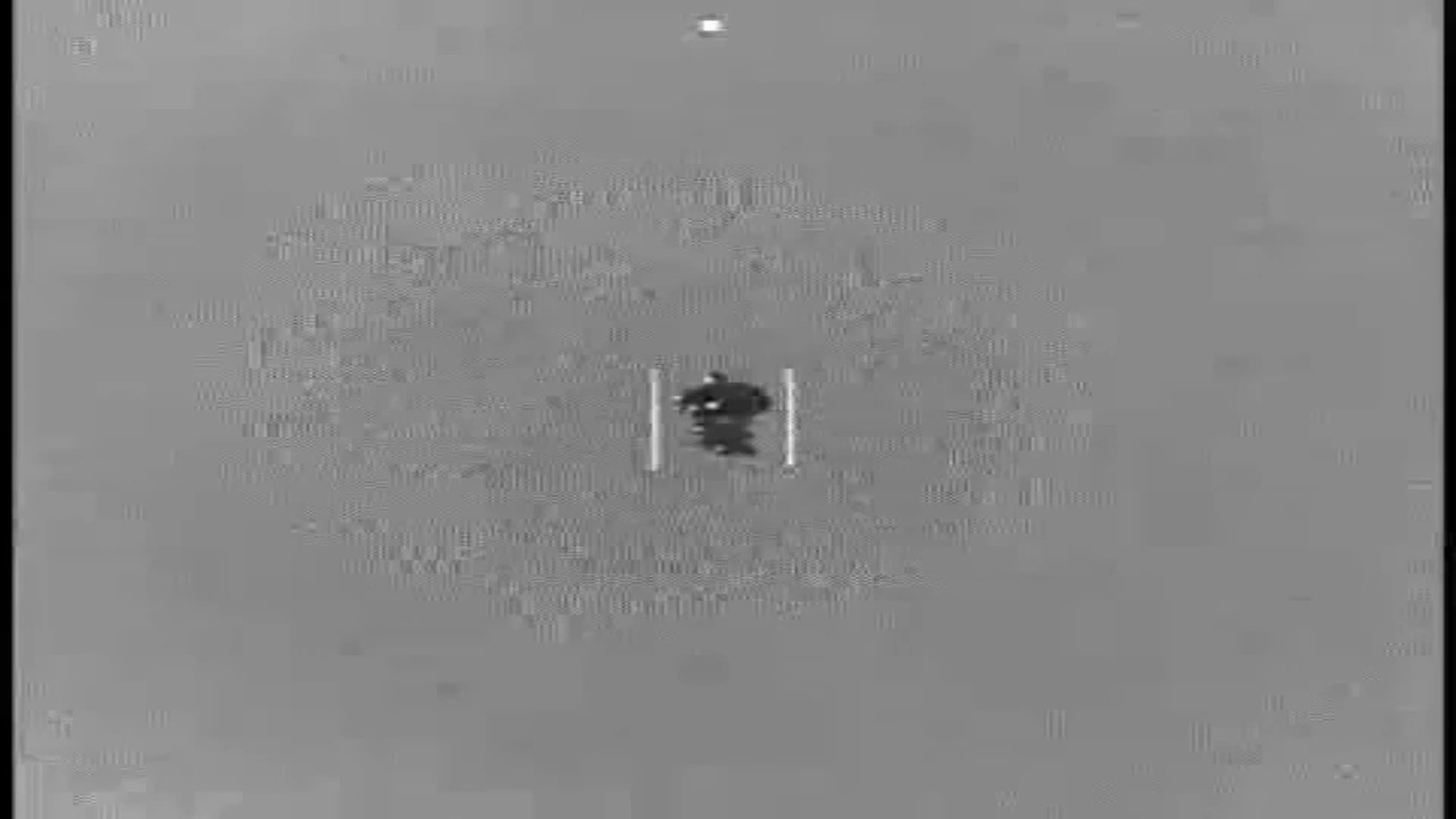
The footage is one minute and forty-six seconds of infrared video from a sensor aboard a U.S. military platform in the South China Sea in 2024. Through the clip the sensor tracks what AARO calls an "elongated area of contrast," a shape that presents as a rough line made of several distinct contrasting patches strung together. It moves across the field of view against a background of thermal cloud, and as the range opens up the line becomes progressively less distinct, fading toward the sensor's resolution limit rather than departing at speed.
In the frames the effect is subtle: a faint bright streak threading past the center reticle, more like a short bar or a train of close-spaced points than a single solid body. It is the longest single video in the release, which is part of why it is worth attention, because duration is exactly what most UAP clips lack.
What is the official explanation?
AARO's caption is careful to the point of self-erasure. It states plainly that "readers should not interpret any part of this description as reflecting an analytical judgment, investigative conclusion, or factual determination." The office is describing pixels, not adjudicating a craft. DOW-UAP-PR101 is listed among the nineteen unresolved infrared videos of the fourth tranche at war.gov/UFO, submitted through U.S. Indo-Pacific Command.
Outside analysis has been light. Avi Loeb, cataloguing the release, noted PR101 as a collection of objects in a narrow formation and flagged it as interesting without offering a firm identification. That is roughly where the public evidence sits: a real, comparatively long thermal recording of a linear, multi-part contrast, with no official cause assigned.
What did the witnesses think it was?
As with the other sensor clips in this batch, there is no named human witness and no quoted testimony, only the operator keeping the elongated contrast in frame. The value of PR101 is not a startled aviator's account but the recording's own length and character. Nearly two minutes of continuous tracking is enough to see how the object behaves over time: it transits steadily and fades with distance, rather than performing the abrupt reversals or accelerations that define the more dramatic cases.
That restraint cuts both ways. It removes the possibility of a witness overstatement, and it also removes the extraordinary kinematics that make other files hard to explain. What remains is the raw morphology, a line of contrasts, which is unusual enough on its own to have drawn notice.
Is the Line of Contrasts Over the South China Sea (PURSUE PR101) real? The two-pass assessment
Pass one, the prosaic reading. A linear string of contrasting patches that drifts and fades with range has several ordinary candidates. A flight of birds in loose line, a train of balloons, a formation of distant drones or aircraft, or even a contrail segment or a line of surface heat sources seen at a shallow angle can all present as an elongated, broken bar on infrared. The fact that the object becomes less distinct as distance grows is consistent with a real but conventional target receding, not with anything exotic. AARO's own refusal to characterize it fits this: there may simply not be enough to distinguish a mundane formation from anything else.
Pass two, the anomalous reading. The clip is long, from a military sensor, filed by a combatant command, and survived review as unresolved. A genuine tight formation of several objects moving as one over contested international waters is operationally significant regardless of what the objects are, and the linear, multi-part morphology is not the usual balloon-or-orb story. If the patches are separate craft holding formation, that is a different and larger claim than a single drifting object.
The verdict is Unknown. There is no official narrative, the leading prosaic explanations, a formation of birds, balloons, or aircraft, are plausible but unproven, and AARO has pointedly declined to decide. The honest position is that PR101 is a real, unusually lengthy recording of an unidentified linear contrast that the government has not explained and the available frames do not resolve.
Sources
- www.dvidshub.net/video/1014097/dow-uap-pr101-unresolved-uap-report-south-china-sea-2024
- www.war.gov/News/Releases/Release/Article/4539898/department-of-war-publishes-fourth-release-of-unidentified-anomalous-phenomena/
- avi-loeb.medium.com/highlights-from-the-fourth-uap-data-release-by-the-u-s-government-105a9b2561c7
- thedebrief.org/pentagon-releases-new-batch-of-uap-videos-and-historical-files-but-clarity-remains-elusive/
More cases from this region: UFO sightings in International waters (South China Sea)