The Five-Minute East China Sea Contrast (PURSUE PR105)
Nearly every video the Pentagon released on 10 July 2026 lasts only seconds. This one runs five minutes. U.S. Indo-Pacific Command filed it, AARO published it as DOW-UAP-PR105, and for five continuous minutes a military sensor tracks a soft smear of heat over the East China Sea as it drifts, fades, and sharpens against thermal cloud. The office assigned no cause and warned that its own description should not be read as any kind of judgment. Outside analysts think the long, slow contact looks like a balloon. It is the rare UAP clip long enough to actually argue about.
What did witnesses see at East China Sea?
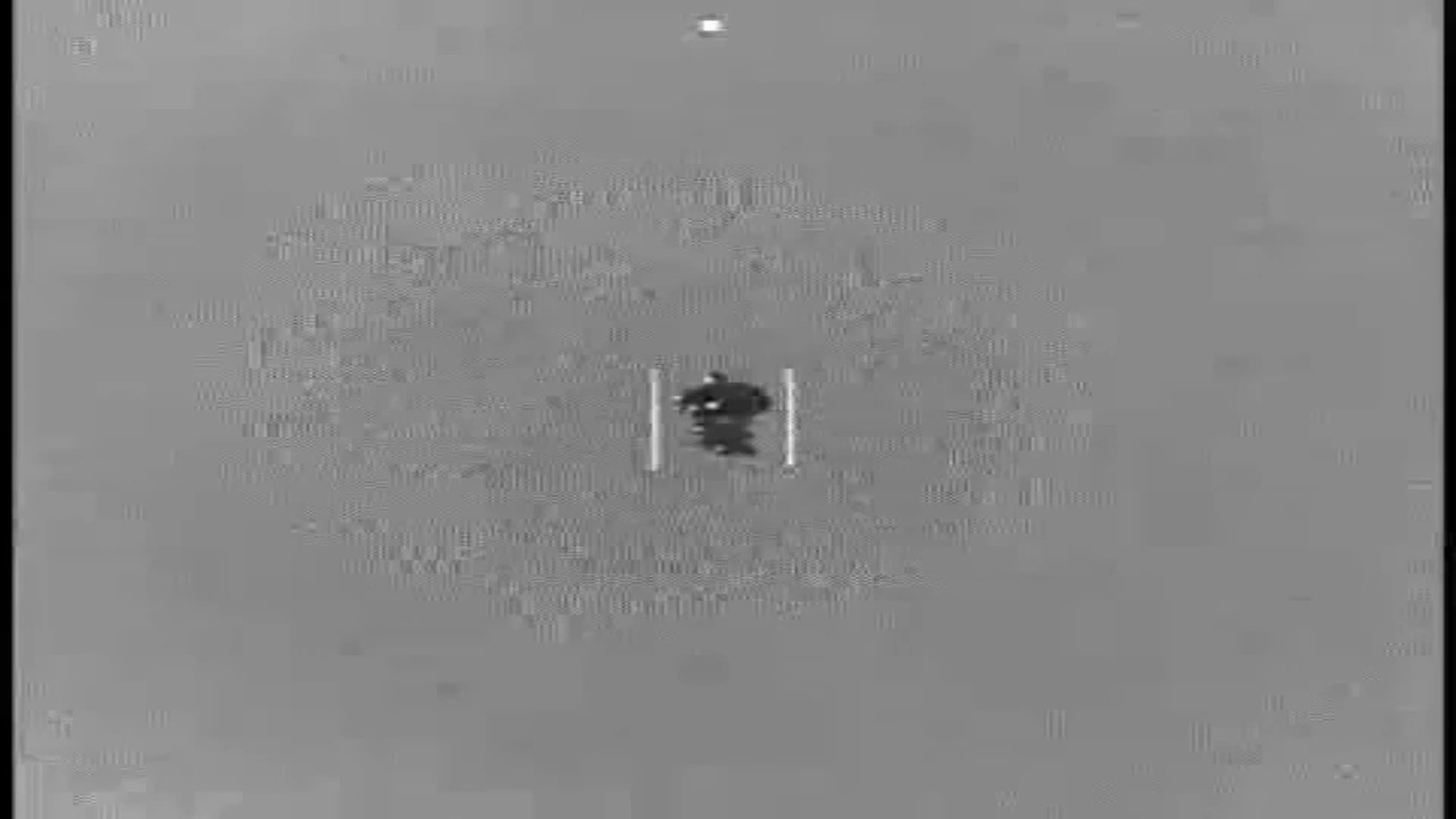
The clip runs five minutes, which alone sets it apart. Almost every video in the fourth PURSUE tranche lasts seconds; DOW-UAP-PR105 is the longest in the release, five continuous minutes of infrared footage from a sensor aboard a U.S. military platform over the East China Sea in 2025. AARO's own frame-by-frame caption describes an operator panning to keep an "area of contrast" centered in the reticle: for the first minute and a half the sensor tracks it steadily, at points the contrast intermittently loses distinctiveness against the background, then from about the ninety-five second mark the camera zooms in and pans right to left as the shape repeatedly drifts off the right edge of the frame. After roughly two minutes the sensor zooms out and in against empty sky with, in AARO's words, "no content."
In the frames the object reads as a small, soft bright blob against a moving field of thermal cloud, sometimes crisp, sometimes smearing into the grey. It does not dart or reverse. It holds a course while the sensor works to keep it in view, and it fades and sharpens as cloud and range change. What makes PR105 worth attention is not a dramatic maneuver but its length: five minutes is enough time to actually watch how a contact behaves, which is exactly what almost every other UAP clip denies the viewer.
What is the official explanation?
The record is a U.S. Indo-Pacific Command submission to the All-domain Anomaly Resolution Office, published as DOW-UAP-PR105 among the nineteen unresolved infrared videos of the fourth release at war.gov/UFO on 10 July 2026. As with the rest of the batch, AARO's caption is deliberately non-committal to the point of self-erasure: it states that readers "should not interpret any part of this description as reflecting an analytical judgment, investigative conclusion, or factual determination regarding the described event's validity, nature, or significance." The office is narrating pixels, not identifying a craft, and it assigns no cause.
The independent read has leaned prosaic. Reviewing the release, astrophysicist Avi Loeb and others noted that in the longer East China Sea material the shapes are consistent with balloons carrying suspended payloads, the sort of slow, wind-borne, tethered-looking objects that a tracking sensor will hold for minutes precisely because they barely move relative to the air. That reading is not an official finding; it is the strongest ordinary candidate offered by outside analysts. AARO itself left PR105 unresolved.
What did the witnesses think it was?
There is no named human witness and no quoted testimony, only the sensor operator and the machine. That is the nature of this class of file: the evidence is the recording, and the credibility rests on the fact that a combatant command filed it, an office reviewed it, and it survived into a public release as unresolved rather than being quietly closed.
The length is the whole point. Nearly two minutes of continuous, deliberate tracking, followed by three more of the sensor searching, lets an analyst see the contact's actual character over time. It transits and fades. It does not perform the abrupt reversals or accelerations that define the more sensational cases in the archive. That restraint is a double-edged fact: it removes any chance of a startled aviator overstating what he saw, and it also removes the extraordinary kinematics that would make a mundane explanation hard to sustain. What is left is morphology and duration, a soft heat source held in frame for five minutes over contested water.
Is the Five-Minute East China Sea Contrast (PURSUE PR105) real? The two-pass assessment
Pass one, the prosaic reading. A soft area of contrast that a sensor can hold for minutes, that drifts rather than darts, and that fades and sharpens with cloud and range is the classic signature of a slow, wind-borne object. Balloons, including instrumented or payload-carrying balloons and balloon clusters, are the leading candidate and the one outside analysts reached for; distant aircraft, birds, or a genuinely ambiguous thermal target seen at long range can all present the same way on infrared. The intermittent loss of distinctiveness against the background is exactly what a real but conventional target does as contrast conditions change. AARO's refusal to characterize it is consistent with there simply not being enough in the imagery to separate a balloon from anything else.
Pass two, the anomalous reading. The clip is long, from a military sensor, filed by U.S. Indo-Pacific Command over strategically sensitive waters, and it cleared review still marked unresolved. Even if the object is prosaic, a slow unidentified contact loitering for five minutes near a sensitive maritime theater is operationally meaningful. And the honest limit of the prosaic case is that the balloon reading is an inference from grainy thermal shapes, not a determination anyone in the chain actually made.
The verdict is Unknown. There is no official narrative, the leading ordinary explanation (a payload-carrying balloon) is plausible but unproven, and AARO has explicitly declined to decide. PR105's real distinction is not that it is inexplicable but that it is long: a rare, patient, five-minute look at an unidentified object the government chose to publish without an answer.
Sources
- www.dvidshub.net/video/1014103/dow-uap-pr105-unresolved-uap-report-east-china-sea-2025
- www.war.gov/News/Releases/Release/Article/4539898/department-of-war-publishes-fourth-release-of-unidentified-anomalous-phenomena/
- avi-loeb.medium.com/highlights-from-the-fourth-uap-data-release-by-the-u-s-government-105a9b2561c7
- thedebrief.org/pentagon-releases-new-batch-of-uap-videos-and-historical-files-but-clarity-remains-elusive/
More cases from this region: UFO sightings in International waters (East China Sea)