The Fartek Sighting: A Mirage Pilot's Grounded Saucer
On the morning of 9 December 1979, at around 9:15, Captain Jean-Pierre Fartek was at home in a village near Dijon, in the Côte-d'Or. This case file covers what witnesses reported, the official narrative, and a two-pass assessment with its evidence tier.
What did witnesses see at Village near Dijon?
On the morning of 9 December 1979, at around 9:15, Captain Jean-Pierre Fartek was at home in a village near Dijon, in the Côte-d'Or. Fartek was a serving fighter pilot, a Mirage III aviator attached to the 2e Escadre de Chasse based at Dijon. His house stood at the edge of a residential development that looked out over open fields, with a cluster of trees roughly 250 metres away. The weather that morning was clear and the visibility excellent. Fartek and his wife both looked out and saw an object standing motionless in the air over the field, in front of the tree line.
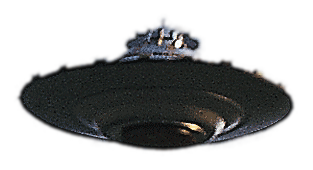
The object, which the French investigation record labels simply "M", had the form of two saucers laid one on top of the other and inverted against each other, "deux soucoupes superposées aux contours très nets, renversées l'une sur l'autre". Its outline was sharp and precise. It showed neither portholes nor lights of any kind. The upper half was a metallic grey; the lower half was darker, a bluish tone. Crucially, the witnesses noted that this division of colour had nothing to do with the position of the sun, so it was not a trick of lighting or shadow on a single curved surface. They estimated the craft at about 20 metres in diameter and 7 metres thick, and judged it to be in stationary hover at roughly 3 metres above the ground.
The object was not perfectly still. It was animated continuously by "very slight oscillations", small balancing movements as if it were holding itself in equilibrium. It made no sound at all. It produced no downwash, no disturbance of the ground or the trees beneath it, and no visible exhaust. Fartek, a professional with thousands of flight hours, was looking at a large solid body parked in the air a few metres up, in broad daylight, doing none of the things a helicopter or any known aircraft would do.
The departure was the detail that stayed with him. He watched the object begin to oscillate more strongly, then tip slightly forward, in his words like a helicopter tilting at the start of forward translation after takeoff. From that nose-down attitude it shot off horizontally at very low altitude, silently, leaving no trail, accelerating to enormous speed and vanishing over the horizon within a few seconds. The whole encounter had lasted long enough for two people to study the shape, the two-tone colouring and the oscillation carefully, then it was gone.
What is the official explanation?
The case was handled inside France's official channels rather than dismissed. Fartek reported the sighting to the gendarmerie de l'Air, the Air Force military police, at Dijon air base, the standard route by which French UFO reports reach the national study group. From there the matter passed into the file of GEPAN/SEPRA, the UFO study unit operating within the French space agency CNES (GEPAN, the Groupe d'Études des Phénomènes Aérospatiaux Non identifiés, later renamed SEPRA and today GEIPAN). The surviving investigation record is written in GEPAN's clinical style, designating the witness "F" and the object "M" and reconstructing the geometry of the observation, the estimated dimensions, the hover height and the manner of departure. According to that record Fartek believed other people had seen the object too, his neighbours and their children among them, but they did not dare come forward to testify.
Notably, no official body produced a conventional explanation for the Fartek sighting. There is no Blue Book-style debunk, no balloon, aircraft, planet or reflection assigned to it in the record. Instead the case became one of the named, retained observations when senior French defence figures revisited the UFO question two decades later. In 1996 Fartek, by then promoted to the rank of Major, was interviewed again, this time before the committee that would produce the COMETA report.
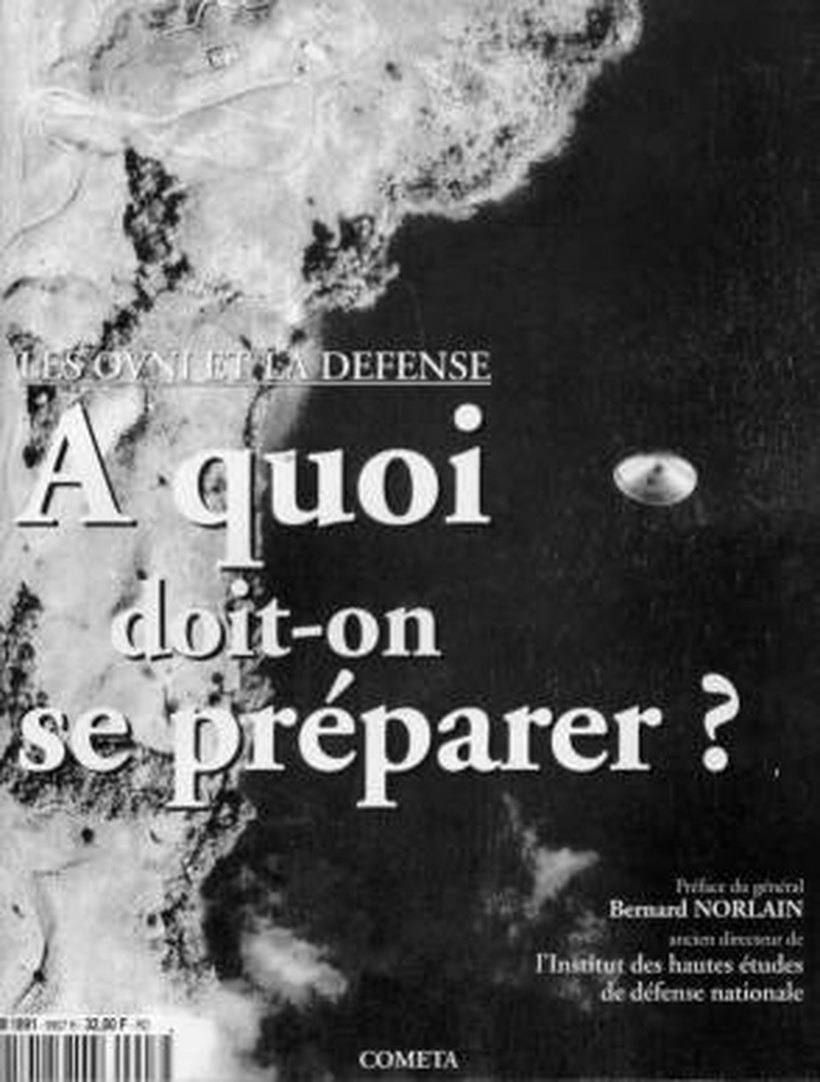
COMETA, the Comité d'Études Approfondies, was an independent association of former high-ranking auditors of the Institut des Hautes Études de Défense Nationale (IHEDN), France's senior defence think tank, together with qualified scientific and military experts. It was chaired by Général de l'Armée de l'Air Denis Letty, a retired French Air Force general. Its 90-page report, titled "Les OVNI et la Défense: à quoi doit-on se préparer?" ("UFOs and Defence: what must we prepare for?"), was published on 16 July 1999 and was delivered to President Jacques Chirac and Prime Minister Lionel Jospin before its public release. Inside that report, in the section listing observations from the ground, the case appears by name: "Observation of a saucer near the ground by a French pilot, J.-P. Fartek (1979)." It was General Letty himself who interviewed Fartek and his wife, and the encounter is bound up directly with the report's origins.
What did the witnesses think it was?
Jean-Pierre Fartek was not a casual observer. He was an operational Mirage III fighter pilot with the 2e Escadre at Dijon, a man trained to identify aircraft at distance and speed, with decades of flying behind him. By his own account he had never believed in flying saucers before this morning. General Denis Letty, who met the couple at the site of the sighting, recorded that the experience called into question Fartek's entire view of what were then called flying saucers, "because he had never believed in them", and that after seeing this craft "he could no longer doubt their existence." When Fartek testified before the COMETA committee in 1996, seventeen years after the event, Letty observed that he was still visibly shaken by what he had seen.
The corroboration is twofold and tight. First, the sighting was not solo: Fartek's wife stood beside him and saw the same object, the same two-saucer shape, the same grey-over-blue colouring, the same silent hover and abrupt departure. Two independent witnesses at close range in good daylight is exactly the configuration that resists the usual single-observer explanations. Second, Fartek's belief in the reality of what he saw never wavered. He reported it formally through military channels at a clear cost to himself. The accounts state he was instructed not to talk publicly about the incident, which for a serving officer was a reason to stay quiet rather than to seek attention. He gained nothing from the report and risked his professional standing by filing it.
The witness who matters most for the case's later prominence is General Letty. As a senior Air Force commander he had every professional incentive to be sceptical, yet he was so disturbed by the Farteks' testimony that, in his own words, he "found the Farteks' testimony so disturbing that I have been preoccupied by the UFO problem ever since." Hearing it, Letty wrote, "I too did not have any more doubt about the reality of the phenomenon." The case is preserved in the public record largely because of this chain of credible witnesses: a fighter pilot and his wife, investigated by GEPAN/SEPRA, then re-examined and vouched for by a French Air Force general, and finally published to American readers in Leslie Kean's 2010 book "UFOs: Generals, Pilots, and Government Officials Go on the Record", where Letty contributed a chapter on the birth of COMETA.
Is the Fartek Sighting: A Mirage Pilot's Grounded Saucer real? The two-pass assessment
Pass one, the ordinary explanations. Because there is no photograph, no radar trace and no recovered physical evidence, the entire case rests on two-witness daylight testimony, and that is where any mundane reading has to work. The honest candidates are a misperceived aircraft, a balloon or a tethered object, or an outright hoax. None fits cleanly. A helicopter or light aircraft hovering at three metres over a field would generate noise, visible downwash on the grass and trees, and an exhaust signature, and Fartek, a career fighter pilot, reported none of these and explicitly contrasted the silent departure with how a helicopter behaves. A balloon does not hold a sharp metallic outline, does not show a deliberate two-tone grey-and-blue body unrelated to sun angle, and above all does not tilt forward and then accelerate to vanish over the horizon in seconds. The hoax reading has no support at all: there is no confession, no recovered prop, no second party claiming to have staged anything, no financial or publicity motive, and a serving officer who was told to keep quiet and who remained shaken seventeen years later is a poor fit for a fabricator. No skeptic, investigator or official body has ever published a method-shown identification of a specific real object for this sighting.
Pass two, if it was real. What Fartek and his wife described is a large, solid, structured craft of around 20 metres across, capable of silent station-keeping a few metres off the ground with no rotor wash and no apparent means of lift, holding itself in equilibrium with small oscillations, then transitioning to extreme horizontal speed without sound or trail. That is a flight envelope with no terrestrial counterpart in 1979 or now. It is precisely the class of observation, a low, slow, silent, structured object seen by trained pilots, that drove a committee of French generals and defence experts to write COMETA and to keep this case on their short list of credible ground observations.
The evidence here is testimonial rather than instrumental, which is why this is not a footage case. But the testimony is unusually strong: two close-range daylight witnesses, one of them a professional aviator, an official GEPAN/SEPRA investigation that produced a detailed record and offered no conventional solution, and independent endorsement by a French Air Force general who interviewed the couple at the site. Against that there is no shown debunk of any kind, no identified object, no recantation, no competing explanation with a demonstrated method. The official handling was to retain the case as unexplained and to elevate it, not to close it. On UAP Globe's standard that places this firmly at Verified Unexplained: officially documented through France's own study apparatus, corroborated, and never accounted for.
Sources
- ufologie.patrickgross.org/htm/cometa.htm
- area51blog.wordpress.com/2008/12/10/le-temoignage-du-lt-colonel-fartek/
- www.centroufologiconazionale.net/documenti/cometa.htm
- www.cosmicparadigm.com/ets-nonphysicals/cometa-report/
- openminds.tv/leslie-kean-review-081110/
More cases from this region: UFO sightings in France