The Fielding Lake Sighting, Alaska, 9 July 1948 (Project Sign Incident 145)
Two U.S. Air Force lieutenants fishing in the Alaska Range watched about twenty grayish black spheroid objects cross the sky in a loose formation, accompanied by a sound they compared to jet aircraft. The Air Force checked and found no fighter formations in the area. The case was filed under the wrong state and has sat almost unread ever since.
What did witnesses see at Fielding Lake?
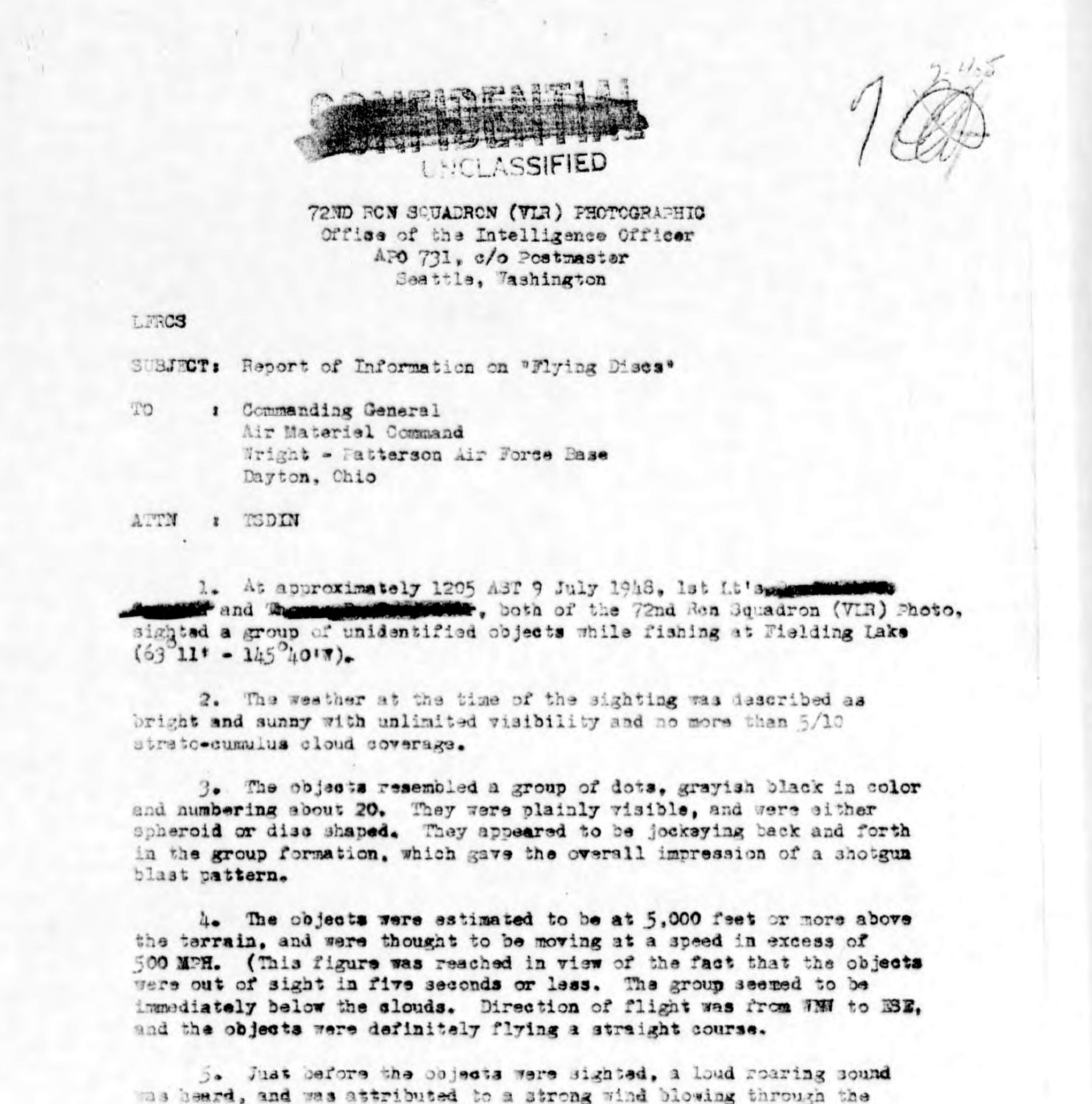
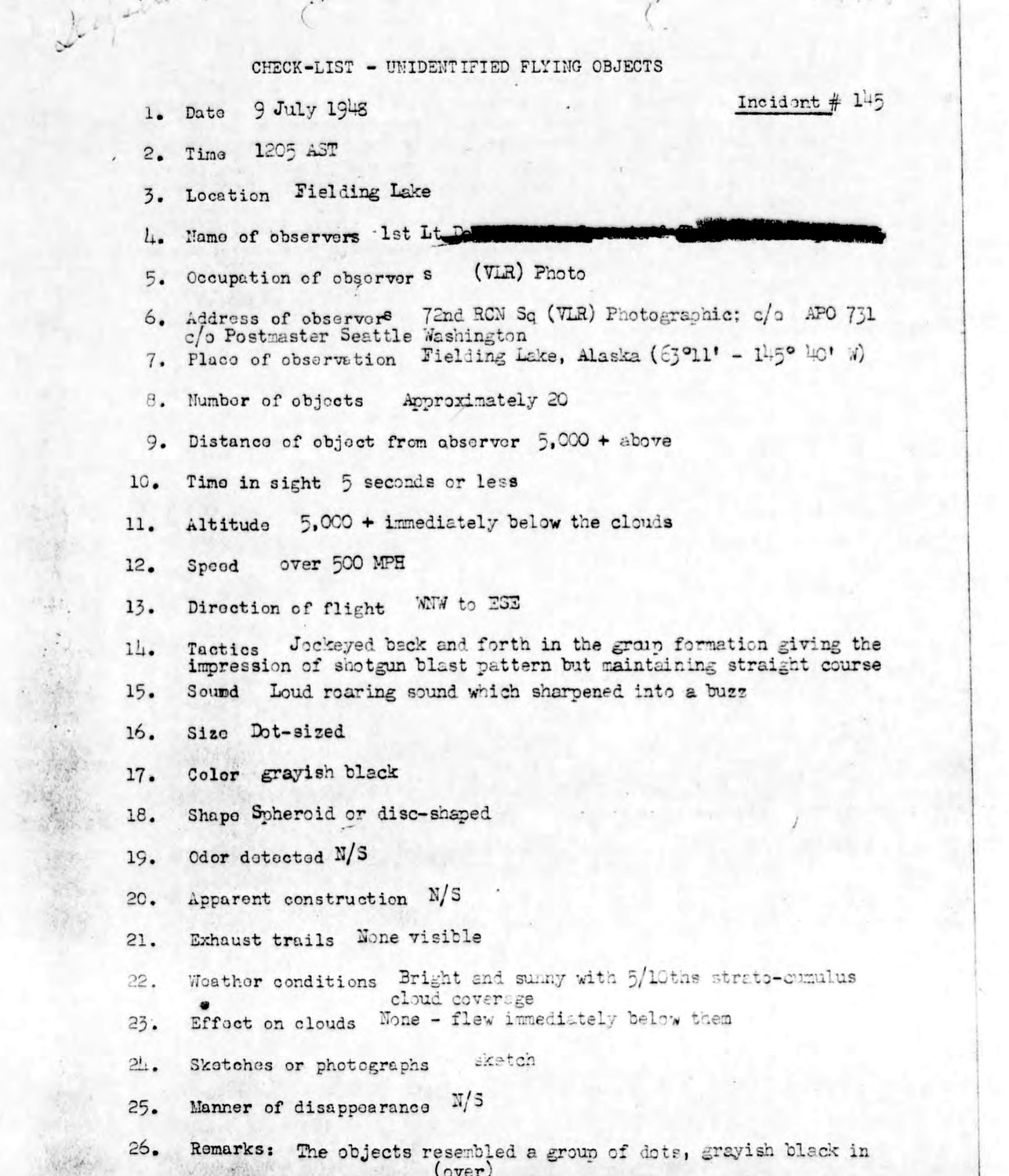
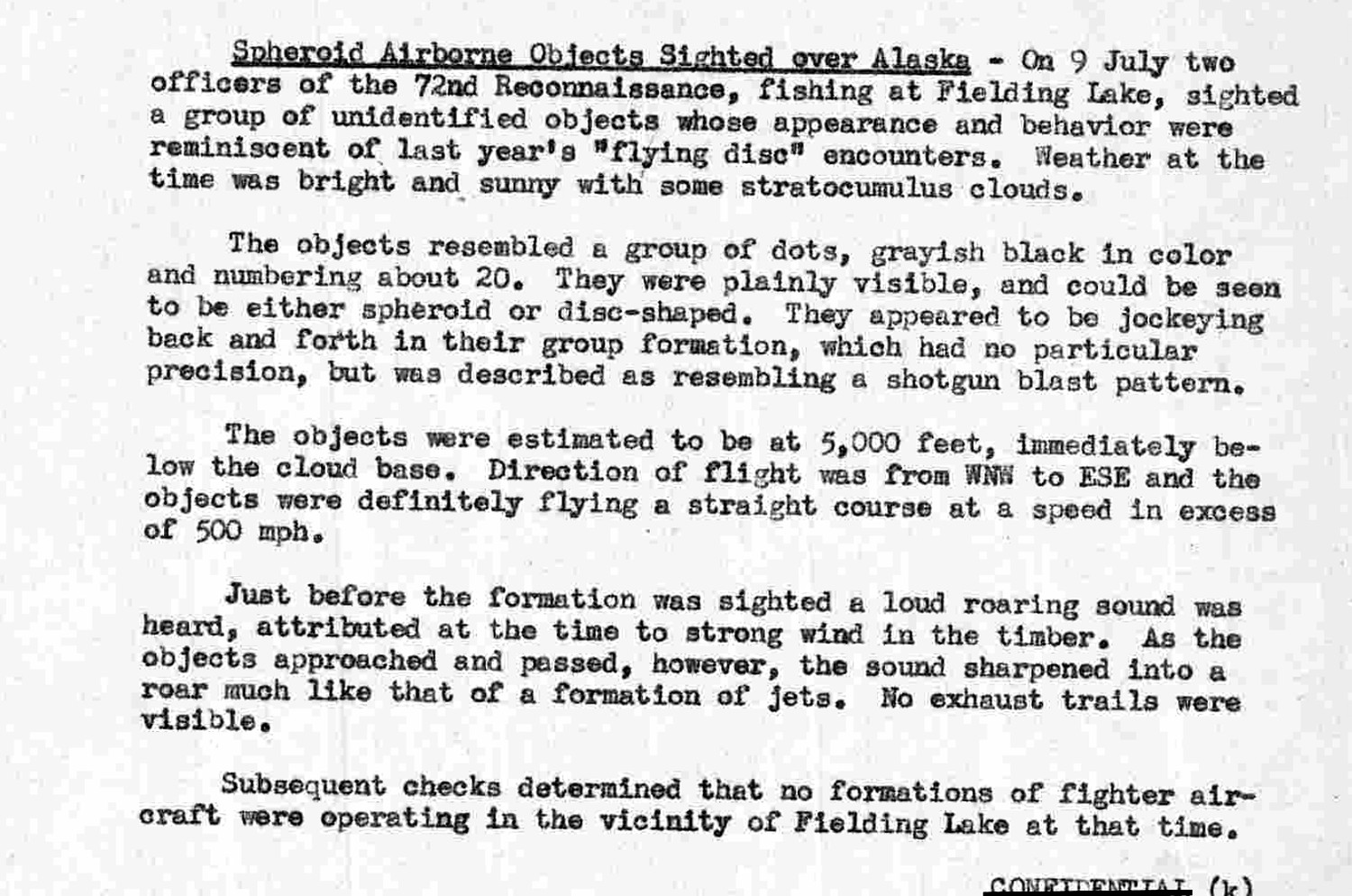
The Fielding Lake sighting happened in interior Alaska on 9 July 1948, when two Air Force officers watched about twenty objects cross the sky. They saw them around midday, and both were unidentified to the men best placed to know. Both were first lieutenants of the 72nd Reconnaissance Squadron (Very Long Range) Photographic, and both were off duty and fishing. The squadron logged the time as approximately 1205 Alaska Standard Time. The squadron's own intelligence report pins the spot exactly, giving the coordinates as 63 degrees 11 minutes north, 145 degrees 40 minutes west. That places the sighting in the Alaska Range about 130 miles southeast of Fairbanks and roughly 59 miles south of Delta Junction. The report records the weather as bright and sunny with unlimited visibility and no more than five tenths strato-cumulus cloud coverage.
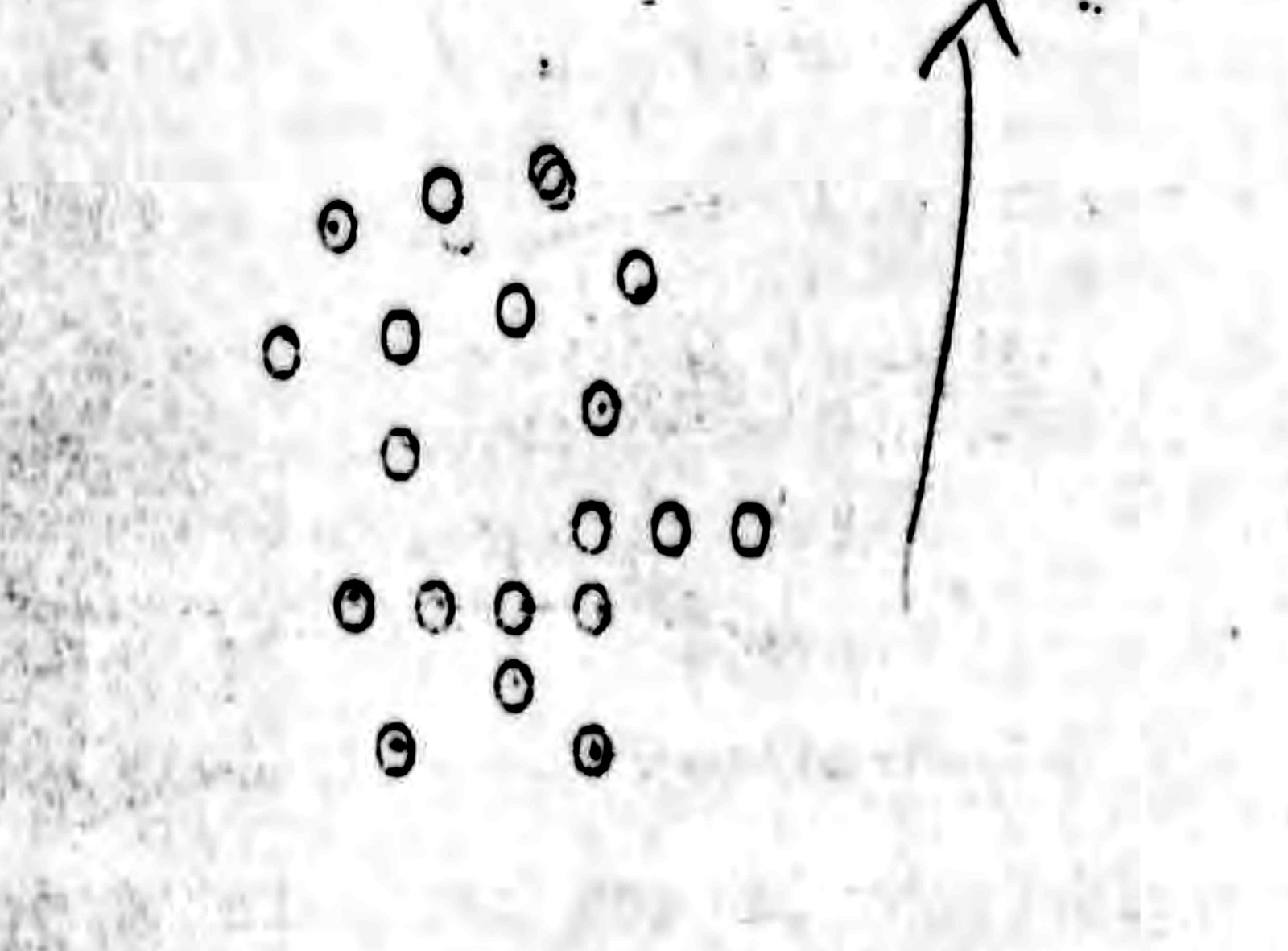
The objects are described in the same terms in every surviving document. They resembled a group of dots, grayish black in colour, numbering about twenty. They were plainly visible and were either spheroid or disc shaped. They appeared to be jockeying back and forth within the group, which the officers said gave the overall impression of a shotgun blast pattern, while the formation as a whole held a straight course. Direction of flight was from west-northwest to east-southeast.
Two numbers are attached to the sighting and both need care. The objects were estimated to be at 5,000 feet or more above the terrain, immediately below the cloud base. They were thought to be moving at a speed in excess of 500 miles per hour. The report is unusually candid about where that second figure came from, and states it in a parenthesis: the speed was reached in view of the fact that the objects were out of sight in five seconds or less. So the 500 miles per hour is not a measurement. It is an inference drawn from how quickly the group left the field of view, and it therefore depends entirely on how far away the objects actually were, which nobody established.
The sound is the detail that separates this report from the ordinary run of 1948 disc sightings. Just before the objects were sighted a loud roaring noise was heard, which the officers at first put down to a strong wind blowing through the surrounding woods. As the objects approached and passed, the sound sharpened into what the original squadron letter calls a buzz much like that made by a group of jet aircraft. No exhaust trails were visible. The Blue Book check-list adds that nothing was seen to happen to the clouds, the objects having flown immediately below them, and that the manner of disappearance was not stated. There were no photographs. What the officers did produce was a sketch of the formation, a scatter of about twenty small circles with an arrow marking the direction of flight, and that drawing survives in the file.
More footage and images of this sighting
What is the official explanation?
The paperwork trail is complete and unusually short. The Office of the Intelligence Officer, 72nd Reconnaissance Squadron (VLR) Photographic, filed a letter dated 12 July 1948 under the subject heading Report of Information on "Flying Discs", addressed to the Commanding General, Air Materiel Command, Wright-Patterson Air Force Base, Dayton, Ohio, attention TSDIN. It was signed by Galen E. Niedenfuehr, Captain, USAFR, Intelligence Officer. Two days later, on 14 July 1948, Headquarters Yukon Composite Wing at Ladd Air Force Base forwarded it as a first endorsement under file LFDIS 350, signed by Howard A. Burd, Major, USAF, Staff Intelligence Officer. At Wright-Patterson the sighting became Incident 145 in the numbered series that ran through Project Sign and into Project Grudge.
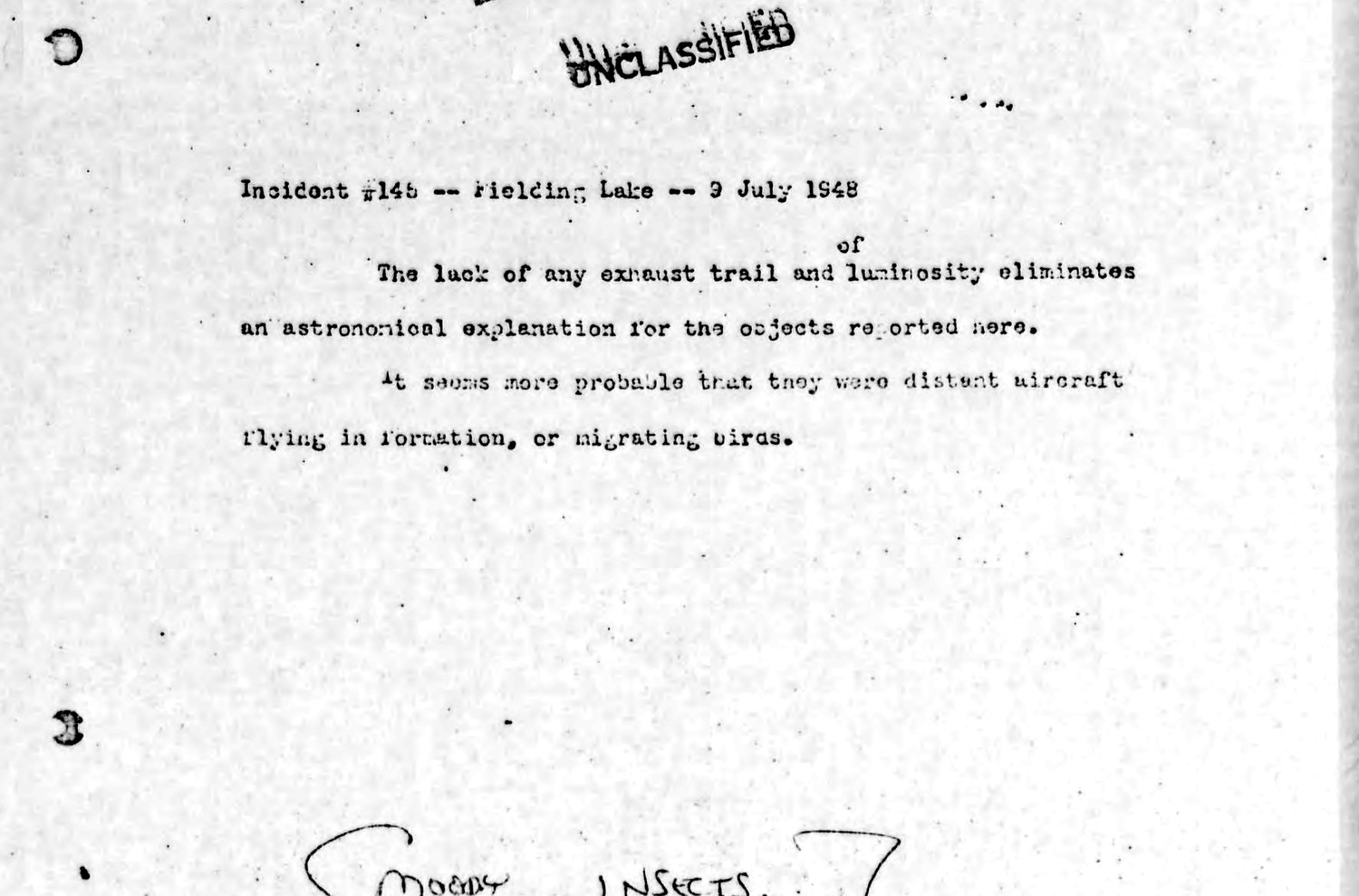
The evaluation is preserved in the extract titled Dr Hynek's Evaluations Extracted from Project Grudge Report. Under the incident index, 145 appears in category two, non-astronomical but suggestive of other explanations, sub-heading balloons or ordinary aircraft. The written assessment for the incident is four lines long and reads in full: the lack of any exhaust trail and luminosity eliminates an astronomical explanation for the objects reported here, and it seems more probable that they were distant aircraft flying in formation, or migrating birds. A later hand has added a bracketed pencil annotation on the same page reading Moody, insects, 5 seconds, daylight observation, which appears to be a subsequent Blue Book staff note proposing insects instead.
Set against that is a check the Air Force itself ran and recorded. The Fifth Air Force intelligence summary that carries the sighting states plainly that subsequent checks determined that no formations of fighter aircraft were operating in the vicinity of Fielding Lake at that time. That sentence appears in the same official document family that produced the report, and it is the Air Force contradicting its own later explanation.
There is also a filing error worth stating clearly, because it very likely explains why this case is almost unknown. The Blue Book record is indexed as Fielding Lake, Wash., and the archived copy carries that state on its summary card. The internal documents do not agree with the card. The check-list inside the same file gives item seven, place of observation, as Fielding Lake, Alaska, with the coordinates 63 degrees 11 minutes and 145 degrees 40 minutes west, and there is no Fielding Lake in Washington at those coordinates. The most probable source of the confusion is visible on the letterhead itself: the 72nd Reconnaissance Squadron's address is given as APO 731, care of Postmaster, Seattle, Washington, which is an Army Post Office routing address used for Alaskan stations rather than a location. Anyone indexing from the letterhead rather than from the body of the report would land on Washington. This archive states that as the likely explanation rather than a proven one, but the underlying error is not in doubt: the event happened in Alaska and the file says so.
What did the witnesses think it was?
The witnesses were two first lieutenants of the 72nd Reconnaissance Squadron (Very Long Range) Photographic. Their names are redacted in the declassified copies, blacked out in both the narrative letter and in item four of the check-list, so this archive cannot name them. Their occupation is given as (VLR) Photo and their unit address as the 72nd Rcn Sq (VLR) Photographic. They were not on duty. They were fishing.
That detail cuts in two directions and both deserve stating. It means there was no instrument, no camera and no radar, and the observation lasted five seconds or less, which is the weakest possible footing for the altitude and speed figures. It also means the observers were photographic reconnaissance officers, which is to say men whose profession was the interpretation of aerial imagery and the recognition of aircraft, reporting through their own chain of command in a formal intelligence letter within three days, at a moment when doing so carried professional risk rather than reward.
The officers did not claim to know what they had seen and the report does not editorialise. What they asserted was narrow and specific: about twenty objects, grayish black, spheroid or disc shaped, in a loose scatter holding a straight course, below the cloud base, with a jet-like sound and no exhaust trails. The one interpretive line in the whole chain belongs to the Fifth Air Force summary writer rather than to the witnesses, and it is the observation that the objects' appearance and behaviour were reminiscent of the previous year's "flying disc" encounters, a reference to the 1947 wave.
Is the Fielding Lake Sighting, Alaska, 9 July 1948 (Project Sign Incident 145) real? The two-pass assessment
Pass one, how could this be mundane. The official answers are on the record and they should be taken seriously, but each one has a specific problem.
Distant aircraft flying in formation is the explanation Hynek preferred, and it is the reason Incident 145 sits in the balloons or ordinary aircraft bin. The difficulty is that the Air Force checked precisely this and wrote down that no formations of fighter aircraft were operating in the vicinity of Fielding Lake at that time. That check is not decisive on its own, since it speaks to fighter formations rather than to all aircraft, and interior Alaska in 1948 was busy with military traffic. But a twenty ship formation is not a small thing to lose track of, and the negative result is the Air Force's own.
Migrating birds is the second half of Hynek's sentence and it accounts well for several features. A loose scatter of dark bodies jockeying back and forth within a group, described as a shotgun blast pattern, is a good description of a flock, and the sketch looks like one. Birds also dissolve the speed problem, because a nearby flock crossing the field of view in five seconds needs no unusual velocity at all. Two things sit awkwardly with it. The first is the date: 9 July is the middle of the northern breeding season rather than a migration period. The second is the sound, since a flock does not produce a roar that sharpens into something the observers compared to a group of jet aircraft.
Insects, the later pencil annotation, is really a variant of the same argument and it is the strongest prosaic candidate for the visual component. A swarm close to the observers would look like grayish dots, would cross the field of view in seconds, and would make the altitude and speed estimates meaningless, which is exactly the weakness the annotation identifies by writing 5 seconds and daylight observation next to it. Against that, the report says the objects were plainly visible and could be seen to be either spheroid or disc shaped, which is more resolution than a distant swarm usually offers, and the sound again does not follow.
The sound is where every mundane reading strains, and it is also where the case is weakest evidentially, because sound is the one element that could easily be coincidental. The officers themselves first attributed the roar to wind in the timber, which is an honest and rather deflating admission, and a genuinely windy day at a lake in the Alaska Range is a perfectly good source of a roar that seems to swell and fade. If the noise was the wind and the objects were a flock or a swarm, the entire case dissolves. Nothing in the file rules that out.
Pass two, if the report is accurate. What is being described is roughly twenty discrete objects of similar appearance, dark rather than luminous, holding a common heading in a loose non-rigid formation, below a cloud deck, with an associated acoustic signature and no visible exhaust. That combination is not a good match for any 1948 aircraft, and the absence of exhaust trails alongside a jet-like noise is internally odd, since the propulsion implied by the sound is the kind that normally leaves something visible. Twenty airframes flying as a group in July 1948 over interior Alaska would also have been an enormous asset to lose, and the Air Force says it could not find them.
What this case is not is a mystery that has withstood decades of scrutiny, because it has not been scrutinised. Its verdict was written in a four line paragraph, it was filed under the wrong state, and its most detailed narrative version stayed classified until 5 May 2025 and did not reach the public until the National Archives published Record Group 615 in August 2026. This archive tiers it Barely Disputed rather than Unknown because an official explanation does exist and is on the record, and rather than anything stronger because that explanation is contradicted by the Air Force's own negative check on aircraft, does not address the sound, and rests on a bird and insect reading that the sighting date does not favour. The honest summary is that Incident 145 is a five second daylight observation by two trained observers which was never properly investigated, and whose best prosaic explanation and best anomalous reading are both still standing.
Sources
- catalog.archives.gov/id/659965376
- catalog.archives.gov/medialz/electronic-records/rg-615/656595571/00258350_Estimate_of_the_Situation.pdf
- archive.org/details/1948-07-9670583-FieldingLake-Wash--145-
- catalog.archives.gov/id/656595571
- catalog.archives.gov/id/445887258
More cases from this region: UFO sightings in United States