The Lintel Lake Incident

In the account that circulates under Marcin Mizera's name, the witness is a 55-year-old Polish emigrant and painter living in Rheda-Wiedenbrück in what was then West Germany. This case file covers what witnesses reported, the official narrative, and a two-pass assessment with its evidence tier.
What did witnesses see at Linteler See?
In the account that circulates under Marcin Mizera's name, the witness is a 55-year-old Polish emigrant and painter living in Rheda-Wiedenbrück in what was then West Germany. He is never named; the Polish text calls him "Pan X." On a morning in the middle of August 1981, around 5 or 6 a.m., he cycled out to the Linteler See, a lake about 4 km from the town, and said he saw a gigantic object hanging silently over the water. It sat roughly 100 to 150 meters out and 15 to 20 meters above the surface. He gave it as 7 to 10 meters high and more than 30 meters long, the shape of a thick, deep plate turned upside down, with a smooth surface in shades of steel, dark green and grey that reflected light and at moments looked almost semi-transparent. There were no windows, no doors, no rivets, no antennas. It made only a low, dull rumble that he could hear from about 2 meters away but not when he stood right against it.
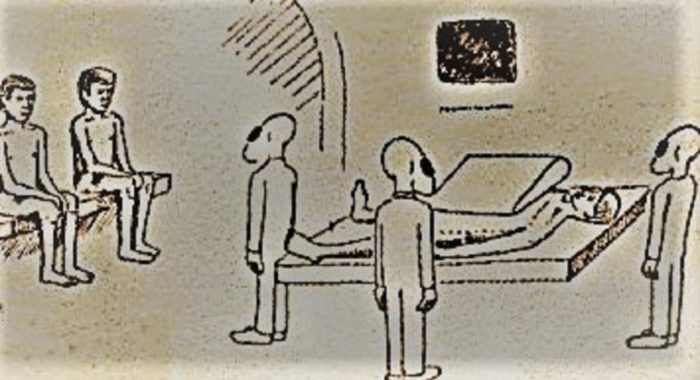
He described the craft drifting slowly, at perhaps 20 km/h, and settling on the grass near a boathouse. Nearby he noticed a fisherman acting strangely, and an elderly woman with a dog. The fisherman, he said, walked off with two or three figures in glittering, mirror-like suits. The witness claims he then entered the object through an oval opening with no door. Inside there was a rose-violet light, transparent compartments, and a bench he could sit on that did not seem to physically exist. He said beings about 120 to 150 cm tall were present: thin, with disproportionate torsos, smooth light-reflecting and possibly semi-transparent skin, faces he called Asiatic with thin lips kept slightly open, large eyes with no clear color, and long fingers without nails. He reported a telepathic command to hand over his document pouch, and a table holding a severed cow's head missing its left eye with a horn half sawn through, plus children's shoes and eyeglasses.
He said he was shown two objects. The first was a thin strip about 5 cm wide and 25 cm long that changed itself into a square, a triangle and a circle and carried raised three-dimensional symbols he later likened to crop-circle markings; it would not stay in his pocket and snapped back to its first shape. The second was a transparent sphere the size of a tennis ball that first displayed an X-ray of the bones of his own hands, then swelled like a balloon and projected three-dimensional images of recognizable buildings from his town, water towers and a town hall, and finally an image of himself holding the sphere, before it vanished.
What is the official explanation?
There is no official record of this case, and that absence is one of the central facts about it. No German police report, no Bundeswehr or Royal Air Force log, no civil aviation note, no newspaper item from 1981, and no investigation by any recognized German UFO organization such as GEP or MUFON-CES has ever been produced in connection with a "Lintel Lake" abduction. The account names no authorities, cites no document, and includes no follow-up by any investigating body. Unlike cases that drew an official debunk, which would itself signal the event was taken seriously enough to close, nothing here was ever opened.
The only geographic and institutional details that can be checked against the real world do hold up, which is worth stating plainly. The Linteler See is a genuine place: a sand and gravel extraction lake of about 16 hectares with a maximum depth near 18 meters, in the Lintel district of Rheda-Wiedenbrück in Kreis Gütersloh, North Rhine-Westphalia, near the A2 motorway and the river Ems. The account also mentions a small military airfield 7 to 9 km away at "Eutersloh," which corresponds to the former Royal Air Force station at Gütersloh, a real RAF base in that area during the Cold War. So the stage is real, but nothing that supposedly happened on it left an official trace.
The case has no chain of custody and no provenance beyond a single modern teller. The English version that most readers encounter, on UFO Casebook, carries the verbatim source line "Source: Marcin Mizera - NPN - www.npn.ehost.pl." NPN stands for "Na Progu Nieznanego," a one-person web project run by Mizera. The two physical objects that might have been examined, the shape-shifting belt and the projecting sphere, are said to have disappeared, the witness's wristwatch was found broken and missing its strap, and his bicycle was gone, so there is nothing left to test. No skeptical body, government office, or scientific panel ever assessed the claim, because there was never any evidence placed before one.
What did the witnesses think it was?
The witness, identified only as "Pan X," is presented as believing he had a genuine encounter with a non-human craft and crew. After the experience inside the object he says he came to roughly 5 km away at a car scrapyard or landfill, dazed, with a splitting headache he compared to a hangover. A clock in a parked car read 9 a.m., several hours after the sighting began, while his own watch had stopped, broken and stripped of its strap. Bathing at home he found his entire body burned a deep bronze-red as if by intense sun. His bicycle was missing, later found without its dynamo and seat, and he abandoned it. The belt and the sphere were gone.
The detail that gives the story its hook is the claimed aftereffect. Pan X is said to have developed, from that day, a sudden and powerful compulsion and talent for painting, despite the account also calling him a painter, and to have become a fairly well-known local artist who made a living from his work. The narrative frames the encounter as the source of his artistic gift. He is also described as having had prophetic dreams a month before leaving Poland in June 1981, foreseeing martial law and a forced move to Germany, and as spending twenty years afterward studying scripture to make sense of what he saw, summarized in the line that what is impossible for man is possible for God.
For corroboration the account offers only the figures Pan X says he glimpsed at the lakeside: a fisherman who reportedly walked off with the suited beings, and an elderly woman with a dog. Neither was ever named, traced, or interviewed, and no independent witness has come forward in more than four decades. On the Polish forum paranormalne.pl, readers themselves flagged internal problems, including the fingernail description shifting between "no nails" and "rounded nails," and the oddity that Pan X retained vivid, detailed memories of the whole event when classic abduction reports usually feature amnesia. The witness's sincerity cannot be assessed at all, because he has never been publicly identified or independently spoken to; everything rests on a retelling.
The dispute
The dispute is not about a specific photograph or a recovered prop, because none exist; it is about whether the case has any evidentiary footing at all. The entire account traces to one source, the Polish ufologist Marcin Mizera and his single-operator NPN ("Na Progu Nieznanego") project, from which it was reproduced in English by UFO Casebook under the line "Source: Marcin Mizera - NPN - www.npn.ehost.pl" and retold on Polish forums. There is no named witness, no contemporary 1981 documentation, no police, military, aviation, or press record, no photograph, no surviving physical object, and no second witness who was ever identified or interviewed. A claim with no independent anchor and a single teller is inherently fragile.
That fragility is sharpened by who the teller is. The credibility of Mizera and NPN is directly contested by other researchers in Polish ufology. Bartosz Rdułtowski, in a post dated 4 August 2014, writes that Mizera was "dramatically expelled from one Polish ufological organization for writing infantile UFO stories," and accuses him of fabricating accounts, including stories about "flying coffins with candles," publishing material under the pseudonym "Tomasz Mróz," and refusing to name witnesses so claims could be checked. The paranormal site Paranormalium announced on 22 January 2012 that it had terminated its cooperation with NPN over plagiarism, finding its own articles republished by NPN with authorship and sourcing removed, alongside what it described as manipulative and threatening behavior. These are motivated parties to some degree, rivals and former partners, so their testimony is weighed as such, but the pattern they describe is consistent and goes to method, not just personality.
What keeps this at Barely Disputed rather than Strongly Disputed is that no one has actually shown the mechanics of a hoax for this particular story. There is no confession by the witness, who remains anonymous and so has never recanted, no recovered staging material, and no positive identification of a real-world object, aircraft, balloon, or event that the sighting can be pinned to. Even the internal inconsistencies that Polish forum readers noticed, the beings' fingernails described both as absent and as rounded, and the witness's uncharacteristically complete memory of an abduction, are reasons for suspicion rather than proof of fabrication. So the case does not collapse under a demonstrated debunk; it simply never rises, because an undated, unwitnessed, unevidenced narrative from a disputed single source has nothing for a verifier to confirm. It is largely discounted on provenance, which is exactly the barely-disputed posture.
Is the Lintel Lake Incident real? The two-pass assessment
Pass one, the ordinary readings. The strongest mundane explanation is that there is no event to explain, only a story. The narrative has every marker of an unverifiable tale: no named witness, no date more precise than "the middle of August," no photograph, no physical object that survived to be tested, no contemporary report of any kind from 1981, and no second witness who was ever traced. The two would-be corroborators, a fisherman and a woman with a dog, are exactly the kind of unfindable bystanders a constructed account includes. The physical aftermath has prosaic alternatives: a man could wake disoriented with a headache far from where he started after a night of drinking, sustain a real sunburn on a clear August day, and lose a cheap watch and an unattended bicycle, then build or absorb a dramatic frame around those facts. The "artistic gift" twist also collides with the account itself, which already calls Pan X a painter, suggesting embellishment. The shifting fingernail detail and the unusually complete recall, both flagged by Polish readers, read as the seams of storytelling rather than the gaps of memory.
The source problem is decisive in pass one. This case has exactly one origin: Marcin Mizera and his one-person NPN project. Within Polish ufology Mizera is not treated as a neutral chronicler. Bartosz Rdułtowski, writing on 4 August 2014, states that Mizera was "dramatically expelled from one Polish ufological organization for writing infantile UFO stories," accuses him of inventing accounts such as "flying coffins with candles" and publishing them under the pseudonym "Tomasz Mróz" while refusing to identify witnesses for verification, and describes his standard of work as that of a ten-year-old. Separately, the site Paranormalium announced on 22 January 2012 that it had ended cooperation with NPN, citing plagiarism, NPN republishing others' articles with the authorship stripped and rebranded as "NPN Service," along with manipulative and threatening conduct. A single uncorroborated abduction story from a teller multiple peers in his own country call a fabulist is, on its face, very weak.
Pass two, if real. Taken at face value the report is a textbook close-encounter-of-the-fourth-kind abduction: a large silent disc, small humanoid beings, missing time of roughly three hours, telepathic instruction, an onboard examination scene complete with mutilated animal parts, anomalous technology demonstrated and then withdrawn, and lasting physical and psychological effects. Nothing in it is physically impossible to assert, and the underlying geography is real, the Linteler See and the nearby former RAF Gütersloh both exist, which is what lets the tale sit on a believable map. But "consistent with a known story template and set in a real place" is not evidence; it is the shape a good invention would take.
Weighing both passes, this is not a verified unexplained event and it is also not a method-shown hoax. No one has produced a confession, the witness has never recanted because he has never been publicly identified, no prop has been recovered, and no specific real-world object, aircraft, or staged scene has been positively identified as the cause. What exists instead is a serious problem of provenance and single-sourcing: an undated, unwitnessed, unevidenced abduction narrative resting entirely on a teller whom independent researchers in his own field regard as unreliable. That is a credibility dispute, not a demonstrated debunk, so under the tiering rules it lands at Barely Disputed rather than strongly disputed. The case largely fails to stand not because anyone proved it false, but because nothing was ever there to verify.
Sources
- www.paranormalne.pl/topic/36992-najdziwniejszy-przypadek-ufo/
- web.archive.org/web/20250130120946/https://www.ufocasebook.com/1981lintellake.html
- bartoszrdultowski.blogspot.com/2014/08/na-progu-nieznanego-czy-gupoty.html
- www.paranormalium.pl/paranormalium-zakonczylo-wspolprace-z-npn,116,2,blog.html
- www.anglermap.de/angeln/steckbrief-gewaesser.php?id=linteler-see-rheda-wiedenbrueck-wiedenbrueck
More cases from this region: UFO sightings in Germany