The Khoury Abduction and DNA Claim
Peter Khoury was a Lebanese-born Sydney resident, born in 1964, married to Vivian and raising two children, when the events that made his name in UFO research began. This case file covers what witnesses reported, the official narrative, and a two-pass assessment with its evidence tier.
What did witnesses see at Sydney?
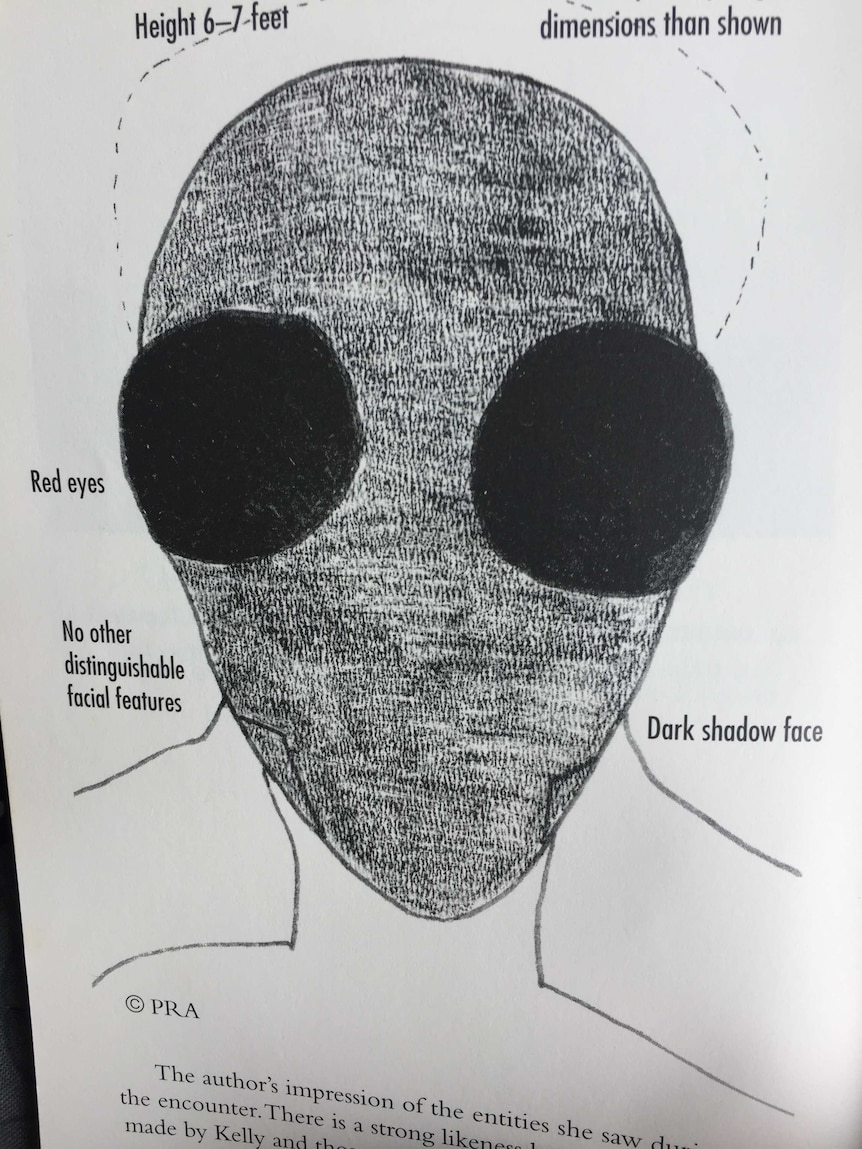
Peter Khoury was a Lebanese-born Sydney resident, born in 1964, married to Vivian and raising two children, when the events that made his name in UFO research began. He first reported an encounter in July 1988. Lying in bed, he felt something grip his ankles and found himself paralysed but conscious. He described three or four small hooded figures and a sense of telepathic instruction to relax. He said a long needle-like object was brought toward the side of his head, after which he lost awareness. When he came round, roughly an hour had passed though it felt like minutes, and he found a puncture mark with dried blood on his head. In some of Chalker's tellings the 1988 figures include a tall thin golden-yellow coloured being with large black eyes.
The event that produced the physical evidence came on the morning of 23 July 1992. Khoury, then 28, had been unwell and was resting. He said he woke to find two naked humanoid women kneeling on his bed. One looked Asian, with dark shoulder-length hair and dark eyes. The other looked Nordic or Scandinavian, with very pale skin, light coloured eyes he thought might be bluish, and long blonde hair. He stressed that the faces were wrong for human beings: elongated, with a sharply pointed chin on the blonde and eyes he estimated as two to three times larger than normal, set above high cheekbones. He felt he was looking at something that was not quite human.
What followed had an intimate and disturbing character. Khoury said the blonde woman pulled his face toward her chest. He bit down, and by his account a small piece of her flesh came away in his mouth. He swallowed it involuntarily and began a violent coughing fit. He described the blonde reacting with what looked like confusion and a wordless exchange between the two women, as if his resistance had broken some expected script. The women were then simply gone. When he recovered himself in the bathroom he found two fine, almost translucent blonde hairs tightly wound around his penis. Crucially, Khoury kept them, sealing the strands in a small plastic sachet, which is the act that turned a private experience into a testable physical specimen years later.
What is the official explanation?
There is no government or military investigation of the Khoury case. No air force, police, or state agency ever opened a file, and Khoury did not report it to officials. The case has no Blue Book equivalent and no official narrative to quote, which places it outside the apparatus of state debunking entirely. What exists instead is a civilian forensic effort, and it is unusually well documented for an abduction claim.
The investigating figure of record is Bill Chalker, a Sydney-based researcher with a chemistry and mathematics background and author of the Australian survey "The OZ Files". Khoury first told Chalker about the 1992 hair in 1996, and Chalker recognised that a preserved biological sample offered something almost no abduction case had: material that could be put through a laboratory. Chalker assembled a small group of working scientists he called the Anomaly Physical Evidence Group. The biochemistry team leader was Dr Horace Drew, a molecular biologist who had spent years as a research scientist with the CSIRO, Australia's national science agency, and was a co-author of the textbook "Understanding DNA". In early 1998 the group ran what Chalker describes as the world's first polymerase chain reaction amplification and mitochondrial DNA sequencing of biological material tied to an alien-abduction claim.
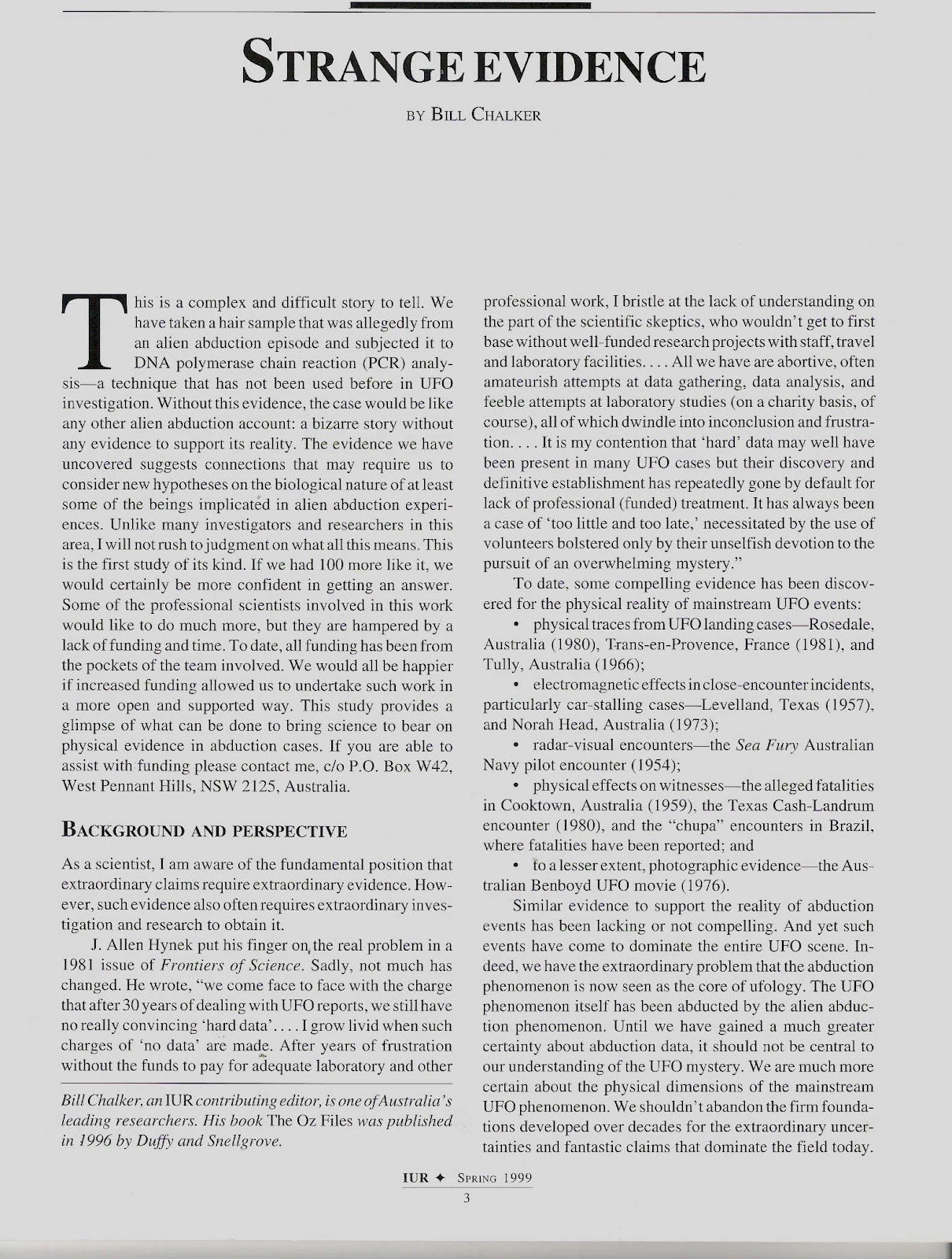
The findings were published in 1999 in an article titled "Strange Evidence" in the International UFO Reporter, the quarterly journal of the Chicago-based J. Allen Hynek Center for UFO Studies. Chalker later expanded the account into his 2005 Simon and Schuster book "Hair of the Alien". The reported result was a genuine anomaly rather than a clean answer. The blonde hair was confirmed as human, but its mitochondrial DNA carried five markers characteristic of a rare sub-group of the Chinese Mongoloid lineage, one of the rarest human maternal lineages then known, with the team finding only a handful of comparable cases in the literature, all in Chinese individuals with black hair. The oddity was that the donor hair was blonde and nearly clear, not the black expected of that lineage. Chalker further reported a mosaic pattern, with the rare Asian-type signature in the hair shaft and a separate rare Basque or Gaelic type signature associated with the root, plus interest in a CCR5 gene deletion. Khoury also passed a polygraph examination administered by Gavin Wilson in 2010, although Chalker himself has cautioned that polygraphs are not reliable proof of anything.
What did the witnesses think it was?
Peter Khoury believed he had been physically taken and interfered with by non-human beings across both encounters, and that the 1992 hair was a literal sample of one of them. He did not seek publicity. By his and Chalker's account he was reticent about the 1992 event for years precisely because of its sexual and humiliating character, only raising it with Chalker in 1996. His conviction was practical rather than evangelical: he treated the strands as evidence to be preserved and tested, not as a story to be sold, and he submitted to a polygraph that, by the examiner Gavin Wilson's stated impression, found merit in what he reported.
Khoury was not a passive figure in the wider abduction community. After his experiences he founded the UFO Experience Support Association, established in Sydney in April 1993, a group meant to help other people who reported strange encounters make sense of and cope with them. That places him as an organiser and supporter of fellow experiencers rather than an isolated claimant. His wife Vivian was part of the household context, and her hair was offered as a comparison sample during the DNA work, although usable DNA could not be recovered from it, reportedly because of chemical treatment.
The principal corroborating witness is in effect Dr Horace Drew, not as a witness to the encounter but as a credentialed scientist willing to put his name to the analysis and to state that the most probable donor of the hair, given the genetics and the blonde colouring, was as Khoury described, a tall fair-skinned female whose hair and skin carried little protective pigment. Chalker, for his part, has been consistent and notably restrained, repeatedly stressing that one anomalous hair from one person is suggestive rather than definitive and does not by itself prove a hybrid breeding programme. That restraint, from the man with the most to gain from overclaiming, is itself part of why the case has held the attention of serious researchers.
The dispute
The dispute runs on two separate tracks, neither of which amounts to a demonstrated debunk. The first track targets the experience. John O'Neill, writing for the Australian Skeptics, argued that the whole pattern is textbook sleep-related phenomena: the paralysis is sleep paralysis, the humanoid women are hypnopompic hallucination at the edge of waking, the missing time is ordinary sleep, and the 1988 puncture wound with its scab could be a pimple, an insect bite, or any small lesion that happened to be in about the right spot. Khoury had been ill on the 1992 morning, which is consistent with the conditions in which such episodes arise. This is a coherent and reasonable account of why a sincere person could report the encounter without anything paranormal occurring. It is, however, a psychological reconstruction, not proof, and it does not address the physical specimen at all.
The second track targets the hair and the DNA. The researcher Luis R. Gonzalez compiled an extensive critical report focusing on chain of custody and contamination. The strands stayed in Khoury's own possession for roughly six years before any analysis, with minimal documentation of handling, and the supporting diary material was reportedly not located until 1999, years after the event. Gonzalez argues that cross-contamination, mixing of nuclear and mitochondrial signals, and degradation over long unmonitored storage could in principle generate the confusing dual-lineage picture without anything exotic being involved. He also notes that the rare Chinese Mongoloid mitochondrial type the team flagged does correspond to a real, if small, fraction of living human populations, on the order of a few percent in some Taiwanese sampling, so a rare human donor is not impossible.
What is missing from both tracks is the thing that would move this to a stronger verdict. There is no confession, no recantation by Khoury, no recovered hoax materials, and no positive identification of the specific real-world woman whose hair this supposedly is. The contamination case is a plausible mechanism for how an ordinary result might be misread, not a demonstration that this particular result was ordinary. Against it stands a named CSIRO scientist, Dr Horace Drew, who ran PCR and mitochondrial sequencing, called the hair human but anomalous, and published the finding in the International UFO Reporter in 1999. Because a serious counter-explanation exists but does not close the case, and because the central physical claim has been disputed rather than positively explained, the case is Barely Disputed rather than discredited.
Is the Khoury Abduction and DNA Claim real? The two-pass assessment
Pass one, the ordinary readings. The encounters themselves carry the classic signature of sleep-related events. John O'Neill of the Australian Skeptics argued exactly this, that the paralysis fits sleep paralysis, the beings fit hypnopompic hallucination, the missing time fits ordinary sleep, and the 1988 puncture and scab could come from a pimple, an insect bite, or any minor lesion in roughly the right place. Khoury had been unwell on the 1992 morning, which fits the conditions in which such episodes occur. That covers the experience but not the hair. For the hair, the strongest ordinary explanation is mundane provenance plus chain-of-custody weakness. The strands sat in Khoury's possession for about six years before any test, the relevant diary entry was reportedly not located until 1999, and researcher Luis R. Gonzalez has laid out in detail how cross-contamination and the long unmonitored storage could in principle produce a confusing dual-lineage signal from ordinary human material. A rare blonde human of part-Asian maternal descent is an unusual person, not an impossible one, and the matching lineage does correspond to a real if small slice of living human populations. On this reading the hair is simply a human hair from a real woman, and the rest is a misremembered nocturnal episode.
Pass two, if the encounter was real. Then the value of the case is that it is the first abduction claim to leave testable biological material that was actually run through PCR and mitochondrial sequencing by a named, credentialed scientist, Dr Horace Drew of the CSIRO, and published in the International UFO Reporter in 1999. The reported result is a genuine puzzle: a confirmed-human but blonde, nearly pigment-free hair carrying a rare Chinese Mongoloid mitochondrial signature, with a mosaic pattern setting an Asian-type shaft against a Basque or Gaelic type root. That is not what a casual hoaxer would invent, and it is not what a single ordinary donor easily explains either, which is why the team called it strange rather than solved. If accurate, it points at something with a deeply unusual genetic profile rather than a being from off the human tree entirely.
Weighing the two, the official-apparatus column is empty here, so nothing pushes the case down from that direction. What disputes it is, on one side, a psychological reconstruction of the experience, and on the other, a contamination-and-custody critique of the evidence. Both are legitimate and both are real weaknesses. Neither is a method-shown discredit. No one has produced a confession, a recantation, recovered hoax props, or a positive identification of the specific living woman whose hair this was. The contamination argument remains a hypothesis about how an ordinary result could look anomalous, not a demonstration that it did. Because a counter-explanation exists and is taken seriously but does not close the case, this sits at Barely Disputed. The experience is consistent with sleep phenomena and the chain of custody is imperfect, yet the central physical claim, an authenticated and published anomalous DNA result, has never been positively explained away.
Sources
- theozfiles.blogspot.com/2012/07/peter-khoury-and-hair-of-alien-20-years.html
- theozfiles.blogspot.com/2017/07/peter-khoury-and-hair-of-alien-25th.html
- www.tall-white-aliens.com/dna-sample-from-khoury-abduction-raises-big-questions/
- ufoconjectures.blogspot.com/2017/08/from-luis-r-gonzalez-his-extensive.html
- anomalien.com/hair-of-the-alien-abduction-case-of-peter-khoury/
- www.simonandschuster.com/books/Hair-of-the-Alien/Bill-Chalker/9780743492867
More cases from this region: UFO sightings in Australia