The Jason Andrews Abduction
The case begins on 2 July 1987 at the Andrews family home near Slade Green in Kent, on what Ann Andrews describes as her son Jason's fourth birthday. This case file covers what witnesses reported, the official narrative, and a two-pass assessment with its evidence tier.
What did witnesses see at Family home near Slade Green?
The case begins on 2 July 1987 at the Andrews family home near Slade Green in Kent, on what Ann Andrews describes as her son Jason's fourth birthday. By her account the party had wound down and a violent thunderstorm was gathering when there came a loud, insistent banging on the front door. Ann's husband Paul went to answer it. In her telling the banging "stopped instantly the moment Jason's father Paul touched the door to open it," and when he opened it there was no one outside. Then, she writes, "after some blindingly bright lightning and frighteningly loud thunder claps," Jason, who had been asleep, sat up and behaved in a way that frightened both parents.
The central reported event is Jason's speech. Ann says he "opened his mouth and started to talk, pouring out an incredible stream of numbers, fantastic numbers, huge numbers, strange algebraic configurations, mathematical terms like 'pi' and 'binary codes' all spewed out," from a boy who normally struggled to count to ten. As he recited, the banging is said to have resumed, this time seeming to come from inside the house. Jason then rose and began walking toward the front door, still in his trance, and Ann says they had to restrain him before he seemed to wake. Family retellings record him saying words to the effect of "They're waiting for me. I have to go."
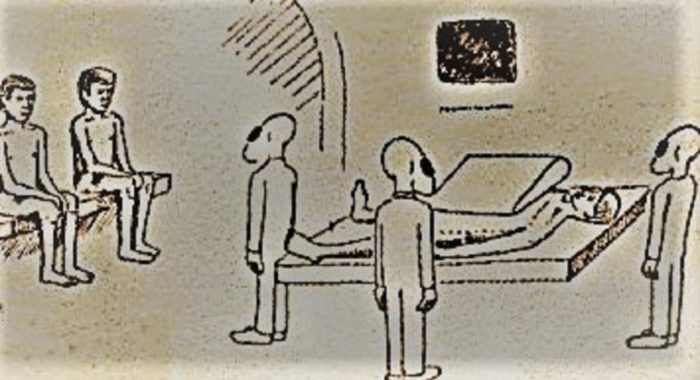
The family treated this as a one-off oddity until 1995, when Jason, then around eleven or twelve, told his mother that "strange beings" had been coming into his room for years and taking him. His description was consistent across retellings: "It's always the light that comes first. Then I see the tall one rise up at the foot of the bed." He spoke of smaller figures, "fuzzy and indistinct," moving very fast around him while he lay paralysed and unable to speak, and of being taken to a bright white room, "an operating theatre, like at the hospital. It's all white and shiny," where the tall entity touched him.
Layered onto Jason's own testimony were phenomena the parents say affected the whole household and their smallholding. The book "Abducted" catalogues unexplained red marks that appeared on Jason's skin overnight and faded by morning, episodes of a "secret language" he babbled, and "terrible nights" when his bed was found empty. On the land the family reported mutilated and dead animals, cattle that died in unexplained circumstances, pregnant cows that suddenly went barren, strange lights in the sky over the property, and silent figures the family came to call the "watchers in the wood" who seemed to keep the farm under observation.
What is the official explanation?
There is no government or military investigation of the Jason Andrews case. No Ministry of Defence file, police report, medical record, or veterinary post-mortem from the events has surfaced in the public record. Unlike radar-or-photo cases, this one generated no official apparatus at all, which is itself significant: the entire evidential base is the family's own retrospective testimony, first assembled in 1995 and published in 1998.
The nearest thing to an investigative record sits inside the civilian UFO community rather than any state body. Ann Andrews became a field investigator for the British group Quest International in 1993, reporting to the prominent investigator Tony Dodd, a former police sergeant who built much of his reputation on cattle-mutilation and abduction claims. Dodd and Quest provided the network through which the Andrews narrative was validated and circulated, and Ann's own role as an investigator means the line between witness and researcher in this case is blurred. The Australian hypnotherapist and "star child" advocate Mary Rodwell is also linked to the case; she is reported to have described Jason's early experiences as fitting a "classic abduction pattern." None of this is independent officialdom; it is a pro-contact community assessing one of its own.
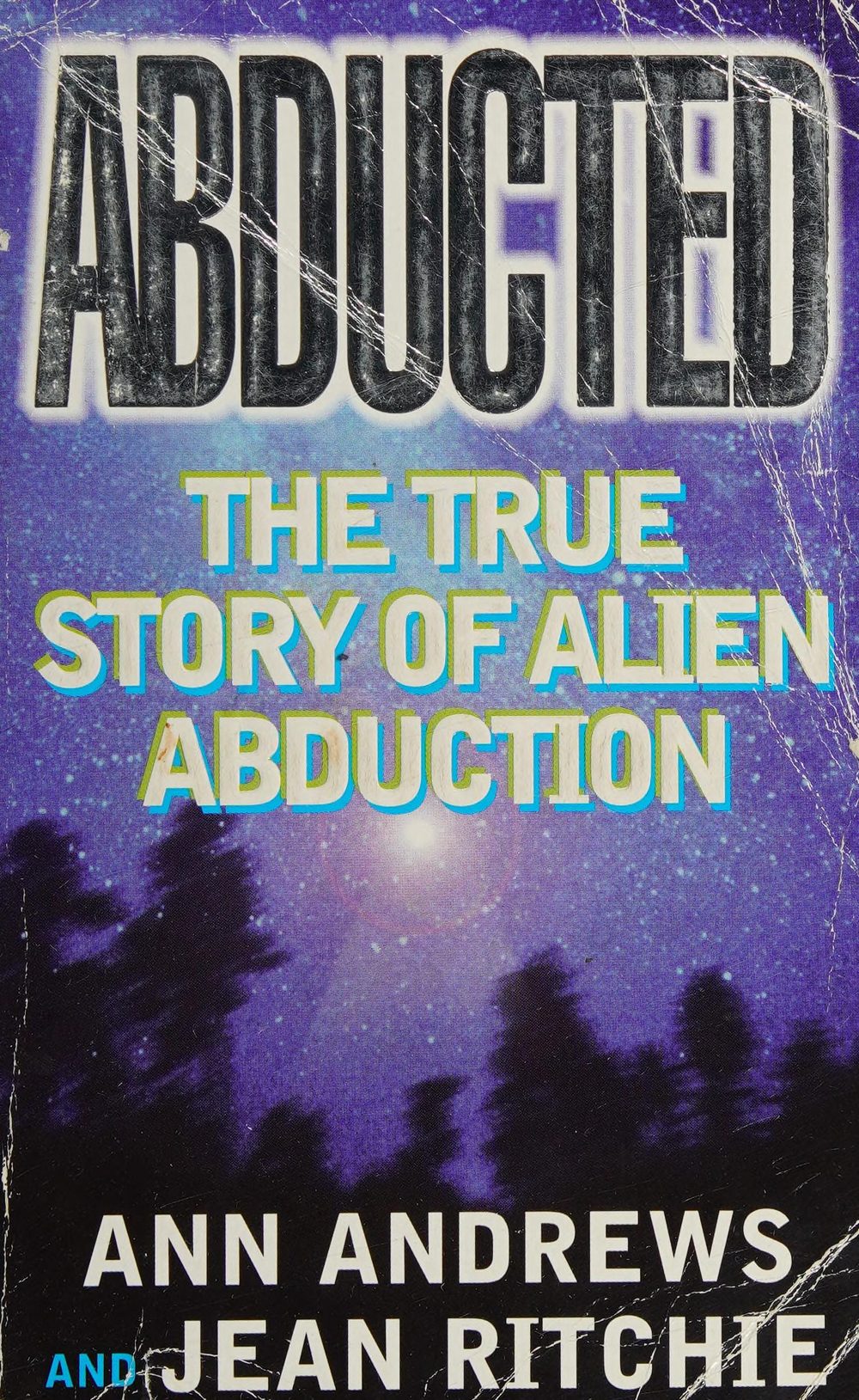
The book itself, "Abducted: The True Tale of Alien Abduction in Rural England" by Ann Andrews and Jean Ritchie, published by Headline in 1998 and held by the Internet Archive as a 340-page volume catalogued under "Alien abduction, Great Britain," is the primary document of the case. It was written more than a decade after the 1987 incident and frames the family as ordinary rural Britons overtaken by extraordinary events. Ann's 2005 follow-up, "Jason, My Indigo Child: Raising a Multidimensional Star Child in a Changing World," reinterprets the same testimony within New Age "star child" doctrine, shifting Jason from victim to chosen being. That evolution in the framing, from trauma to spiritual election, is itself part of why critics treat the narrative with caution.
What did the witnesses think it was?
The witnesses are the Andrews family themselves. Jason Andrews is the experiencer, the boy at the centre of every episode, who from 1995 onward described nightly visitations, paralysis, the tall figure and the smaller ones, and the bright examination room. His mother Ann Andrews is the narrator and chief documentarian of the case; she believed her son completely, came to regard herself as an abductee, and built a second career as a UFO investigator around the family's experiences. By her account abduction "runs in families," and she folded a range of household misfortunes, miscarriage, Jason's school difficulties, animal deaths, into the same explanatory frame.
The 1987 birthday incident is the one event with more than one adult witness. Ann and her husband Paul both report the gathering storm, the banging at the door that stopped the instant Paul touched it, and Jason's stream of numbers and mathematical terms. Paul is presented as an independent witness to the door and the trance, experiencing them alongside but separately from Jason. Jason's elder brother Daniel appears in the family narrative as present and aware of the disturbances, and in some accounts as having experiences of his own, though the published material keeps the focus firmly on Jason. Ann has also said that in later years the family and unnamed friends saw "several sightings, both of lights above the house and figures around the property," extending the witness pool beyond the household, though no named outside witness or dated statement from those friends has been published.
What the witnesses believed is not in doubt: they were sincere, frightened, and convinced. There is no estranged-spouse recantation, no relative calling it a hoax, no insider confession. The weakness is not hostile testimony but the opposite, a tightly closed family circle in which the child's account reaches the public almost entirely through his mother's voice, written down years after the events, with no contemporaneous diary, recording, photograph, or medical note to anchor it.
The dispute
The counter-explanation is psychological and folkloric, and it is advanced by named critics. The philosopher A. C. Grayling reviewed "Abducted" for Prospect magazine in 1998 in an essay titled "Arguing with aliens." He treated the book as an example of the abduction genre's incoherence rather than a case to be solved, and his core charge was internal contradiction: the narrative mixes physical abduction with astral wandering, having Jason carried bodily from the house on some nights yet leaving his sleeping body in bed on others, and it asks readers to accept beings capable of interstellar travel who nonetheless perform crude examinations leaving temporary marks and once return the boy to the wrong place. His conclusion was that psychological and cultural explanations are far more plausible than literal extraterrestrial abduction. The British skeptical circle around Magonia magazine and Kevin McClure's "Abduction Watch" newsletter addressed the case in the same period and from the same standpoint, emphasising memory reliability, suggestion, and the heavy parental mediation of a child's testimony.
The specific mundane mechanisms the critics invoke are well documented. Jason's nocturnal experiences, the light first, then paralysis, then a tall figure at the foot of the bed and small fast shapes, are a near-textbook description of sleep paralysis with hypnagogic hallucination. The overnight marks that vanish by morning fit scratching, dermatographia, or minor injury. The empty-bed nights fit sleepwalking. The 1987 mathematical trance reaches us only as a parental recollection set down eleven years later, which is exactly the window in which a memory can be reshaped by a belief adopted in the interim. The farm anomalies, dead and barren cattle and mutilated animals, sit within the ordinary background rate of rural livestock loss, and no veterinary documentation has ever been published.
What keeps this in the "barely" tier rather than "strongly" is what the critics do not have. There is no confession by any participant, no hoax prop recovered, no witness recantation, and no positive identification of a specific real-world object or cause for any one episode. The skeptical case is a strong, named, plausible reconstruction, but it remains a reconstruction. The standard reserves the strong tier for a demonstrated fabrication or a specific identified cause, and treats a contested psychological argument, however reasonable, as a partial counter that leaves the case largely standing on its testimony. That is the situation here.
Is the Jason Andrews Abduction real? The two-pass assessment
Pass one, the ordinary reading. Every element of this case has a mundane candidate and none of it left physical evidence that survives in the public record. A thunderstorm in Kent in July is unremarkable. Banging on a door during a storm can be wind, thermal movement, or a prank, and the noise stopping as Paul reached the door is the kind of coincidence memory sharpens over a decade. A four-year-old reciting "numbers" is the softest claim of all: the only versions we have are the parents' recollections written eleven years later, and "pouring out pi and binary codes" is exactly the sort of detail that grows in the retelling once a family has decided their son is gifted and chosen. Jason's nocturnal experiences, a light, paralysis, a tall figure at the foot of the bed, small fast-moving shapes, map precisely onto sleep paralysis and hypnagogic imagery, the best-documented natural engine of abduction reports. The overnight marks that fade by morning fit scratching, dermatographia, or ordinary childhood knocks. The empty-bed nights fit sleepwalking. The cattle deaths, barren cows, and mutilations fit the unremarkable background rate of rural livestock mortality and scavenging, none of it supported by a single veterinary report. The lights and the "watchers in the wood" fit aircraft, planets, and pareidolia at a treeline for a family already primed to expect observers. The philosopher A. C. Grayling, reviewing the book in Prospect in 1998, pressed the internal incoherence: the narrative cannot decide whether Jason is physically carried off or wanders in astral form while his body sleeps, and it asks us to believe in beings advanced enough to cross interstellar space yet crude enough to leave temporary scratches and put a child back in the wrong place. The British skeptical circle around Magonia and Kevin McClure's "Abduction Watch" treated the case in the same vein, as a textbook example of testimony shaped by belief, suggestion, and parental mediation of a child's words.
Pass two, if real. Taken at face value, this is a multi-year, multi-generational abduction series centred on one child, with a second adult witness to the inciting event, a consistent first-person description from the experiencer, and a cluster of supporting household anomalies. If genuine it would belong to the "special child" subtype of the abduction literature, in which a young experiencer reports recurring contact from early childhood. The 1987 door-and-trance event, witnessed by both parents, is the part that resists the purest psychological reading, since it was a waking, shared experience rather than a solitary night terror.
The verdict. The dispute here is real and named, but it is the weaker kind. Grayling and the Magonia skeptics show that the story is internally contradictory and evidentially thin, and they offer strong natural candidates for every element. What they do not have is the thing that would make this Strongly Disputed: there is no confession, no recovered prop, no recantation, and no positive identification of a specific real-world cause for any single episode. A plausible reconstruction in terms of sleep paralysis and false memory is exactly the kind of contested psychological argument that the standard keeps in the lower disputed tier. The case largely stands as the family tells it, against a credible but unproven counter-explanation. That is Barely Disputed.
Sources
- anomalien.com/jason-my-indigo-child/
- archive.org/details/abductedtruetale0000andr
- www.prospectmagazine.co.uk/magazine/arguingwithaliens
- www.qbd.com.au/abducted/ann-andrews-jean-ritchie/9780747259138/
- cosmiccauldronbooks.com.au/products/abducted-ann-andrews-jean-ritchie
More cases from this region: UFO sightings in United Kingdom