NASA’s No Records Position and the 3,668 Page UAP FOIA Release (28 September 2026)
NASA told its own records officer it held no records specifically classified as UAP documents. Two FOIA releases show the agency’s records officer openly disputing that in writing, and a senior advisor asking the independent study team to restructure its report to reduce the giggle factor.
What happened
NASA stated in writing that it holds no records specifically classified as UAP documents. Two releases made under the Freedom of Information Act, published together on 30 September 2026 by the researcher Grant Lavac, show that the position was contested inside the agency at the time it was made, and that NASA’s newly appointed Director of UAP Research was simultaneously running a literature search on drone airframes, propulsion and human perception through the Goddard Space Flight Center library.
The larger of the two releases, NASA FOIA case 26-00789-F-HQ, was filed on 4 May 2026 and answered on 28 September 2026. NASA reported 3,668 pages, 2,778 released in full and 890 released in part. It covers correspondence between Mark McInerney, NASA’s first Director of UAP Research, and research librarians at Goddard. The second release, case 26-00029-F-HQ, carries the internal correspondence around the UAP Independent Study Team.
This archive obtained and read both released PDFs directly rather than relying on the published summary of them. The documents are reproduced above and the quotations below were read from the released pages, not from any secondary account.
Documents and images
What is the official position?
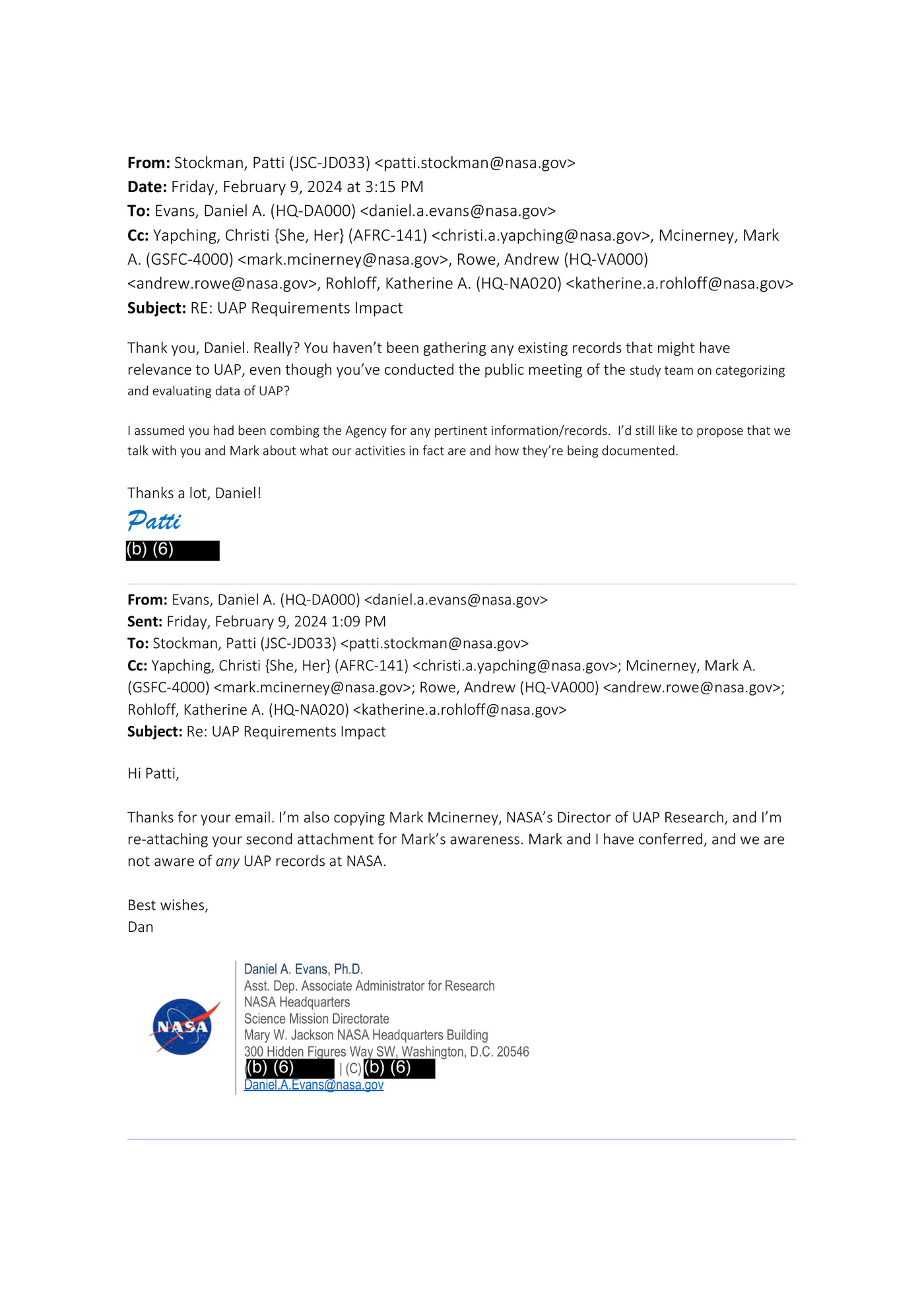
The agency position is stated by Dr. Daniel A. Evans, then Assistant Deputy Associate Administrator for Research in NASA’s Science Mission Directorate and the Designated Federal Officer for the UAP Independent Study Team. Writing to NASA Records Officer Patti Stockman on 9 February 2024 at 3:00 PM, Evans said that "following a comprehensive review of our activities and the discussions held during the public meeting on UAP, as well as the subsequent report, NASA currently does not hold or manage records classified specifically as UAP documents."
NASA repeated the substance of that position to the Government Accountability Office. In a written response to GAO questions filed under the GAO’s UAP engagement 106545, NASA answered "N/A" to a question asking whether the National Archives and Records Administration had requested historical UAP information from NASA for NARA’s UAP Record Group, and stated separately that "NASA does not maintain formal records specific to UAP phenomena."
Evans also explained the absence of a public correspondence record. He wrote that he and McInerney received a large volume of unsolicited emails from members of the public claiming UAP sightings, and that following Stockman’s own 2022 guidance that such messages "do not constitute records and should be immediately destroyed", he had "followed your direction and deleted most of them". The document records that he retained a few and attached a representative example, so the deletion was not total.
What the people involved say
The most striking material in the release is not the agency line but the internal pushback against it, which came from NASA’s own records officer.
Fifteen minutes after Evans sent his no records statement, Patti Stockman replied: "Thank you, Daniel. Really? You haven’t been gathering any existing records that might have relevance to UAP, even though you’ve conducted the public meeting of the study team on categorizing and evaluating data of UAP? I assumed you had been combing the Agency for any pertinent information/records. I’d still like to propose that we talk with you and Mark about what our activities in fact are and how they’re being documented."
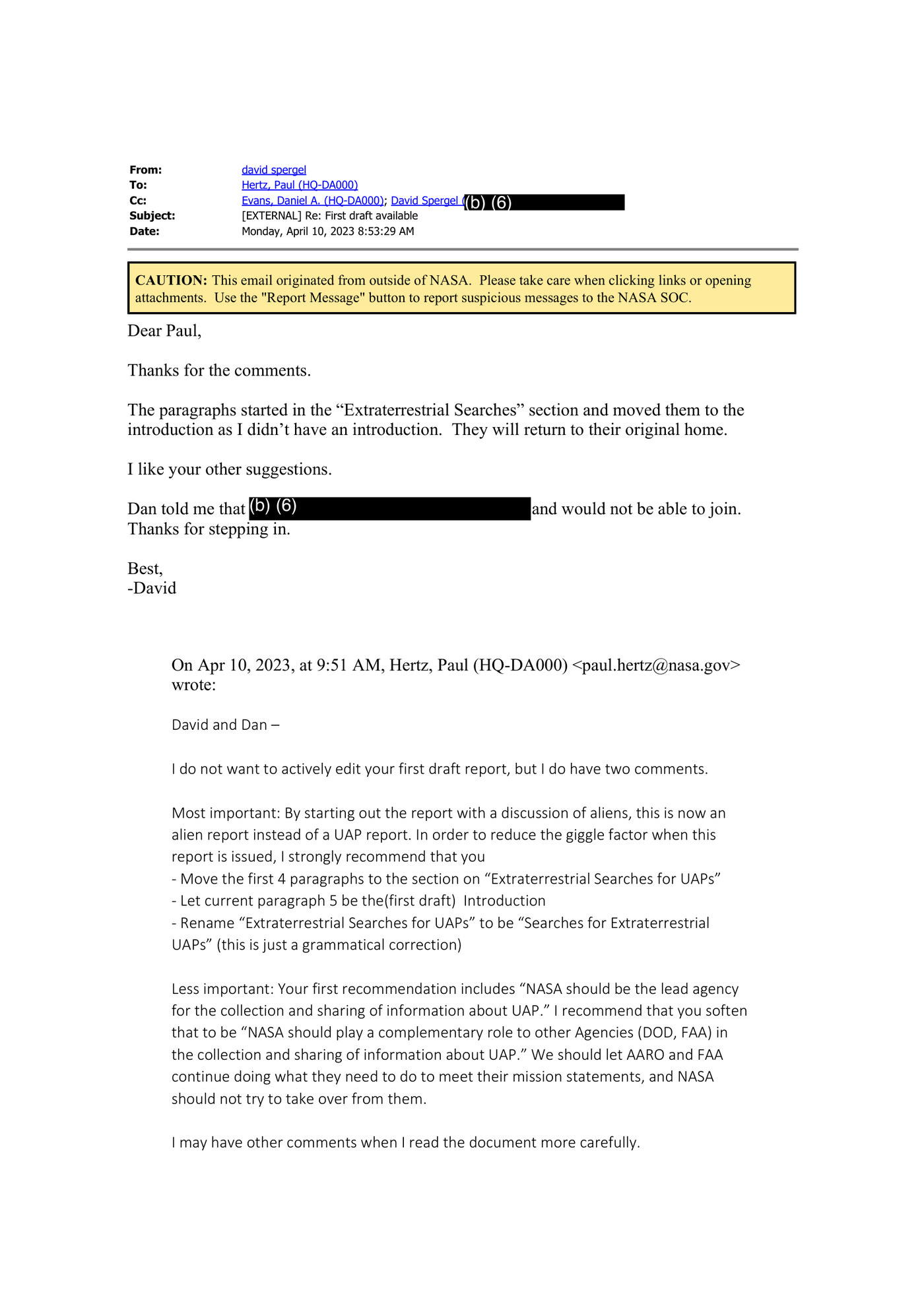
A separate exchange, a year earlier, shows the agency shaping how its UAP report would be received. On 10 April 2023 Paul Hertz, Senior Advisor in the Science Mission Directorate, wrote to David Spergel and Evans about the first draft of the Independent Study Team report. Hertz said he did not want to actively edit the draft but had two comments. The first: "By starting out the report with a discussion of aliens, this is now an alien report instead of a UAP report. In order to reduce the giggle factor when this report is issued, I strongly recommend that you" move the first four paragraphs into the extraterrestrial section and promote paragraph five to the introduction. The second: the draft’s first recommendation said "NASA should be the lead agency for the collection and sharing of information about UAP", and Hertz recommended softening it to a "complementary role to other Agencies (DOD, FAA)", adding that NASA "should not try to take over from them". Spergel replied the same morning agreeing, and said the paragraphs "will return to their original home".
The Goddard library trail in the second release shows what NASA’s UAP research director was actually asking for in the same period. Librarians compiled papers on spherical and Coanda effect drones, ion and electromagnetic propulsion, and on parallax and apparent position shift, the last to help explain sightings where a pilot sees an object below them that appears to move faster than reality. Librarian John Grunwell noted the requests might require expanding into "journals of vision, perception, consciousness studies, etc." His own assessment of triangular craft reports was prosaic: he wrote that he suspected genuinely triangular designs "are not that common", and that people who report triangular craft have usually seen "a suspected B-2 stealth bomber, or a similar drone deployed by the USAF".
Is the NASA’s No Records Position and the 3,668 Page UAP FOIA Release (28 September 2026) real? The two-pass assessment
Pass one, the mundane reading, and it is strong. A director of UAP research asking a library for peer reviewed papers on drones, propulsion and visual perception is exactly what that job should look like. Several commenters on the thread that surfaced this release made that point, and they are right. Nothing in 3,668 pages describes a sighting, an object, a recovered material or a concealed program. The material is administrative: literature requests, Zotero bibliographies, database searches and scheduling.
The deletion of public correspondence is likewise ordinary on its face. Unsolicited mail to a federal employee that does not arise from agency business is not a federal record, and Evans was following written guidance from the records officer when he discarded it.
One claim circulating with this release does not survive checking and is not adopted here. The Goddard library closed on 2 January 2026, and that closure has been offered as evidence of a UAP transparency rollback. It was part of an agency wide consolidation affecting many buildings and laboratories across the Goddard campus, and connecting it specifically to UAP research is not supported by these documents.
Pass two, what the release does establish. Two things, both narrow and both real.
First, the no records position was disputed inside NASA in writing, by the official whose job is records. Stockman’s "Really?" is not a researcher’s inference or a journalist’s framing. It is the agency’s own records officer telling the study team’s designated federal officer that she assumed he had been combing the agency for pertinent records, and asking to discuss how the work was being documented. Whether the agency ever answered her is not shown in what was released.
Second, and independently checkable, the Hertz email documents senior staff steering the framing of a public scientific report toward a lower giggle factor. This archive tested whether his requests reached the published version. They did in substance and not in wording. In the final report released on 14 September 2023, the extended discussion of extraterrestrial origin sits at pages 27 to 29, well inside the body rather than opening the document. The phrase "NASA should be the lead agency for the collection and sharing of information about UAP" does not appear; the report instead frames NASA’s role around interagency cooperation, stating that "the establishment of a NASA/AARO liaison will be an important step towards enabling interagency cooperation". Hertz’s own proposed wording, a "complementary role", does not appear verbatim anywhere in the report, and neither does his suggested section heading. So the substance of both recommendations shipped while his literal language did not.
That is the honest size of this release. It is not evidence that NASA concealed UAP data. It is evidence that the agency’s public posture on UAP was actively managed, and that its own records officer did not accept the no records position when it was made. The tier is Unknown because there is no phenomenon here to adjudicate, only a documentary record.
Sources
- drive.google.com/file/d/1XcpFAQVHn8Ap3Gtuc0g4akat50axo8e5/view
- drive.google.com/file/d/1BDCfb_VhNqecSNG0omC4tPaoOR3-lSdf/view
- science.nasa.gov/wp-content/uploads/2023/09/uap-independent-study-team-final-report.pdf
- science.nasa.gov/uap/
- grantlavac.substack.com/p/nasa-claimed-they-had-zero-uap-records
- www.reddit.com/r/UFOs/comments/1wu1c25/nasa_claimed_they_had_zero_uap_records_a_3668page/
More cases from this region: UFO sightings in United States