The Scott Bray UAP Emails: The Navy's 1,321 Page FOIA Release (23 September 2026)
A Freedom of Information Act request filed in May 2022 was answered in September 2026. The Navy found 1,321 pages of Scott Bray's unidentified anomalous phenomena email, withheld 302 of those pages in full, and released the rest with redactions.
What happened
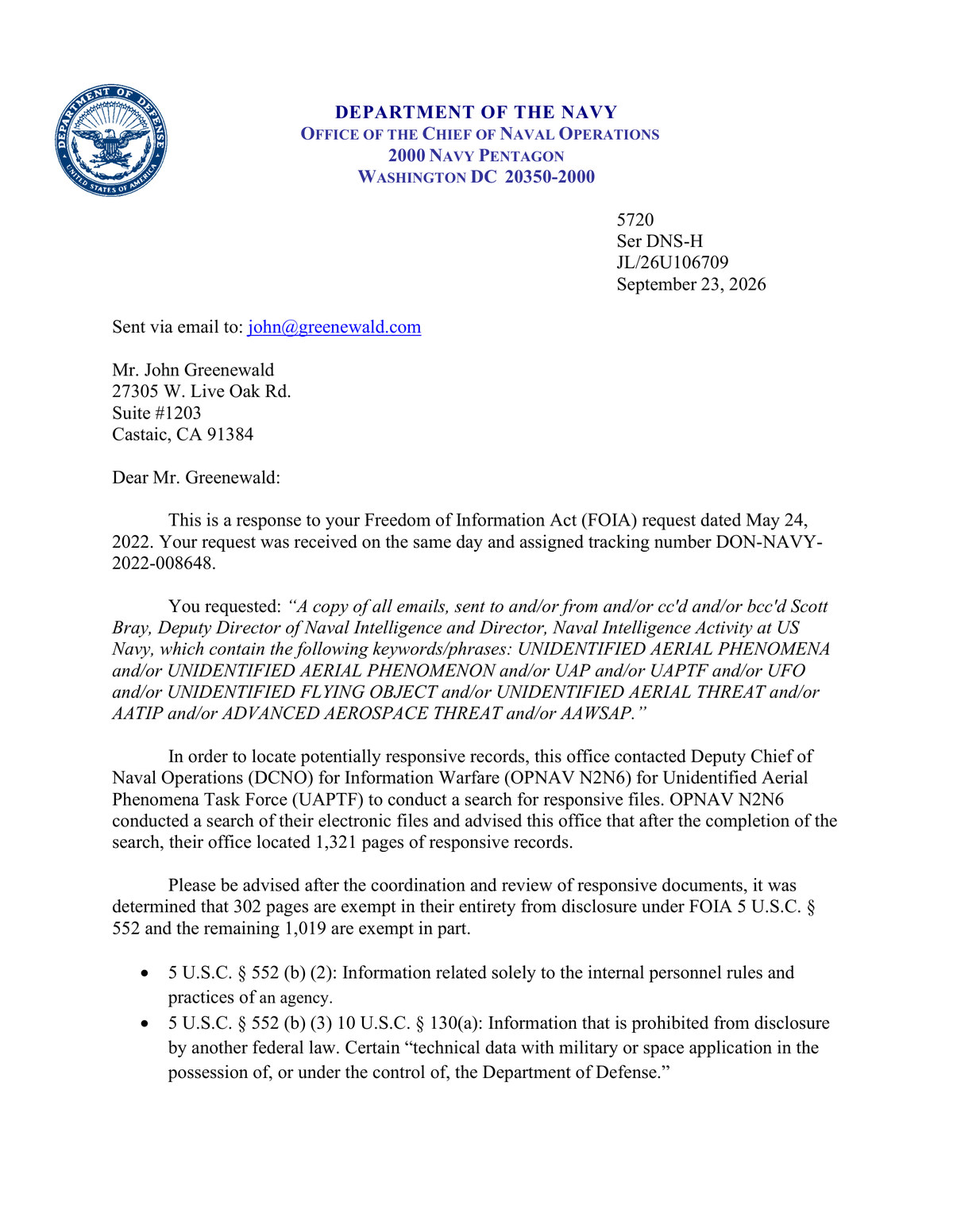
On 23 September 2026 the Department of the Navy answered a Freedom of Information Act request it had received on 24 May 2022. The response letter runs to four pages and the records behind it run to 1,321.
The request was filed by John Greenewald of The Black Vault, a document archive that has been running FOIA requests against the UAP subject for more than two decades. It asked for a copy of all email sent to, from, copied to or blind copied to Scott W. Bray, then Deputy Director of Naval Intelligence and Director of the Naval Intelligence Activity, containing any of a list of keywords the letter reproduces verbatim: UNIDENTIFIED AERIAL PHENOMENA, UNIDENTIFIED AERIAL PHENOMENON, UAP, UAPTF, UFO, UNIDENTIFIED FLYING OBJECT, UNIDENTIFIED AERIAL THREAT, AATIP, ADVANCED AEROSPACE THREAT and AAWSAP. The office assigned it tracking number DON-NAVY-2022-008648.
Bray is not an incidental figure. On 17 May 2022, five days before the anniversary of this request, he sat beside Under Secretary of Defense for Intelligence and Security Ronald Moultrie at the first open congressional hearing on unidentified phenomena in over half a century, and it was Bray who narrated the video clips shown to the House Intelligence Committee's counterterrorism subcommittee. The request therefore reaches into the working inbox of the officer who was the Navy's public face on the subject.
To find the records, the FOIA office contacted the Deputy Chief of Naval Operations for Information Warfare, OPNAV N2N6, the organisation that housed the Unidentified Aerial Phenomena Task Force. That office searched its electronic files and reported 1,321 pages of responsive material.
Of those, the Navy determined that 302 pages are exempt in their entirety and the remaining 1,019 are exempt in part. Nothing in the release is unredacted. The published file as posted runs to 1,325 pages including the determination letter, carries roughly 1.73 million characters of extractable text, and contains 313 pages from which no text can be extracted at all.
The correspondence itself is concentrated in a narrow window. Counting the dated headers across the corpus gives 372 items from 2020 and 417 from 2021, against a handful from every other year. That is precisely the span from the Navy's official release of three infrared videos to the delivery of the Office of the Director of National Intelligence preliminary assessment, and it is the reason the file is worth reading.
Documents and images
What is the official position?
The Navy's position is the determination letter, and the letter is an exemption schedule rather than a narrative. It claims five separate grounds for withholding.
Exemption (b)(2) covers information related solely to the internal personnel rules and practices of an agency. Exemption (b)(4) covers trade secrets and confidential commercial or financial information. Exemption (b)(6) covers information whose disclosure would invade another individual's personal privacy, and it is by far the most visible marker in the released pages, appearing as a red and black block over names, signature blocks and email addresses many dozens of times.
Exemption (b)(3) is the one with teeth. It withholds information prohibited from disclosure by another federal law, and the letter names that law as 10 United States Code section 130(a), which permits the withholding of certain technical data with military or space application in the possession of, or under the control of, the Department of Defense. The statute exists to keep exportable engineering detail out of public circulation.
The longest passage in the letter is reserved for exemption (b)(5), the deliberative process privilege. The Navy writes that the privilege is held to encourage open, frank discussions on matters of policy between subordinates and superiors, to protect against premature disclosure of proposed policies before they are adopted, and to protect against public confusion that might result from disclosure of reasons and rationales that were not in fact ultimately the ground of the agency's action. It then makes a narrower and more specific claim about this particular file, stating that release would reveal agency employees' internal predecisional deliberations about application of the FOIA exemptions and redactions in an active FOIA case that was not finalized at the time of the discussions.
The Navy adds that it applied the foreseeable harm standard and concluded that releasing the pre-decisional material could cause significant injury to the decision-making process, a chilling effect on discussion, hasty or uninformed decision-making, and public confusion.
The letter closes with appeal rights under 32 CFR section 701.12(a), giving 90 calendar days from the date of the letter and directing appeals through the Casepoint public portal that the Department of the Navy uses to process FOIA cases.
There is no statement anywhere in the release about what any observed object was. The Navy is describing a records decision, not a phenomenon.
What the people involved say
The substance sits in the released pages, and three threads carry most of it.
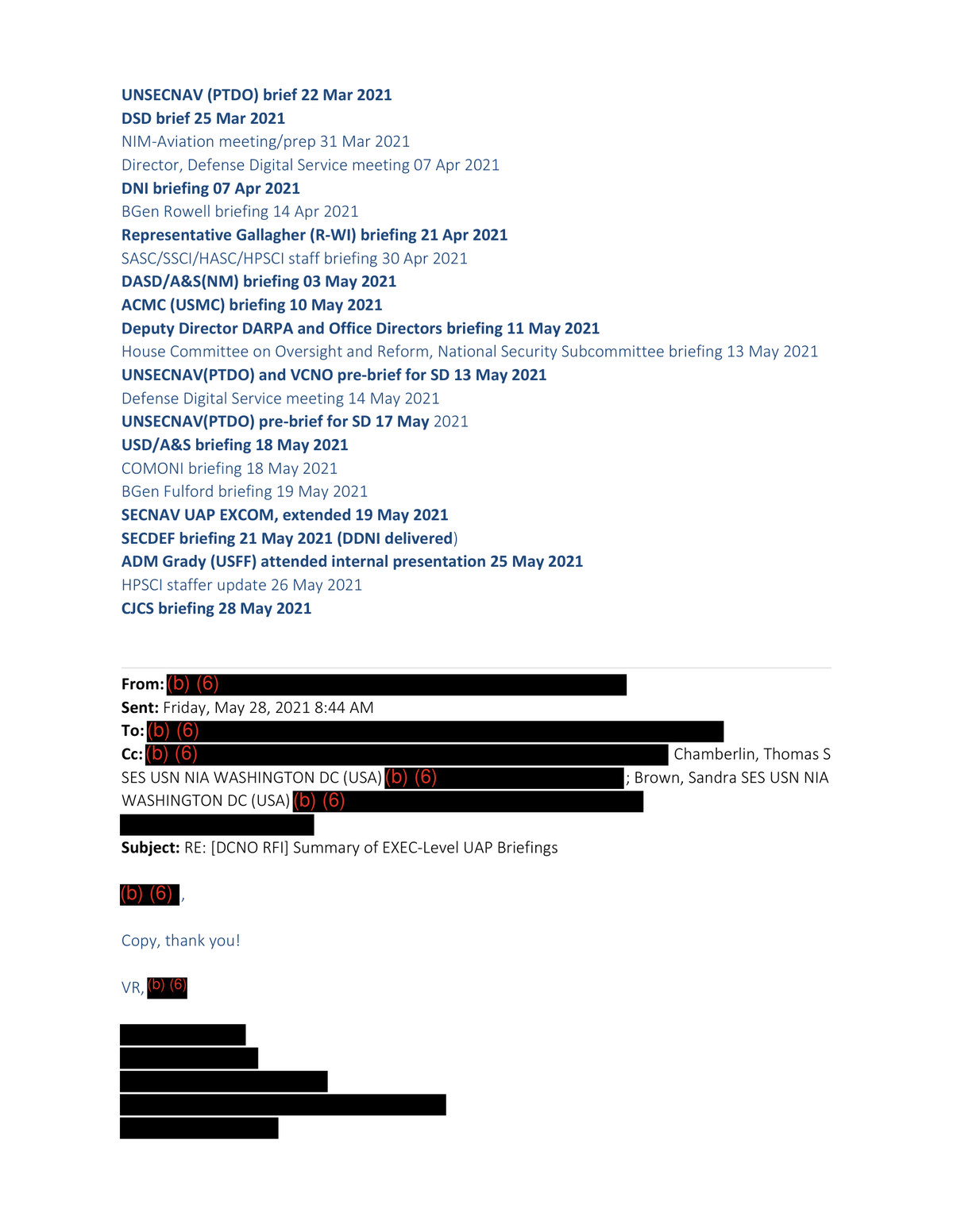
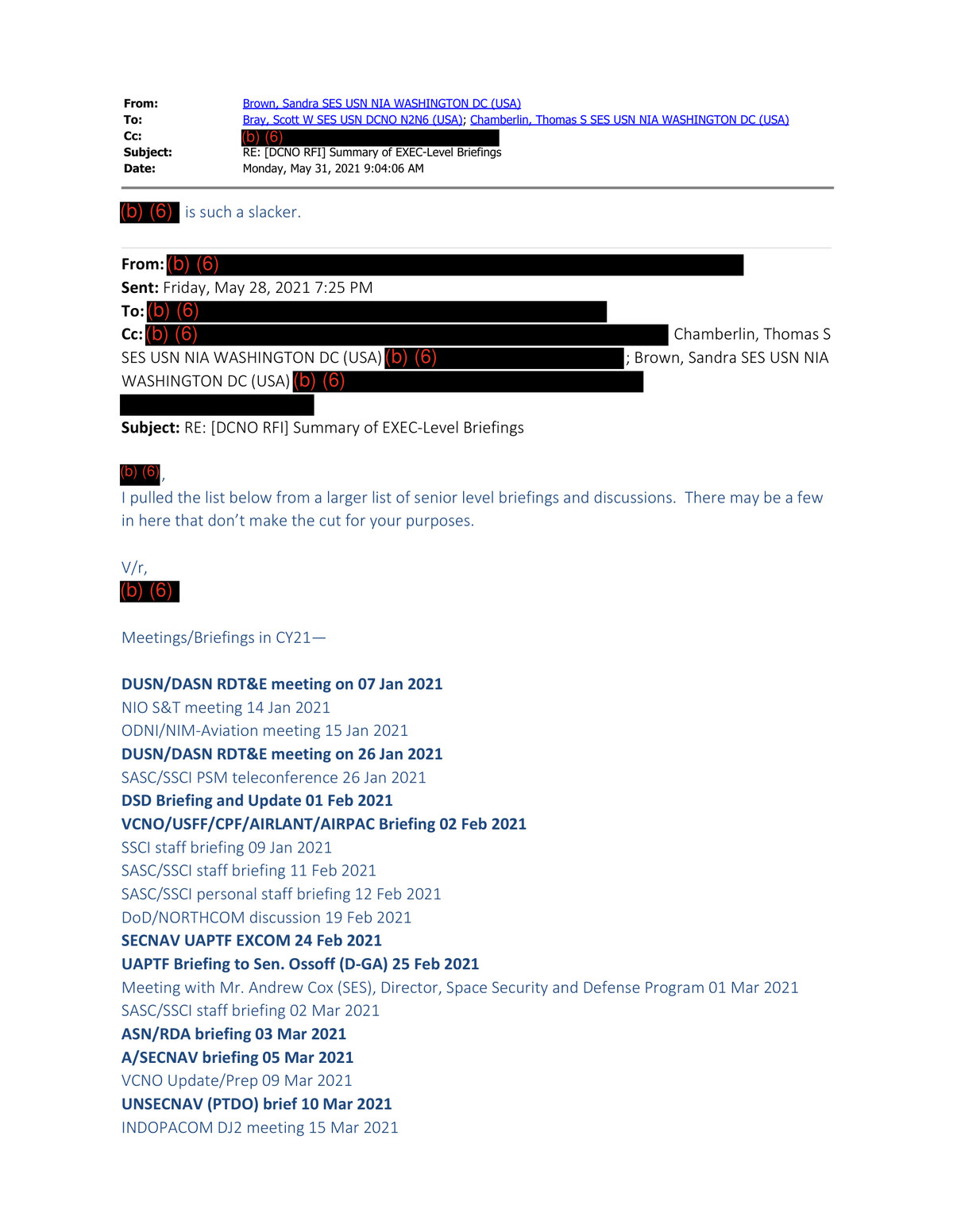
The first is a roster. On 31 May 2021 Sandra Brown, a member of the Senior Executive Service at the Naval Intelligence Activity, sent Bray and fellow SES officer Thomas S. Chamberlin a message under the subject line "RE: [DCNO RFI] Summary of EXEC-Level UAP Briefings". The thread behind it shows the request being passed down three days earlier, with the staff officer who compiled it writing simply "The list is long." It is. The compiler attaches a caveat worth preserving, that the list was pulled from a larger list of senior level briefings and discussions and that there may be a few in here that do not make the cut.
What follows is 43 dated entries running from 7 January to 28 May 2021, a span of 21 weeks. They include a Deputy Secretary of Defense briefing and update on 1 February, a Department of Defense and NORTHCOM discussion on 19 February, a Secretary of the Navy UAP Task Force executive committee on 24 February, a task force briefing to Senator Jon Ossoff on 25 February, a meeting on 1 March with Andrew Cox, Director of the Space Security and Defense Program, an INDOPACOM DJ2 meeting on 15 March, a Director of National Intelligence briefing on 7 April, a briefing to Representative Mike Gallagher on 21 April, a combined SASC, SSCI, HASC and HPSCI staff briefing on 30 April, a briefing to the Deputy Director of DARPA and office directors on 11 May, a House Committee on Oversight and Reform National Security Subcommittee briefing on 13 May, a Secretary of Defense briefing on 21 May noted as delivered by the Deputy Director of National Intelligence, and a Chairman of the Joint Chiefs of Staff briefing on 28 May. The Director of the Defense Digital Service appears twice, on 7 April and 14 May.
One entry sits out of chronological order in the original, an SSCI staff briefing dated 9 January that is listed after an item from 2 February. The list is a working document and reads like one.
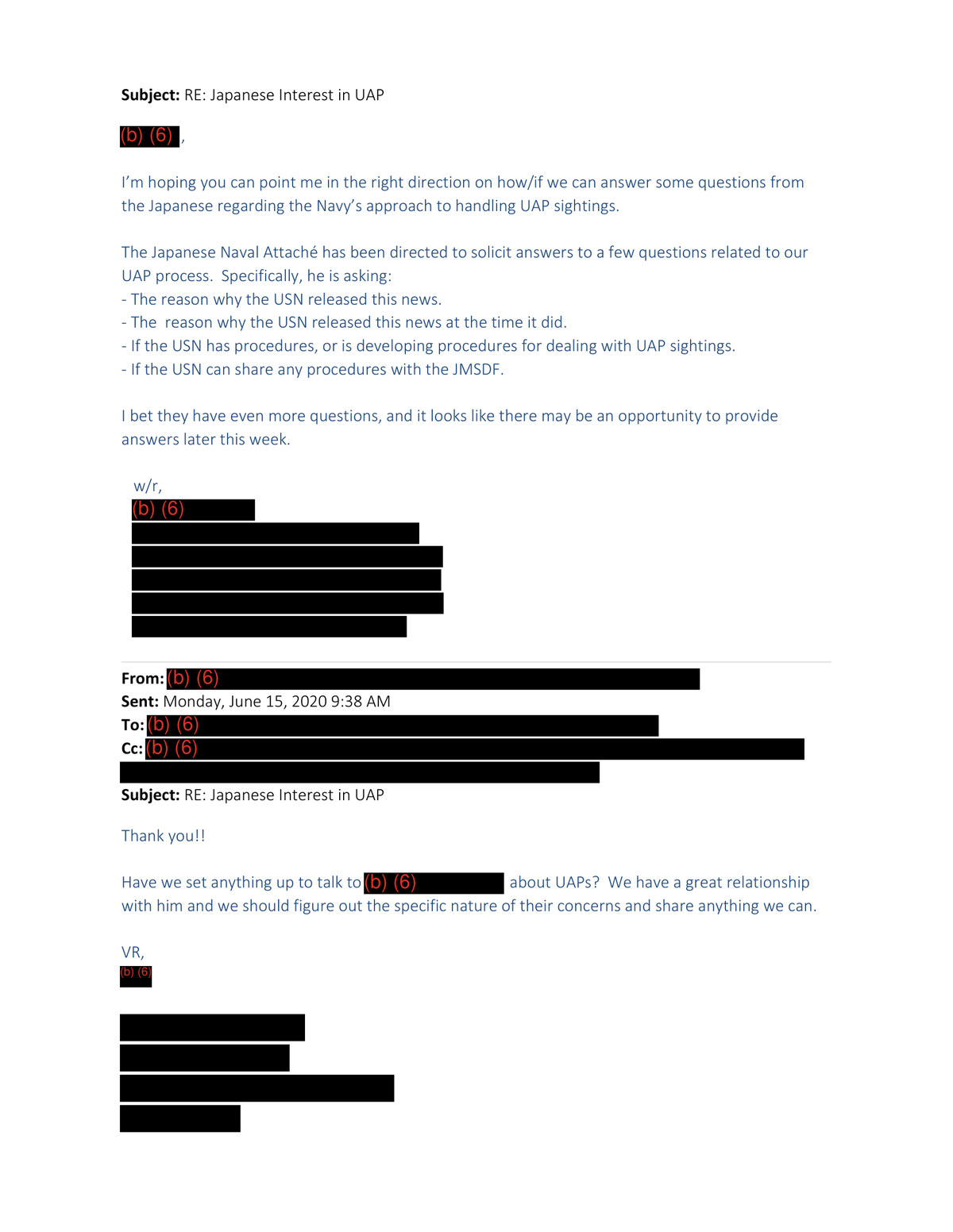
The second thread is foreign. In June 2020, weeks after the Navy formally released its three infrared videos, a Navy officer wrote asking for help answering questions from Japan. The message states that the Japanese Naval Attache had been directed to solicit answers about the Navy's approach to handling UAP sightings, and it sets out four questions: the reason why the Navy released this news, the reason why it released the news at the time it did, whether the Navy has or is developing procedures for dealing with UAP sightings, and whether the Navy can share any such procedures with the Japan Maritime Self-Defense Force. A colleague replies that the Navy's safety of flight procedures for range foulers might be useful to them. Jay Stratton, then at the Office of Naval Intelligence and later publicly identified as the director of the UAP Task Force, answers from a BlackBerry: "I agree and if DNI/DDNI concur I would be happy to meet with them."
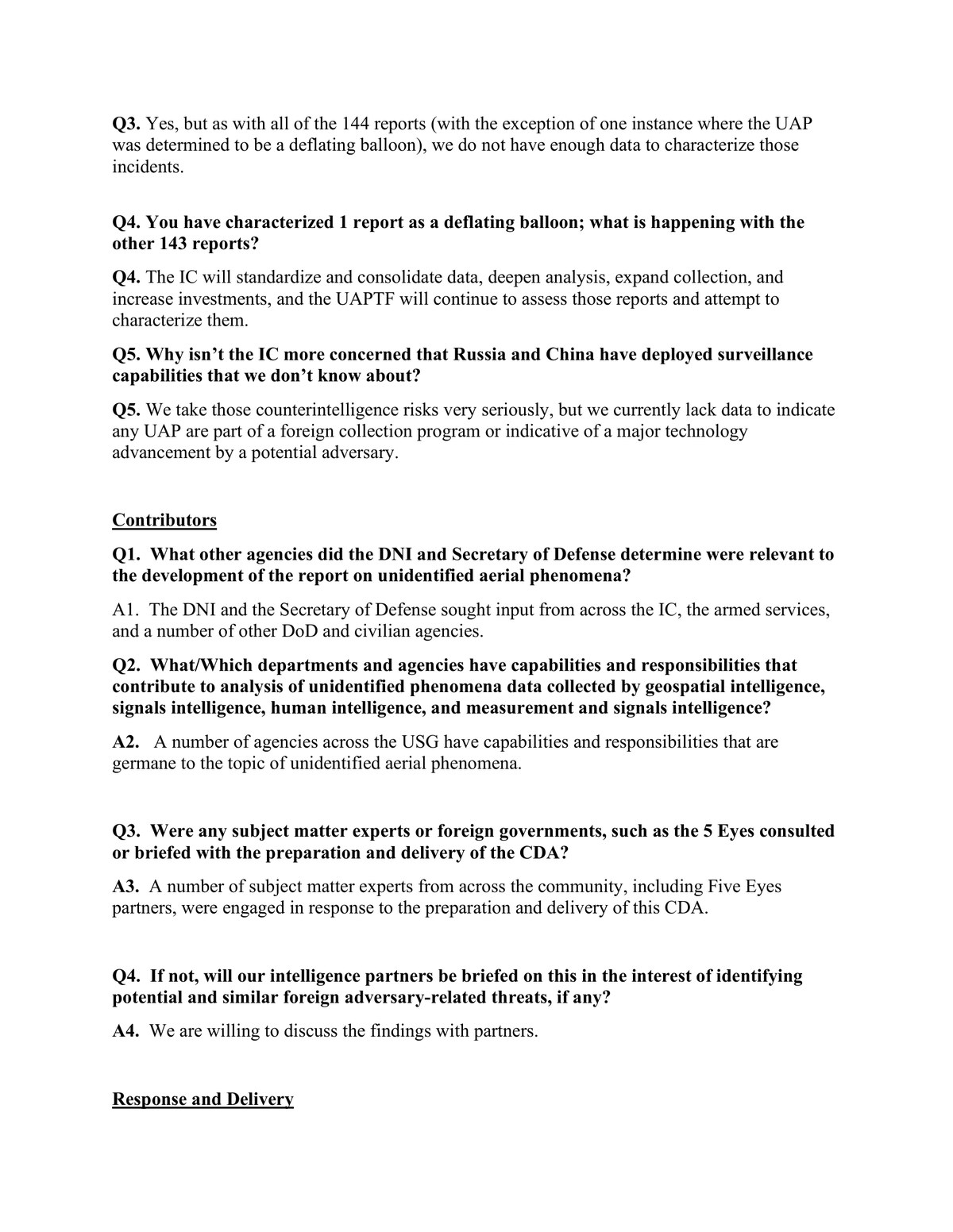
The third thread is the prepared script for the June 2021 assessment. The corpus contains a full question and answer package written for the rollout of the congressionally directed report, and its answers track the public document closely. Asked whether the incidents shown on a recent 60 Minutes programme were among the 144 reports, the prepared answer is yes, but that as with all of the 144 reports, with the exception of one instance where the UAP was determined to be a deflating balloon, there is not enough data to characterise those incidents. Asked why the intelligence community is not more concerned about Russian and Chinese surveillance, the answer is that those counterintelligence risks are taken very seriously but that there is currently no data indicating any UAP are part of a foreign collection program or indicative of a major technology advancement by a potential adversary. On propulsion the script concedes that in a limited number of incidents, UAP appeared to exhibit advanced propulsion characteristics, and that more collection and analysis is needed.
One answer in that package goes further than the published report does. Asked whether any subject matter experts or foreign governments such as the Five Eyes were consulted or briefed in the preparation and delivery of the assessment, the prepared answer states that a number of subject matter experts from across the community, including Five Eyes partners, were engaged in response to the preparation and delivery of this congressionally directed action, and that the United States is willing to discuss the findings with partners.
A fourth thread is notable mainly for being closed. Running through March 2020 is a chain titled "Release of Navy videos", copying Bray, Stratton, Matthew C. Cummings of the Office of the Under Secretary of Defense for Intelligence, and Christopher A. Julka of the Naval Air Systems Command FOIA office. It is the internal coordination behind the most famous official disclosure the Pentagon has made on this subject. Its contents are redacted under exemption (b)(5).
Is the Scott Bray UAP Emails: The Navy's 1,321 Page FOIA Release (23 September 2026) real? The two-pass assessment
Pass one, how this could be mundane, and largely it is.
This is a release of administrative email, and most of it reads that way. The bulk of the corpus is meeting invitations, press office coordination, talking points, legislative affairs updates, magazine queries and forwarded news clippings. Nothing in it describes a recovered object, a materials analysis or a programme of the kind alleged by claimants elsewhere in this archive. The words that would matter most are largely absent or trivial in context.
The four year delay invites suspicion and does not clearly earn it. Federal FOIA backlogs of this length are ordinary, particularly for a request that requires a custodian search of a senior officer's mailbox against ten keywords and then a line by line review of 1,321 pages by multiple coordinating offices. A slow answer is not by itself evidence of a withheld one.
The briefing roster is also, on its face, what a task force preparing a congressionally directed report would produce. A report was due to Congress in June 2021. Briefing the committees that requested it, the service chiefs whose aircrew generate the reports, and the executive officials who must sign off, is the normal machinery of government rather than a sign of alarm.
Even the Five Eyes answer admits an unremarkable reading. The Five Eyes arrangement exists precisely so that partners consult on air and maritime domain awareness, and an assessment about unidentified objects in military airspace is an obvious candidate for that consultation.
Pass two, what is genuinely new here.
The value of this release is documentary rather than evidential, and three things in it are not available elsewhere in the public record.
The first is the scale and altitude of the 2021 campaign. It has always been known that the Task Force briefed widely before the June 2021 assessment. This file enumerates it: 43 executive level engagements in 21 weeks, ending with the Chairman of the Joint Chiefs of Staff. Two entries stand out because they are not the usual intelligence or legislative audience. The Deputy Director of DARPA and the office directors were briefed on 11 May 2021, and the Director of the Defense Digital Service appears twice. The Defense Digital Service was a software and rapid prototyping unit, not an intelligence organisation, and its presence in a UAP briefing schedule is the kind of detail that only a document like this surfaces.
The second is the Five Eyes line. The published preliminary assessment of 25 June 2021 is nine pages long and contains no occurrence of the phrase Five Eyes, and no statement that allied governments were engaged in preparing it. The internal package written to answer questions about that same report states plainly that Five Eyes partners were engaged in its preparation and delivery. That is not a contradiction, because the public report never denied it, but it is a fact the public was not told and would have had no way to establish. It should be read for exactly what it is, a prepared answer to an anticipated question, and it is being reported here because the archive can point at the page it sits on.
The third is Japan, and here the dates do real work. The public milestone in Japanese UAP policy is 14 September 2020, when Defense Minister Taro Kono announced procedures directing the Self-Defense Forces to record and photograph unidentified aerial objects and pass them for analysis. The reporting at the time traced that decision to a meeting Kono held with United States Defense Secretary Mark Esper in Guam at the end of August 2020, where the two discussed the subject.
This correspondence sits three months earlier than the announcement and two months earlier than the Guam meeting. In June 2020 the Japanese Naval Attache had already been directed to approach the United States Navy, asking not only whether procedures existed and whether they could be shared with the Japan Maritime Self-Defense Force, but why the Navy had released the videos at all and why it had chosen that moment to do it. The reply offered was the Navy's range fouler procedure, the routine for handling anything that intrudes on a live training range. It is a small exchange and it adjusts a piece of policy history, showing the approach running from Tokyo upward through a naval attache before it became a ministerial decision, and showing an ally trying to work out what the American announcement meant before deciding what to do about it.
Against those gains sits the clearest limitation. The chain documenting the internal deliberation over releasing the three Navy videos, the single most consequential official act in the modern history of this subject, is present in the file and withheld under the deliberative process privilege. The Navy's stated reason for that withholding is narrow and procedural, that the discussions concerned the handling of an unfinished FOIA case. The effect is that the reasoning behind the disclosure remains unpublished more than six years after the disclosure itself.
No tier above Unknown is available here, and none is claimed. This case records a document release and what can be read in it. It makes no finding about any object, because the release makes none either.
Sources
- documents3.theblackvault.com/documents/navy/DON-NAVY-2022-008648.pdf
- www.theblackvault.com/documentarchive/navy-releases-massive-cache-of-scott-bray-uap-emails-after-four-years-more-than-300-pages-withheld-in-full/
- www.dni.gov/files/ODNI/documents/assessments/Prelimary-Assessment-UAP-20210625.pdf
- www.navy.mil/Press-Office/News-Stories/Article/2233370/statement-by-the-department-of-the-navy-on-the-release-of-historical-navy-videos/
- uscode.house.gov/view.xhtml?req=granuleid:USC-prelim-title10-section130&num=0&edition=prelim
- www.congress.gov/117/meeting/house/114761/documents/HHRG-117-IG05-Transcript-20220517.pdf
- www.japantimes.co.jp/news/2020/09/14/national/japan-defense-ministry-ufo/
- thediplomat.com/2020/09/japans-defense-ministry-launches-protocol-for-ufo-sightings/
More cases from this region: UFO sightings in United States