The Quarouble Railway Landing: Marius Dewilde, Nord, France (10 September 1954)
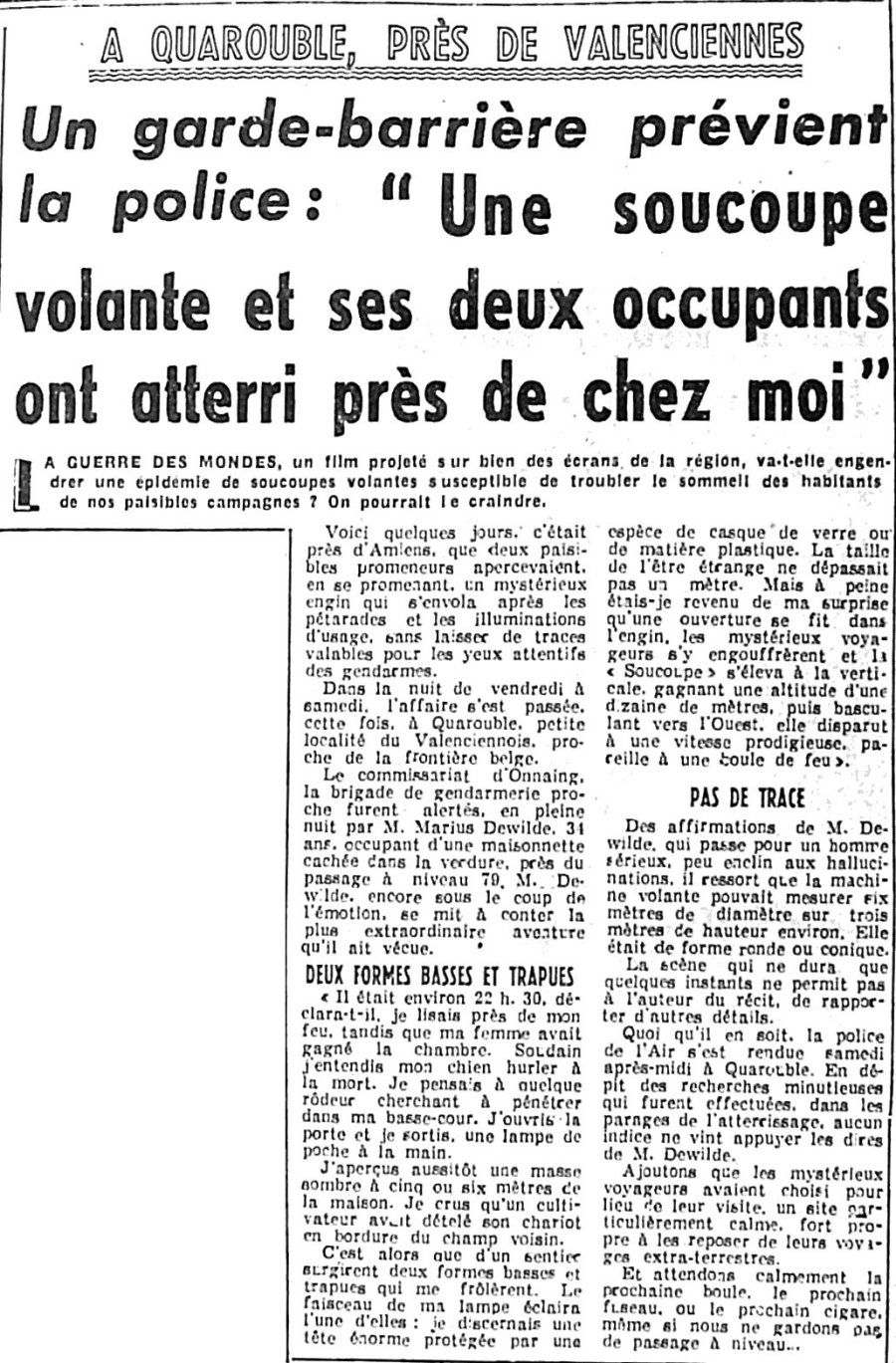
The case that opened the great French wave of autumn 1954, rebuilt from the newspapers of the Nord that printed it within thirty six hours, and from the one page gendarmerie report that surfaced in December 2025. The famous version, a green paralysing beam and sleepers crushed by a thirty tonne machine, is not what the earliest record says. Three separate inspections on the first day found nothing at all.
What did witnesses see at Level crossing 79?
Quarouble is a village of the Valenciennois, about eight kilometres from Valenciennes and close to the Belgian border. On the night of Friday 10 September 1954 Marius Dewilde, thirty four years old, a metalworker at the Ateliers du Nord de la France at Blanc-Misseron, was reading by the fire in a small house at level crossing 79, on a colliery railway running from Saint-Amand to Blanc-Misseron. His wife had gone up to bed with their three year old son. The house stood alone in fields and copses more than two kilometres from the village, with the track passing a few metres from the garden fence. At about half past ten his dog, Kiki, began to bark and then, in the phrase every paper repeated, to howl at death.
The fullest of the earliest accounts is his own, printed in La Voix du Nord on Sunday 12 September. "En ouvrant la porte, je ne vis rien tout d'abord, mais mon chien se tournant alternativement vers moi et vers la voie ferrée qui longe la maison, j'observais un peu plus attentivement. Je distinguais alors, posée sur la voie à quelques mètres de moi, une masse ovale en forme de dôme qui pouvait avoir environ six mètres de long et trois de haut. Je pensais qu'il s'agissait d'un chariot de récolte abandonné là par quelque cultivateur." The dog then barked in another direction. "Dans le faisceau, je vis parfaitement deux êtres étranges se dirigeant rapidement vers la masse sombre, distante de quatre à cinq mètres. Ils étaient petits, pas plus d'un mètre m'a-t-il semblé, et trapus. Ils avaient de grosses têtes sur lesquelles le rayon de ma lampe s'est réfléchi comme s'il s'agissait d'un globe de verre."
His first thought about the figures was not that they were visitors from anywhere. As he told Nord-Matin the same day, they came up a track the locals called the smugglers' path, and "tout de suite j'ai pensé à des contrebandiers ployant sous leur charge". Then, in La Voix du Nord, "je vis encore un carré de vive lumière s'ouvrir sur le flanc de l'engin. Effrayé cette fois, je fermais les yeux un instant. Lorsque je les rouvris, la lumière avait disparu, et la machine se balançant légèrement montait verticalement en dégageant de la fumée. Ayant une hauteur d'environ dix mètres, le dessous a rougi et l'appareil a disparu rapidement. Je n'ai entendu aucun bruit, sauf un soufflement au départ."
Read the state of that light carefully, because it is where the modern retelling parts company with the record. Nord-Matin, La Bourgogne Républicaine and Libre Artois all print the same sentence from him: "Une vive lumière m'a ébloui comme ferait un éclair de magnésium. Aveuglé, paralysé par la peur, j'ai vu la porte se refermer." Blinded by a flash like magnesium, and paralysed by fear. There is no green ray in the local papers of 12 September, there is no attempt to run round the fence and cut the figures off, and there is no beam that holds him where he stands. Those elements appear four days later, when the Paris press arrived. The whole thing, he told La Voix du Nord, had lasted barely more than fifteen seconds.
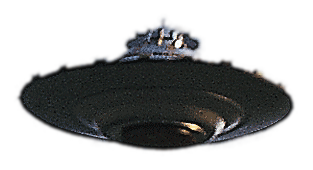
The object itself is described consistently across the first five newspapers: a dark mass the size of a harvest cart, oval or dome shaped, roughly six metres long by three metres high, round or perhaps conical. To France-Soir he later gave it "la forme d'une cloche à fromage, haute d'environ 3 mètres et d'un diamètre de 5 à 6 mètres". It rose swaying, like a helicopter in his later phrasing, put out thick dark smoke with a hiss, reddened underneath and went west toward Anzin, resembling a ball of fire.
Even the departure moved as the story was retold. On camera for the Pathe newsreel a few days later he told the reporter it had gone straight up "peut-etre 40 metres" and had left "dans la direction de l'est". Every local paper of 12 September has ten metres and westward, toward Anzin. That drift is small, it is easy to explain by a frightened man being asked the same question forty times in a week, and it is exactly the kind of thing this archive records rather than smooths over.
The beings were under a metre tall, very broad in the shoulder, with enormous heads that reflected his torch beam like glass or plastic, apparently in one piece suits like divers, with legs proportioned to their size and, in the version he gave France-Soir on 14 September, no visible arms. He was clear about the limits of what he saw. It was pitch dark, the whole thing lasted about fifteen seconds, and Nord-Matin published the sensible caveat in its own voice: the fear he felt "a tres certainement fausse ses appreciations, tant sur la taille que sur l'aspect des occupants", the more so because the night was particularly black.
What is the official explanation?
The response was fast, and it came from several directions at once. Dewilde woke his wife, then a neighbour, and set off on foot along the track to the gendarmerie at Blanc-Misseron, where nobody answered the bell. He told the story in a cafe that was still open and was sent on to Onnaing, more than five kilometres away by the Route Nationale 29, where he reached the commissariat around midnight. The two duty officers found him pale and terrified, judged the story too extravagant to wake their commissaire for, sent him home and telephoned the commissaire afterwards. Commissaire Gouchet, whose name several papers render as Grouchet, went to the site on the Saturday morning. Nord-Matin reported that he found in front of him "un homme tremblant de tous ses membres, souffrant de contractions intestinales qui écartaient l'hypothèse de la comédie".
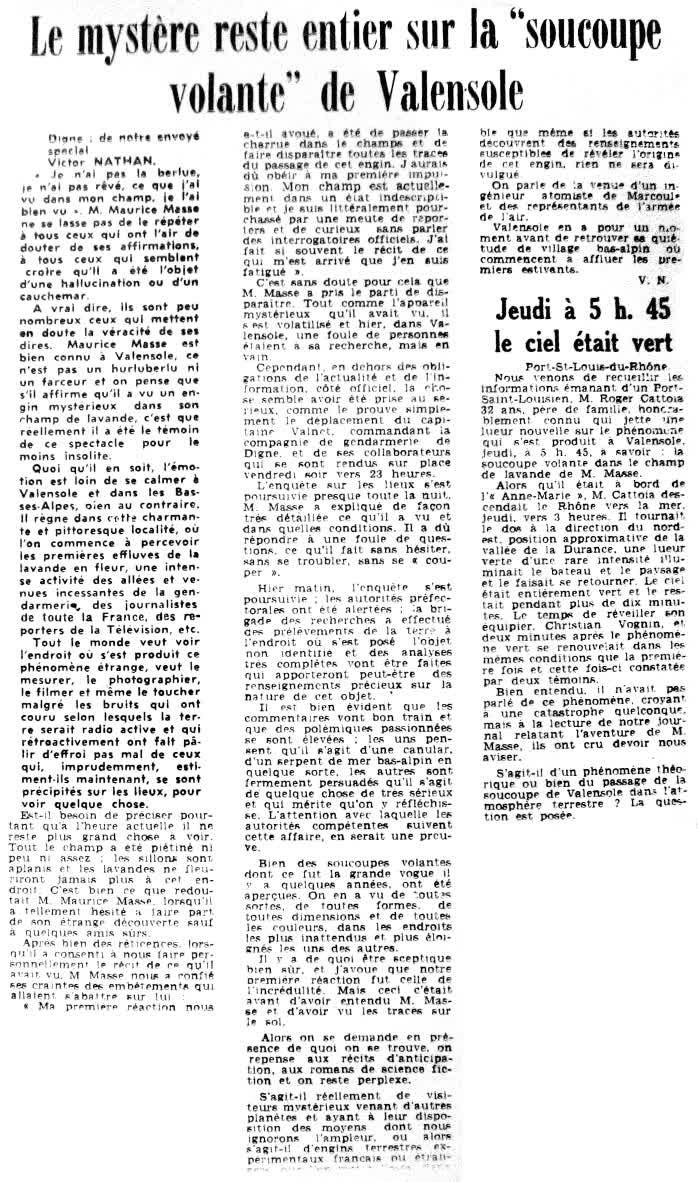
What happened next is the most important and least reported part of the case. On Saturday 11 September, Gouchet searched the site and, in the words of La Voix du Nord, "après de minutieuses recherches, il dut constater qu'il ne pouvait relever la moindre trace, tant sur le ballast que sur les rails ou dans les environs immédiats de l'habitation du témoin". In the afternoon the police de l'air came and searched too. Nord-Eclair of 12 September ran the result under the flat subheading PAS DE TRACE, reporting that despite minute searches around the supposed landing place "aucun indice ne vint appuyer les dires de M. Dewilde". La Croix du Nord and Nord-Matin printed the same thing, adding only that one piece of ballast looked freshly loosened and that no footprints could be found on ground trodden daily by cattle. A third inspection the same day produced nothing either: the researcher Dominique Caudron records that Monsieur Delvincourt, chef de voie for the SNCF, arrived at the site on his ordinary Saturday round, found the police there, and inspected the track as he did every week without noticing anything abnormal.
The marks appeared on the third day. Inspectors of the police de l'air returned on Monday 13 September, and France-Soir reported it in two stages. On 14 September, page 7, it recorded that a commissaire and an inspector had gone back to the site the previous day and had noticed that "des traverses portaient des marques de martèlement" and that the ballast stones were friable "comme si elles avaient été soumises à une haute température". The next day it led its front page with the harder claim: "Les inspecteurs de la police de l'air ont relevé des traces de béquilles sur les traverses." The measurements printed in that dispatch, filed from Valenciennes on 14 September, are the ones everything since has repeated. "En cinq endroits, le bois de la traverse est taraudé sur une surface d'environ quatre centimètres carrés. Ces marques ont toutes le même aspect et elles sont disposées d'une façon symétrique, sur une même ligne; trois d'entre elles, celles du milieu, sont séparées par un intervalle de 43 centimètres. Les deux dernières sont distantes des précédentes de 67 centimètres." One of the inspectors was quoted directly: "Un engin qui atterrirait sur des béquilles et non pas sur des roues comme nos avions ne laisserait pas d'autres traces."
The same France-Soir report of 14 September supplied its own caution in the very next sentence, and it has been almost entirely forgotten: "Mais ces quelques traces ne prouvent rien: les marques de martèlement peuvent avoir été faites par ces ouvriers de la voie posant des tire-fonds et le ballast est constitué par une sorte de mâchefer naturellement friable." In 1954, on the day the marks were first reported, the track workers' screw spikes and ordinary clinker ballast were already on the record as candidate causes of the two effects the case now rests on.
The inspectors who found the marks on the Monday are named in Dominique Caudron's dossier as Desmet, Lemaire and Montacq, and one detail of what they saw has been quietly dropped from every retelling since: there were wood chips lying beside the marks. Wood chips mean material removed, which is cutting, not crushing. A weight bearing down on a sleeper compresses the fibres, it does not produce shavings.
The apparatus that gathered at level crossing 79 over the following days was substantial: the Onnaing commissariat, the gendarmerie brigade of Quievrechain in whose territory Quarouble lay, inspectors of the police de l'air from Lille and from Paris, and the Direction de la Surveillance du Territoire. Ballast samples were taken by the DST and sent for analysis. The results were never published. Jacques Vallee recorded the local police chief's explanation that the body working with the air police answered to the Ministry of National Defence, and that the name of that ministry excluded any communication whatever. The first working hypothesis of the air police and of customs, according to Franc-Tireur of 16 September 1954, was not a spacecraft at all but smuggling by light aircraft, and Bigorne, a career customs inspector, has reported that the principal inspector who worked the file found nothing and that customs closed it as outside their competence.
There is one contemporary government document that survives and can be read. A Central Intelligence Agency FBIS digest, "Sightings of Unidentified Flying Objects, 31 July to 20 September 1954", date distributed 29 October 1954, carries a section headed "BELIEVE FLYING SAUCER PILOTS WERE SMUGGLERS" sourced to the Paris paper Franc-Tireur of 16 September 1954. It reports that the two landings of 10 September "are considered by the local air police to have been nothing more than the landing of planes used in smuggling", that in the Valenciennes case "the witness may have once been sincere, but it should be noted that he had a cranial traumatism one year ago and severe nervous disturbances since", and then adds the counterweight: "It is true, however, that in the latter case, the air police found four unusual marks on the railroad ties near the spot indicated by the witness, marks that could not have been made by the tools of railroad workers." Four marks, not five, in the American digest of the French press.
For seventy one years the French side of the official record was considered lost. No report by Commissaire Gouchet has ever been produced, researchers including the customs inspector and Lumieres Dans La Nuit investigator Jean-Marie Bigorne searched for it without success, and nothing surfaced from the DST. Caudron traced Gouchet's notes as far as the archives of the central commissariat at Valenciennes, the Onnaing station having since closed, and was given to understand that access would be very difficult.
Then, in December 2025, one piece of it came back. The makers of the documentary Quarouble 1954, three Valenciennois named Jordan Anatole, Remi Waquet and Sam Nolin, located the gendarmerie report of Quievrechain, described by France 3 Hauts-de-France on 19 December 2025 as an official and recently declassified piece of the investigation file running to a single page. What it contains matters more than its existence. Dewilde states in it that the marks on the sleepers were made by the unidentified flying machine. The gendarmes record a different hypothesis: "elles auraient pu être faites à l'aide de ciseaux à bois, comme des marques identiques et plus anciennes sur d'autres traverses, plus loin." They had found identical but older marks on other sleepers further down the line, and they proposed wood chisels. The report also notes in Dewilde "une tendance très nette à la mythomanie", and then, to its credit, immediately qualifies it: "Mais cela ne saurait être suffisant pour montrer si tout a été inventé."
That is the primary French document this case always lacked, and it does not read like a cover up. It reads like a rural brigade writing down what it thought, including its reservations about its own reservation.
One modern absence remains, and it is worth stating precisely. GEIPAN, the official French UAP unit inside CNES, has published almost all of its old cases for 1954. This archive queried its public case search for the whole of that year on 16 August 2026 and it returns twenty one cases, from Mers-el-Kebir in August to Temara in November. Not one of them is in the Nord, and not one of them is Quarouble. The most famous French landing report of the twentieth century has no file in the French government's own UAP archive.
What did the witnesses think it was?
Dewilde did not claim to have seen a flying saucer and he did not claim to have seen Martians. He said he saw a dark mass he took for a farm cart and two hurrying figures he took for smugglers, and that a light from the mass blinded him. The saucer and the Martians were supplied by the newspapers within four days. Nord-Eclair made the mechanism explicit in its own opening line on 12 September, before it had told the story at all: "LA GUERRE DES MONDES, un film projete sur bien des ecrans de la region, va-t-elle engendrer une epidemie de soucoupes volantes susceptible de troubler le sommeil des habitants de nos paisibles campagnes?"
The character testimony collected at the time was good. Nord-Matin: "Le Quaroublain est par ailleurs connu pour un sceptique, un dur disent ses amis. Et il est intelligent." La Bourgogne Republicaine: "Dans son quartier, M. Dewilde a la reputation d'un homme sobre et plein de bon sens." Several papers added that he passed for a serious man little given to hallucinations. Nord Littoral, alone, gave his age as twenty four rather than thirty four, and Le Courrier Picard put the crossing at number 97 rather than 79, which is a useful reminder of how much of the period reporting was copied at speed.
There were other witnesses that night, and they matter. At Onnaing, about two kilometres away, a young man named Edmond Auverlot and a retired man named Hublart saw a red glow crossing the sky at about half past ten, the hour Dewilde gave. At Vicq, three young people coming out of a dance saw the same light; Semaine du Monde photographed two of them, Robert Delhaye and Augustin Ravet. Nord-Eclair went further: "Plus de dix personnes ont declare avoir vu, ce soir la, aux environs de 22 h. 30, soit une boule de feu, soit un disque laissant echapper une trainee de feu dans le ciel. Tous les temoignages concordent pour affirmer que l'engin se dirigeait vers Anzin."
There is one more group of witnesses, and it is the most awkward fact in the whole file for the extraterrestrial reading. Claude Gaudeau and Jean-Louis Gouzien, in a 1981 study for the group I.R.A.M.E., recorded testimony from a former gamekeeper and his wife living nearby. The wife described two men calling at her door around noon the following day trying to sell cloth, one small and one bigger, dark complexioned, very broad in the shoulder, in long dark overcoats and bargee caps with rounded shiny peaks. A cousin's daughter had met the same two men that morning and thought they were the men from the saucer. Broad shoulders, and a peak that throws back a torch beam like glass.
What the affair did to Dewilde is part of the evidence. He was not enriched by it in any way that lasted. Nord-Matin said so plainly on 25 September 1954: "Ceux qui avaient pu croire M. Dewilde interesse devront abandonner ce prejuge favorable: la soucoupe de Quarouble lui coute cher. Il n'a pas fini de payer l'addition. C'est un argument en faveur de son temoignage." The Quaroublains called him Cacoule l'parisien and laughed at him, and by 19 October Liberte reported that he had thought of laying a complaint with the public prosecutor at Valenciennes over the sarcasm; he had to be talked out of it. L'Observateur of 29 September recorded that he was being accused of being "un visionnaire, un hurluberlu, un hallucine, voire meme un imposteur". The SNCF, learning from the national press that the crossing house was occupied by a man with no title to it, moved to evict him, and Radar quoted him on 17 October: "Songez que la S.N.C.F., decouvrant que j'occupais cette maison sans aucun titre, va m'expulser." He complained of three hundred letters a day and of tourist coaches. On 29 October Nord-Matin summed it up in a subheading: "M. Dewilde est devenu misanthrope."
The famous photograph of Dewilde carrying the marked sleeper away on his shoulder is a fake, and he said so himself, in writing, to Jean-Marie Bigorne: "En ce qui concerne la traverse que j'avais sur l'epaule, c'etait pour le folklore. Voici le fait: un journaliste de RADAR m'avait demande d'en porter une, ceci pour la photo. Les cercles representes avaient ete peints pour la circonstance, donc sans empreintes." A different sleeper, chalk circles painted on for the camera, no marks in it at all. That is a witness volunteering that a celebrated piece of the case's imagery was staged for a magazine, which is a point in his favour and a warning about everything else the press produced.
He reported a second encounter, and the archive has to correct two common errors here. It was not in 1955, and the date usually given is not securely sourced. It happened in October 1954, in broad daylight, and it began when his young son came in to say there was a car on the track. The only contemporary press notice is a short passage in Nord-Matin at the end of October, which gives no date at all, saying that the little men spoke to him in an unknown language, that similar but slightly wider marks were found on the sleepers, and that a few crushed blades of grass marked the spot. The date of 10 October comes solely from Marc Thirouin's investigation, made in September 1957 and published in the Ouranos review in 1959; Caudron argues 17 or 24 October are equally possible. Police confirmed on 19 November 1954 that Dewilde had made a second statement, and recorded that he and his family had decided, for fear of bad publicity, to say nothing more publicly. Thirouin's fuller version has five beings and a leader who walked to within three metres of him. The son, then three and a half, only ever remembered a car on the rails.
Nord-Matin's own reporter added a technical objection in that October article that has never been answered. All the impact points on the sleepers lay along the longitudinal axis of the wood. "Il est difficilement admissible qu'un aeronef se posant puisse se trouver avec une telle precision le centre d'un plateau aussi etroit. On aurait du relever des griffes sur les bords des pieces de bois."
After that the story kept growing, and it grew fastest in the company of ufologists. Dewilde gave an expanded interview to Jacques Lob in the magazine Imagine in 1975. By 1976 he was on Antenne 2 saying "c'est tout juste s'ils ne m'ont pas mis dans une maison de fous", and by 1977 French television was billing him as a contactee. In 1980 he published a book with Roger-Luc Mary, Ne Resistez Pas Aux Extraterrestres, prefaced by Jimmy Guieu, which added a metallic black box recovered from the site and seized by officers who promised him a large sum he never received, days of detention with injections and electric shocks, a lenticular craft shown to him inside a blockhouse by the sea, three cows found drained of blood, and a household telephone and torch batteries drained flat on the night. Two things have to be said about that book. Dewilde publicly disagreed with the finished text, which Mary had rewritten and padded with his own esoteric chapters. And Caudron's dossier records the flat contradiction at the heart of the material: the crossing house at PN 79 had no running water, no gas, no electricity and no telephone, so there was no household telephone to go dead and no television for his wife to watch, a point sourced to Claude Gaudeau and Jean-Louis Gouzien's 1981 study.
The rest of his life is not the life of a man who profited. He lost the job and the house, remarried, took odd jobs, went back to Tours in 1960 and drove for a living, and lost his right arm in a hunting accident in 1972. The civil register gives Marius Adolphe Dewilde, born 12 January 1921 at Maromme in the Seine-Maritime, died 1 October 1996 at Tours, and the academic treatment of the case by James Miller carries the same dates. He was seventy five. His son Serge, two and a half in 1954, appears in the 2025 documentary as its last surviving thread, and is not a witness to the first encounter.
Is the Quarouble Railway Landing: Marius Dewilde, Nord, France (10 September 1954) real? The two-pass assessment
PASS ONE. Could this be entirely ordinary?
Start with the chronology of the traces, because it is documented in the newspapers themselves and it is decisive. On Saturday 11 September three separate parties looked at the site: Commissaire Gouchet in the morning, the inspectors of the police de l'air in the afternoon, and Monsieur Delvincourt, the SNCF track chief, on his routine weekly inspection. All three found nothing. Five papers printed that result on 12 September, one of them under the heading PAS DE TRACE, and Var-Matin Republique repeated it on 13 September: "La police de l'Air s'est rendue sur les lieux mais aucune trace n'a ete relevee." The marks that made Quarouble famous appear on Monday 13 September, on the third day, after a Sunday, after forty eight hours of national publicity and after dozens of journalists had walked the ballast. Any account of this case that presents the sleeper indentations as evidence found by investigators on arrival is describing something that did not happen.
And the people who knew that track thought they were tool marks. Delvincourt, the man who inspected the line every week, later recalled two marks that looked to him like coups de bedane, chisel cuts. The gendarmes of Quievrechain wrote wood chisels into their report in 1954, and gave the reason: they had found identical but older marks on other sleepers further along the same line. That last clause is the strongest single piece of evidence in the case, in either direction, because it is a contemporary official observation that the marking was not unique to the landing site.
The most developed ordinary reading is Dominique Caudron's, a named French sceptic from the Nord who has published a long dossier, "L'etonnante confusion de Quarouble", last revised 30 April 2024. His method is to work only from sources closest to the event, the local dailies of 12 September and the account Gouchet himself gave Nord-Eclair on 16 September, and then to rebuild the scene photographically. He notes that in Thirouin's own record Dewilde heard a sliding door, that the mass was the size of a harvest cart with a profile like a cheese bell, and that a period delivery van, a fourgon, matches all three. He puts two men on the smugglers' path carrying a load and trying not to be seen, an accomplice in the vehicle who shone a powerful torch at the man who had surprised them, a diesel engine that smoked, a body that rocked as it drove over the sleepers, and rear lights that reddened as it took the cart track. He reconstructs the view by inserting a Renault fourgon at the correct perspective into the press photograph of Madame Dewilde pointing out the spot. He argues that the one element that cannot be a van, the rise to about ten metres, is a perceptual bridge the brain builds between two real images, the van vanishing at ground level and a bright object appearing at treetop height, and he points out that the bolide reported that evening by more than ten people, all agreeing it travelled toward Anzin, is exactly the object ufology has always counted as independent corroboration of Dewilde. He shows his working elsewhere too. He relocates PN 79 to 50 degrees 24 minutes 24 seconds north, 3 degrees 38 minutes 13 seconds east by matching 1959 IGN mapping at 1 to 25,000 against period photographs. He dates the demolition of the cottage from the IGN aerial series of 1951, 1957 and 1963, standing in May 1957 and gone by February 1963, which disposes of Dewilde's later claim that the SNCF razed it a fortnight after he left. He even dates Thirouin's site visit by photogrammetry, deriving a solar altitude of about 22 degrees and an azimuth of about 250 degrees from the shadow of an isolated tree in Thirouin's own photograph and concluding the visit was made on 10 September 1957, the third anniversary. And for the height of the beings he does the arithmetic instead of asserting: fifteen centimetres of embankment drop, a fence of 1.30 metres, five centimetres for a stooped posture and ten to twenty centimetres of head showing above the fence gives men of 1.60 to 1.70 metres, not eighty centimetres. Commissaire Gouchet had reached the same place by experiment in 1954, putting a policeman in a padded overall to walk half bent behind the same fence, at which point he too appeared not to exceed a metre and to be very broad in the shoulder.
This is a reconstruction, not an identification. Caudron never names the van, the men or the meteor, he has never found a scientific catalogue entry for a bolide over northern France that evening, and he says so himself. That is the honest limit of his case. But it is worked, it is sourced to the earliest documents, it makes falsifiable claims, and it accounts for the whole sequence rather than one piece of it.
The second serious line is documentary genealogy. Jean Giraud, a veteran French ufologist who founded Group 03100 and worked for Lumieres Dans La Nuit, published a study in 2024 tracing where the famous details entered the record. His finding is that the green paralysing ray, the intention to intercept the beings, the craft resting on supports, the divers' suits and the mysterious traces all appear together for the first time in Samedi-Soir of 14 September 1954, in an article headlined as the great Martian hoax, and that Dewilde had said the opposite of several of them. Giraud counts only four articles, out of dozens he collected, written by journalists who actually went to Quarouble and signed their copy. He also records that the traces multiplied in the telling, from five to seven and eventually to fifteen or eighteen. Caudron adds a plausible route for the accretion to return as memory: Marc Thirouin sent Dewilde a copy of Jimmy Guieu's book, so Dewilde may have read back to himself a detail a Paris journalist had invented.
Now the thirty tonnes, which is the most quoted number in the case and the least examined. It appears in no newspaper of September 1954. It enters the literature in Aime Michel's Mysterieux Objets Celestes in 1958, at pages 64 to 69, credited to railway specialists consulted by the investigators. Michel adds a sentence that should have ended the number's career and instead was never quoted again: he had only learned of this capital point two years after the event. No name, no method, no indication that anyone went to the site. Every later citation, Vallee, Michel Carrouges, Gordon Creighton, Peter Rogerson, Ted Phillips, Richard Hall, traces back to Michel, and Vallee says so explicitly. No calculation has ever been published: no wood species or density, no penetration depth, no bearing model, no contact area beyond France-Soir's "about four square centimetres". Nobody re-measured anything. The sleeper was never lifted for analysis; Delvincourt, asked whether the SNCF took it away, laughed and said it never moved from the track, and it stayed there until the disused line was pulled up around 1971. And there is one more thing about the thirty tonnes that the ufological literature has managed not to repeat for sixty five years. It was tested, on site, by a believer, and it failed.
Marc Thirouin directed the Ouranos group and was wholly sympathetic to Dewilde. His investigation ran in two parts, Ouranos number 24 in 1959 under the title Marius Dewilde did not lie, and Ouranos number 25 in 1960 under the title the Quarouble craft. The second part carries the only physical measurement of the marks that anyone has ever published. Thirouin counted ten marks across four sleepers, each about 35 millimetres long and between 5 and 10 millimetres deep, cut at 45 degrees at one end and vertically at the other, with wood flakes still weakly attached and sitting flush with the surface. That last detail is the one that matters, and he saw immediately what it meant. If the wood had been crushed downward by an enormous weight, the surrounding surface would be depressed and the flakes could not lie flush. What he was looking at was material that had been torn out. His own words, footnoted to Michel at page 69, ask how such experts could seriously speak of pressure on the sleepers when what lay in front of him was on the contrary the trace of a tearing away, and he adds that the hollow is not an impact but a loss of matter.
Thirouin then drew the conclusion his own side did not want. If the marks are anchor points that were ripped free, the craft was not heavy but very light, and he observes that a thirty tonne disc under gravitic equilibrium would have torn such anchorages out after a few seconds of moderate traction. So the sole on-site examination of the famous impressions, conducted by a man who titled his report Marius Dewilde did not lie, measured them and concluded they were the opposite of what the thirty tonne figure requires. Michel's number, learned second hand two years late and given only in substance, has been quoted ever since. Thirouin's measurement, taken with his own hands and published in a journal that believed the witness, has not.
That same relationship is the source of the case's worst contamination problem, and it is worth stating plainly. Thirouin sent Dewilde a copy of Jimmy Guieu's Black Out sur les Soucoupes Volantes at Dewilde's own insistence. After that, details began appearing in Dewilde's account that are in Guieu's book but are absent from his own 1954 statements, including the green tinted paralysing beam and the divers' suits in place of the loose overalls he first described. A witness who has been handed the literature about himself is no longer a clean witness, however honest he is, and every later version of this story has to be read with that in mind.
Set against that, the ordinary candidates are strong. A colliery train ran that route daily. Sleepers are struck and bored for tire-fonds as routine maintenance, and the police de l'air put that in print on 14 September. There were wood chips beside the marks. The gendarmerie found identical older marks further down the line. The track chief called them chisel cuts, the gendarmes called them chisel cuts, and Caudron, who has looked at the close photographs, calls them chisel cuts. His objection to the screw spike version is worth keeping too, because it shows he is not simply reaching for any ordinary answer: since when, he asks, does anyone put tire-fonds in the middle of a sleeper? The strongest evidential element in the case therefore rests on a figure whose own author admitted he heard it two years late, describing marks that no independent party ever measured, found on the third day, and read as tool work by every railwayman and gendarme who saw them.
Hoax and publicity motive have to be weighed both ways, and the archive's rule that witnesses are not on trial applies with force here. Dewilde gained nothing durable and lost his home; he was mocked in his own village and considered suing over it; Nord-Matin wrote in September 1954 that the saucer was costing him dear and treated that as an argument for his testimony; and Marc Thirouin, a believer, says he specifically investigated whether the statements were driven by profit or publicity and found deliberate mystification practically inconceivable. Against that, the marks appeared only once the story risked collapsing for want of evidence, and he was a man under a police residence order who had an obvious interest in not being taken for a liar by the police. The hostile character material has to be handled honestly rather than either suppressed or relied on. Almost all of it is village opinion about a resented outsider, reported second hand: an incomer from Paris, from a fairground family, known to the gendarmes as a brawler, nicknamed Cacoule l'parisien. None of it is first person named testimony and none of it is evidence about the night of 10 September. The one piece of hard character evidence, the gendarmerie's own "tendance tres nette a la mythomanie", comes with the gendarmes' own caveat attached and is quoted here with it.
Finally, priming. This is a textbook flap contagion setting, and the period press said so at the time rather than being told so decades later. La Guerre des Mondes had played at the Noveac cinema in Valenciennes the previous week, and Nord-Eclair named the film in the opening sentence of the first report ever published on the case. A landing had been reported near Amiens three days earlier. Paris-Match had announced in May 1954, on Aime Michel's own authority, that the summer would be fertile in saucers. On 15 September, in a signed piece in L'Aurore, Robert Cusin wrote that the air police ought to be made to read Wells and to watch the extravagant film Hollywood had made of the novel, from which the Quarouble witness had plainly drawn the essentials of his interesting vision. Franc-Tireur of 16 September reported that many of the crossing keeper's neighbours had remained sceptical throughout and regretted that unbridled publicity had been given to statements it called far too obviously inspired by the classics of science fiction. Within four days of Quarouble, a Correze farmer said a saucer pilot had embraced him. This is the wave-level argument made at book length by Gerard Barthel and Jacques Brucker in La grande peur martienne in 1979, and treated academically by James Miller in his chapter on Quarouble in Imagining Outer Space in 2012, which reads the encounter through the anxieties of a France losing an empire. The medical point raised at the time belongs here too, handled carefully: Dewilde had suffered a cranial trauma at work about a year before with lasting nervous effects, which the French press and the CIA digest both recorded, and which the papers used to float a waking hallucination. This archive does not treat a head injury as a licence to erase a witness, and Caudron uses it economically, to explain a freeze and tingling rather than a true paralysis. The tingling Dewilde described is a nervous sign, not a paralysis; a paralysed man falls over.
PASS TWO. If something real happened, what was it?
Something happened. A man walked several kilometres in the dark to fetch police, was recorded by two duty officers as pale and frightened, and was found the next morning by a commissaire who ruled out play acting on the strength of his physical state. His earliest account is modest, internally consistent and free of the mythology: no saucer, no Martians, no green ray. Whatever the source, the reaction was genuine and it was immediate. The response was also independent and quick by any standard: the local commissariat, the Quievrechain gendarmerie, the police de l'air from Lille and Paris and the DST were all on a colliery siding in the Nord within days.
The lights are real reports too. Auverlot and Hublart at Onnaing, Delhaye and Ravet and the others at Vicq, and more than ten people in all describing a fireball or a disc trailing fire heading toward Anzin at about the same minute. If Caudron is right, they saw a bolide, and a bolide over the Valenciennois at 22:30 on 10 September 1954 is itself an event nobody has ever tied to a meteor catalogue. It explains the corroboration; it does not make the corroboration imaginary.
The official conduct belongs in this pass, not against the witness. The DST took ballast samples and the analyses were never published; the local police chief said the responsible body reported to the Ministry of National Defence and would not communicate; Gouchet's report is still sitting somewhere in the Valenciennes commissariat archives behind a door researchers have not been able to open. Under this archive's standing rule, an official apparatus closing a case tightly is logged as evidence the case was real enough to need closing, never as a mark against it. But it has to be logged accurately, and the one French document that did come back does not support a cover up reading. The Quievrechain gendarmerie report is a single page of a rural brigade writing that the witness showed a marked tendency to mythomania, that the marks looked like chisel work because there were older identical ones down the line, and that none of this was enough to show the whole thing was invented. That is a police unit reasoning in public view, seventy one years late. The other absence is simply institutional: GEIPAN's public archive, which has published almost all its old 1954 cases, holds twenty one of them and not one is in the Nord, so the French state's own modern UAP unit has never assessed the most famous French landing report of the century.
The serious French investigators split, and their reasons are instructive. Marc Thirouin, who conducted the first proper investigation for Ouranos in 1957 and published it in 1959, was a jurist rather than a scientist, and his question was not what happened but whether the witness could be trusted; he concluded that he could. Aime Michel gave the case eight pages in 1958 and made it a pillar of his straight line alignments, but according to Giraud he never interviewed Dewilde or verified a fact, assembling the account from press cuttings. Michel Carrouges in 1963 then praised the coherence of a narrative that was Michel's, not the witness's. Jacques Vallee, who catalogued the event as case 144 of his century of landings, was the most careful of them. Writing in Flying Saucer Review in 1964 he allowed that few students of the phenomenon who were in France when the Quarouble psychosis developed doubted that Marius Dewilde had seen something, and then drew the line exactly where it belongs: whether he really saw a craft and two pilots, or a classic phenomenon under unusual circumstances, was another question entirely, and to settle it one would need a full psychological description of the witness, which to his knowledge had never been made.
TIER: Barely Disputed, and close to the top of that band. Named analysts have advanced specific counter-explanations and shown their methods. Dominique Caudron has a photographic reconstruction, a photogrammetric dating, a height calculation and a documented chronology in which no trace existed for two days; Jean Giraud has a genealogy putting the case's celebrated details in a single Paris article of 14 September 1954; and since December 2025 there is an official 1954 gendarmerie document that independently reaches the chisel reading and gives its reason. That is a great deal more than an official assertion, and this page states it plainly. It still does not reach Strongly Disputed under this archive's rules, because there is no confession, no recantation, no recovered prop, and no positive identification of a specific vehicle, a specific pair of men or a specific meteor. Caudron's van is a model, not a licence plate. What can be said with confidence is narrower and more useful than either camp usually allows. The Quarouble of ufology, a thirty tonne craft on legs, a green beam that froze a man where he stood and sleepers crushed by an unearthly weight, is substantially a construction of the September 1954 press and of Aime Michel's 1958 retelling. The small, strange, badly lit fifteen seconds that Marius Dewilde described to a policeman at midnight on 11 September remains unresolved, and the documents that might have resolved it were never released and can no longer be found.
Why this case matters more than its own evidence, which is the part the ufological literature and the debunkers both tend to skip. Quarouble is not merely an early case in the 1954 wave. The serious French literature identifies it as the thing that started it. Jacques Scornaux, a founding member of SOBEPS and later president of SCEAU, sets out the general structure in his 2009 essay on the sociopsychological hypothesis: a wave begins with one particularly striking observation that the media carry heavily, after which people in the area covered by those media watch the sky more attentively and interpret more of what they see as a UFO, the press reports those new cases in turn, and the thing snowballs until media and public tire of it. He names three examples, and the French one is this: the 1954 wave took off after the heavily publicised observation of humanoids at Quarouble.
There is documentary evidence that this is what actually happened, and it is unusually direct. Frederic Dumerchat, writing in the review Ovni-Presence in January 1987, reconstructed a 3 October 1954 humanoid encounter at Bressuire in the Deux-Sevres, tracked down the witness's son, and established from him that his father had invented the story to pull his abattoir workmates' legs. The valuable part is what Dumerchat did next. He went back through the local edition of La Nouvelle Republique du Centre-Ouest, the paper the hoaxer actually read, and listed what it had fed him in the preceding three weeks. Dewilde's adventure ran on 13 September on page two and again on 16 September on page one with a photograph, describing a craft and two beings of human appearance, no more than a metre tall, and wearing diving suits. Then came Antoine Mazaud on 15, 16 and 17 September, then Yves David on 29 September, then, on 2 October, the day before the invented encounter, a small man in a coverall with a diver's helmet at Marcilly-sur-Vienne. The little French divers of 1954 were in the regional press, in sequence, before the hoaxer produced his own.
So the honest way to hold this case is that its influence is established even where its facts are not. Whatever Marius Dewilde saw at the crossing on 10 September, the account of it that reached print, complete with the diving suits he had not originally described, is demonstrably part of what the next several weeks of French witnesses had in their heads. That is a real historical finding, and it does not require deciding whether he was truthful.
Sources
- ufologie.patrickgross.org/1954/10sep1954quaroublef.htm
- ufologie.patrickgross.org/1954/10sep1954quarouble.htm
- ufologie.patrickgross.org/1954/10sep1954onnaingf.htm
- ufologie.patrickgross.org/1954/10oct1954quaroublef.htm
- oncle-dom.fr/paranormal/ovni/confusions/bolides/quarouble/quarouble.htm
- ufologie.patrickgross.org/1954/pics/nordeclair12sep1954.jpg
- ufologie.patrickgross.org/1954/pics/francesoir14sep1954p7.jpg
- ufologie.patrickgross.org/1954/pics/francesoir14sep1954p1.jpg
- ufologie.patrickgross.org/1954/pics/cia-fbis-29oct1954-01.jpg
- ufologie.patrickgross.org/1954/pics/cia-fbis-29oct1954-09.jpg
- www.cnes-geipan.fr/fr/actualites/poursuite-publication-1954
- www.cnes-geipan.fr/fr/recherche/cas?field_date_d_observation_value%5Bmin%5D=1954-01-01&field_date_d_observation_value%5Bmax%5D=1954-12-31
- france3-regions.franceinfo.fr/hauts-de-france/nord-0/valenciennes/il-a-vu-un-ovni-et-des-extraterrestres-en-1954-la-celebre-affaire-marius-dewilde-ressuscitee-dans-un-documentaire-inedit-3264173.html
- quarouble1954.com
- link.springer.com/chapter/10.1057/9780230361362_13
- ufo-scepticisme.forumactif.com/t4131-l-affaire-dewilde-quarouble
- www.openarchieven.nl/ins:0a271c68-f107-8146-c69d-6f3c8c342fb9/fr
- ufologie.patrickgross.org/1954/pics/francesoir15sep1954p1.jpg
- www.lobservateur.fr/valenciennes-folle-enquete-affaires-ovni/
- archive.org/details/Ouranos_No_25_1960
- archive.org/details/Ouranos_No_24_1959
- archive.org/details/Ouranos_No_12_4e_trim_1954
- oncle-dom.fr/paranormal/ovni/confusions/bolides/quarouble/moc.htm
- web.archive.org/web/20160303184752id_/http://scepticismescientifique.blogspot.com/2009/08/lhypothese-sociopsychologique-ce-quelle.html
- archive.org/download/Ovni_Presence_No_36/Ovni_Presence_No_36_djvu.txt
- oncle-dom.fr/paranormal/ovni/confusions/lune/3_octobre/3_octobre_1954.htm
More cases from this region: UFO sightings in France