Unidentified Aircraft over RAAF Base Williamtown and the Defence Files Released About Them
Objects nobody has ever identified flew over Australia's front line fighter base for three nights, and the paragraph saying what commanders were told to do about it is blacked out.
What did witnesses see at RAAF Base Williamtown (YWLM)?
Unidentified aircraft flew over RAAF Base Williamtown in New South Wales on three consecutive nights in July 2026. Australian Defence records of the incursions were released in redacted form three months later.
Williamtown, ICAO code YWLM, is the main operating base of Australia's air combat capability. It hosts Headquarters Air Combat Group, the F-35A Lightning II fleet and the E-7A Wedgetail airborne early warning aircraft, and it shares its runways with the civil Newcastle Airport. The confirmation that something unauthorised was over it comes from the Department of Defence's own internal email, released under Freedom of Information and read for this case file in the original.
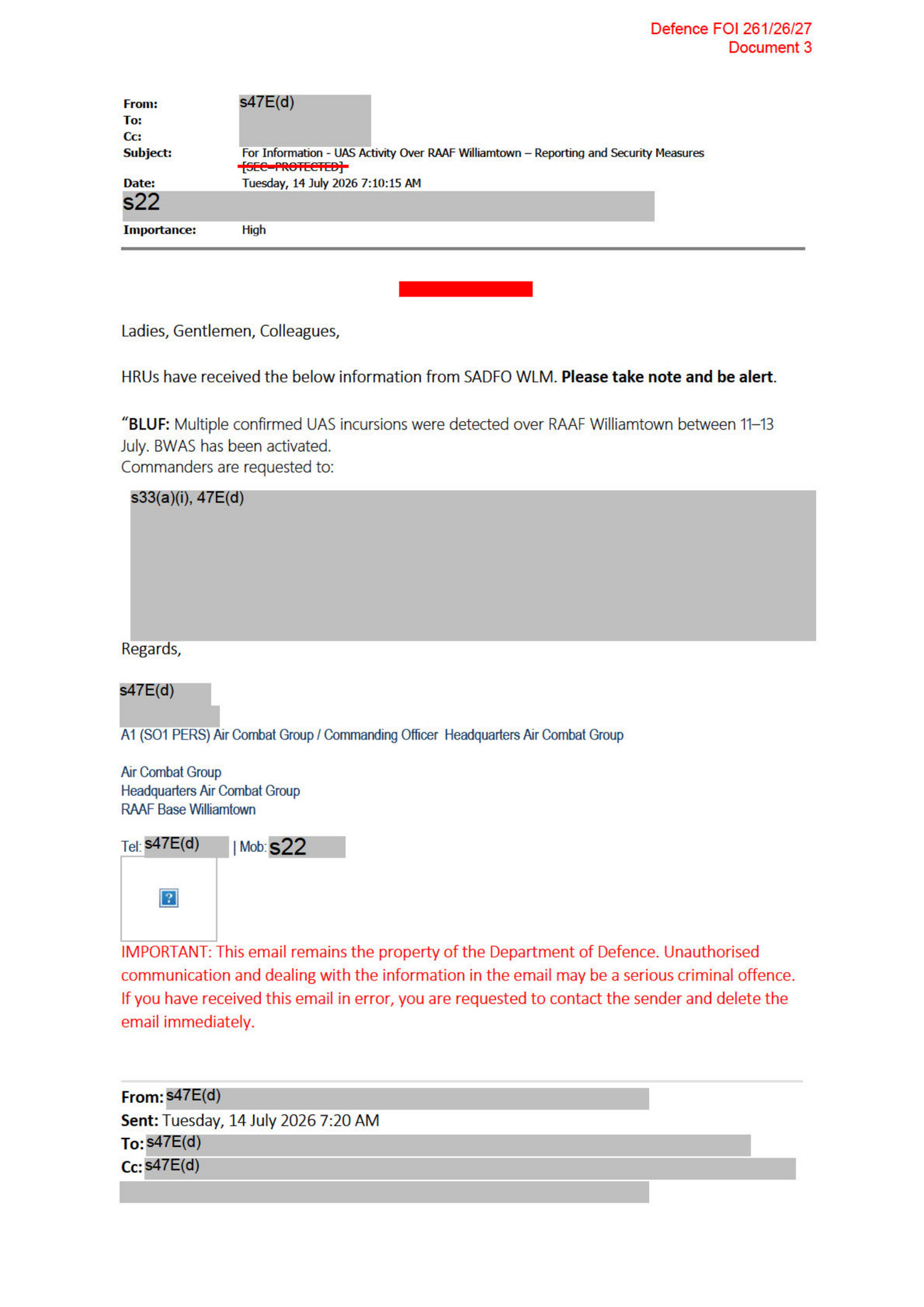
Document 3 of the release is an email of Tuesday, 14 July 2026, timestamped 7:10:15 AM and flagged importance high, subject "For Information - UAS Activity Over RAAF Williamtown - Reporting and Security Measures". Its sender block identifies A1 (SO1 PERS) Air Combat Group and the Commanding Officer, Headquarters Air Combat Group, at RAAF Base Williamtown. It opens "Ladies, Gentlemen, Colleagues," and continues "HRUs have received the below information from SADFO WLM. Please take note and be alert." The quoted passage then reads in full:
"BLUF: Multiple confirmed UAS incursions were detected over RAAF Williamtown between 11-13 July. BWAS has been activated. Commanders are requested to:"
The list that follows that colon is withheld in its entirety under sections 33(a)(i) and 47E(d). BLUF is bottom line up front; BWAS is the Base Warning and Alert System, named in the document itself as having been activated.
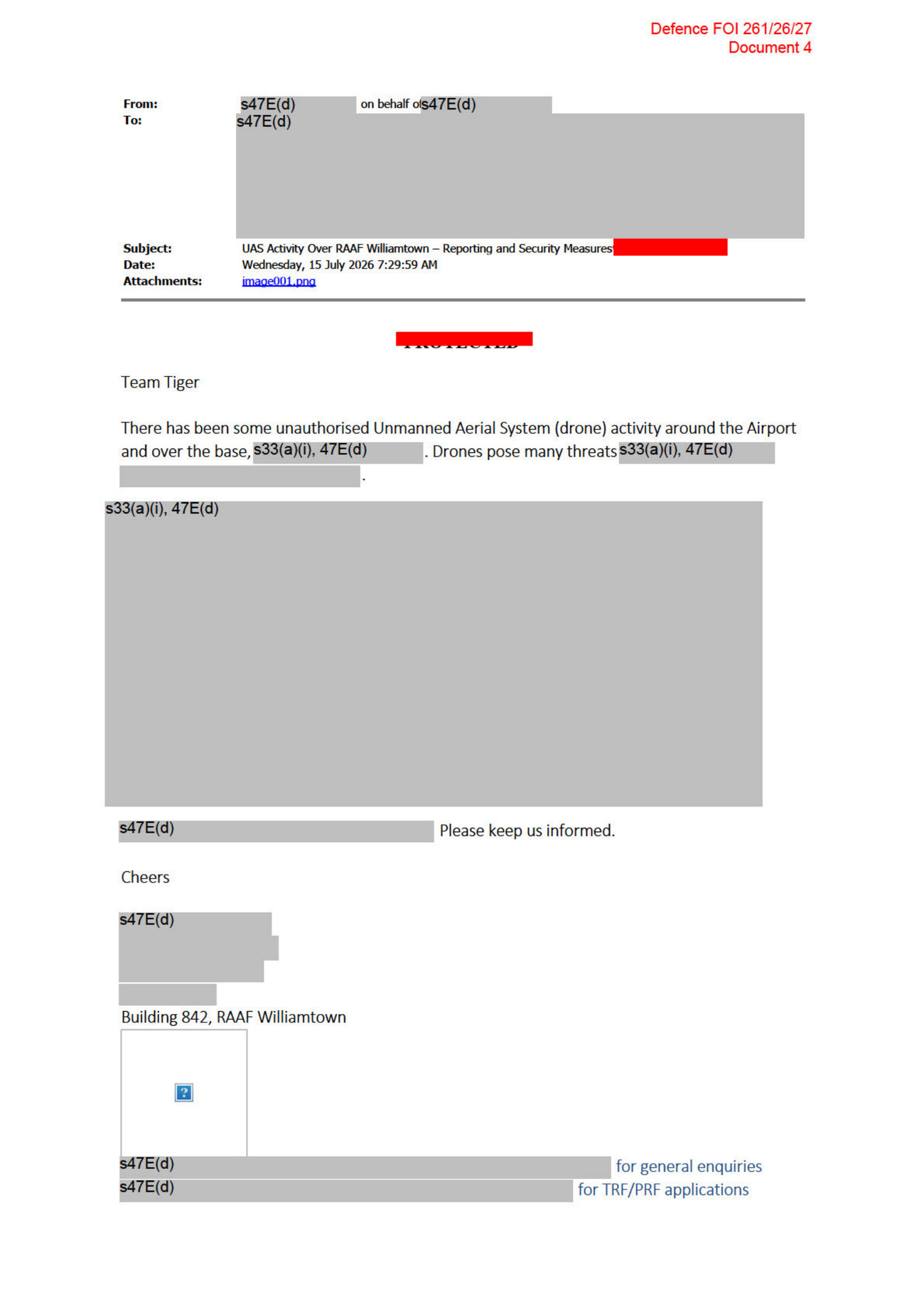
Document 4 is a second email, Wednesday, 15 July 2026 at 7:29:59 AM, same subject line, carrying one attachment. It is addressed to "Team Tiger" and begins: "There has been some unauthorised Unmanned Aerial System (drone) activity around the Airport and over the base," followed by a redaction, then "Drones pose many threats" followed by a further redaction, then a large withheld block. What survives after it is the phrase "Please keep us informed." and the signature line "Building 842, RAAF Williamtown".
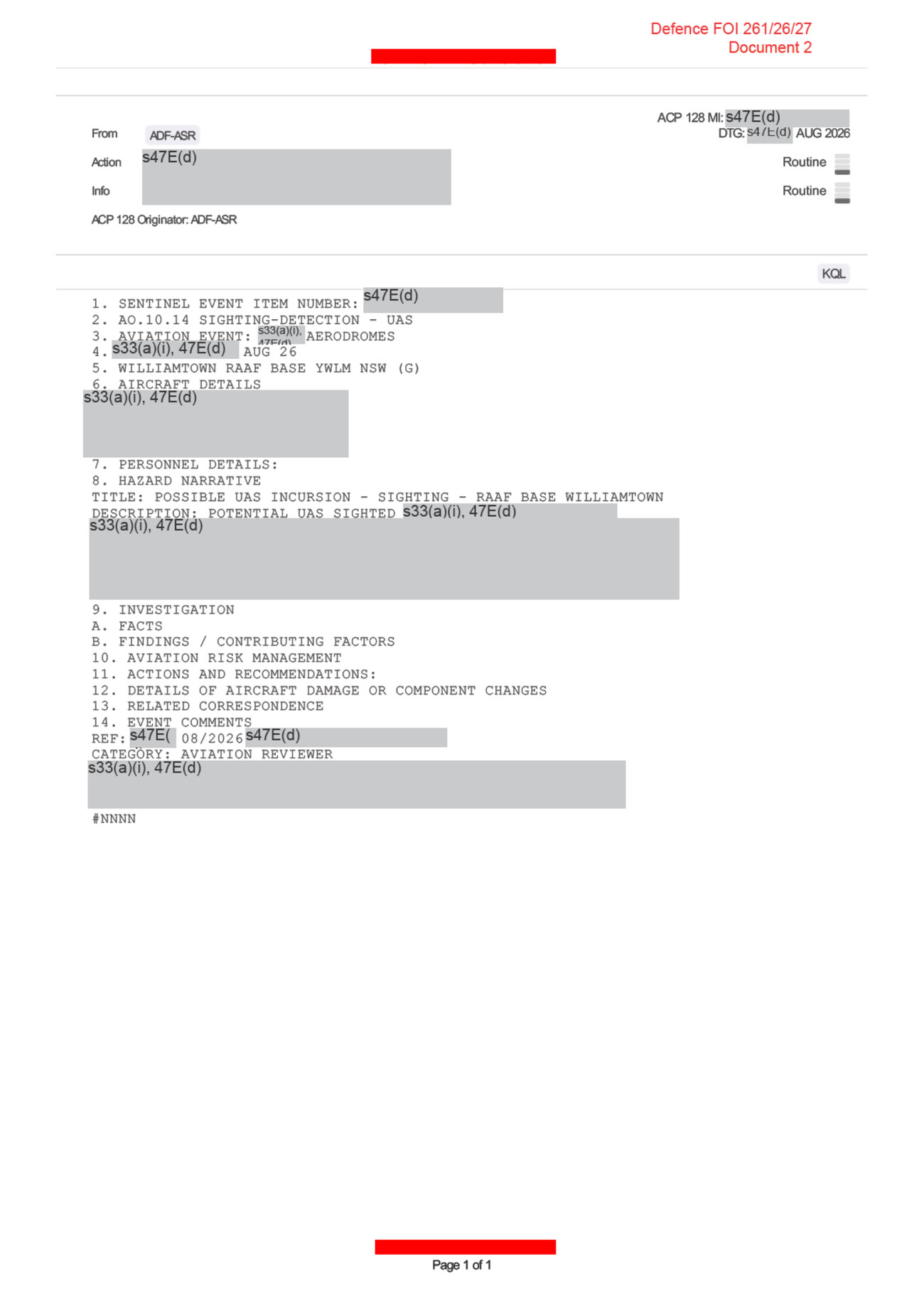
Document 2 is the most structured record in the release and the one that puts the events in Australia's formal aviation safety system. It is an ADF Aviation Safety Report transmitted in ACP 128 message format, originator ADF-ASR, date time group redacted but dated August 2026. Its numbered fields read, in part: "2. AO.10.14 SIGHTING-DETECTION - UAS", "5. WILLIAMTOWN RAAF BASE YWLM NSW (G)", and under "8. HAZARD NARRATIVE" the title "POSSIBLE UAS INCURSION - SIGHTING - RAAF BASE WILLIAMTOWN" and the description "POTENTIAL UAS SIGHTED" followed immediately by redaction. The headings for sections 9 through 14, covering investigation, facts, findings and contributing factors, aviation risk management, actions and recommendations, aircraft damage, related correspondence and event comments, appear on the page with no content beneath them.
More footage and images of this sighting
What is the official explanation?
The release is Defence FOI 0261/26/27. The request was made by Grant Lavac, a Melbourne based researcher, and received by the Department of Defence on 11 August 2026. It sought incident reports and operational logs on the detection and tracking of the drones, internal emails and briefing memos to base commanders, correspondence with the NSW Police Force including its Counter-UAS Unit, damage and intelligence assessments, and correspondence involving the Air Commander Australia.
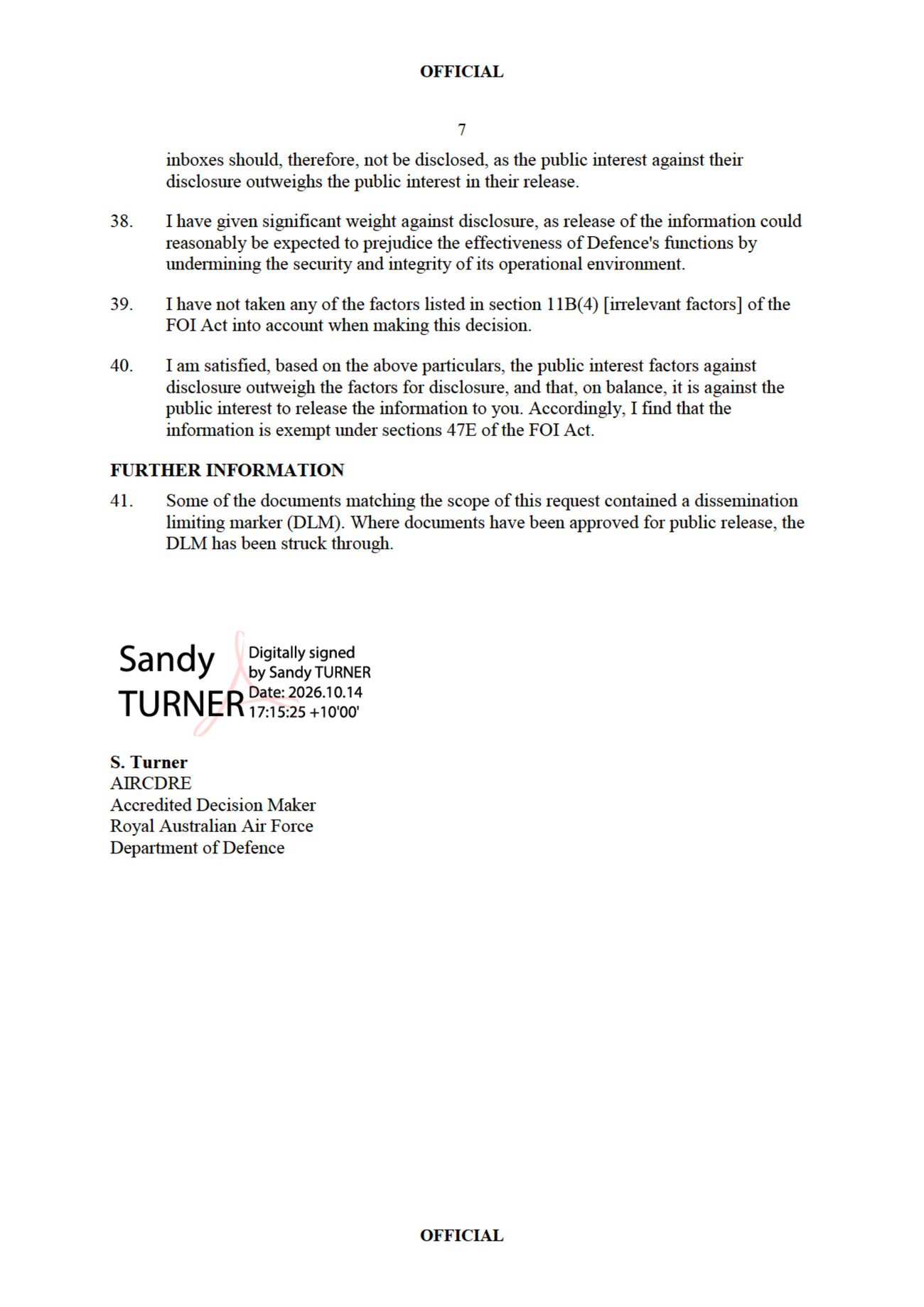
Defence extended its deadline twice with the applicant's written agreement under section 15AA, from 10 September to 20 September and then to 10 October 2026. The decision was signed by S. Turner, Air Commodore, Accredited Decision Maker, Royal Australian Air Force, digitally timestamped 14 October 2026 at 17:15:25 Australian Eastern Standard Time.
Five documents were identified as within scope. Two were refused in full, an email of 3 August 2026 and an email of 13 July 2026, on the ground that they "would be meaningless and of little or no value once the exempt material is removed". Three were released in part. The withholding rests on section 33, documents affecting national security, defence or international relations, and section 47E, conditional exemptions covering certain operations of agencies.
The reasoning is quoted here because it is the most revealing passage Defence published. Air Commodore Turner wrote that "the exempt material contains sensitive information regarding the operations and capability of the RAAF and could potentially allow adversaries with hostile intentions to exploit Australian Defence Force capabilities. If such documents were disclosed, this could reasonably lead to Nation States not allied with Australia, to take steps or devote resources to counter and exploit any weaknesses inferred from the information contained, causing damage to the security of the Commonwealth." She invoked the mosaic theory explicitly, the principle that individual pieces of information combined with what is already public can form a damaging composite, and recorded that she was satisfied disclosure "would provide insight into Defence's methods for detecting, assessing and responding to potential security threats".
One paragraph of the decision cuts directly against how the release has been read since, and it is reproduced here for that reason. At paragraph 39 the decision maker states: "I have not taken any of the factors listed in section 11B(4) [irrelevant factors] of the FOI Act into account when making this decision." Section 11B(4) is the provision that forbids withholding information merely because its release could embarrass the Commonwealth. An express statement is not proof, but it is on the record and any argument that the redactions exist to avoid embarrassment has to contend with it.
No object, operator, launch point or recovery was ever identified in anything Defence has published.
What did the witnesses think it was?
There are no named eyewitnesses in the released record. Every personal name, email address and telephone number in all three documents is redacted under section 47E(d), so the people who saw the objects, the people who wrote about them and the people who were told to act are all anonymous on the page. What survives is institutional: a headquarters, a squadron appointment, a building number and a base.
The account that reached the public first did not come through Defence at all. The incursions were reported by 7NEWS, whose Sunrise programme broadcast the story under the headline that Australia must assume the worst after a drone breach at the country's top fighter jet base. Through that coverage, and in the article that brought the FOI release to this archive's attention, the Shadow Minister for Defence Industry and Personnel, Phillip Thompson, is reported as saying that Williamtown personnel observed a swarm of up to twenty drones near the base's northern gate, and that Defence personnel contacted him directly, frustrated that the operational direction amounted to closing the blinds.
That detail requires care, because it is the one most likely to be misattributed. The instruction to close window blinds is not in the released documents. The applicant's own FOI request asked specifically for the memo containing it, and whatever the answer was, it sits inside the block withheld after "Commanders are requested to:". The blinds claim originates in the broadcast reporting and the Shadow Minister's account, not in the Defence file, and this archive records it as their claim rather than as a document fact.
The Minister for Defence Industry, Pat Conroy, addressed the incursions in a radio interview with ABC Newcastle on 10 August 2026, in which he is reported to have pointed to counter drone investment under Project LAND 156 and to regulations permitting personnel to disable unauthorised drones, while declining to say whether any defensive action was taken at Williamtown, and to have said the matter was referred to the NSW Police Force. The archive flags a limit on this: both minister.defence.gov.au and airforce.gov.au were unreachable from this environment, returning connection failures rather than error pages on every attempt, although their DNS resolves normally. The transcript was therefore not read here, and the account of it above is carried as the reporting's characterisation and not as a verified quotation.
Is the Unidentified Aircraft over RAAF Base Williamtown and the Defence Files Released About Them real? The two-pass assessment
Pass one, how could this be mundane. It very likely is, in the narrow sense. Defence calls these objects unmanned aircraft systems throughout, the aviation safety report classifies the occurrence as a UAS sighting, and consumer and commercial drones fly near Australian airfields constantly. The base shares its runways with a civil airport, which puts a large volume of legitimate and illegitimate drone traffic in the same airspace. Nothing in the released file describes anomalous flight performance, and this archive is not going to invent any. There is no reported radar track, no reported speed, no reported shape, no reported altitude, because every one of those fields is redacted or absent.
That is the point of the case rather than an objection to it. These objects are unidentified in the ordinary and literal sense. They were detected over a fifth generation fighter base on three consecutive nights, they triggered a base wide alert system, they generated a formal aviation hazard report, they were referred to civil police, and the investigation closed without an operator being identified or a platform being recovered. Defence's own chosen label, UAS, is a description of what the objects were presumed to be and not a finding about what they were. This archive files them as unidentified because no document says otherwise.
Pass two, if real, what is it. The honest answer is that the released record cannot support any characterisation at all, and the reason is worth stating precisely. The exemptions have removed exactly the fields this archive uses to test a case: the number of objects, the times, the dimensions and shapes, the duration in controlled airspace, the headings, the detection method and the investigation's findings. A structured aviation safety report is normally the most testable document a sighting can generate, and this one has its entire investigative half blank. That produces the same outcome recorded in the Colorado law enforcement case in Release 06 of the United States PURSUE disclosures, where redaction of the date, time and location disabled every instrument available from outside. A file can look maximally testable and be untestable, and when that happens the right thing is to say so rather than guess.
One precision correction to the secondary account that surfaced this release. The article that broke it states that nearly the entire investigative section of the aviation safety report, covering facts, findings, contributing factors, risk management and event comments, has been excised under section 33(a)(i). On the rendered page, sections 9 through 13 appear as bare headings with no redaction boxes drawn beneath them; only the hazard narrative at section 8 and the material at section 14 carry visible exemption markings in that part of the document. Whether those middle sections were redacted or were simply never completed is not determinable from the released page, and the two possibilities mean very different things. The same article describes the 15 July email's addressee, "Team Tiger", as No. 78 Wing. The document does not say that; it says "Team Tiger" and gives a signature block reading Building 842, RAAF Williamtown. The identification is the author's inference and is recorded here as such.
There is also a genuine tension in the wider argument that this release is used to support, and the primary document is what exposes it. The case for an Australian UAP reporting gap rests partly on the claim that Defence has no reporting channel for anomalous aerial objects. Document 2 shows that it has a very specific one, occurrence category AO.10.14, SIGHTING-DETECTION - UAS, inside the ADF Aviation Safety Report system. The channel exists, and it is shaped like a drone. The sharper version of the argument, which the document supports rather than undercuts, is that an unidentified object has nowhere to be recorded except as a presumed drone, and that once it is logged that way the question of what it actually was is closed by the filing category itself.
The case is tiered Unknown. No official narrative identifies these objects, Defence has published no explanation beyond the presumptive label, the NSW Police investigation ended with nobody identified, and the material that would allow an independent assessment is withheld under sections 33(a)(i) and 47E(d) of the Freedom of Information Act 1982 (Cth). The applicant lodged an Application for Internal Review on 15 October 2026 challenging the breadth of the exemptions and seeking release of basic observational parameters, and the outcome of that review is the obvious thing for a future run to check.
Sources
- grantlavac.substack.com/p/closing-the-blinds-on-airspace-security
- drive.google.com/file/d/1trg9987qcgZoyhjsFu9hBXKNpmDCa_Ul/view
- drive.google.com/file/d/1Mj0om2AY6Dd-92DyZcNc_H0HbxWL8Gqs/view
- drive.google.com/file/d/1ZF51Jl7WZWfxMYZ2iOZ40yWB7ace4v3f/view
- 7news.com.au/video/sunrise/drones-breach-australias-top-fighter-jet-base-bc-6403130325112
- www.reddit.com/r/UFOs/comments/1x73ycj/
More cases from this region: UFO sightings in Australia