The F-86D Radar and Visual Encounter near Ube, Japan, 17 December 1956
A United States Air Force F-86D interceptor held an unidentified radar return for seven to eight minutes off western Honshu on 17 December 1956, closed to within four or five miles, saw something, and watched it leave at an estimated 1,500 to 1,800 knots. The report, published for the first time on 20 November 2026, also contains an instruction not to read the negative ground radar result the way the headlines have read it.
What did witnesses see at Near Ube?
Two United States Air Force F-86D interceptors were flying practice intercepts near Ube on the afternoon of 17 December 1956. One of them found a third target. The file that records what happened next, DOW-UAP-D205, was published for the first time on 20 November 2026 in the eighth PURSUE tranche.
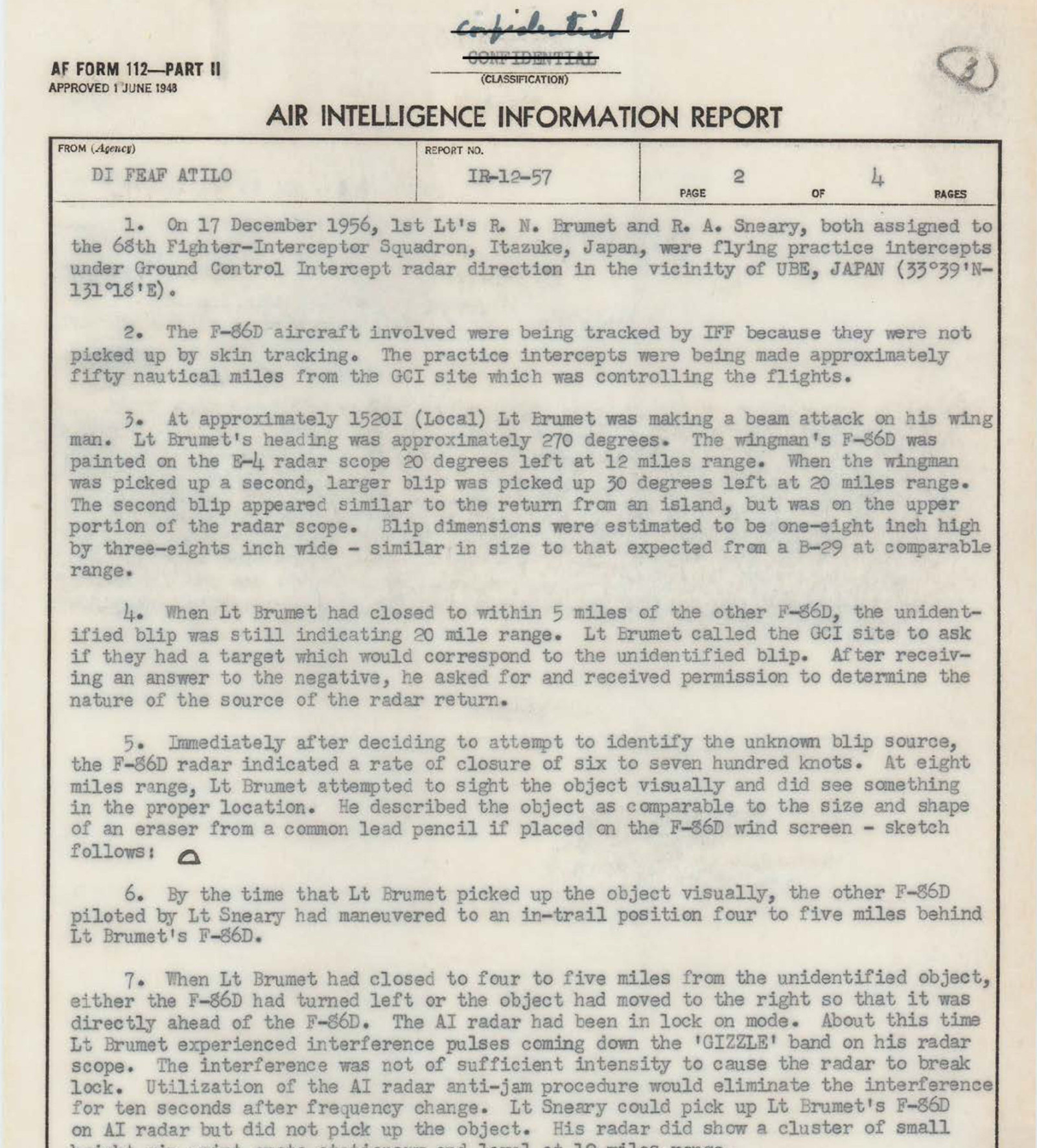
The two pilots were 1st Lt R. N. Brumet and 1st Lt R. A. Sneary, both of the 68th Fighter-Interceptor Squadron at Itazuke, Japan, working under ground control intercept direction about fifty nautical miles from the controlling site. At approximately 1520 local, which is 0620 Zulu, Brumet was making a beam attack on his wingman on a heading of roughly 270 degrees. His wingman's F-86D painted on the E-4 radar scope twenty degrees left at twelve miles.
A second, larger blip painted thirty degrees left at twenty miles. The report is careful about what it looked like: it "appeared similar to the return from an island, but was on the upper portion of the radar scope", and its dimensions on the scope were estimated at one eighth of an inch high by three eighths wide, "similar in size to that expected from a B-29 at comparable range".
Brumet closed to within five miles of his wingman and the unidentified blip was still reading twenty miles. He asked the ground site whether they held anything that would match it. They did not. He asked for and received permission to go and find out what it was.
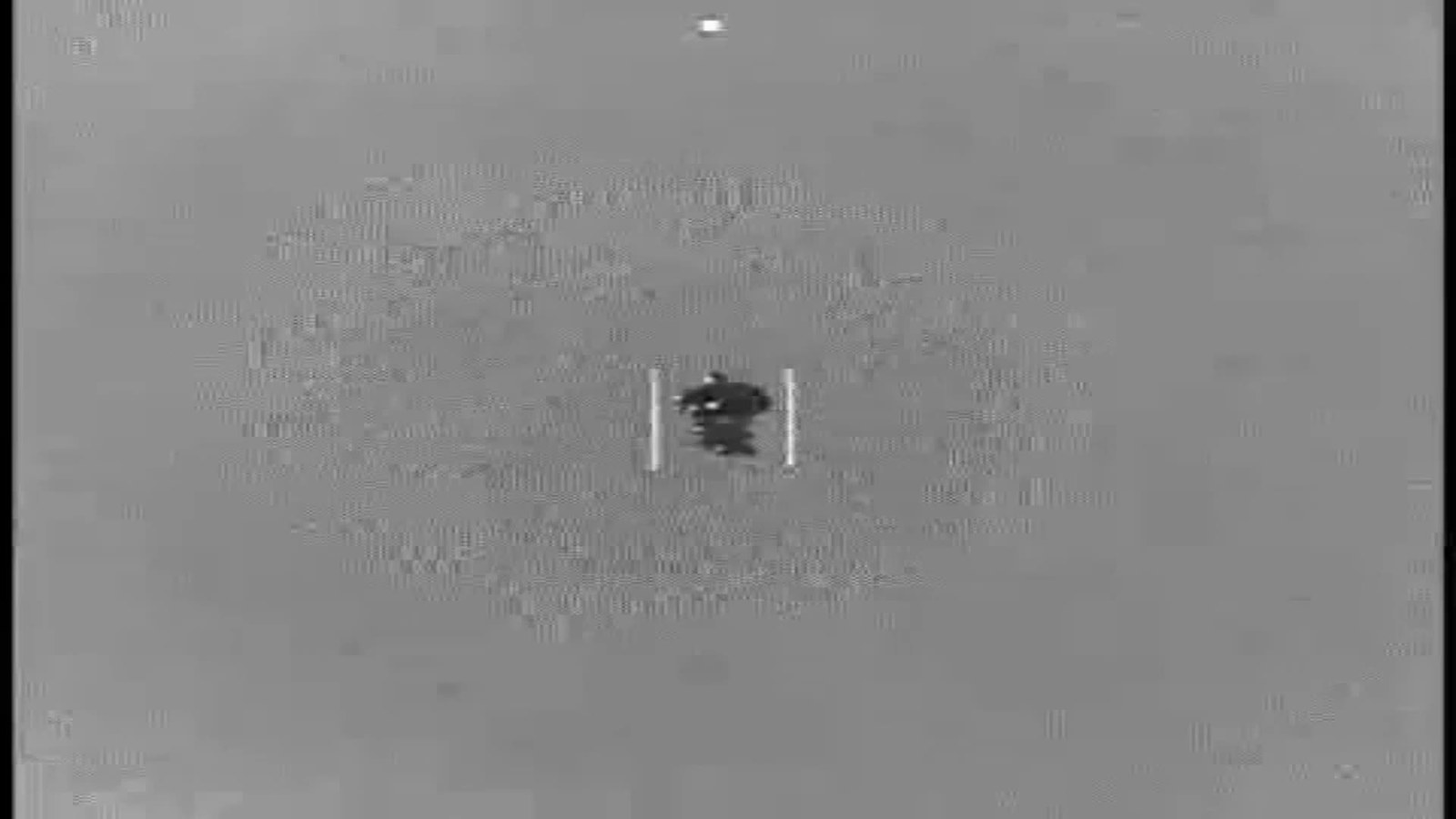
The moment he turned toward it the radar showed a rate of closure of six to seven hundred knots. At eight miles he looked for the object and saw something in the right place, and the report records how small that something was: comparable to the size and shape of an eraser from a common lead pencil held against the windscreen. A tiny dome shaped symbol is inked into the page at that point. By then Sneary had dropped into trail four to five miles behind.
At four to five miles from the object, either the fighter turned left or the object moved right, because it ended up directly ahead. The AI radar was in lock on mode. About then Brumet began taking interference pulses coming down what the report calls the GIZZLE band on his scope. It was not strong enough to break the lock, and running the anti-jam procedure cleared it for ten seconds at a time after each frequency change. Sneary could see Brumet's aircraft on his own AI radar and could not see the object, but his scope did show something: "a cluster of small bright pin point spots stationary and level at 12 miles range".
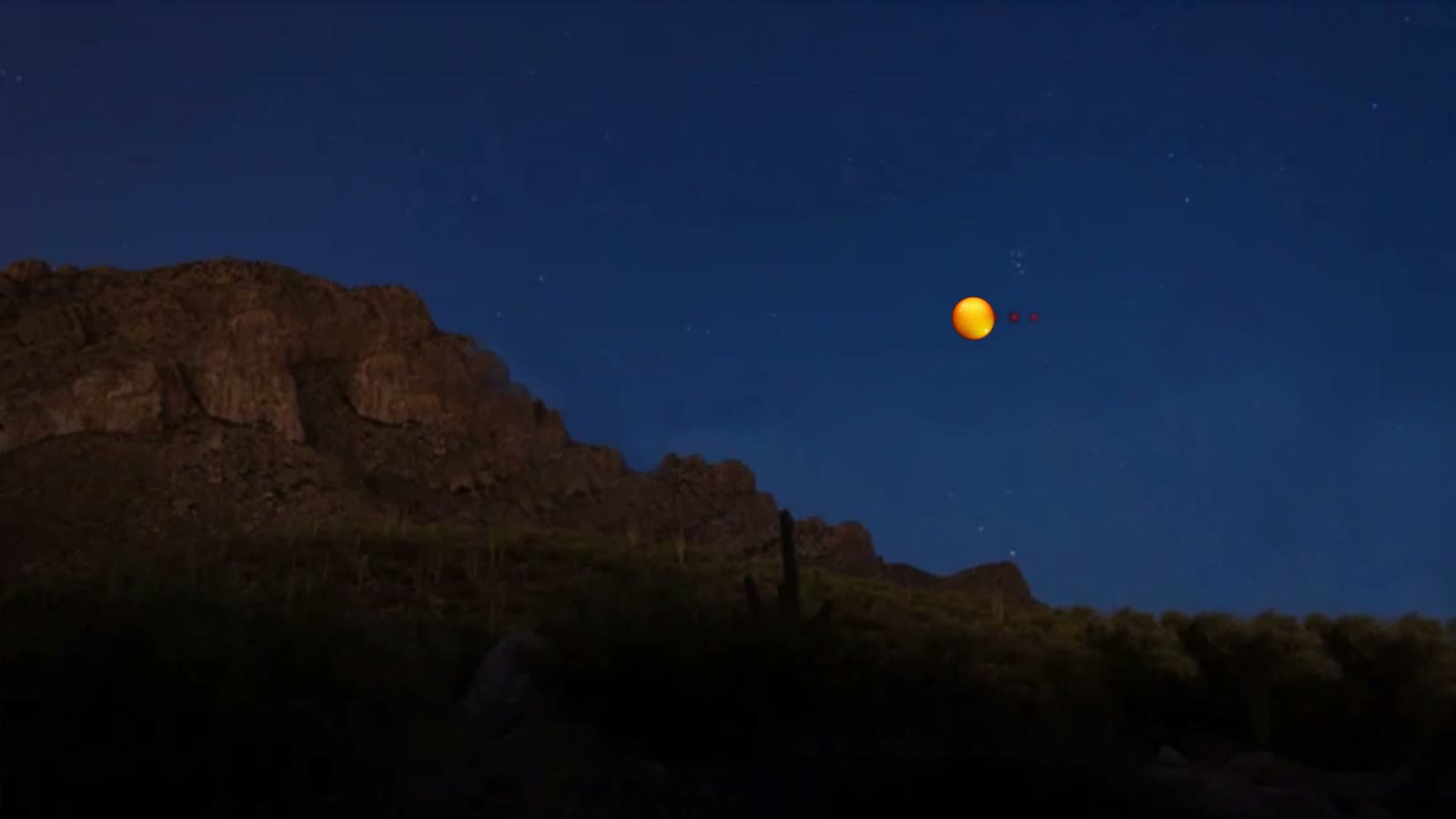
At the closest point the object appeared to make a shallow left turn. The report gives three observations of it and no more. It had the appearance of being circular on the bottom. Its colour was described as golden tan. And, in the preparing officer's own construction, "even though the sun was in a position to reflect off a metalic object, there was no reflection".
After the turn the return moved up and away at an indicated 1,500 to 1,800 knots. The report immediately qualifies its own number: the figure is an estimate, because it is considerably faster than the radar set can indicate as a negative rate of closure. The object had been on the scope for seven to eight minutes and had been seen on and off for three to four.
More footage and images of this sighting
What is the official explanation?
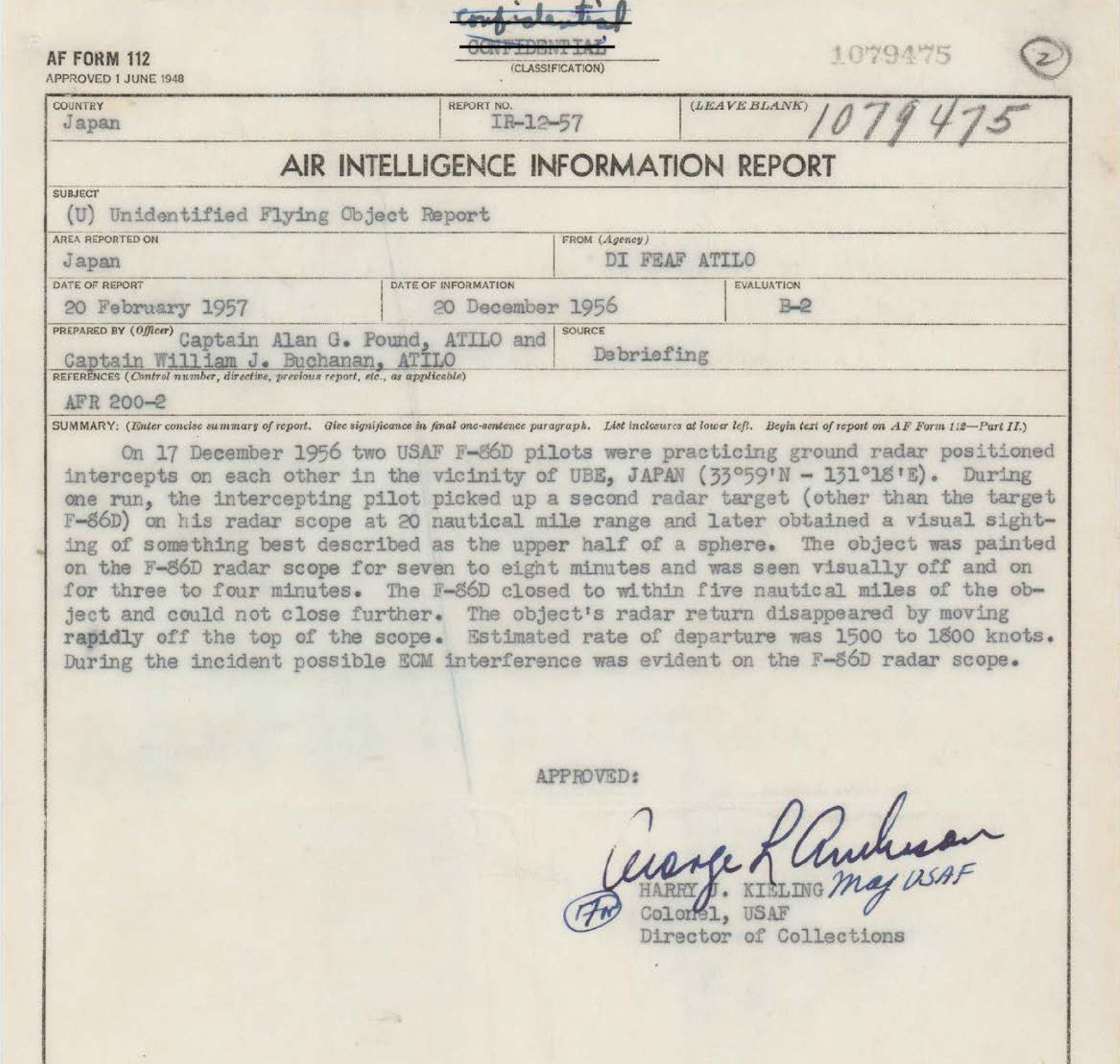
The document is an Air Intelligence Information Report on AF Form 112, report number IR-12-57, from DI FEAF ATILO, the Air Technical Intelligence Liaison Office of Far East Air Forces, prepared under AFR 200-2. It is signed by two Air Technical Intelligence Liaison Officers, Captain Alan G. Pound and Captain William J. Buchanan, and the statement of the preparing officer records that the report "was prepared in its entirety by members of the Air Technical Intelligence Liaison Office". The page header carries a CONFIDENTIAL marking struck through by hand. Distribution by originator went to AFOIN at Wright-Patterson, the Air Research and Development Command, the Air Defense Command, the Alaskan Air Command, Fifth Air Force and the 41st Air Division.
Paragraph 11 records the checks that were run afterwards. Brumet's aircraft was flown by another pilot and all systems appeared to operate satisfactorily. Ground personnel checked it after the next landing and found all systems satisfactory. All ground radar sites were checked and none reported unidentified tracks, and the report states that there were no other tracks that could have been the object.
Paragraph 14 is the officer's assessment of his witness. Brumet had 1,475 hours and 45 minutes of flying time, of which 667 hours and 15 minutes were in the F-86D. He "appeared to be conscientious and reported the incident in a straight forward, slightly embarrassed manner, saying that he would doubt the possibility of such an occurrance if it hadn't actually happened to him".
Paragraph 15 is the most important sentence in the file and it is the one that gets dropped. It reads: "The fact that no unidentified tracks were observed by ground radar should not be given much weight in evaluating this report. Both F-86D aircraft involved required IFF in order that the controlling GCI site could plot them." Paragraph 2 had already said the same thing from the other direction, that the two fighters "were being tracked by IFF because they were not picked up by skin tracking".
Read together those two paragraphs say something specific. At the ranges being worked that afternoon, the ground radar could not skin paint a jet fighter it already knew was there, and was following both aircraft only because each was squawking a transponder. An object with no transponder was therefore never going to appear on it. The preparing officer saw that and wrote the instruction into the report, and it is the difference between a negative result and a meaningless one.
The Department of War's release blurb reports the encounter accurately and stops one step short. It records the 20 nautical mile acquisition, the seven to eight minutes on the scope, the three to four minutes of intermittent visual contact, the upper half of a sphere description, the possible countermeasures interference, the 1,500 to 1,800 knot estimate with its own caveat about the radar set, and the fact that neither the ground sites nor the second pilot acquired the object. It does not carry paragraph 15, and it does not mention the cluster of stationary pin point returns on Sneary's scope.
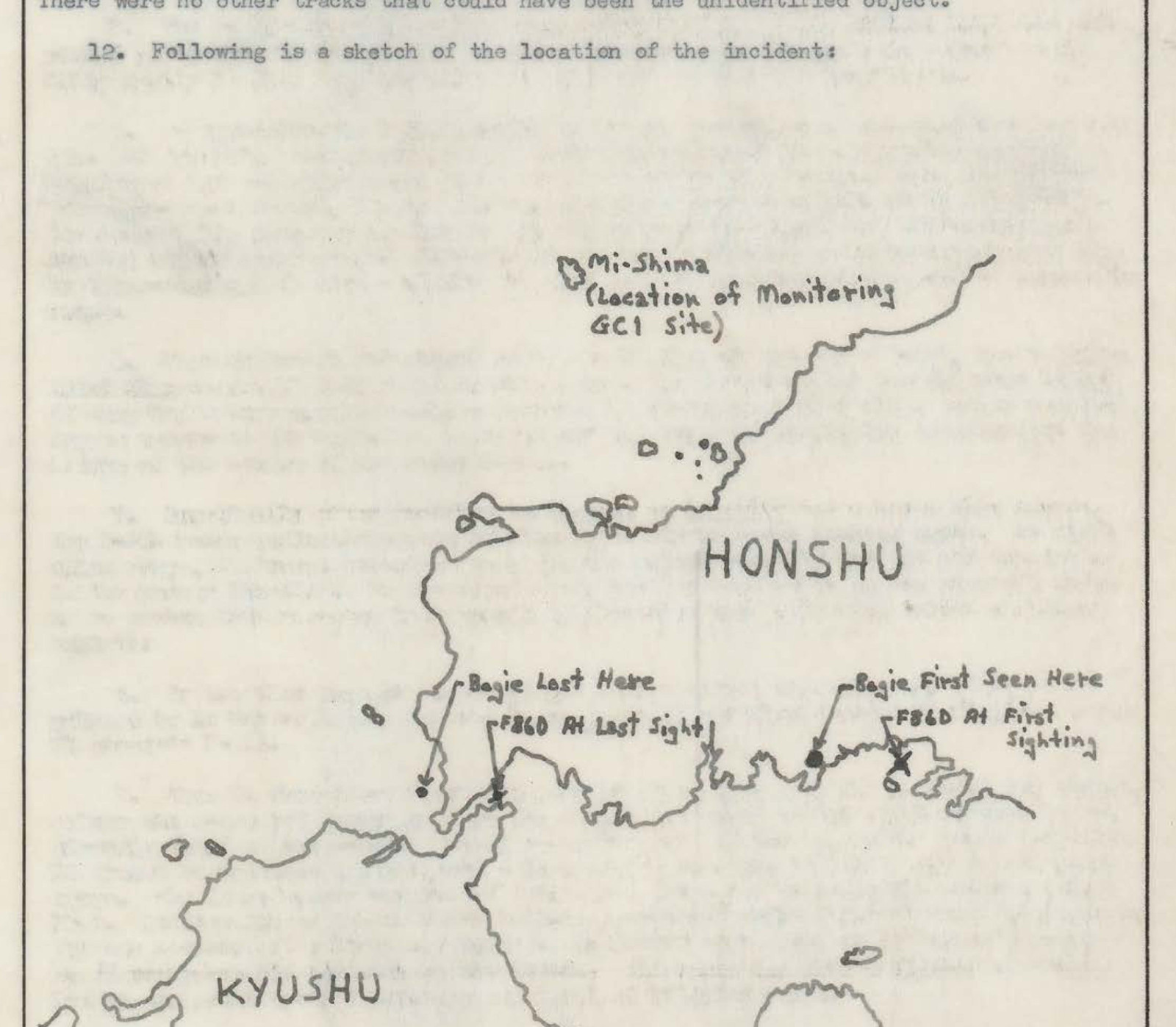
The file also disagrees with itself about where this happened. Page one gives the position as 33 degrees 59 minutes north, 131 degrees 18 minutes east. Page two, in the narrative, gives 33 degrees 39 minutes north at the same longitude. Those are about thirty seven kilometres apart, the first on the Honshu coast beside Ube and the second out in the Suo-nada. The hand drawn overlay reproduced above puts the first sighting near the coast east of Ube, which favours the page one reading, so this archive pins the case on Ube itself and states the conflict rather than resolving it silently.
What did the witnesses think it was?
There is only one witness to the object in any real sense, and the report says so. Brumet saw it; Sneary, four to five miles behind in trail, never acquired it on radar or visually. What Sneary contributes is narrower and arguably more interesting than corroboration would have been, because his scope showed "a cluster of small bright pin point spots stationary and level at 12 miles range" while his leader was locked on to something he could not see. The report offers no interpretation of that and neither will this page.
The electronic countermeasures detail is the part of the account that a pilot was uniquely qualified to give. Brumet had flown practice missions against ECM equipped B-36 and B-47 aircraft, which is to say he knew from training what deliberate United States jamming looked like on an E-4 scope. His comparison is specific: the interference on this mission was "similar to but less intense than that experienced during runs against USAF ECM". That is a trained comparative judgement rather than an impression, and it is the only observation in the file that rests on a skill rather than on a glance.
Against that, the visual content is thin and the report does not pretend otherwise. A pencil eraser at arm's length, a bottom that appeared circular, a golden tan colour, a shallow left turn. The release blurb's phrase "best resembling the upper half of a sphere" comes from the one line summary on page one and is a fair compression of the narrative, but no part of the document describes structure, edges, lights, markings or exhaust.
Is the F-86D Radar and Visual Encounter near Ube, Japan, 17 December 1956 real? The two-pass assessment
Pass one asks how this could be ordinary, and the file gives an unusual amount to work with because the preparing officer wrote his own reasoning down.
The strongest conventional reading is an aircraft, and the report's own radar description leans that way harder than its summary does. A return one eighth by three eighths of an inch on the scope, explicitly compared to what a B-29 would paint at the same range, is a large aircraft sized return, not an anomaly. A rate of closure of six to seven hundred knots between a fighter and a target is ordinary. What does not fit the aircraft reading is the end of it: a departure the radar could only call an estimate because the set could not measure negative closure that fast, from an object that had been holding station on the scope for several minutes while the fighter failed to gain on it.
The second conventional reading is a radar artifact, and the report half invites it by noting the blip "appeared similar to the return from an island" and by recording the interference. Anomalous propagation over a winter sea, with a ducting layer returning ground or sea clutter at long range, can put a convincing stationary target on an airborne scope. Three things in the file sit awkwardly with it. The target held a consistent range of twenty miles while the aircraft manoeuvred. It was tracked in lock on mode, which a clutter return does not usually sustain. And Brumet saw something at the right bearing when he looked.
That third point is where the honest limit of this case sits. A pilot who has been staring at a lock on symbol for minutes and then looks for a pencil eraser against a winter sky is the most suggestible observer in aviation, and the report's own phrasing, "did see something in the proper location", is weaker than its summary line. It is not nothing and it is not much.
The lighting claim can be tested independently and it survives. The Sun's position was computed for the event from a NOAA and Meeus routine validated first against two results already published on this site, reproducing a documented solar altitude of -19.46 degrees exactly and a documented azimuth to within one and a third degrees. At 0620Z on 17 December 1956 over western Honshu the Sun stood at azimuth 224.9 and altitude 17.2 degrees, low in the southwest. Brumet's heading was about 270 and the object lay thirty degrees left of it at first acquisition, so his line of sight ran near azimuth 240, roughly fifteen degrees to the right of the Sun. By the closest approach the object was dead ahead near 270, about forty five degrees from the Sun. Through the whole engagement, then, a low Sun sat on the left front quarter, and the face of the object turned toward the pilot was partly in direct sunlight.
So the preparing officer's premise was correct and his observation is a real one rather than a geometric accident. A specular metal surface in that lighting should have thrown at least one flash at some point across several minutes of relative motion including a turn, and none was seen. The same low Sun also explains the colour term without any exotic assumption, because sunlight at seventeen degrees of altitude has been reddened by the atmosphere and golden tan is what it makes of a diffuse pale surface. The bearings here carry real slack, since the heading is given as approximately 270 and thirty degrees left is a scope reading rather than a measurement, but no plausible error moves the Sun out of the forward left quadrant.
Pass two asks what is left if the account is taken at face value. A large aircraft sized return that an interceptor could not close on, that produced interference a trained pilot compared to friendly jamming, that was never acquired by a second aircraft two to three minutes behind, and that left at a rate the radar could not measure. The 1,500 to 1,800 knot figure, which converts to roughly 1,726 to 2,071 miles per hour, is the number that will be quoted everywhere and it is the number the document itself flags as unreliable, in its own sentence, for a stated technical reason. This page quotes it in knots, with the caveat attached, because the caveat is part of the measurement.
Tier Unknown. The Air Force recorded the event, checked the aircraft, checked the ground sites, assessed the pilot favourably, instructed its readers not to lean on the negative ground radar result, and reached no conclusion at all.
One open test that nobody appears to have run. The report names its own chart, "OVERLAY TO WAC 388 G", and names the monitoring ground control intercept site as Mi-Shima, the island in the Sea of Japan north of Yamaguchi. Fifth Air Force and 41st Air Division records for 17 December 1956, and any surviving log from that site, would say whether anything else was airborne in the Suo-nada that afternoon. The file asserts there was not. It does not show the check.
Sources
- www.war.gov/UFO/
- www.war.gov/medialink/ufo/docs-112026-release-08/DOW-UAP-D205_Air_Intelligence_Information_Report_Japan-1956.pdf
- www.war.gov/Portals/1/Interactive/2026/UFO/uap-data.csv
- ssd.jpl.nasa.gov/horizons/
More cases from this region: UFO sightings in Japan