The Martha's Vineyard and Woods Hole UFO Sighting of 12 October 1957
Five men fishing in Vineyard Sound on the afternoon of 12 October 1957 watched a spiked metallic cylinder for about twenty seconds. Two of them were the masters of Woods Hole Oceanographic Institution research vessels. The Air Force graded the source completely reliable, then declined to investigate. The file, with both of the witnesses' sketches, was published for the first time on 20 November 2026.
What did witnesses see at Vineyard Sound?
Five men on a fishing boat in Vineyard Sound watched a metallic cylinder with spikes for about twenty seconds. Two of them were masters of Woods Hole research vessels, and the Air Force form that records what they saw was released to the public for the first time on 20 November 2026, in the eighth PURSUE tranche, as DOW-UAP-D190.
The time on the form is written in the clipped style the 1608th Air Transport Wing used, "203512Z October 1957", which is 2035 Zulu on the twelfth. Massachusetts was still on daylight time that day, so the local clock read 4:35 in the afternoon. The weather block is as clean as a sighting form ever gets: clear, no ceiling, visibility fifteen miles, no cloud cover, no thunderstorms in or near the area.
The object was first noticed overhead and fifteen degrees to the right of the boat. Captain Gene Maysona saw it first. It appeared at first to be falling at a high rate of speed, then slowed, then moved comparatively slowly to the right, then reversed and moved left at about the same speed, then reversed again to the right and disappeared at high speed, ending about thirty five degrees to the right. After the initial descent it held the same altitude throughout. The last detail on the form is the one that is hardest to explain away and hardest to use: before it faded from view the object "became wavy and blurred". At least part of the observation was made through binoculars, make and power unknown.
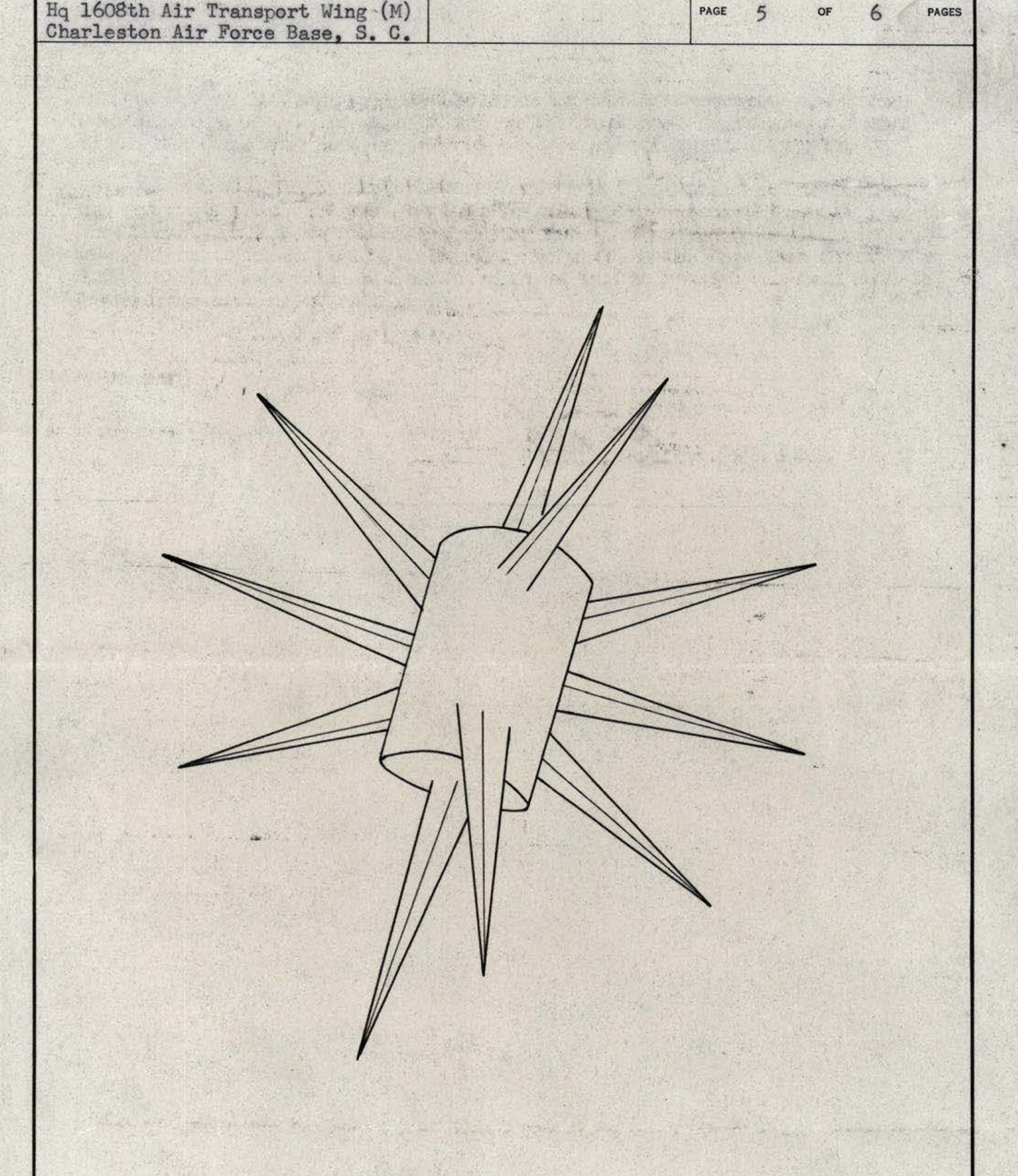
The description block is terse and specific. Shape: cylindrical. Colour: nickel, then aluminum. Number: one. And then the feature that the summary flattens into four words: "trihedral protrusions on front, rear and sides (exact number unknown)". No sound, no trail, no exhaust, no lights.
Inclosure 2 is what that sentence actually means, and it is reproduced at the top of this page. The witnesses drew a rounded cylinder with roughly a dozen long, sharply tapering, three sided spikes radiating from it in every direction, closer to a sea mine or a caltrop than to anything in the 1957 flying saucer vocabulary. A reader working only from the text would picture something else entirely. This is the single strongest reason to publish the drawing rather than describe it.
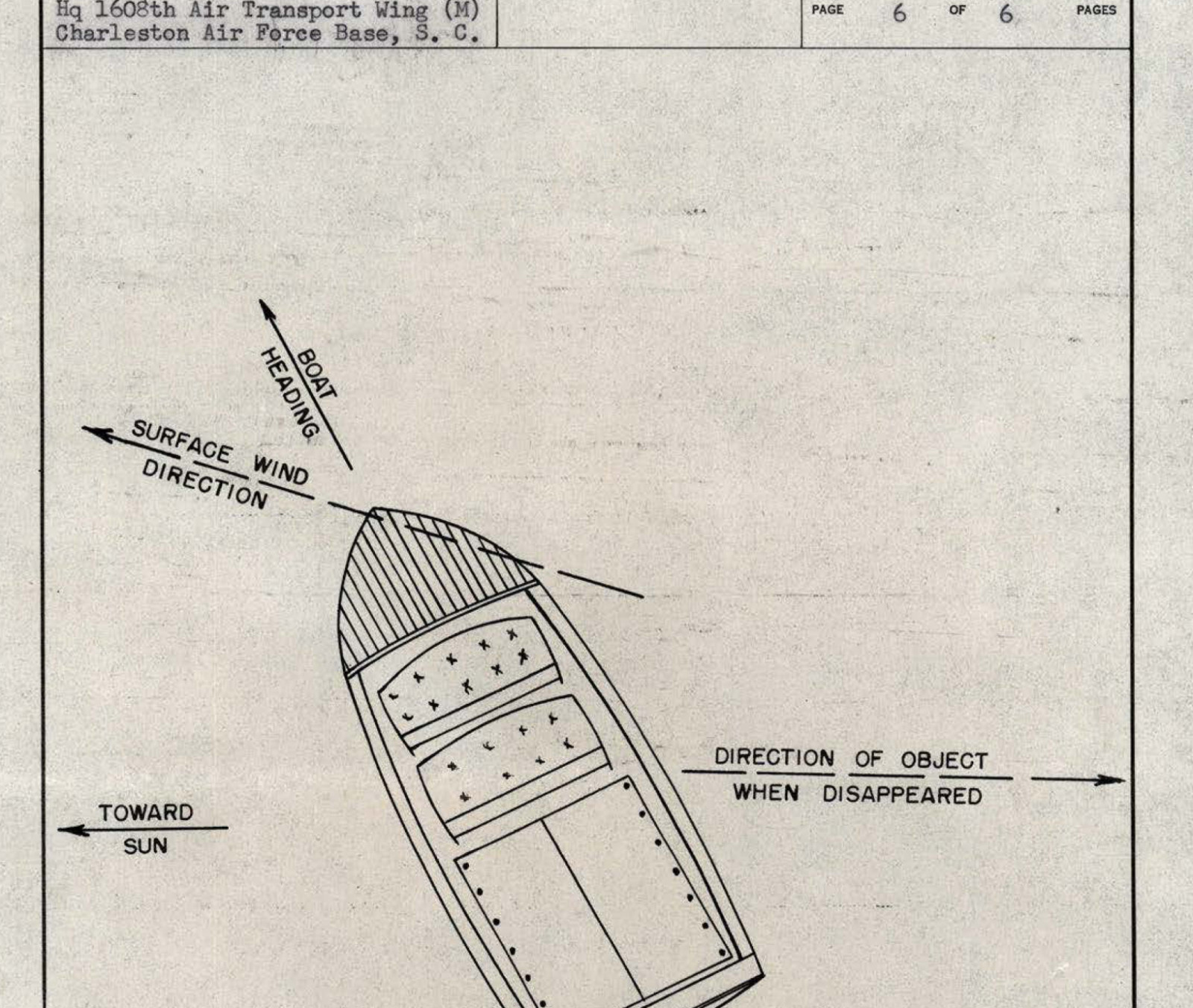
Inclosure 3 is a sketch of the boat with three labelled arrows, and it carries the geometry that no summary mentions. One arrow is marked TOWARD SUN. A second is marked SURFACE WIND DIRECTION and runs parallel to it. The third is marked DIRECTION OF OBJECT WHEN DISAPPEARED, and it points the opposite way, a full one hundred and eighty degrees from the Sun.
One last item sits in the data block without comment. About thirty minutes after the sighting a C-121 was observed doing what appeared to be touch and go landings at Otis Air Force Base. The preparing officer wrote it down and left it there.
More footage and images of this sighting
What is the official explanation?
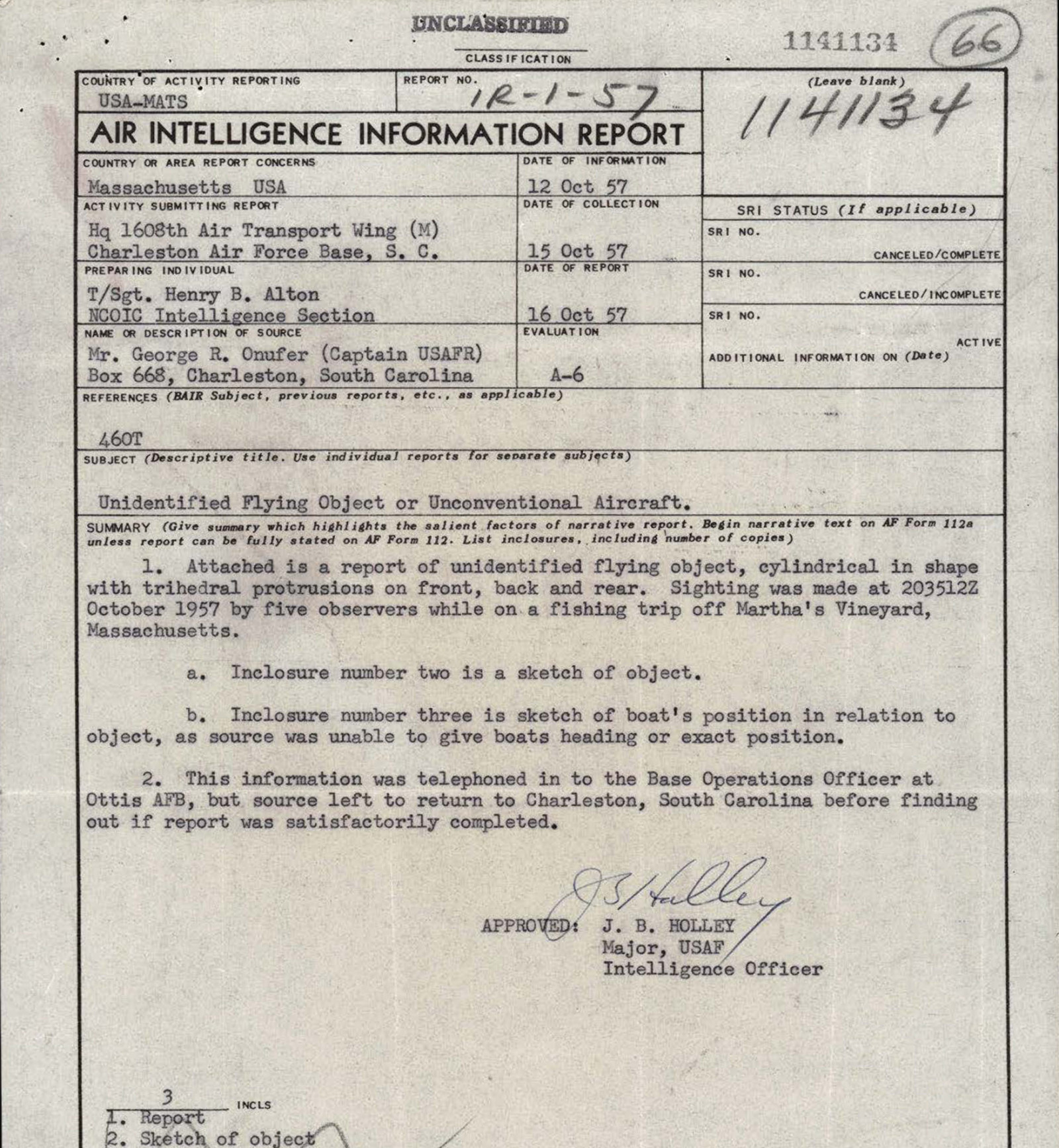
The document is an Air Intelligence Information Report on AF Form 112, submitted by Headquarters, 1608th Air Transport Wing (Medium), Charleston Air Force Base, South Carolina, under Air Force Regulation 200-2. Country of activity reporting is given as USA-MATS, the Military Air Transport Service. Date of information 12 October 1957, date of collection 15 October, date of report 16 October. The preparing individual is T/Sgt Henry B. Alton, NCOIC of the Intelligence Section. A photostat stamp on the distribution sheet reads 12 November 1957.
The source evaluation is the field that matters most, and it reads A-6. In the standard NATO style admiralty grading the letter rates the source and the number rates the information, so A-6 is "completely reliable" source, "truth cannot be judged" information. The Air Force is saying, on its own form, that it has no reason to doubt the man and no way to check the story.
The reason it had no way to check is stated plainly in paragraph 3: "In view of the fact that action has most probably been taken and distance involved, no attempt has been made to investigate or analyze this report." Charleston is about a thousand miles from Vineyard Sound. The wing wrote the report down, attached the drawings, and sent it up.
The distribution sheet on the first two pages is nevertheless enormous, listing the Directorate of Intelligence at Headquarters USAF, ATIC, the Atomic Energy Commission, Strategic Air Command, Tactical Air Command, the Air Defense Command, CONAD, the National Photographic Interpretation Center, USAFE, the Pacific Air Forces, the Alaskan Air Command, the 1127th Air Activities Squadron and the United States Information Agency, among others. Distribution by the Air Defense Command sent the original to the Assistant Chief of Staff, Intelligence, and copies to the commanders of ATIC and ADC, with headquarters receiving its copy without inclosures 2 and 3. Whatever was decided after that is not in this file, and the manifest records no paired document.
The Department of War's own release blurb is accurate on the substance and slightly loose on the headcount. It describes "two Air Force officers, two sailing masters assigned to research vessels with the Oceangraph Institute, and a civilian". The form lists George R. Onufer as a Captain in the Air Force Reserve and Ronald Veeder as a Major in the Air Force Reserve, so the two officers are reservists rather than serving officers, and Veeder is listed in the same line as Assistant to the Director of the institution. The blurb's stated local time of 4:35 p.m. is correct, which is worth saying because it is easy to get wrong: converted on the assumption that the Northeast had already left daylight time in October, 2035Z would read 3:35 p.m., and the answer would be an hour out. Daylight time did not end in 1957 until 27 October.
What did the witnesses think it was?
The witness list is the reason this file is worth a page, and it is unusually checkable for a 1957 sighting because three of the five men are identified by their jobs rather than only by name.
Capt Scott Bray, age 46, is given as Master of the Research Vessel Atlantis, Oceangraph Institute, Woods Hole, Massachusetts. Capt Gene Maysona, age 46, is given as Master of the Research Vessel Bear at the same institution. Mr. Ronald Veeder, a Major in the Air Force Reserve, is given as Assistant to the Director. Mr. M. R. Onufer, age 42, is president of Southeastern Supply of Charleston, South Carolina. Mr. George R. Onufer, age 35, a Captain in the Air Force Reserve with service number A0720343, is the manager of the same firm and is the man who made the report.
The misspelling on the form, "Oceangraph Institute", is the Woods Hole Oceanographic Institution, and both vessels can be independently confirmed as hers on the day. The institution's own Digital Library and Archives lists Atlantis, the ketch built in Copenhagen in 1931 and the first vessel built anywhere specifically for interdisciplinary ocean research, and lists Bear, a 103 foot Herreshoff hull of 1942 that was chartered in 1951 and bought in 1952 and stayed in the fleet until 1963. Both were therefore in WHOI service in October 1957, and a fishing party in Vineyard Sound carrying the masters of two of them is exactly the kind of outing the institution's small fleet supported. The witness identifications check out against a source that has nothing to do with the Air Force.
What the file does not contain is any statement by any of the other four. T/Sgt Alton writes that "Mr. George R. Onufer was the only one I contacted as his brother was not available", and his judgement of the man he did reach is the only character assessment in the document: Onufer "has been on active duty as an officer in the USAF for approximately ten years, flying both jet and multi-engine aircraft and appears to be completely reliable".
There is a second account in the file of what the witnesses did next, and it is the detail that makes the group read as serious rather than excited. They telephoned the sighting in to the Base Operations Officer at Otis Air Force Base at about 2400Z, which is eight o'clock that evening, roughly three and a half hours after the event. Onufer then left for Charleston before finding out whether the report had been satisfactorily completed, and three days later, "in view of the exceptional good sighting and number of persons observing this object, he felt he should report it again". He drove to the nearest Air Force intelligence section and filed it a second time because he was not sure the first one had taken.
One correction to any reading of the file: the form itself says Onufer could not give the heading or exact position of the boat, and names Mr. Ronald Veeder as the man who could. Nobody appears to have asked him.
Is the Martha's Vineyard and Woods Hole UFO Sighting of 12 October 1957 real? The two-pass assessment
Pass one asks how this could be ordinary. The honest starting point is that twenty seconds of unaided and binocular observation from a small boat, with no photograph, no radar and no instrument of any kind, cannot settle what an object was. The file itself concedes as much with its A-6 grade.
The prosaic candidate the form half suggests is aircraft. A C-121 Constellation was observed about half an hour later doing touch and go landings at Otis, twenty miles away, and Otis was an active air defence base. But a Constellation is a four engined airliner with propellers, and the report gives no sound, no trail and no lights, a single object, and a reversal of direction twice inside twenty seconds while holding altitude. The aircraft reading has to discard most of the description to survive.
The balloon candidate is the serious one, because a metallic radiosonde or a research balloon at a few tens of thousands of feet is bright, silent, apparently slow, and routinely reported as cylindrical. Here the archive can test it against the witnesses' own diagram rather than against intuition. Inclosure 3 draws the surface wind direction and the object's departure direction as very nearly opposite one another. The arrow convention on a hand drawn sketch is not stated, so a reader cannot be certain whether SURFACE WIND DIRECTION means the way the wind blew or the way it came from, and that ambiguity is real and is not resolved anywhere in the file. What survives either way is narrower and still useful: the object's departure was drawn as anti-parallel to the wind arrow, so on one of the two readings the object left directly into the surface wind, and on the other it left directly downwind. A balloon explanation is only available on the second reading, and the file gives no way to choose. The honest statement is that the drawing constrains the balloon hypothesis without closing it.
The same sketch does close one explanation outright. A bright object that vanishes "at a high rate of speed" low in the sky most often does so by being lost in solar glare, and this archive has used that reading before. It is not available here. The Sun's position was computed independently for the sighting coordinates and moment, using a NOAA and Meeus routine first validated against two results already published on this site, reproducing a documented solar altitude of -19.46 degrees exactly and a documented azimuth of 159 degrees to within one and a third. At 2035Z on 12 October 1957 in Vineyard Sound the Sun stood at azimuth 244.7 and altitude 15.5 degrees, that is west southwest and low. The witnesses drew the departure as the exact opposite of that bearing, about azimuth 65, east northeast. The object did not go into the Sun. It went away from it, and the fading happened with the Sun behind the observers rather than behind the object.
That geometry cuts the other way too, and it belongs on the page. With a low Sun behind them, the men were looking at a fully front lit object against a clear sky, which is the best possible lighting for judging shape and the explanation for a description as confident as a drawn silhouette with a dozen spikes. It is also consistent with the colour terms on the form, nickel and aluminum, which are the words people reach for when sunlight is reflecting off bare metal.
"Became wavy and blurred before fading from view" is the one phrase in the file that reads as a measurement rather than an impression. At the end of the sighting the object was low, roughly east northeast, and anything low is seen through several times the air mass of an overhead object. Refractive shimmer is strongest in exactly that band, and this archive has already had to use the same argument on a 2026 case where a magnitude 0.08 star at thirteen degrees of altitude was reported as a colour changing object. A real distant object low in the sky will go wavy and blurred as a matter of course. So the phrase supports a genuine distant object and tells you nothing at all about what it was.
Pass two asks what is left if the description is taken at face value, and the answer is a short list with an honest hole in it. Five men, two of them professional mariners whose employment is independently verifiable, one of them a reserve officer with ten years of flying, in clear air with fifteen mile visibility, using binoculars, agreeing on a single silent metal object that changed direction twice and held altitude. Against that: no instrument, no photograph, twenty seconds, no statement from four of the five, no investigation of any kind, and a drawing so unusual that it is as easy to read as a memory reconstructed after the fact as it is to read as a record.
The tier is Unknown because that is literally the Air Force's own position. There is no official narrative to weigh. The service graded the source completely reliable, graded the information unjudgeable, wrote down that it would not investigate, and distributed the file to twenty four addressees anyway.
Two checks would still move this case and neither needs the Air Force. The Woods Hole Oceanographic Institution keeps cruise records and personnel files, and Bray, Maysona and Veeder should all appear in them; any of the three may have left an account. And the Otis Air Force Base operations log for the evening of 12 October 1957, if it survives, should carry the telephone call that Onufer says he made at eight o'clock and was never sure had been written down.
Sources
- www.war.gov/UFO/
- www.war.gov/medialink/ufo/docs-112026-release-08/DOW-UAP-D190-Air_Intelligence_Information_Report_Massachusetts-1957.pdf
- www.war.gov/Portals/1/Interactive/2026/UFO/uap-data.csv
- www.dla.whoi.edu/ships/776503d6-babd-4478-a209-f886d9b13bd2
- www.dla.whoi.edu/ships/a138fbd0-43fb-4f4c-82be-489d8c612363
More cases from this region: UFO sightings in United States