The Burkes Flat Bent Headlights
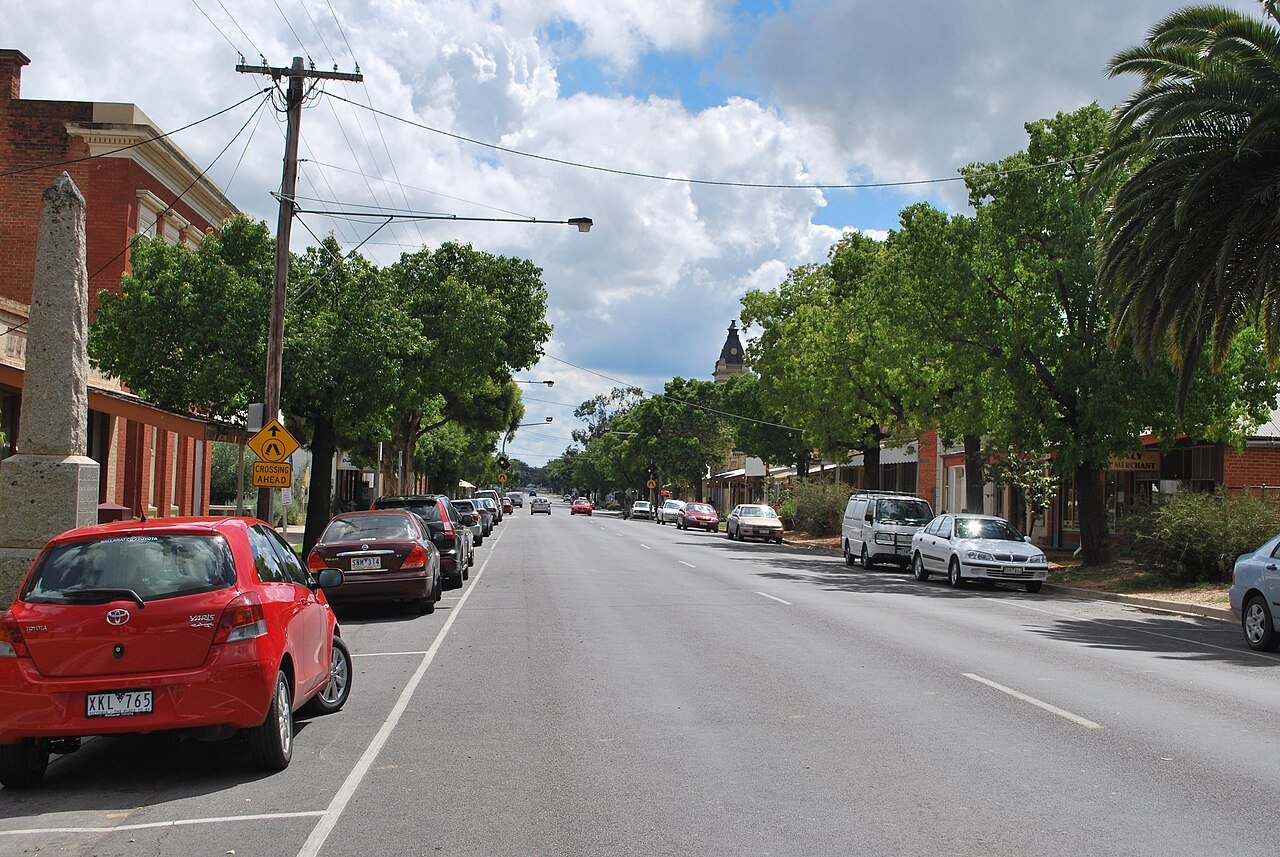
On the night of 4 April 1966, Ron Sullivan, a steel contractor, was driving home along a straight sealed stretch of the Dunolly to St Arnaud road near Burkes Flat in central country Victoria, at around 8 o'clock in the evening. This case file covers what witnesses reported, the official narrative, and a two-pass assessment with its evidence tier.
What did witnesses see at Dunolly to St Arnaud road near Burkes Flat?
On the night of 4 April 1966, Ron Sullivan, a steel contractor, was driving home along a straight sealed stretch of the Dunolly to St Arnaud road near Burkes Flat in central country Victoria, at around 8 o'clock in the evening. He was at the wheel of a 1965 Ford Falcon sedan, travelling at roughly 60 miles per hour. The sky was clear, there was no moon and only a slight breeze. Out in the paddock to his right he saw a light he first took for a tractor doing night ploughing.
As he drew closer the light resolved into something he could not place. By his account, given over the years to investigators and on camera, a white phosphorescent glow sat on the ground, an oval roughly 15 feet across. From it a second white oval rose, and the two joined into the shape of a cone, narrow at the bottom and wider at the top, standing perhaps 20 to 30 feet tall. Running through the cone were vertical tubes or shafts of coloured light, which Sullivan described as all the colours of the spectrum, red, blue, indigo and purple, moving up and down between the small lower oval and the larger upper one. Each tube he put at four to five inches in diameter.
While he watched the display his car's headlight beams did something he could not explain. They appeared to swing to the right, bending toward the object in the paddock as if drawn to it, becoming more sharply angled as he came level with the light. For a moment the beams cut out entirely, then came back, still pointing off to the right by something like 30 to 45 degrees, before snapping back to normal. The whole headlight effect, he said, lasted only a couple of seconds. Sullivan, thinking his car was drifting off the road, corrected hard to the left and very nearly ran into a tree at the roadside. The light display then collapsed back into a single oval and was gone. The only physical sensation he reported was a brief mental paralysis, a kind of difficulty thinking, that passed. Shaken but uninjured, he did not stop. He drove on roughly 40 miles to his destination and at first told only his wife.
Two nights later, on 6 April 1966, a 19 year old named Gary Taylor, from Carnegie in Melbourne, ran his car off the road at the very same spot and struck the same roadside tree. He was killed. A local man, Peter Vanrennan, was the first to reach the wreck. It was the news of this death at the identical location that reportedly moved Sullivan to come forward to police about what he had seen. When the paddock was examined, a circular depression was found in the freshly ploughed earth, set back from the road and lined up with where Sullivan said the light had been. Accounts of its size vary with the source: Chalker's narrative gives it as a little over 3 feet across and a few inches deep, while the record of Sullivan's own interview describes it as four to five feet in diameter and seven to eight inches deep. All accounts agree it was cleanly scooped from the sandy soil, that the soil inside appeared rippled in a clockwise direction, that there was no debris thrown up around it and no human or animal tracks nearby, and that the paddock owner said it had not been there when he finished ploughing.
What is the official explanation?
There was no significant Australian government investigation of the Burkes Flat sighting, and that absence is itself part of the record. When the American atmospheric physicist James E. McDonald interviewed Sullivan in July 1967 during his Australian fact finding trip, an audio recording that survives in the case archive, Sullivan confirmed directly that neither the Royal Australian Air Force nor the Department of Civil Aviation had ever investigated his experience. The case was instead worked by police and by civilian researchers. According to the surviving record, the investigation at the time involved local police, the UFO Investigation Centre and the Victorian Flying Saucer Research Society, along with some university students. The ground trace was examined by police, with Sergeant Suttie of Maryborough named as the officer who recorded the circular depression in the paddock.
The contemporary documentary trail is newspaper rather than government file. The Melbourne Age carried reports on 7 and 12 April 1966, the Ballarat Courier on 12 April 1966 and the Maryborough Advertiser on 15 April 1966. The APRO Bulletin of May 1966 ran the case on page one, and the Australian Flying Saucer Review, Victorian edition number 5 of July 1966, covered it on page 12. These are the primary period sources, all within weeks of the event.
The one piece of laboratory work attached to the case came years later and concerns the linked fatality, not the light. VUFORS investigator Paul Norman recovered a headlight from Gary Taylor's crashed car and passed it to Dr Geoff Stevens, then working with the Australian Atomic Energy Commission at Lucas Heights. Stevens traced the lines of magnetic force across the headlight by marking them in chalk. The result was negative for the UFO hypothesis in a specific and honest way: the lines of force ran in relatively random directions, whereas exposure to a strong external magnetic field would have aligned them all the same way. So the recovered headlight showed no sign of having been magnetised by anything. Researcher Bill Chalker, who interviewed Sullivan in 1980 and again in 1984 and carried out site work at Burkes Flat, also went on record correcting the later Discovery Canada Close Encounters television recreation, saying the direction and nature of the headlight bend it depicted were wrong, and that the program showed Sullivan avoiding the tree when, by what Sullivan told him, that part of the dramatisation did not match the witness account.
What did the witnesses think it was?
Ron Sullivan never described himself as a believer in flying saucers and never claimed to know what he had seen. What he was consistent about, across fifty years and multiple interviewers, was the bend in his headlight beams, the detail he could least explain and least wanted to invent. He attributed the effect vaguely to magnetism or gravity because he had no other language for it, and he was candid that the experience was difficult to describe. He told only his wife at first, and came forward to police largely because a young man had died at the same tree. Bill Chalker, who interviewed him in 1980 and 1984, wrote of him plainly after his death at 91 on 25 May 2019: he was a good man who back in 1966 experienced something that defies explanation.
The case is unusual among single witness reports because the surrounding human web is so well documented. The Victorian UFO Association president Ben Hurle ran a six month investigation that put on camera not only Sullivan but the people around the tragedy: Peter Vanrennan, the first person to find Gary Taylor's body, Sheryl Saint, the owner of the paddock where the depression was found, Lawrence Boyle, a close friend of Taylor's, and others who remembered the impact tree and the accident. The ground trace photograph used here came from the Saint family who owned the land. None of these people are claiming to have seen the object. What they corroborate is the physical and circumstantial frame around Sullivan's account: that the depression was real and freshly made, that the tree was real and lethal, and that a death did occur at the precise location two nights after the sighting.
That convergence is what witnesses and researchers have found hardest to dismiss. Sullivan reported a near miss at a roadside tree because his steering felt wrong while his headlights pointed the wrong way. Two nights later a teenager died hitting that same tree. The trace in the ground sat directly opposite it. Sullivan gained nothing from the story, avoided publicity for years, and went to his grave with the same plain account he started with.
The dispute
The substantive counter explanation is the Mount Tarrengower fire tower hypothesis, set out in detail by the skeptic writing as Charlie Wiser in a 25 June 2024 analysis on the Metabunk forum. The argument is that Sullivan, driving across open country at night, saw the Mount Tarrengower lookout tower near Maldon, a steel observation tower about 20 metres tall standing at roughly 569 metres elevation, which is decorated with lights each year from Easter Thursday for the Maldon Easter Fair and is said to be visible for tens of kilometres. Wiser maps several possible routes Sullivan could have taken and argues the tower would have fallen within view, that the lit tower frame could read as an inverted ice cream cone shape with narrow wavering columns of light matching the coloured tubes Sullivan described, and that the paddock depression was an ordinary animal scrape rather than a landing trace. It is a genuine, geographically argued reconstruction and it names a specific real object, which is why the case is disputed at all.
It does not, however, close the case, and the reasons are not hand waving. Wiser himself states he cannot account for several things. He cannot show that the tower was actually lit on the night in question, since by his own reconstruction the official lighting begins on Easter Thursday and he has to hypothesise an unconfirmed earlier practice run to fit the timeline, which then collides with the alternative dating of the event. More seriously, he openly concedes he cannot explain how a distant, fixed, stationary tower light would make a moving car's headlight beams appear to swing 30 to 45 degrees to the right and momentarily switch off, which is the single most distinctive and least dismissible element of Sullivan's account. A fixed light on a hill does not bend your headlights.
The tower theory also leaves the physical evidence untouched. It offers nothing for the fresh circular depression that Sergeant Suttie and others recorded in the just ploughed paddock, with its clockwise rippled soil, absence of debris and absence of human or animal tracks, sitting directly opposite the tree. Reclassifying that as a routine animal scrape is an assertion, not a demonstration, and it runs against the paddock owner's statement that the mark was not there when ploughing finished. And the only laboratory test in the entire file, Dr Geoff Stevens' chalk tracing of the magnetic force lines on the headlight recovered from Gary Taylor's crashed car, was reported as negative, the lines lay in random directions rather than the uniform alignment a strong magnetic field would impose. That test argues against a crude magnetic explanation but it does nothing to support the tower reading either. So the dispute is real and the candidate object is named, which keeps the case out of the unexplained tier, but the explanation is a plausible reconstruction that its own author admits cannot cover the headlight effect, the timing or the ground trace. That is the definition of barely disputed rather than strongly disputed.
Is the Burkes Flat Bent Headlights real? The two-pass assessment
Pass one, the ordinary explanations. The most developed mundane reconstruction comes from skeptic Charlie Wiser on Metabunk, who argues the light was the Mount Tarrengower lookout tower near Maldon, a roughly 20 metre steel tower at about 569 metres elevation that is strung with lights each year from Easter Thursday for the Maldon Easter Fair, visible at distance across the flat country. On that reading the cone of coloured tubes was the lit tower frame seen from far off, the steering wander was an ordinary night driving correction misremembered as a force, and the paddock depression was a natural scrape rather than a landing mark. It is a serious, map based argument and it is the strongest case for the prosaic. It also has admitted holes that its own author flags: it depends on the tower being lit for a practice run several days before its official Easter lighting, which is not established, and Wiser concedes he cannot account for how a distant fixed tower would make a driver's headlight beams appear to swing 30 to 45 degrees to one side and momentarily fail. Other ordinary candidates fare worse. A distant fixed light source does not explain the contemporaneous, fresh, clockwise rippled depression in just ploughed soil with no tracks and no thrown debris, recorded by police. The vehicle effect cannot be a magnetised electrical fault either, because the only physical test in the whole file, Dr Geoff Stevens' magnetic tracing of the recovered headlight, came back showing no exposure to any strong magnetic field. Hoax is poorly supported: the witness shunned attention, the trace was on a working farm, and a real death occurred at the site.
Pass two, if the core of the account is real. Then Burkes Flat is a classic vehicle interference and physical trace case, the kind catalogued worldwide in the 1960s, in which a luminous low object is associated with a transient effect on a car's electrical or optical system and leaves a ground mark. The bent and failing headlights, the brief mental fog, the cone of moving spectral light and the cleanly scooped, rippled depression form an internally consistent pattern that the witness reported before the vocabulary of such cases was common in Australia. The physicist James McDonald thought it worth recording Sullivan himself in 1967.
The verdict is Barely Disputed. There is a named, specific real world candidate, the Mount Tarrengower tower, advanced with maps and distances, which is more than most disputed cases have. But it is a plausible reconstruction, not a demonstrated identification: its own author cannot make it explain the headlight bend or the timing, and it does not touch the police recorded ground trace or the negative magnetic test. No confession, no recovered hoax props, and no positive proof that the tower was lit and was what Sullivan saw. Under the tier rules a contested, partially self defeating natural explanation is barely disputed, not strongly, so the case stands with a real and named counter explanation hanging over it rather than closing it.
Sources
- theozfiles.blogspot.com/2014/03/the-1966-burkes-flat-bent-headlight.html
- theozfiles.blogspot.com/2019/07/the-passing-of-ron-sullivan-witness-to.html
- ufos-scientificresearch.blogspot.com/2016/11/ron-sullivan-victoria-april-1966.html
- www.metabunk.org/threads/burkes-flat-aus-the-bent-headlights-case-another-fire-tower.13518/
- rmitcatalyst.com/2017/04/19/exploring-the-outer-fabric-of-reality/
- web.archive.org/web/20250802051536/http://www.ufocasebook.com/2014/1966-australia-burkes-flat-ufo.html
More cases from this region: UFO sightings in Australia